

Contact Us
  Search
The Business Research Company Logo
Termite Control Global Market Opportunities And Strategies To 2035
Published :June 2026
Pages :220
Format :PDF
Delivery Time :2-3 Business Days
Why 2-3 days? We update the report with the latest data and news before delivery. Let us know if you need us to expedite.
Report Price :$4,490.00

Termite Control Global Market Opportunities And Strategies To 2035

By Type (Chemical Termite Control, Physical And Mechanical Termite Control, Biological Termite Control), By Species Type (Dampwood Termites, Subterranean Termites, Drywood Termites, Other Species Types), By Application (Commercial And Industrial Sector, Residential Sector, Agriculture And Livestock Farms, Other Applications), And By Region, Opportunities And Strategies – Global Forecast To 2035

Termite Control Market Definition

Termite control refers to the range of products and services designed to detect, prevent, manage and eliminate termite infestations in residential, commercial, industrial and agricultural structures. Termites are wood-destroying insects that feed on cellulose-based materials such as timber, paper and plant-derived products and can cause severe structural damage and economic loss if left untreated. The termite control market consists of sales by entities (organizations, sole traders and partnerships) of termite control solutions are used by homeowners, property developers, facility managers, industrial operators, agricultural producers and public institutions to safeguard buildings, wooden assets and infrastructure. These solutions are deployed during pre-construction phases as preventive soil treatments, at post-construction stages when infestations are detected, during property inspections for real estate transactions and as part of routine maintenance contracts.
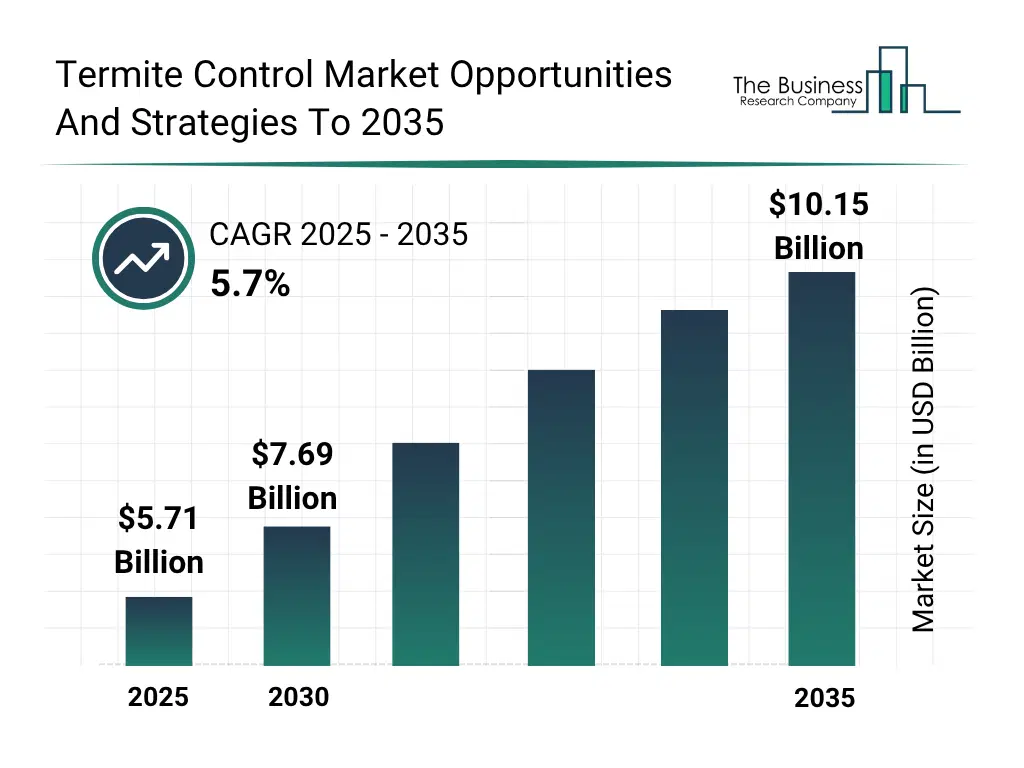
Termite Control Global Market Opportunities And Strategies To 2035 Market Size and growth rate 2026 to 2030: Graph

Termite Control Market Size

The global termite control market reached a value of nearly $5,707.5 million in 2025, having grown at a compound annual growth rate (CAGR) of 6.9% since 2020. The market is expected to grow from $5,707.5 million in 2025 to $7,694.6 million in 2030 at a rate of 6.2%. The market is then expected to grow at a CAGR of 5.7% from 2030 and reach $10,154.5 million in 2035. Growth in the historic period resulted from rising urbanization and semi-urban construction, rise in home renovation and maintenance, expansion of residential construction and expansion of furniture manufacturing and woodworking industries. Factors that negatively affected growth in the historic period were high treatment and annual contract costs and DIY chemical availability reducing professional demand. Going forward, climate change expanding termite-prone geographies, expansion of professional pest control service networks, expansion of agricultural storage facilities (granaries, warehouses, silos) and higher awareness of long-term structural damage prevention will drive the growth. Factors that could hinder the growth of the termite control market in the future include regulatory restrictions on certain termiticides, skilled labor shortage and impact of trade war and tariffs.
Research Expert

Book your 30 minutes free consultation with our research experts

Termite Control Market Segmentation

The termite control market is segmented by type, by species type, and by application.

By Type–
The termite control market is segmented by type into:
    • a) Chemical Termite Control
    • b) Physical And Mechanical Termite Control
    • c) Biological Termite Control
The chemical termite control market was the largest segment of the termite control market segmented by type, accounting for 61.0% or $3,484.0 million of the total in 2025. Going forward, the chemical termite control segment is expected to be the fastest-growing segment in the termite control market segmented by type, at a CAGR of 5.7% during 2025-2030.

By Species Type–
The termite control market is segmented by species type into:
    • a) Dampwood Termites
    • b) Subterranean Termites
    • c) Drywood Termites
    • d) Other Species Types
The subterranean termites was the largest segment of the termite control market segmented by species type, accounting for 55.7% or $3,181.7 million of the total in 2025. Going forward, the dampwood termites segment is expected to be the fastest-growing segment in the termite control market segmented by species type, at a CAGR of 7.4% during 2025-2030.

By Application–
The termite control market is segmented by application into:
    • a) Commercial And Industrial Sector
    • b) Residential Sector
    • c) Agriculture And Livestock Farms
    • d) Other Applications
The commercial and industrial sector market was the largest segment of the termite control market segmented by application, accounting for 48.4% or $2,760.6 million of the total in 2025. Going forward, the agriculture and livestock farms segment is expected to be the fastest-growing segment in the termite control market segmented by application, at a CAGR of 7.5% during 2025-2030.

By Geography - The termite control market is segmented by geography into:
      o Asia Pacific
      • China
      • India
      • Japan
      • Australia
      • Taiwan
      • South Korea
      o South East Asia
      • Indonesia
      o North America
      • USA
      • Canada
      o South America
      • Brazil
      o Western Europe
      • France
      • Germany
      • UK
      • Italy
      • Spain
      o Eastern Europe
      • Russia
      o Middle East
      o Africa
North America was the largest region in the termite control market, accounting for 36.9% or $2,107.0 million of the total in 2025. It was followed by Asia Pacific, Western Europe and then the other regions. Going forward, the fastest-growing regions in the termite control market will be Asia Pacific and Western Europe where growth will be at CAGRs of 7.1% and 6.0% respectively. These will be followed by North America and Eastern Europe where the markets are expected to grow at CAGRs of 5.8% and 5.4% respectively.

Termite Control Market Competitive Landscape

Major Competitors are:

  • Rentokil Initial plc
  • Rollins Inc.
  • Arrow Exterminators
  • Ecolab Inc.
  • Truly Nolen of America Inc.
  • Other Competitors Include:

  • Syngenta AG
  • HomeTeam Pest Defense
  • FMC Corporation
  • BASF SE
  • Sumitomo Chemical Co., Ltd.
  • Insecticides (India) Limited (IIL)
  • Envu India
  • Ensystex Australia
  • Aijin Group
  • Bayer AG
  • Syngenta AG
  • Sumitomo Chemical Co. Ltd.
  • Asante Incorporated
  • Cesco Co. Ltd.
  • Korea Pest Control Co. Ltd.
  • Woori C&G Co., Ltd.
  • Rave One Co. Ltd.
  • Chung Hsi Chemical Plant Ltd.
  • Johnson Group
  • Evergreen Pest Control Co. Ltd.
  • Innopest
  • Rentokil Pest Control Malaysia
  • Anticimex Group
  • Aardwolf Pestkare
  • PestBusters Singapore
  • GFC Pest Control
  • Beaver Pest Control Ltd
  • WEISS Hygiene-Service GmbH
  • MARNI-Hygiene-Dienst GmbH
  • ZPUH BEST-PEST
  • Pest Pro Sp. z o.o
  • INSEKT S.C.Poland
  • ACTION Termite & Pest Control
  • Termite Watkins Services
  • Rentokil Terminix
  • Nisus Corporation
  • Terminix International Company L.P.
  • Orkin LLC
  • Simcoe PestX
  • Terminix International Company L.P.
  • Orkin LLC
  • Burnham Holdings Inc
  • Cupim Fim
  • Jopestkil Brazil
  • Truly Nolen Argentina
  • Jumeira Pest Control Service
  • Quality Pest Control LLC
  • Supreme Pest Control Services LLC
  • Concept View Pest Control Services
  • ORKIN Egypt
  • Turly Nolen International
  • Rotimax Integrated Services Limited
  • Rentokil Initial South Africa
  • Termite Control Market Drivers

    The key drivers of the termite control market include: Climate Change Expanding Termite-Prone Geographies During the forecast period, climate change is expected to expand termite-prone geographies by shifting temperature and moisture conditions that influence termite survival and activity. Infestation risk is likely to become more widespread and less seasonal in several regions. This will increase the need for preventive approaches, monitoring-led programs and repeat interventions. Property owners and facility managers are expected to prioritize termite protection earlier in the asset lifecycle. As a result, termite control demand is expected to rise across residential, commercial and agricultural structures. The growth in climate change is expected to expand termite-prone geographies growth contribution during the forecast period in 2025 is 1.5%.

    Termite Control Market Restraints

    The key restraints on the termite control market include: Regulatory Restrictions On Certain Termiticides During the forecast period, regulatory restrictions on certain termiticides are expected to increase compliance complexity for both manufacturers and applicators. Tighter requirements around labeling, permitted uses and application practices can reduce product flexibility and raise training needs. This may increase operating costs and slow the rollout of new solutions in some markets. Providers may need to adjust service protocols and shift portfolios toward compliant alternatives. As a result, regulatory friction is expected to moderate growth in regions with more restrictive pesticide frameworks. Growth affected by regulatory restrictions on certain termiticides during the forecast period in 2025 is -2.0%.

    Need data on a specific region in this market?

    Opportunities And Recommendations In The Termite Control Market

    Opportunities – The top opportunities in the termite control market segmented by type will arise in the chemical termite control segment, which will gain $1,115.9 million of global annual sales by 2030. The top opportunities in the termite control market segmented by species type will arise in the subterranean termites segment, which will gain $1,074.8 million of global annual sales by 2030. The top opportunities in the termite control market segmented by application will arise in the commercial and industrial sector segment, which will gain $937.3 million of global annual sales by 2030. The termite control market size will gain the most in the USA at $629.5 million. Recommendations- To take advantage of the opportunities, The Business Research Company recommends the focus on connected and intelligent termite monitoring solutions, focus on environmentally responsible bait-based termite solutions, focus on durable preventive termite protection solutions, focus on advanced detection-enhancement solutions, focus on biological termite control segment for sustainable growth, focus on dampwood termite control in humid coastal markets, expand in emerging markets, continue to focus on developed markets, focus on expanding multi-channel distribution and local reach, focus on value-based and tiered pricing strategies, focus on building trust and urgency across residential and commercial segments, focus on building consistent brand visibility and recall through targeted and repeated exposure, focus on agriculture and livestock farms segment for high-growth opportunities.
    Chat with us