
Textile Waste Management Market Report 2026
Global Outlook – By Processing Method (Recycling, Waste-To-Energy, Landfilling, Incineration), By Waste Type (Post-Consumer Waste, Post-Industrial Waste, Pre-Consumer Waste, Unsold Goods), By Material Type (Natural Fibers, Synthetic Fibers, Blended Fabrics), By Application (Apparel, Home Furnishing, Industrial, Other Applications), By End User (Textile Manufacturers, Retailers, Recyclers, Consumers) – Market Size, Trends, Strategies, and Forecast to 2030
Textile Waste Management Market Overview
• Textile Waste Management market size has reached to $9.25 billion in 2025 • Expected to grow to $13.87 billion in 2030 at a compound annual growth rate (CAGR) of 8.4% • Growth Driver: Increasing Investment In Recycling Infrastructure Fueling The Growth Of The Market Due To Rising Government Awareness And Circular Economy Initiatives • Market Trend: Enzymatic Recycling Boosts Circular Textile Innovation • Asia-Pacific was the largest region in 2025 and North America is the fastest growing region.What Is Covered Under Textile Waste Management Market?
Textile waste management refers to the process of collecting, sorting, recycling, and disposing of discarded textile materials. It aims to reduce environmental impact by diverting textile waste from landfills through reuse, recycling, or upcycling, thereby conserving resources and supporting a circular economy. The main processing methods of textile waste management are recycling, waste-to-energy, landfilling, and incineration. Recycling in textile waste management refers to the process of collecting, sorting, and converting used or discarded textile materials into new fibers, yarns, or products to reduce waste, conserve resources, and support sustainable production. It involves various waste types such as post-consumer waste, post-industrial waste, pre-consumer waste, and unsold goods across material types such as natural fibers, synthetic fibers, and blended fabrics. These materials find applications in apparel, home furnishings, industrial uses, and others, serving end users such as textile manufacturers, retailers, recyclers, and consumers.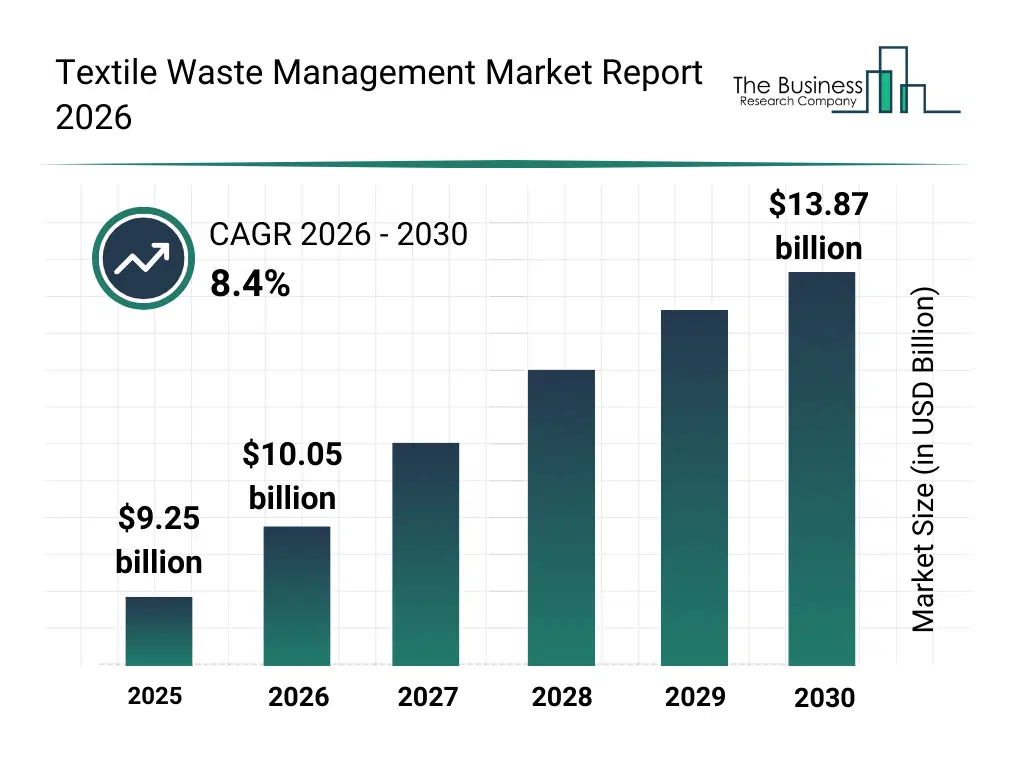
What Is The Textile Waste Management Market Size and Share 2026?
The textile waste management market size has grown strongly in recent years. It will grow from $9.25 billion in 2025 to $10.05 billion in 2026 at a compound annual growth rate (CAGR) of 8.7%. The growth in the historic period can be attributed to growth of fast fashion consumption, increasing textile waste generation, expansion of apparel manufacturing, limited landfill capacity, rising awareness of textile pollution.What Is The Textile Waste Management Market Growth Forecast?
The textile waste management market size is expected to see strong growth in the next few years. It will grow to $13.87 billion in 2030 at a compound annual growth rate (CAGR) of 8.4%. The growth in the forecast period can be attributed to increasing regulatory mandates on textile recycling, rising investments in circular fashion models, expansion of chemical recycling capacity, growing demand for recycled fibers, increasing adoption of digital waste tracking systems. Major trends in the forecast period include increasing adoption of textile recycling technologies, rising use of chemical recycling methods, growing focus on closed-loop textile systems, expansion of waste-to-energy applications, enhanced emphasis on textile traceability.
Global Textile Waste Management Market Segmentation
1) By Processing Method: Recycling, Waste-To-Energy, Landfilling, Incineration 2) By Waste Type: Post-Consumer Waste, Post-Industrial Waste, Pre-Consumer Waste, Unsold Goods 3) By Material Type: Natural Fibers, Synthetic Fibers, Blended Fabrics 4) By Application: Apparel, Home Furnishing, Industrial, Other Applications 5) By End User: Textile Manufacturers, Retailers, Recyclers, Consumers Subsegments: 1) By Recycling: Mechanical Recycling, Chemical Recycling, Open-Loop Recycling, Closed-Loop Recycling 2) By Waste-To-Energy: Incineration With Energy Recovery, Gasification, Pyrolysis, Anaerobic Digestion 3) By Landfilling: Municipal Solid Waste Landfills, Industrial Landfills, Bioreactor Landfills 4) By Incineration: Mass Burn Incineration, Refuse-Derived Fuel (RDF) Incineration, Fluidized Bed IncinerationWhat Is The Driver Of The Textile Waste Management Market?
The increasing investment in recycling infrastructure is expected to propel the growth of the textile waste management market going forward. Recycling infrastructure refers to the systems, facilities, and technologies used for efficiently collecting, sorting, and processing textile waste into reusable raw materials. The increasing investment in recycling infrastructure is driven by growing awareness among governments about the environmental impact of textile waste and the need to promote a circular economy. Investment in recycling infrastructure aids in textile waste management by providing advanced systems and technologies for efficient collection, sorting, and processing, thereby promoting sustainable resource recovery and reducing landfill waste. For instance, in September 2023, according to the Environmental Protection Agency (EPA), a US-based government agency, more than $100 million has been allocated through President Biden’s Investing in America agenda to strengthen recycling infrastructure and waste management systems nationwide, marking the EPA’s largest investment in recycling in the past 30 years. Additionally, the EPA has selected 25 communities to receive over $73 million in grants under the newly established Solid Waste Infrastructure for Recycling funding program. Therefore, the increasing investment in recycling infrastructure is driving growth of the textile waste management industry.Key Players In The Global Textile Waste Management Market
Major companies operating in the textile waste management market report are Veolia Environnement SA, Republic Services Inc, Infinited Fiber Company, TEXAID, Procotex Corporation SA, Boer Group Recycling Solutions GmbH, ICOLLECT India Private Limited, Pure Waste Textiles Oy, Nathan’s Wastesavers Ltd, Retex Textiles Inc, Ecocitex, Lenzing AG, Worn Again Technologies, Circ BV, Recover Textile Systems SL, SOEX Group, Martex Fiber Southern Corporation, Leigh Fibers Inc, FabScrap Inc, Evrnu Inc, Ambercycle Inc
This chart is for illustrative purposes; the full report includes a detailed competitor analysis and comprehensive overview of the top 10 companies in the market.
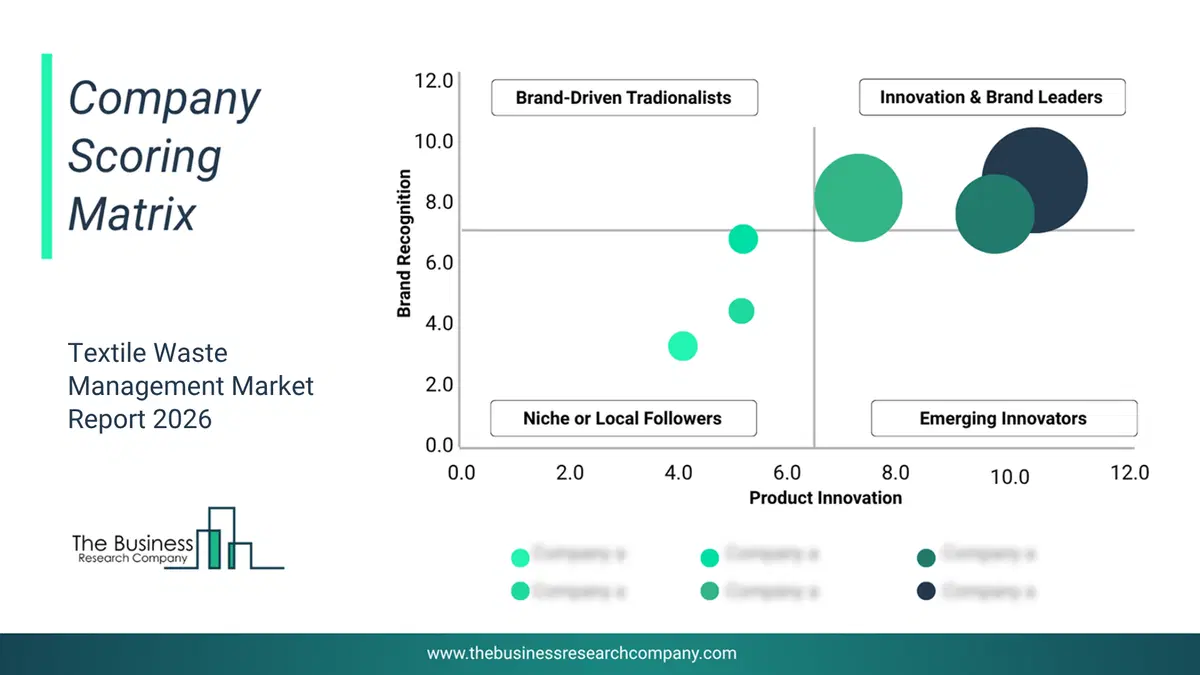
This chart maps companies by product innovation and brand strength, with bubble size indicating relative revenue, helping identify market leaders, challengers, and niche players. This is an illustrative chart; the full report provides a complete and accurate competitive analysis.
Global Textile Waste Management Market Trends and Insights
Major companies operating in the textile waste management market are focusing on developing technologically advanced solutions, such as enzymatic recycling technologies, to enhance sustainability and efficiency in recycling operations. Enzymatic recycling technologies refer to processes that use specially engineered enzymes to break down synthetic and natural polymers in textile or plastic waste into their original monomers or raw materials, which can then be reused to produce new products. For instance, in April 2024, Samsara Eco, an Australia-based recycling technology company, in partnership with Lululemon, a Canada-based athletic apparel brand, launched an apparel line made from enzymatically recycled polyester. The launch features garments produced through Samsara Eco’s patented enzymatic process, which transforms end-of-life textiles into regenerated polyester without compromising durability or performance. This innovation advances the textile waste management industry by reducing dependence on virgin resources and supporting a closed-loop, circular economy.What Are Latest Mergers And Acquisitions In The Textile Waste Management Market?
In June 2024, Altor Equity Partners, a Sweden-based investment firm, acquired the remaining assets of Renewcell for an undisclosed amount. With this acquisition, Altor aims to secure financing and ensure the continued development of Renewcell’s pioneering cotton textile recycling technology. It aligns with Altor’s strategy to support circular economy leaders and scale sustainable innovations within the textile industry. Renewcell, now renamed Circulose, is a Swedish textile recycling company that plays a significant role in textile waste management.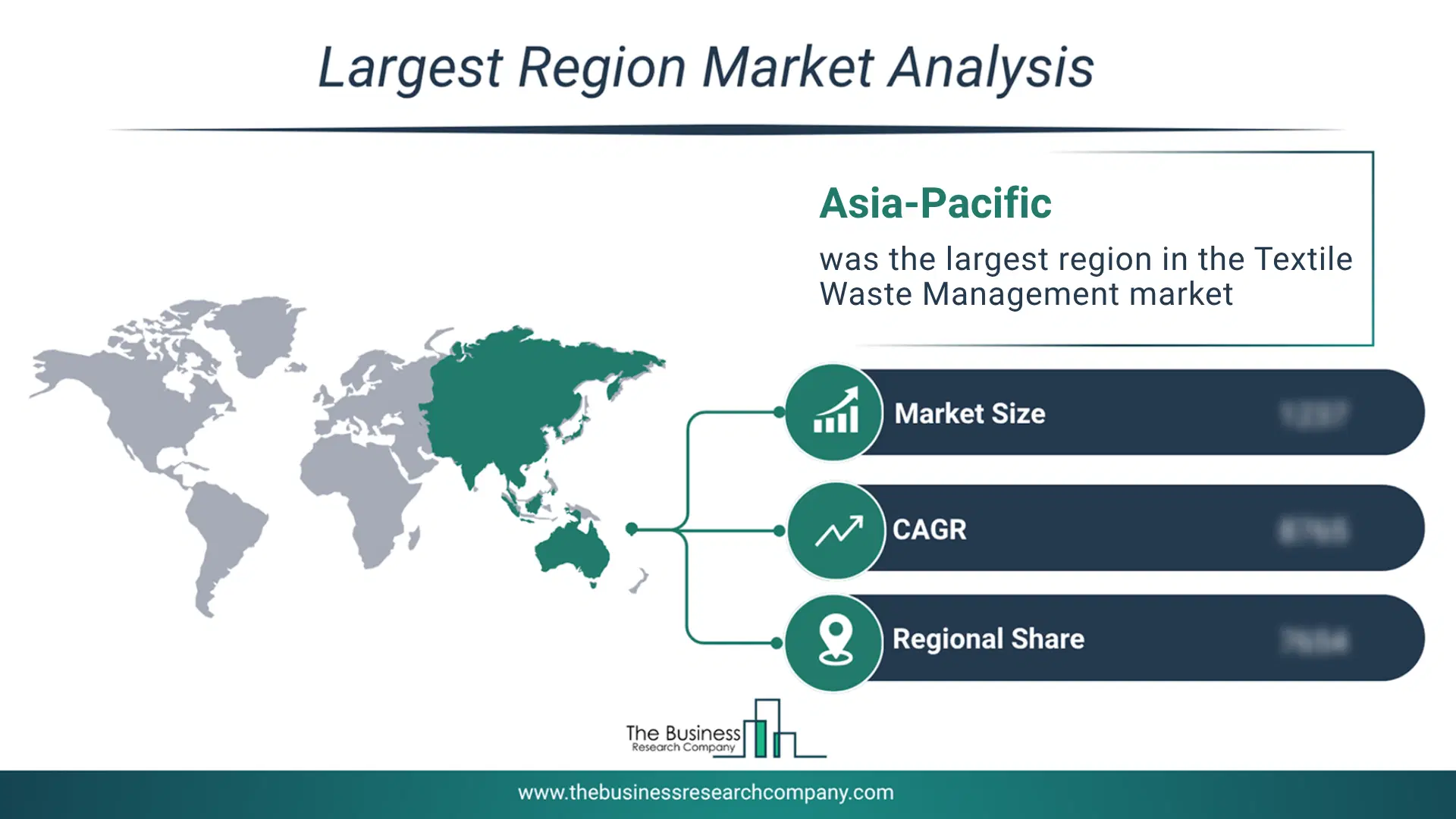
Regional Outlook
Asia-Pacific was the largest region in the textile waste management market in 2025. North America is expected to be the fastest-growing region in the forecast period. The regions covered in this market report are Asia-Pacific, South East Asia, Western Europe, Eastern Europe, North America, South America, Middle East, Africa. The countries covered in this market report are Australia, Brazil, China, France, Germany, India, Indonesia, Japan, Taiwan, Russia, South Korea, UK, USA, Canada, Italy, SpainWhat Defines the Textile Waste Management Market?
The textile waste management market includes revenues earned by entities by providing services such as textile waste collection, sorting, recycling, disposal, and related environmental management services. The market value includes the value of related goods sold by the service provider or included within the service offering. Only goods and services traded between entities or sold to end consumers are included.How is Market Value Defined and Measured?
The market value is defined as the revenues that enterprises gain from the sale of goods and/or services within the specified market and geography through sales, grants, or donations in terms of the currency (in USD unless otherwise specified). The revenues for a specified geography are consumption values that are revenues generated by organizations in the specified geography within the market, irrespective of where they are produced. It does not include revenues from resales along the supply chain, either further along the supply chain or as part of other products.
This chart presents market attractiveness based on a quantitative evaluation of growth, competition, strategic alignment, and risk, offering a clear view of opportunity areas for decision-making. This chart is for illustrative purposes; the full report contains the complete analysis.

This chart highlights the Total Addressable Market (TAM) by estimating the maximum revenue opportunity using an assumption-driven approach, supporting strategic planning and opportunity sizing across markets. The chart is illustrative; the full report provides a more comprehensive analysis.
What Key Data and Analysis Are Included in the Textile Waste Management Market Report 2026?
The textile waste management market research report is one of a series of new reports from The Business Research Company that provides market statistics, including industry global market size, regional shares, competitors with the market share, detailed market segments, market trends and opportunities, and any further data you may need to thrive in the textile waste management industry. The market research report delivers a complete perspective of everything you need, with an in-depth analysis of the current and future state of the industry.Textile Waste Management Market Report Forecast Analysis
| Report Attribute | Details |
|---|---|
| Market Size Value In 2026 | $10.05 billion |
| Revenue Forecast In 2030 | $13.87 billion |
| Growth Rate | CAGR of 8.7% from 2026 to 2030 |
| Base Year For Estimation | 2025 |
| Actual Estimates/Historical Data | 2020-2025 |
| Forecast Period | 2026 - 2030 - 2030 |
| Market Representation | Revenue in USD Billion and CAGR from 2026 to 2030 |
| Segments Covered | Processing Method, Waste Type, Material Type, Application, End User |
| Regional Scope | Asia-Pacific, Western Europe, Eastern Europe, North America, South America, Middle East, Africa |
| Country Scope | The countries covered in the report are Australia, Brazil, China, France, Germany, India, Indonesia, Japan, Taiwan, Russia, South Korea, UK, USA, Canada, Italy, Spain. |
| Key Companies Profiled | Veolia Environnement SA, Republic Services Inc, Infinited Fiber Company, TEXAID, Procotex Corporation SA, Boer Group Recycling Solutions GmbH, ICOLLECT India Private Limited, Pure Waste Textiles Oy, Nathan’s Wastesavers Ltd, Retex Textiles Inc, Ecocitex, Lenzing AG, Worn Again Technologies, Circ BV, Recover Textile Systems SL, SOEX Group, Martex Fiber Southern Corporation, Leigh Fibers Inc, FabScrap Inc, Evrnu Inc, Ambercycle Inc |
| Customization Scope | Request for Customization |
| Pricing And Purchase Options | Explore Purchase Options |