
Textile Weaving Residencies Market Report 2026
Global Outlook – By Residency Type (Handloom Weaving Residencies, Contemporary Textile Art Residencies, Sustainable Textile Residencies, Artisan Collaboration Residencies, Academic Textile Residencies), By Duration (Short Term, Long Term), By Funding Type (Government Funded Residencies, Privately Funded Residencies, Institution Sponsored Residencies, Non Profit Supported Residencies, Self Funded Residencies), By Application (Fashion And Apparel, Home Furnishing Textiles, Artistic Textile Installations, Cultural And Heritage Projects, Educational And Training Programs), By End User (Individuals, Educational Institutions, Textile Manufacturers, Art Organizations, Other End Users) – Market Size, Trends, Strategies, and Forecast to 2030
Textile Weaving Residencies Market Overview
• Textile Weaving Residencies market size has reached to $0.73 billion in 2025 • Expected to grow to $1.06 billion in 2030 at a compound annual growth rate (CAGR) of 7.7% • Growth Driver: Rising Government Support For Arts And Crafts Driving The Market Growth Due To Increasing Public Investment In Cultural Preservation And Creative Skill Development Initiatives • Market Trend: Enhancement Of Event Registration Through Automated Credential Printing • North America was the largest region in 2025 and Asia-Pacific is the fastest growing region.What Is Covered Under Textile Weaving Residencies Market?
Textile weaving residencies are structured, time-bound programs that enable textile artists, designers, and researchers to focus on creative exploration, experimentation, and the advancement of weaving practices in a dedicated environment. They promote artistic innovation, cultural exchange, and the preservation of traditional and contemporary weaving knowledge while fostering collaboration and professional development within the textile community. The main residency types of textile weaving residencies include handloom weaving residencies, contemporary textile art residencies, sustainable textile residencies, artisan collaboration residencies, and academic textile residencies. Handloom weaving residencies refer to structured programs that provide artisans, designers, and researchers with dedicated spaces, mentorship, and resources to develop traditional and contemporary weaving practices. These residencies are offered as short term and long term programs and are funded through government funded residencies, privately funded residencies, institution sponsored residencies, non profit supported residencies, and self funded residencies. They find application in fashion and apparel, home furnishing textiles, artistic textile installations, cultural and heritage projects, and educational and training programs, serving end users including individuals, educational institutions, textile manufacturers, art organizations, and others.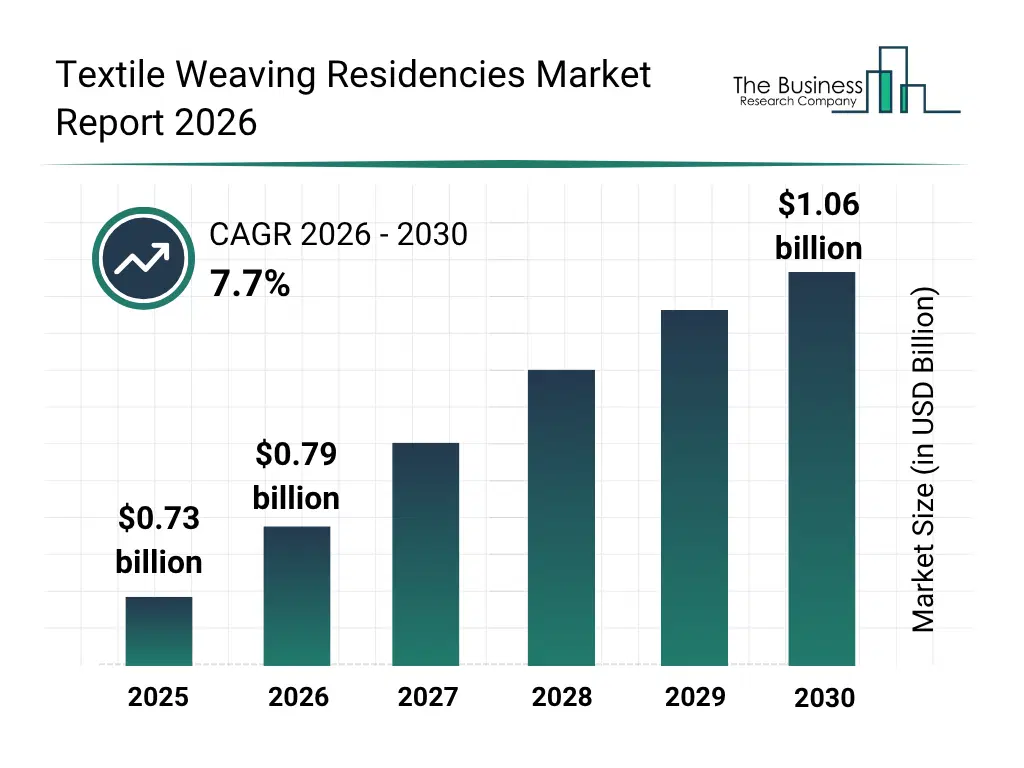
What Is The Textile Weaving Residencies Market Size and Share 2026?
The textile weaving residencies market size has grown strongly in recent years. It will grow from $0.73 billion in 2025 to $0.79 billion in 2026 at a compound annual growth rate (CAGR) of 8.1%. The growth in the historic period can be attributed to increasing interest in preserving traditional textile weaving techniques, growing support for textile artists through cultural and creative programs, rising demand for dedicated spaces enabling textile experimentation, expanding recognition of weaving as an artistic and cultural practice, increasing participation of artisans and designers in collaborative textile initiatives.What Is The Textile Weaving Residencies Market Growth Forecast?
The textile weaving residencies market size is expected to see strong growth in the next few years. It will grow to $1.06 billion in 2030 at a compound annual growth rate (CAGR) of 7.7%. The growth in the forecast period can be attributed to growing demand for sustainable textile innovation and eco-conscious weaving practices, increasing adoption of interdisciplinary textile research programs, rising collaboration between artists educational institutions and textile organizations, expanding global interest in cultural exchange through textile residencies, increasing investment in creative communities supporting advanced weaving practices. Major trends in the forecast period include increasing focus on preservation of traditional weaving knowledge and cultural heritage practices, growing adoption of collaborative textile residency models among artists and designers, rising demand for sustainable material experimentation in textile creation, expanding participation of emerging textile artists in specialized residency programs, increasing development of cross cultural textile exchange initiatives.
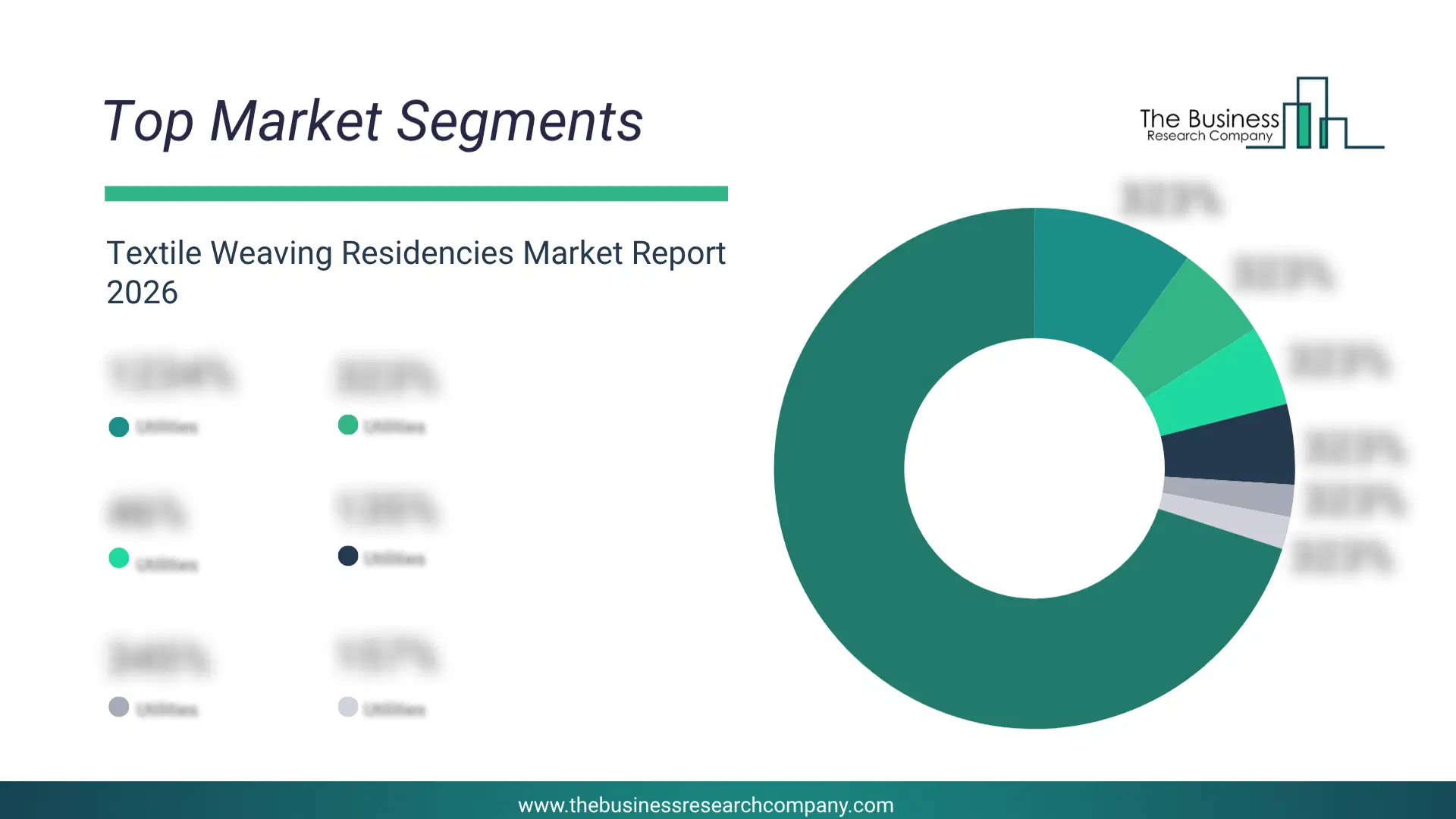
Global Textile Weaving Residencies Market Segmentation
1) By Residency Type: Handloom Weaving Residencies, Contemporary Textile Art Residencies, Sustainable Textile Residencies, Artisan Collaboration Residencies, Academic Textile Residencies 2) By Duration: Short Term, Long Term 3) By Funding Type: Government Funded Residencies, Privately Funded Residencies, Institution Sponsored Residencies, Non Profit Supported Residencies, Self Funded Residencies 4) By Application: Fashion And Apparel, Home Furnishing Textiles, Artistic Textile Installations, Cultural And Heritage Projects, Educational And Training Programs 5) By End User: Individuals, Educational Institutions, Textile Manufacturers, Art Organizations, Other End Users Subsegments: 1) By Handloom Weaving Residencies: Traditional Loom Based Residencies, Heritage Weaving Skill Development Residencies, Community Based Handloom Training Residencies, Master Weaver Mentorship Residencies, Rural Handloom Craft Revival Residencies 2) By Contemporary Textile Art Residencies: Experimental Textile Art Residencies, Mixed Media Textile Practice Residencies, Conceptual Textile Design Residencies, Digital Fabrication Textile Art Residencies, Installation Based Textile Art Residencies 3) By Sustainable Textile Residencies: Eco Friendly Dyeing And Weaving Residencies, Circular Textile Design Residencies, Zero Waste Textile Production Residencies, Organic Fibre Textile Development Residencies, Recycled Material Textile Innovation Residencies 4) By Artisan Collaboration Residencies: Cross Cultural Weaving Collaboration Residencies, Designer Artisan Co Creation Residencies, Indigenous Craft Integration Residencies, Intergenerational Craft Knowledge Exchange Residencies, Community Artisan Cooperative Residencies 5) By Academic Textile Residencies: University Based Textile Research Residencies, Textile Material Science Research Residencies, Curriculum Integrated Weaving Training Residencies, Student Led Textile Innovation Residencies, Interdisciplinary Textile Studies ResidenciesWhat Is The Driver Of The Textile Weaving Residencies Market?
The growing government support for arts and crafts is expected to propel the growth of the textile weaving residencies market going forward. Government support for arts and crafts is the provision of grants, funding, training, infrastructure, and policy initiatives to encourage artistic creation, preserve traditional crafts, and foster the growth of creative industries. Government support for arts and crafts is increasing to preserve cultural heritage by funding initiatives that protect traditional craftsmanship, sustain indigenous artistic practices, and pass cultural knowledge to future generations. Government support for arts and crafts helps textile weaving residencies by providing funding, infrastructure, training programs, and market access that enable weavers to preserve traditional techniques, experiment with new designs, and sustain their livelihoods. For instance, in February 2024, according to the GIA Reader, a US-based national publication, in fiscal year 2024, federal, state, and local funding for the arts in the United States totaled $1.8 billion, representing a per capita investment of $5.44, reflecting continued public investment in creative industries. Therefore, the growing government support for arts and crafts is driving the growth of the textile weaving residencies industry.Key Players In The Global Textile Weaving Residencies Market
Major companies operating in the textile weaving residencies market are Fondation d'Entreprise Hermès, Banff Centre for Arts and Creativity, Haystack Mountain School of Crafts, Penland School of Craft, Stichting TextielMuseum, Fondazione Arte della Seta Lisio, Cité Internationale de la Tapisserie, Australian Tapestry Workshop, Textile Museum of Canada, Dovecot Studios Limited, Arquetopia A.C., Textile Arts Center Inc., The Weaving Mill, Praxis Fiber Workshop, Córtex Frontal Associação, Thread Caravan LLC, Tabby Studio, Maria Sigma Studio, Freeweaver Studio, Textile Center, Stofnun Textílína á Íslandi, Salem Art Works Inc., Qhatuy Lab, La Napoule Art Foundation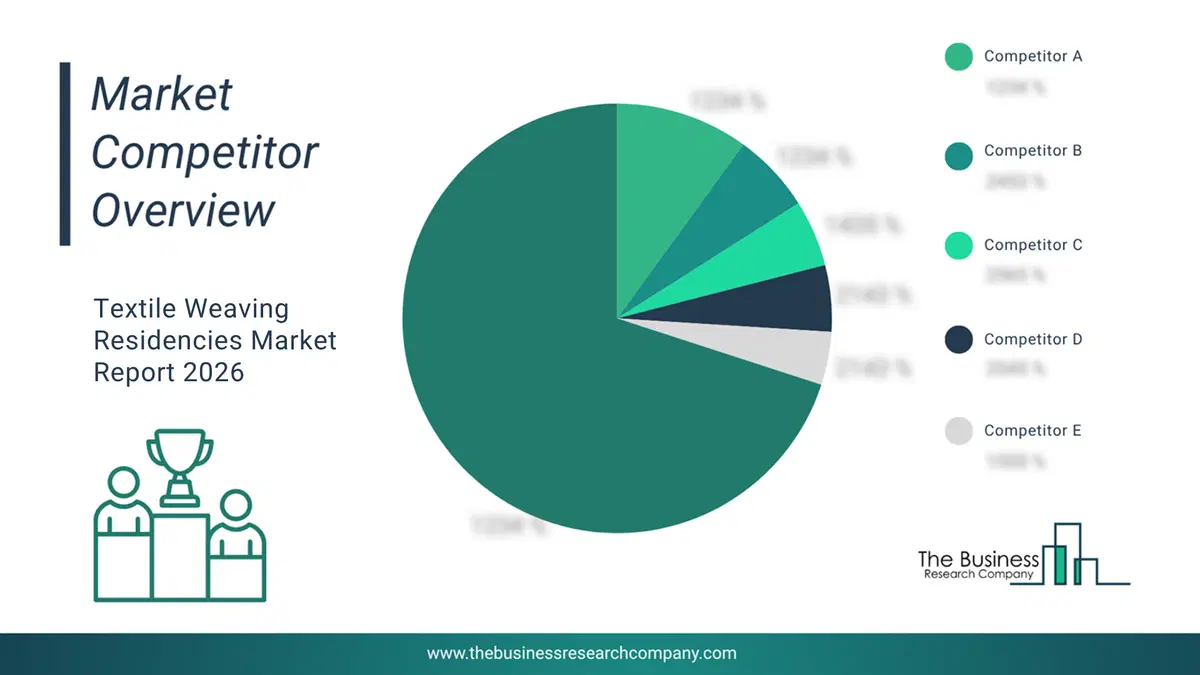
This chart is for illustrative purposes; the full report includes a detailed competitor analysis and comprehensive overview of the top 10 companies in the market.
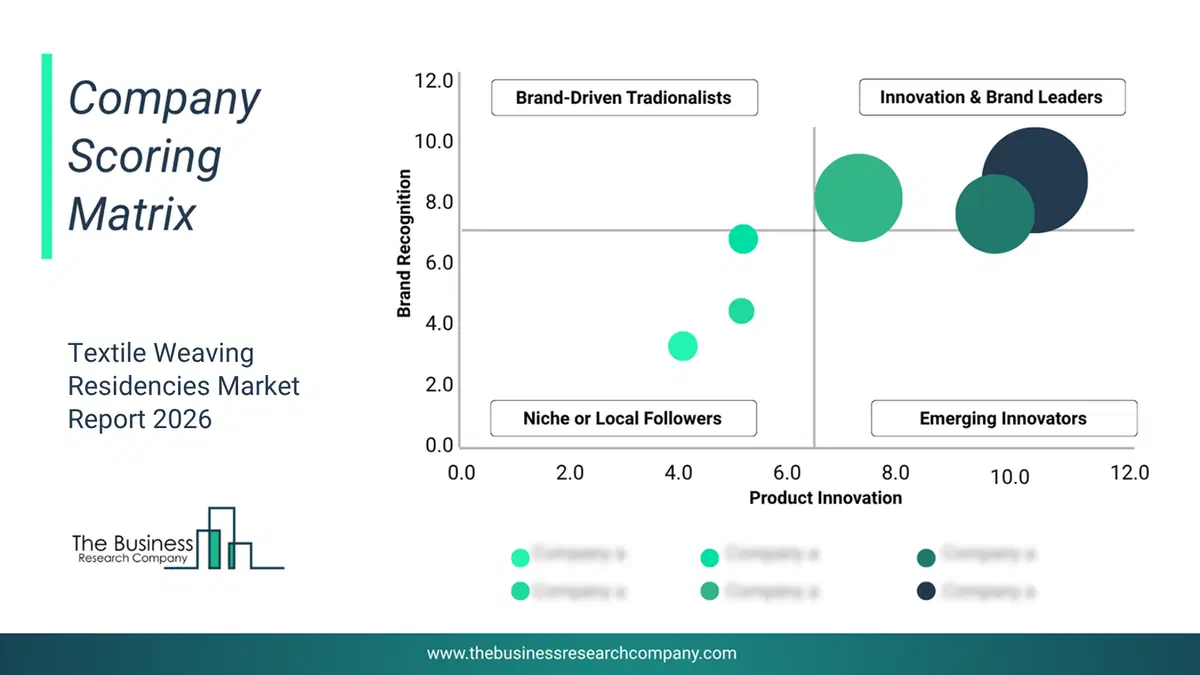
This chart maps companies by product innovation and brand strength, with bubble size indicating relative revenue, helping identify market leaders, challengers, and niche players. This is an illustrative chart; the full report provides a complete and accurate competitive analysis.
Global Textile Weaving Residencies Market Trends and Insights
Major companies operating in the textile weaving residencies market are increasingly prioritizing multidisciplinary weaving residency programs that combine traditional textile practices with scientific, cultural, technological, and environmental perspectives to encourage knowledge exchange and collaborative creative development. Multidisciplinary weaving residency programs refer to structured collaborative programs that bring together artists, scientists, knowledge holders, technologists, and creatives from different fields to develop weaving-based or interdisciplinary projects. For instance, in January 2026, Treecreate Studio, an Australia-based creative and cultural organization, announced three Weaving Water residencies for 2026, including programs in Vanuatu, Looming, and Yarun (Bribie Island), Queensland. The residencies bring together scientists, knowledge holders, technologists, and creatives to explore themes including climate change, ecological restoration, water, and more-than-human perspectives. It is combining weaving practices with scientific, cultural, and environmental knowledge, the Weaving Water residencies support collaborative textile creation, interdisciplinary learning, and creative exploration of ecological and cultural issues.What Are Latest Mergers And Acquisitions In The Textile Weaving Residencies Market?
In March 2025, Yodomo Ltd, a UK-based organization that supports sustainable design and creative businesses, partnered with Hackney Wick and Fish Island Community Development Trust, to support the Sustainable Young Makers Programme 2025. Through this partnership, Yodomo and Hackney Wick and Fish Island Community Development Trust aim to support emerging sustainable fashion and textile entrepreneurs by providing mentorship, resources, community engagement, and weaving residency opportunities that give young weavers access to post-industry yarns and traditional weaving techniques. Hackney Wick and Fish Island Community Development Trust is a UK-based community development organization that supports local creative, cultural, and sustainable initiatives, including textile and weaving programmes.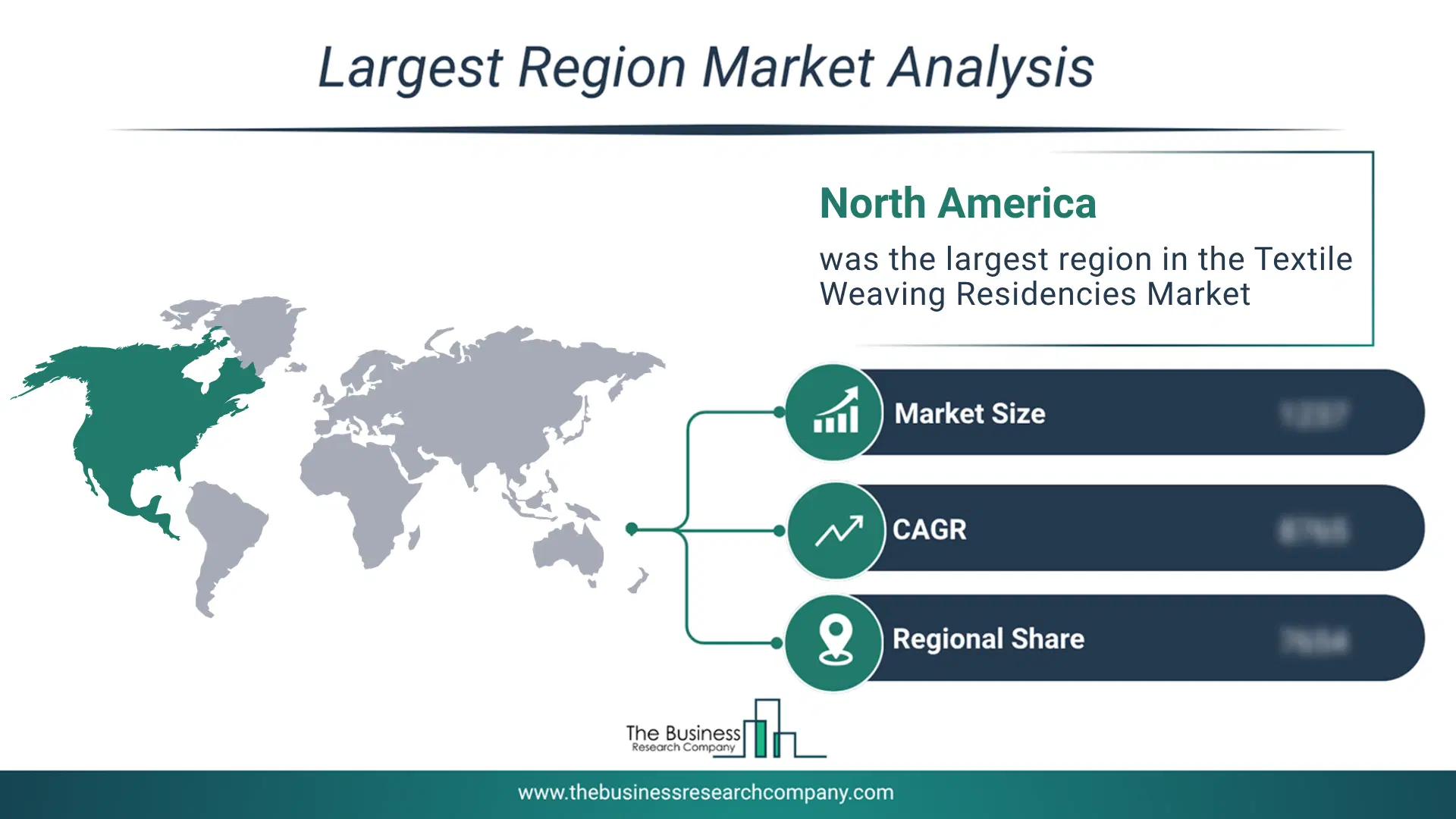
Regional Outlook
North America was the largest region in the textile weaving residencies market in 2025. Asia-Pacific is expected to be the fastest-growing region in the forecast period. The regions covered in this market report are Asia-Pacific, South East Asia, Western Europe, Eastern Europe, North America, South America, Middle East, Africa. The countries covered in this market report are Australia, Brazil, China, France, Germany, India, Indonesia, Japan, Taiwan, Russia, South Korea, UK, USA, Canada, Italy, Spain.What Defines the Textile Weaving Residencies Market?
The textile weaving residencies market includes revenues earned by entities by providing services such as studio space and weaving facilities, technical guidance and weaving support, and material and fiber experimentation support. The market value includes the value of related goods sold by the service provider or included within the service offering. Only goods and services traded between entities or sold to end consumers are included.How is Market Value Defined and Measured?
The market value is defined as the revenues that enterprises gain from the sale of goods and/or services within the specified market and geography through sales, grants, or donations in terms of the currency (in USD unless otherwise specified). The revenues for a specified geography are consumption values that are revenues generated by organizations in the specified geography within the market, irrespective of where they are produced. It does not include revenues from resales along the supply chain, either further along the supply chain or as part of other products.
This chart presents market attractiveness based on a quantitative evaluation of growth, competition, strategic alignment, and risk, offering a clear view of opportunity areas for decision-making. This chart is for illustrative purposes; the full report contains the complete analysis.

This chart highlights the Total Addressable Market (TAM) by estimating the maximum revenue opportunity using an assumption-driven approach, supporting strategic planning and opportunity sizing across markets. The chart is illustrative; the full report provides a more comprehensive analysis.
What Key Data and Analysis Are Included in the Textile Weaving Residencies Market Report 2026?
The textile weaving residencies market research report is one of a series of new reports from The Business Research Company that provides market statistics, including industry global market size, regional shares, competitors with the market share, detailed market segments, market trends and opportunities, and any further data you may need to thrive in the textile weaving residencies industry. The market research report delivers a complete perspective of everything you need, with an in-depth analysis of the current and future state of the industry.Textile Weaving Residencies Market Report Forecast Analysis
| Report Attribute | Details |
|---|---|
| Market Size Value In 2026 | $0.79 billion |
| Revenue Forecast In 2030 | $1.06 billion |
| Growth Rate | CAGR of 7.7% from 2026 to 2030 |
| Base Year For Estimation | 2025 |
| Actual Estimates/Historical Data | 2020-2025 |
| Forecast Period | 2026 - 2030 |
| Market Representation | Revenue in USD Billion and CAGR from 2026 to 2030 |
| Segments Covered | Residency Type, Duration, Funding Type, Application, End User |
| Regional Scope | Asia-Pacific, Western Europe, Eastern Europe, North America, South America, Middle East, Africa |
| Country Scope | The countries covered in the report are Australia, Brazil, China, France, Germany, India, Indonesia, Japan, Taiwan, Russia, South Korea, UK, USA, Canada, Italy, Spain. |
| Key Companies Profiled | Fondation d'Entreprise Hermès, Banff Centre for Arts and Creativity, Haystack Mountain School of Crafts, Penland School of Craft, Stichting TextielMuseum, Fondazione Arte della Seta Lisio, Cité Internationale de la Tapisserie, Australian Tapestry Workshop, Textile Museum of Canada, Dovecot Studios Limited, Arquetopia A.C., Textile Arts Center Inc., The Weaving Mill, Praxis Fiber Workshop, Córtex Frontal Associação, Thread Caravan LLC, Tabby Studio, Maria Sigma Studio, Freeweaver Studio, Textile Center, Stofnun Textílína á Íslandi, Salem Art Works Inc., Qhatuy Lab, La Napoule Art Foundation |
| Customization Scope | Request for Customization |
| Pricing And Purchase Options | Explore Purchase Options |