

TextileGenesis Traceability Market Report 2026
Global Outlook – By Component (Software, Services), By Material Type (Cotton, Recycled Polyester, Wool, Cellulosic Fibers, Synthetic Fibers, Blended Fabrics), By Deployment Mode (Cloud, On-Premises), By Application (Supply Chain Transparency, Material Traceability, Digital Product Passport, Sustainability Compliance, Supplier Verification), By End User (Textile Manufacturers, Apparel Brands, Retailers, Fiber Producers, Fashion Companies, Certification Bodies) – Market Size, Trends, Strategies, and Forecast to 2030
TextileGenesis Traceability Market Overview
• TextileGenesis Traceability market size has reached to $1.32 billion in 2025 • Expected to grow to $3.11 billion in 2030 at a compound annual growth rate (CAGR) of 18.7% • Growth Driver: Increasing Digital Transformation Across Industries Driving The Growth Of The Market Due To The Growing Need For Operational Efficiency • Market Trend: Development Of Immersive Weaving Residencies Combining Cultural And Scientific Knowledge • North America was the largest region in 2025 and Asia-Pacific is the fastest growing region.What Is Covered Under TextileGenesis Traceability Market?
TextileGenesis traceability is a cloud-based digital traceability platform that enables end-to-end tracking of textile materials and products across the supply chain, from raw fiber to finished garment. It uses technologies such as blockchain and digital chain-of-custody records to enhance supply chain transparency, verify sustainability claims, support regulatory compliance, and improve material authenticity. The main components of textilegenesis traceability include software and services. Software refers to digital traceability platforms that enable end-to-end tracking, verification, and authentication of textile materials across the supply chain while supporting sustainability and compliance initiatives. These solutions support material types including cotton, recycled polyester, wool, cellulosic fibers, synthetic fibers, and blended fabrics and are deployed through cloud and On-Premises environments. The various applications involved are supply chain transparency, material traceability, digital product passport, sustainability compliance, and supplier verification and they are utilized by end users including textile manufacturers, apparel brands, retailers, fiber producers, fashion companies, and certification bodies.
What Is The TextileGenesis Traceability Market Size and Share 2026?
The textilegenesis traceability market size has grown rapidly in recent years. It will grow from $1.32 billion in 2025 to $1.57 billion in 2026 at a compound annual growth rate (CAGR) of 19.1%. The growth in the historic period can be attributed to increasing demand for supply chain transparency in the textile industry, growing regulatory focus on sustainable textile production, rising concerns regarding counterfeit textile materials and product authenticity, expanding adoption of digital supply chain management solutions, increasing need for improved supplier verification and compliance monitoring.What Is The TextileGenesis Traceability Market Growth Forecast?
The textilegenesis traceability market size is expected to see rapid growth in the next few years. It will grow to $3.11 billion in 2030 at a compound annual growth rate (CAGR) of 18.7%. The growth in the forecast period can be attributed to growing demand for end-to-end textile traceability solutions, increasing adoption of digital product passport requirements, rising focus on circular economy practices in textile value chains, expanding implementation of cloud-based supply chain platforms, increasing demand for verified sustainability claims from consumers and brands. Major trends in the forecast period include increasing adoption of digital traceability solutions across textile supply chains, growing demand for verified sustainable sourcing and material authenticity, rising implementation of digital product passports for textile compliance, expanding focus on supplier transparency and responsible sourcing practices, increasing integration of traceability platforms with textile certification processes.

Global TextileGenesis Traceability Market Segmentation
1) By Component: Software, Services 2) By Material Type: Cotton, Recycled Polyester, Wool, Cellulosic Fibers, Synthetic Fibers, Blended Fabrics 3) By Deployment Mode: Cloud, On-Premises 4) By Application: Supply Chain Transparency, Material Traceability, Digital Product Passport, Sustainability Compliance, Supplier Verification 5) By End User: Textile Manufacturers, Apparel Brands, Retailers, Fiber Producers, Fashion Companies, Certification Bodies Subsegments: 1) By Software: Platform Software, Integration Software, Data Management Software, Analytics Software, Blockchain Traceability Software 2) By Services: Implementation Services, Consulting Services, Support And Maintenance Services, Training And Onboarding Services, System Integration ServicesWhat Is The Driver Of The TextileGenesis Traceability Market?
The increasing digital transformation across industries is expected to propel the growth of the TextileGenesis traceability market going forward. Digital transformation across industries is the widespread adoption of digital technologies to improve operational efficiency, enhance customer experiences, and drive innovation across various business sectors. Digital transformation across industries is increasing due to the growing need for operational efficiency, as organizations adopt digital technologies to automate processes, reduce costs, and improve productivity. TextileGenesis traceability supports digital transformation across industries by digitizing supply chain data, enabling real-time traceability, automating documentation, and improving transparency, compliance, and operational efficiency across the textile value chain. For instance, in November 2023, according to the Central Digital and Data Office, a UK-based government agency responsible for digital transformation across UK government departments, the overall size of the Government Digital and Data profession grew from April 2022 to April 2023, reflecting an increase of 19%. Therefore, the increasing digital transformation across industries is driving the growth of the TextileGenesis traceability industry.Key Players In The Global TextileGenesis Traceability Market
Major companies operating in the textilegenesis traceability market are Alliance for European Flax-Linen & Hemp, Arvind Limited, Bombyx PLM Ltd., Circulor Ltd., EON Group Limited, Eastman Chemical Company, Grasim Industries Limited, Haelixa AG, Lenzing AG, Provenance Technologies Ltd., Retraced GmbH, Sourcemap Inc., Supima Association of America, Tailorlux GmbH, Textile Exchange, The Schneider Group, TrusTrace AB, National Cotton Council of America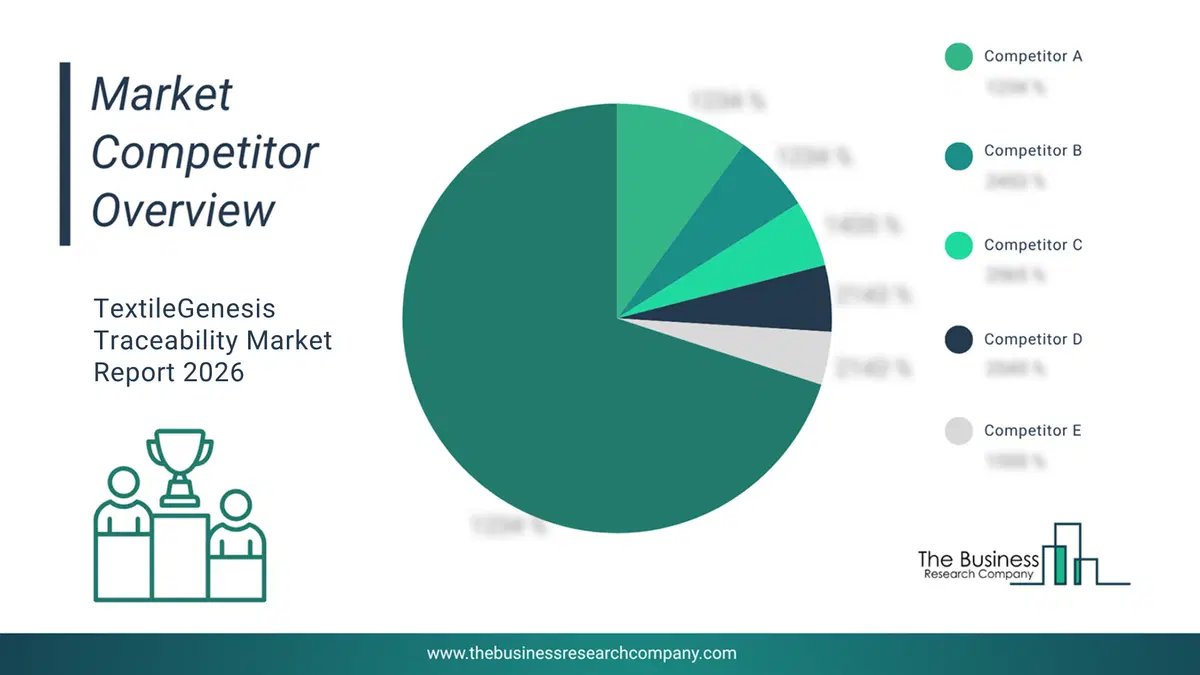
This chart is for illustrative purposes; the full report includes a detailed competitor analysis and comprehensive overview of the top 10 companies in the market.
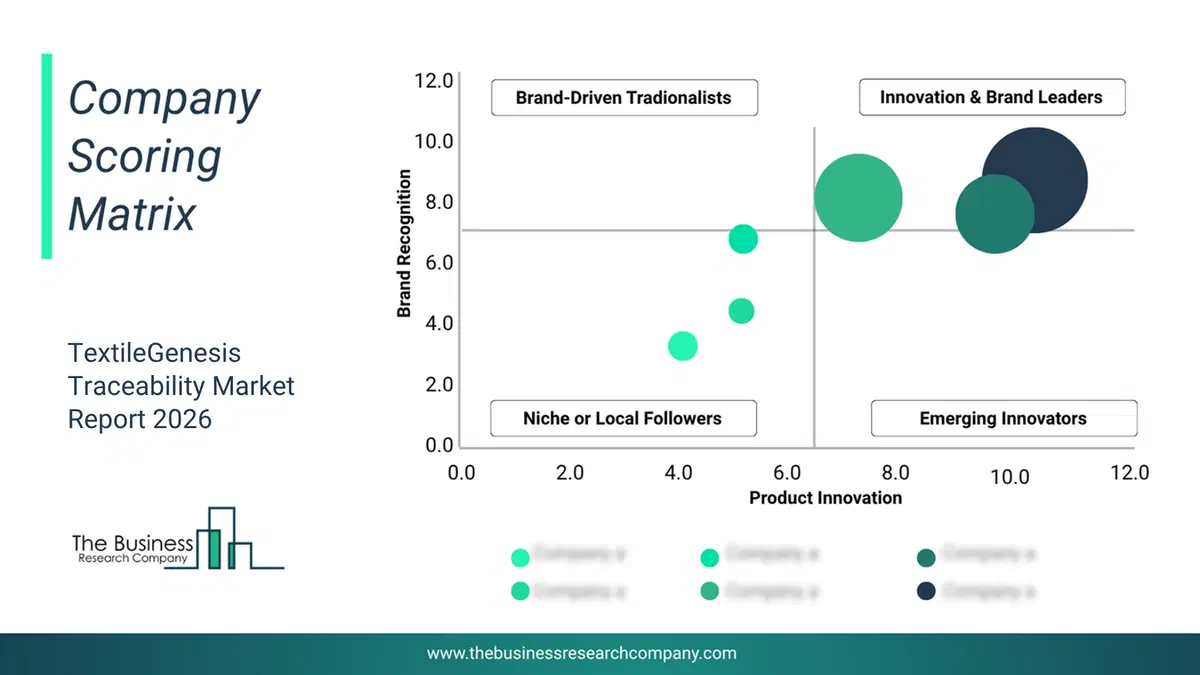
This chart maps companies by product innovation and brand strength, with bubble size indicating relative revenue, helping identify market leaders, challengers, and niche players. This is an illustrative chart; the full report provides a complete and accurate competitive analysis.
Global TextileGenesis Traceability Market Trends and Insights
Major companies operating in the TextileGenesis traceability market are focusing on developing innovative solutions such as traceability consortium platforms to strengthen end-to-end supply chain transparency, improve material traceability, and support sustainability compliance across industries. Traceability consortium platforms refer to collaborative digital networks that connect brands, suppliers, manufacturers, and certification bodies to securely track and verify the origin and movement of materials throughout the supply chain. For instance, in January 2024, TextileGenesis, a Hong Kong-based supply chain traceability technology company, launched the footwear and leather traceability consortia, designed to enable end-to-end traceability of footwear and leather supply chains. It offers benefits such as authenticated material traceability, enhanced collaboration among ecosystem participants, and streamlined sustainability and compliance verification. The launch aims to help customers improve supply chain transparency and verify product authenticity while supporting sustainability initiatives, responsible sourcing, and digital supply chain transformation.What Are Latest Mergers And Acquisitions In The TextileGenesis Traceability Market?
In May 2023, Birla Cellulose, an India-based manufacturer of man-made cellulosic fibers, partnered with TextileGenesis to deliver trusted, end-to-end digital traceability and transparency across the textile value chain. The partnership aims to integrate TextileGenesis' blockchain-based traceability platform with Birla Cellulose's fiber supply chain to enable authenticated tracking from fiber to finished garment. It also seeks to strengthen sustainability, improve supply chain transparency, and help brands meet growing regulatory and consumer demand for verified sourcing. TextileGenesis is a Hong Kong-based supply chain traceability technology company that provides TextileGenesis traceability solutions for the fashion and textile industry.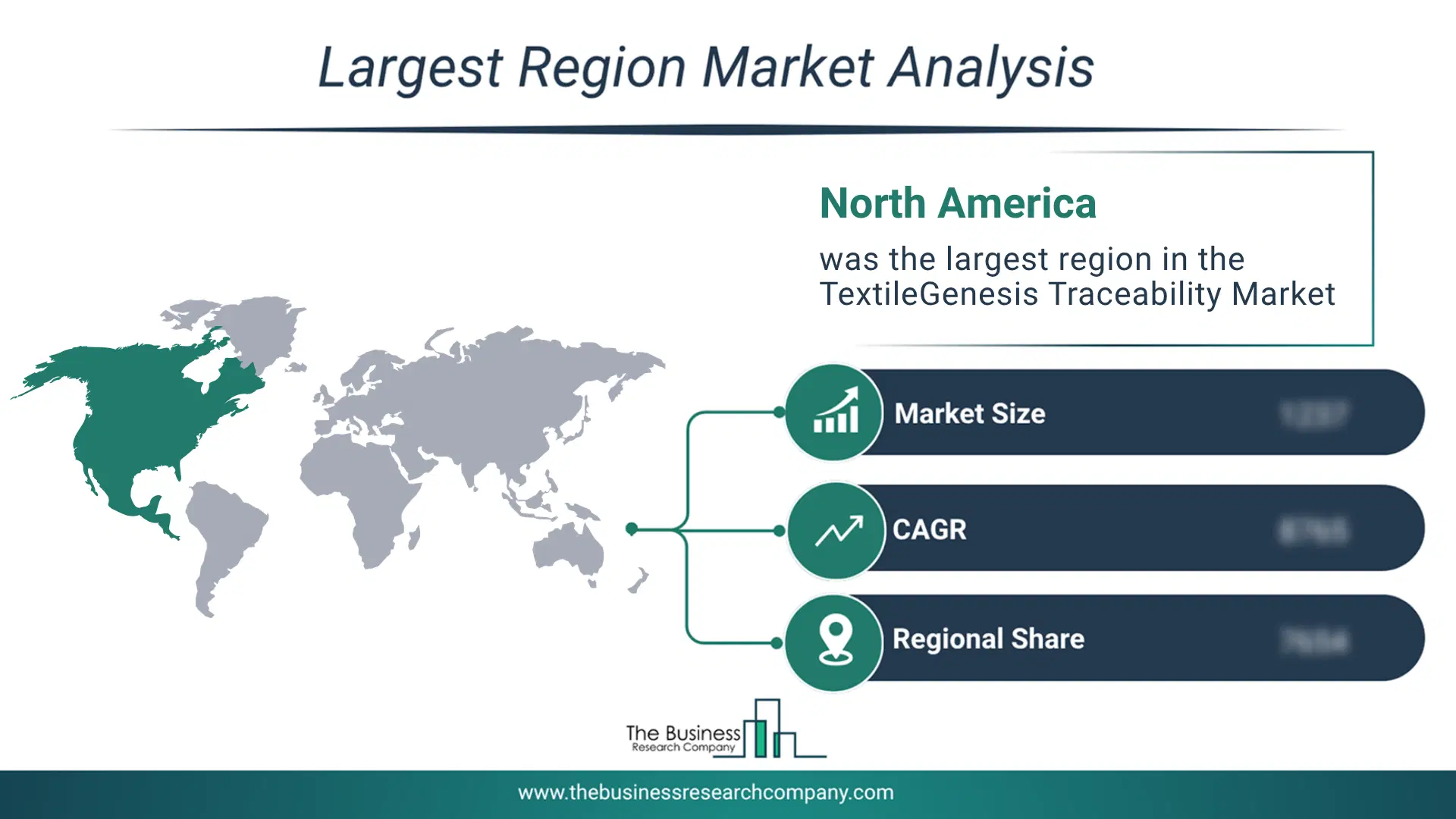
Regional Outlook
North America was the largest region in the textilegenesis traceability market in 2025. Asia-Pacific is expected to be the fastest-growing region in the forecast period. The regions covered in this market report are Asia-Pacific, South East Asia, Western Europe, Eastern Europe, North America, South America, Middle East, Africa. The countries covered in this market report are Australia, Brazil, China, France, Germany, India, Indonesia, Japan, Taiwan, Russia, South Korea, UK, USA, Canada, Italy, Spain.What Defines the TextileGenesis Traceability Market?
The textileGenesis traceability market includes revenues earned by entities by providing services such as chain-of-custody management, certified material authentication, and multi-tier supply chain mapping. The market value includes the value of related goods sold by the service provider or included within the service offering. Only goods and services traded between entities or sold to end consumers are included.How is Market Value Defined and Measured?
The market value is defined as the revenues that enterprises gain from the sale of goods and/or services within the specified market and geography through sales, grants, or donations in terms of the currency (in USD unless otherwise specified). The revenues for a specified geography are consumption values that are revenues generated by organizations in the specified geography within the market, irrespective of where they are produced. It does not include revenues from resales along the supply chain, either further along the supply chain or as part of other products.
This chart presents market attractiveness based on a quantitative evaluation of growth, competition, strategic alignment, and risk, offering a clear view of opportunity areas for decision-making. This chart is for illustrative purposes; the full report contains the complete analysis.

This chart highlights the Total Addressable Market (TAM) by estimating the maximum revenue opportunity using an assumption-driven approach, supporting strategic planning and opportunity sizing across markets. The chart is illustrative; the full report provides a more comprehensive analysis.
What Key Data and Analysis Are Included in the TextileGenesis Traceability Market Report 2026?
The textilegenesis traceability market research report is one of a series of new reports from The Business Research Company that provides market statistics, including industry global market size, regional shares, competitors with the market share, detailed market segments, market trends and opportunities, and any further data you may need to thrive in the textilegenesis traceability industry. The market research report delivers a complete perspective of everything you need, with an in-depth analysis of the current and future state of the industry.TextileGenesis Traceability Market Report Forecast Analysis
| Report Attribute | Details |
|---|---|
| Market Size Value In 2026 | $1.57 billion |
| Revenue Forecast In 2030 | $3.11 billion |
| Growth Rate | CAGR of 18.7% from 2026 to 2030 |
| Base Year For Estimation | 2025 |
| Actual Estimates/Historical Data | 2020-2025 |
| Forecast Period | 2026 - 2030 |
| Market Representation | Revenue in USD Billion and CAGR from 2026 to 2030 |
| Segments Covered | Component, Material Type, Deployment Mode, Application, End User |
| Regional Scope | Asia-Pacific, Western Europe, Eastern Europe, North America, South America, Middle East, Africa |
| Country Scope | The countries covered in the report are Australia, Brazil, China, France, Germany, India, Indonesia, Japan, Taiwan, Russia, South Korea, UK, USA, Canada, Italy, Spain. |
| Key Companies Profiled | Alliance for European Flax-Linen & Hemp, Arvind Limited, Bombyx PLM Ltd., Circulor Ltd., EON Group Limited, Eastman Chemical Company, Grasim Industries Limited, Haelixa AG, Lenzing AG, Provenance Technologies Ltd., Retraced GmbH, Sourcemap Inc., Supima Association of America, Tailorlux GmbH, Textile Exchange, The Schneider Group, TrusTrace AB, National Cotton Council of America |
| Customization Scope | Request for Customization |
| Pricing And Purchase Options | Explore Purchase Options |