

Texture Generation Artificial Intelligence (AI) Market Report 2026
Global Outlook – By Component (Software, Hardware, Services), By Deployment Mode (On-Premises, Cloud), By Technology (Diffusion Models, Generative Adversarial Networks (GANs), Procedural Generation (AI-Enhanced), Neural Rendering Or Image Synthesis), By Application (Gaming, Film And Animation, Architecture And Design, Virtual Reality, Automotive, Fashion, Other Applications), By End-User (Entertainment, Automotive, Architecture, Fashion, Advertising, Other End-Users) – Market Size, Trends, Strategies, and Forecast to 2030
Texture Generation Artificial Intelligence (AI) Market Overview
• Texture Generation Artificial Intelligence (AI) market size has reached to $2.18 billion in 2025 • Expected to grow to $7.25 billion in 2030 at a compound annual growth rate (CAGR) of 27.1% • Growth Driver: Surge In Emphasis On Personalized And Immersive Digital Experiences Fueled Growth Of Texture Generation AI Market • Market Trend: Advancing AI-Driven Texture Generation Platforms To Streamline 3D Asset Workflows And Enhance Visual Realism • North America was the largest region in 2025 and Asia-Pacific is the fastest growing region.What Is Covered Under Texture Generation Artificial Intelligence (AI) Market?
Texture generation artificial intelligence (AI) refers to the use of machine learning models to automatically create realistic or stylized digital textures for visual content. It analyzes patterns, materials, and surface details to generate high-quality textures that can be applied in graphics, gaming, design, or simulation. This technology streamlines creative workflows by reducing manual texture creation time while ensuring consistency and visual accuracy. The main components of texture generation ai include software, hardware, services, and others. Software refers to a set of programs, applications, and instructions that enable a computer or electronic device to perform specific tasks or functions. Different deployment modes are on-premises, cloud. Multiple technologies are diffusion models, generative adversarial networks, procedural generation (ai-enhanced), neural rendering or image synthesis. Various applications involved are gaming, film and animation, architecture and design, virtual reality, automotive, fashion, and others, and they are used by several end-users include entertainment, automotive, architecture, fashion, advertising, and others.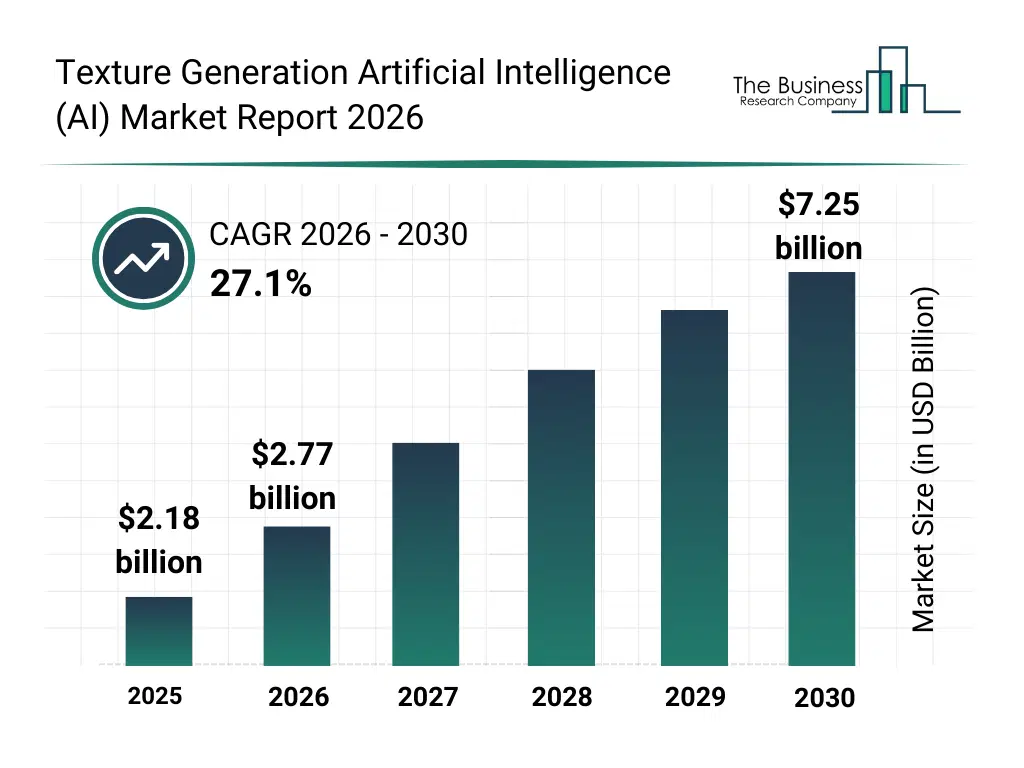
What Is The Texture Generation Artificial Intelligence (AI) Market Size and Share 2026?
The texture generation artificial intelligence (AI) market size has grown exponentially in recent years. It will grow from $2.18 billion in 2025 to $2.77 billion in 2026 at a compound annual growth rate (CAGR) of 27.4%. The growth in the historic period can be attributed to increasing demand for photorealistic digital content, growing adoption in gaming and entertainment industry, rising need for faster and cost?efficient texture creation, expansion of artificial intelligence (AI)-powered creative tools and software, and growing availability of powerful artificial intelligence (AI) hardware and cloud computing.What Is The Texture Generation Artificial Intelligence (AI) Market Growth Forecast?
The texture generation artificial intelligence (AI) market size is expected to see exponential growth in the next few years. It will grow to $7.25 billion in 2030 at a compound annual growth rate (CAGR) of 27.1%. The growth in the forecast period can be attributed to increasing adoption of virtual reality (VR) or augmented reality (AR) and immersive experiences, rising demand for customizable and on?demand digital assets, expansion of artificial intelligence (AI) tools into architecture or automotive or fashion design, growing investments in generative artificial intelligence (AI) research and infrastructure, and rising pressure on content creators for high?fidelity visuals and faster production. Major trends in the forecast period include advancements in generative artificial intelligence (AI) algorithms and diffusion or generative adversarial networks (GANs) models, innovations in 3d asset and texture synthesis techniques, developments in real?time texture generation and rendering pipelines, research and developments enabling text?to?texture and style?transfer capabilities, increasing integration of texture artificial intelligence (AI) with virtual reality (VR) or metaverse or digital twin applications.
Global Texture Generation Artificial Intelligence (AI) Market Segmentation
1) By Component: Software, Hardware, Services 2) By Deployment Mode: On-Premises, Cloud 3) By Technology: Diffusion Models, Generative Adversarial Networks (GANs), Procedural Generation (AI-Enhanced), Neural Rendering Or Image Synthesis 4) By Application: Gaming, Film And Animation, Architecture And Design, Virtual Reality, Automotive, Fashion, Other Applications 5) By End-User: Entertainment, Automotive, Architecture, Fashion, Advertising, Other End-Users Subsegments: 1) By Software: Texture Creation Tools, Rendering Engines, Integration Plugins, Development Frameworks, Algorithm Libraries 2) By Services: Professional Consulting Services, Training And Support Services, System Integration Services, Managed Services, Custom Development Services 3) By Hardware: Graphics Processing Units, Central Processing Units, Memory Modules, Storage Devices, Dedicated Acceleration UnitsWhat Is The Driver Of The Texture Generation Artificial Intelligence (AI) Market?
The rising emphasis on personalized and immersive digital experiences is expected to propel the growth of the texture generation artificial intelligence (AI) market going forward. Personalized and immersive digital experiences refer to user-focused, highly interactive visual or virtual environments tailored to individual preferences or contexts. The rise in emphasis on personalized and immersive digital experiences is due to users expecting content and interfaces that adapt to their individual preferences and behaviors, which increases engagement satisfaction and long-term loyalty. Texture generation artificial intelligence (AI) enhances digital experience ecosystems by offering highly detailed and customizable visual content, making it ideal for gaming, virtual reality, and creative applications. It reduces design time and manual effort by generating realistic textures automatically, improving personalization and immersion in digital environments. For instance, in October 2024, according to the United Nations Economic Commission for Europe, a Switzerland-based regional commission of the United Nations, the global augmented reality ecosystem expanded rapidly with active augmented reality user devices rising from about 1.4 billion in 2023 to an expected level exceeding 17.3 billion by 2024, alongside strong consumer awareness where roughly three in four adults under 44 years were familiar with augmented reality and more than 91.75% of Generation Z showed interest in augmented reality applications. Therefore, the rising emphasis on personalized and immersive digital experiences is driving the growth of the texture generation artificial intelligence (AI) industry.Key Players In The Global Texture Generation Artificial Intelligence (AI) Market
Major companies operating in the texture generation artificial intelligence (AI) market are Microsoft Corporation, Meta Platforms, International Business Machines Corporation, NVIDIA Corporation, Adobe Inc., OpenAI, Unity Technologies ApS, Lightricks Ltd., Stability AI Ltd., Luma AI, Quixel AB, Runway AI Inc., Leonardo AI Inc., Prisma Labs Inc., Masterpiece Studio, Kaedim Ltd., Nextech AR Solutions Inc., Capturing Reality, Polycam Inc., Promethean AI, DeepArt GmbH, Hyper3D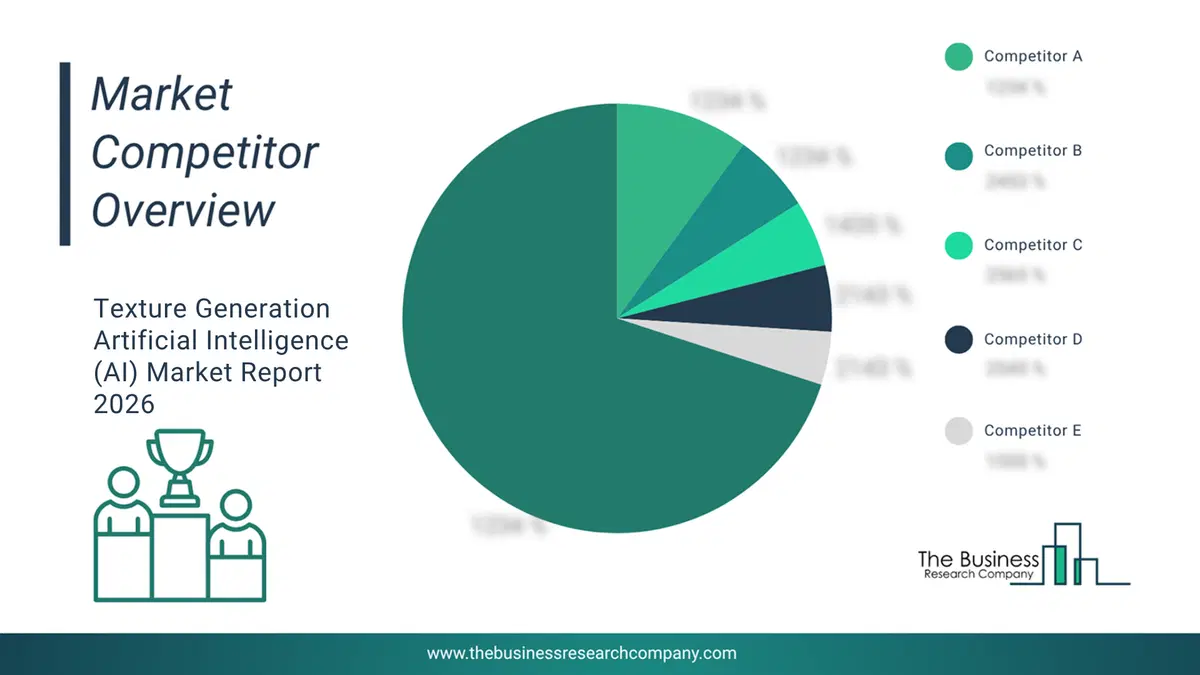
This chart is for illustrative purposes; the full report includes a detailed competitor analysis and comprehensive overview of the top 10 companies in the market.
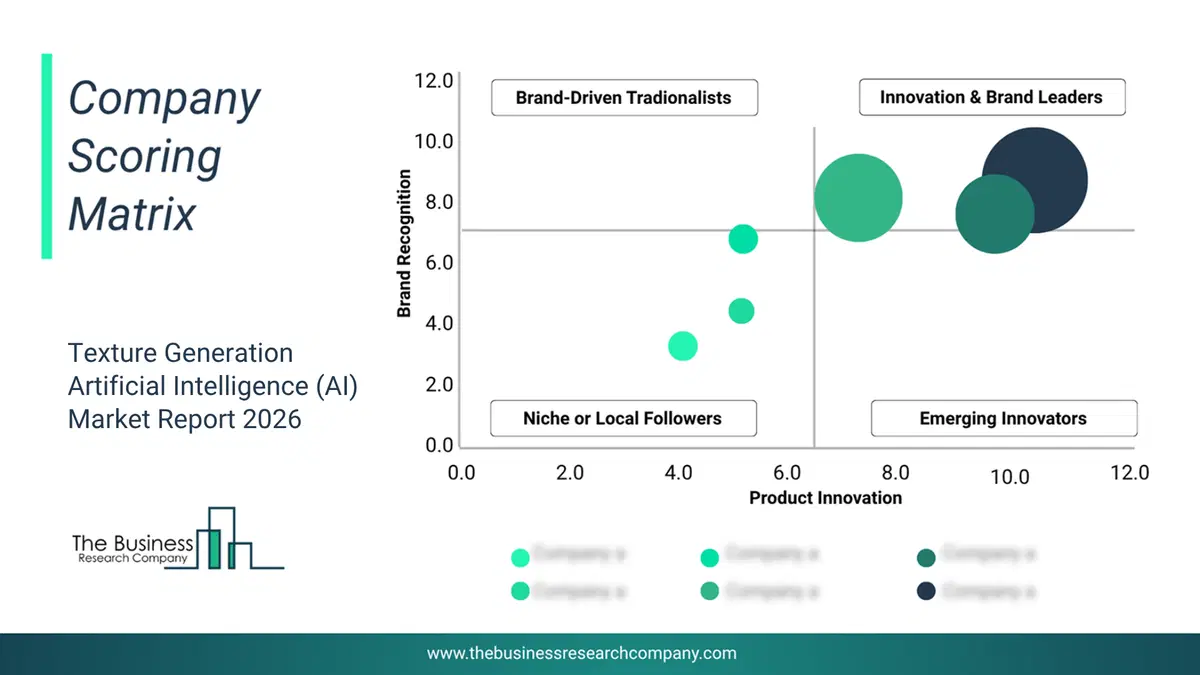
This chart maps companies by product innovation and brand strength, with bubble size indicating relative revenue, helping identify market leaders, challengers, and niche players. This is an illustrative chart; the full report provides a complete and accurate competitive analysis.
Global Texture Generation Artificial Intelligence (AI) Market Trends and Insights
Major companies operating in the texture generation AI market are focusing on developing advanced solutions, such as SaaS and plugin-based solutions, to transform base assets into fully textured materials without manual intervention. Software as a service (SaaS) and plugin-based solutions refer to software delivery models that provide functionality through cloud-hosted platforms or modular add-ons that integrate with existing systems. For instance, in May 2024, Toggle3D.ai, a Canada-based AI software company, launched its updated generative AI tool capable of converting CAD and 3D mesh files into fully textured 4K models ready for rendering. The platform supports distribution of 2K, 4K, and 8K renders directly from 3D models, reducing manual workload, improving visual fidelity, and accelerating time-to-market for design-oriented 3D assets. This launch represents a significant advancement by extending AI-driven texturing to a broader range of design applications, offering scalable, efficient, and high-quality solutions for studios and creators working with 3D content.What Are Latest Mergers And Acquisitions In The Texture Generation Artificial Intelligence (AI) Market?
In July 2024, Canva Pty Ltd., an Australia-based provider of online design and graphic-creation tools, acquired Leonardo Interactive Pty Ltd (Leonardo.AI) for an undisclosed amount. With this acquisition, Canva aims to accelerate its generative AI roadmap by integrating Leonardo.AI’s research, foundational models, and generative-image and video-creation capabilities, broadening its visual-AI toolset for millions of global users across marketing, design, e-commerce, and creative industries. Leonardo Interactive Pty Ltd (Leonardo.AI) is an Australia-based generative artificial intelligence (AI) startup providing tools for texture generation and image and video creation from prompts.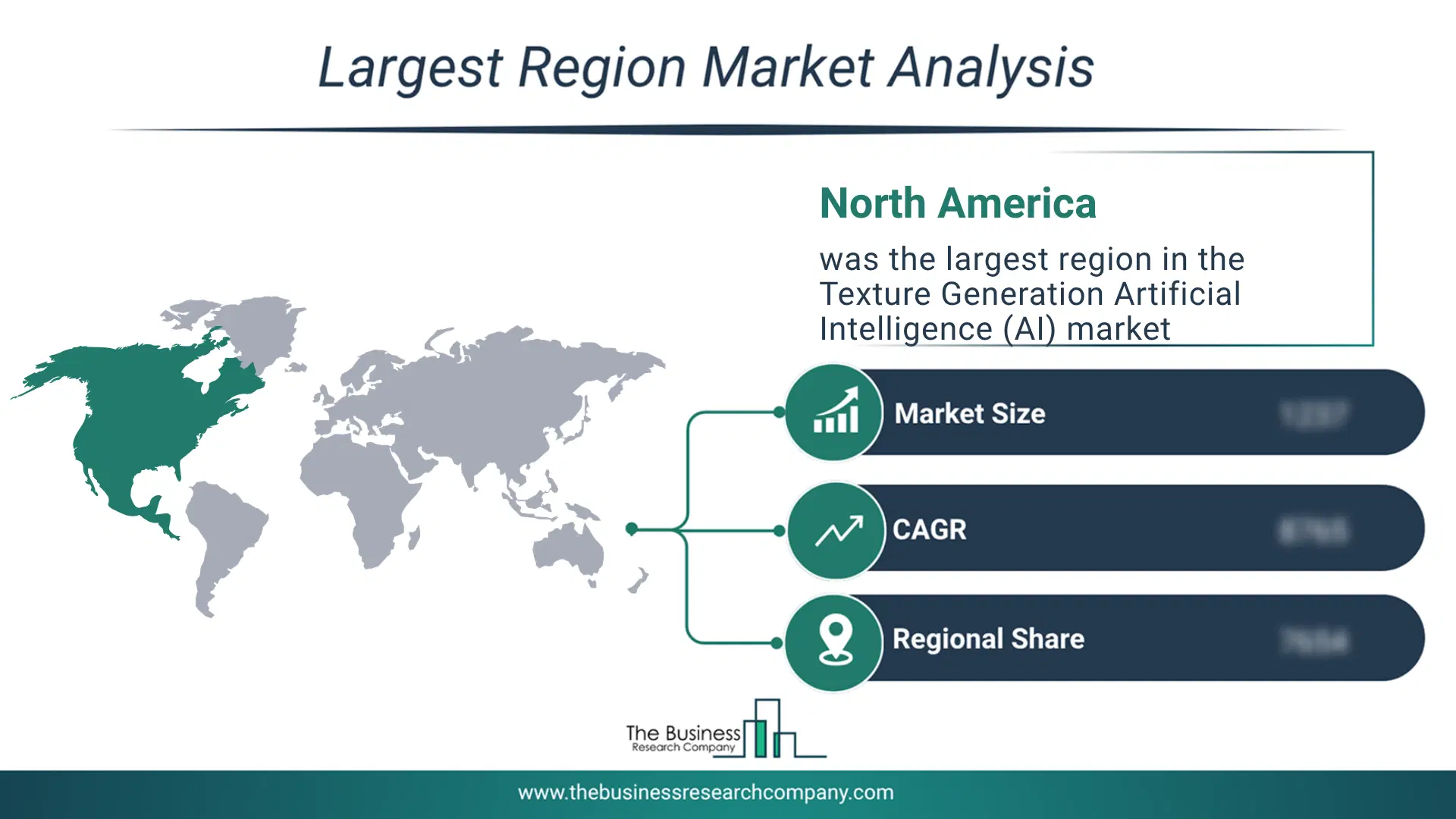
Regional Insights
North America was the largest region in the texture generation artificial intelligence (AI) market in 2025. Asia-Pacific is expected to be the fastest-growing region in the forecast period. The regions covered in this market report are Asia-Pacific, South East Asia, Western Europe, Eastern Europe, North America, South America, Middle East, Africa. The countries covered in this market report are Australia, Brazil, China, France, Germany, India, Indonesia, Japan, Taiwan, Russia, South Korea, UK, USA, Canada, Italy, Spain.What Defines the Texture Generation Artificial Intelligence (AI) Market?
The texture generation artificial intelligence (AI) market consists of revenues earned by entities by providing services such as texture optimization services, workflow automation support, technical support and maintenance, consulting and implementation services, and data preprocessing services. The market value includes the value of related goods sold by the service provider or included within the service offering. The texture generation artificial intelligence (AI) market also includes sales of texture capture devices, high-resolution scanning equipment, graphics workstations, rendering servers, calibration tools, and lighting rigs for texture capture. Values in this market are ‘factory gate’ values, that is, the value of goods sold by the manufacturers or creators of the goods, whether to other entities (including downstream software providers, distributors, and retailers) or directly to end customers. The value of goods in this market includes related services sold by the creators of the goods.How is Market Value Defined and Measured?
The market value is defined as the revenues that enterprises gain from the sale of goods and/or services within the specified market and geography through sales, grants, or donations in terms of the currency (in USD unless otherwise specified). The revenues for a specified geography are consumption values that are revenues generated by organizations in the specified geography within the market, irrespective of where they are produced. It does not include revenues from resales along the supply chain, either further along the supply chain or as part of other products.
This chart presents market attractiveness based on a quantitative evaluation of growth, competition, strategic alignment, and risk, offering a clear view of opportunity areas for decision-making. This chart is for illustrative purposes; the full report contains the complete analysis.

This chart highlights the Total Addressable Market (TAM) by estimating the maximum revenue opportunity using an assumption-driven approach, supporting strategic planning and opportunity sizing across markets. The chart is illustrative; the full report provides a more comprehensive analysis.
What Key Data and Analysis Are Included in the Texture Generation Artificial Intelligence (AI) Market Report 2026?
The texture generation artificial intelligence (ai) market research report is one of a series of new reports from The Business Research Company that provides market statistics, including industry global market size, regional shares, competitors with the market share, detailed market segments, market trends and opportunities, and any further data you may need to thrive in the texture generation artificial intelligence (ai) industry. The market research report delivers a complete perspective of everything you need, with an in-depth analysis of the current and future state of the industry.Texture Generation Artificial Intelligence (AI) Market Report Forecast Analysis
| Report Attribute | Details |
|---|---|
| Market Size Value In 2026 | $2.77 billion |
| Revenue Forecast In 2030 | $7.25 billion |
| Growth Rate | CAGR of 27.1% from 2026 to 2030 |
| Base Year For Estimation | 2025 |
| Actual Estimates/Historical Data | 2020-2025 |
| Forecast Period | 2026 - 2030 |
| Market Representation | Revenue in USD Billion and CAGR from 2026 to 2030 |
| Segments Covered | Component, Deployment Mode, Technology, Application, End-User |
| Regional Scope | Asia-Pacific, Western Europe, Eastern Europe, North America, South America, Middle East, Africa |
| Country Scope | The Countries Covered In This Market Report Are Australia, Brazil, China, France, Germany, India, Indonesia, Japan, Taiwan, Russia, South Korea, Uk, Usa, Canada, Italy, Spain. |
| Key Companies Profiled | Microsoft Corporation, Meta Platforms, International Business Machines Corporation, NVIDIA Corporation, Adobe Inc., OpenAI, Unity Technologies ApS, Lightricks Ltd., Stability AI Ltd., Luma AI, Quixel AB, Runway AI Inc., Leonardo AI Inc., Prisma Labs Inc., Masterpiece Studio, Kaedim Ltd., Nextech AR Solutions Inc., Capturing Reality, Polycam Inc., Promethean AI, DeepArt GmbH, Hyper3D |
| Customization Scope | Request for Customization |
| Pricing And Purchase Options | Explore Purchase Options |