
The Antiviral & Antimicrobial Coatings Market Report 2026
Global Outlook – By Type (Antimicrobial Coatings, Antiviral Coatings), By Material (Silver, Organic Materials, Copper), By Form (Liquid, Powder), By Application (Healthcare, Building And Construction, Packaging, Automotive, Protective Clothing) – Market Size, Trends, Strategies, and Forecast to 2030
The Antiviral & Antimicrobial Coatings Market Overview
• The Antiviral & Antimicrobial Coatings market size has reached to $5.37 billion in 2025 • Expected to grow to $9.58 billion in 2030 at a compound annual growth rate (CAGR) of 12.3% • Growth Driver: Surging Prevalence Of Infectious Diseases Fuels Growth In Antiviral And Antimicrobial Coatings Market • Market Trend: Advanced Antimicrobial Surface Technologies Enhancing Hygiene And Durability Across High-Touch Environments • North America was the largest region in 2025 and Asia-Pacific is the fastest growing region.What Is Covered Under The Antiviral & Antimicrobial Coatings Market?
Antiviral and antimicrobial coatings refer to the materials that can be applied to surfaces to prevent the spread of viruses and bacteria. Antiviral coatings are specifically designed to inactivate viruses, while antimicrobial coatings can target a broader range of microorganisms, including bacteria and fungi. The main antiviral and antimicrobial coatings types are antimicrobial coatings, and antiviral coatings. Antimicrobial coatings refer to the application of a chemical on a surface that can hinder the spread and growth of bacteria and viruses. The various materials are silver, organic materials, copper, aluminum, and silicon dioxide, that comes in different forms includes liquid, powder, and aerosol. The various applications are healthcare, building and construction, food and beverage, packaging, automotive, protective clothing, and air and water treatment.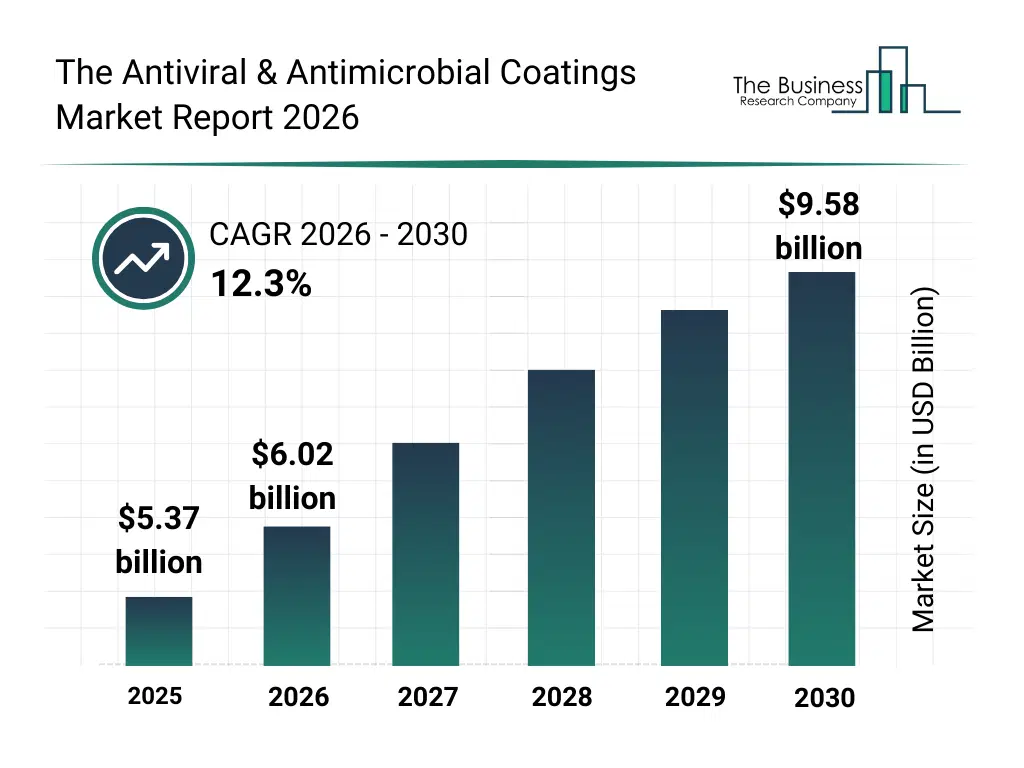
What Is The The Antiviral & Antimicrobial Coatings Market Size and Share 2026?
The the antiviral & antimicrobial coatings market size has grown rapidly in recent years. It will grow from $5.37 billion in 2025 to $6.02 billion in 2026 at a compound annual growth rate (CAGR) of 12.2%. The growth in the historic period can be attributed to expansion of healthcare infrastructure, rising awareness of hygiene standards, increasing use of antimicrobial materials in medical settings, growth of food safety regulations, adoption of protective surface technologies.What Is The The Antiviral & Antimicrobial Coatings Market Growth Forecast?
The the antiviral & antimicrobial coatings market size is expected to see rapid growth in the next few years. It will grow to $9.58 billion in 2030 at a compound annual growth rate (CAGR) of 12.3%. The growth in the forecast period can be attributed to increasing demand for preventive healthcare solutions, rising investments in antimicrobial R&D, expansion of smart building materials, growing use of coatings in public infrastructure, increasing regulatory focus on infection control. Major trends in the forecast period include increasing adoption of surface protection technologies, rising demand for infection-resistant materials, growing use of nano-enabled coatings, expansion of long-lasting antimicrobial formulations, enhanced focus on multi-surface applicability.
Global The Antiviral & Antimicrobial Coatings Market Segmentation
1) By Type: Antimicrobial Coatings, Antiviral Coatings 2) By Material: Silver, Organic Materials, Copper 3) By Form: Liquid, Powder 4) By Application: Healthcare, Building And Construction, Packaging, Automotive, Protective Clothing Subsegments: 1) By Antimicrobial Coatings: Silver-Based Coatings, Copper-Based Coatings, Zinc-based Coatings, Organic Coatings, Other Antimicrobial Coatings 2) By Antiviral Coatings: Coatings With Antiviral Agents, Nanoparticle-Based Coatings, Other Antiviral CoatingsWhat Are The Drivers Of The The Antiviral & Antimicrobial Coatings Market?
The rising prevalence of infectious diseases is expected to propel the growth of the antiviral and antimicrobial coatings market. Infectious diseases refer to illnesses caused by microorganisms or parasites that enter the body, multiply, and cause an infection. Some infectious diseases may be contagious or non-contagious. Antiviral and antimicrobial coatings have been developed to inhibit the spread of infectious diseases on contaminated surfaces. Peptides and nanomaterials have been used to create antimicrobial coatings with antiviral properties to curb infectious bacteria and viruses. For instance, in February 2024, according to the UK Health Security Agency, a UK-based government department, cases of tuberculosis (TB) in England increased by 10.7% in 2023, rising from 4,380 in 2022 to 4,850. Therefore, the rising prevalence of infectious diseases is driving the growth of the antiviral and antimicrobial coatings market going forward. The expansion of the food and beverage industry is expected to propel the growth of the antiviral and antimicrobial coatings market going forward. The food and beverage industry is a vast sector that comprises a diverse variety of enterprises participating in different phases of the food supply chain. Foodborne infections and contamination provide issues for the food and beverage business. Antimicrobial coatings are used to improve cleanliness and safety in food packaging materials and processing equipment. For instance, in April 2024, according to the National Association of Convenience Stores, a US-based trade association, reported that in 2023, foodservice sales, including prepared foods, commissary items, and dispensed beverages, accounted for 26.9% of in-store sales, up from 25.6% in 2022. Additionally, sales of prepared foods per store per month rose by 12.2% in 2023 compared to 2022. Therefore, the expansion of the food and beverage industry is driving the antiviral and antimicrobial coatings market.Key Players In The Global The Antiviral & Antimicrobial Coatings Market
Major companies operating in the the antiviral & antimicrobial coatings market are Axalta Coating Systems Ltd., PPG Industries, Inc., The Sherwin-Williams Company, Akzo Nobel N.V., Hempel A/S, Jotun A/S (Jotun Paints), Nippon Paint Holdings Co., Ltd., RPM International Inc., Lonza Group AG, Clariant AG, Covestro AG, BASF SE, Arkema S.A. (Arkema Group), Huntsman Corporation, TIGER Coatings GmbH & Co. KG, TIGER Drylac U.S.A., Inc., Microban International Ltd., Sanitized AG, Zochem Inc., Nanovere Technologies
This chart is for illustrative purposes; the full report includes a detailed competitor analysis and comprehensive overview of the top 10 companies in the market.
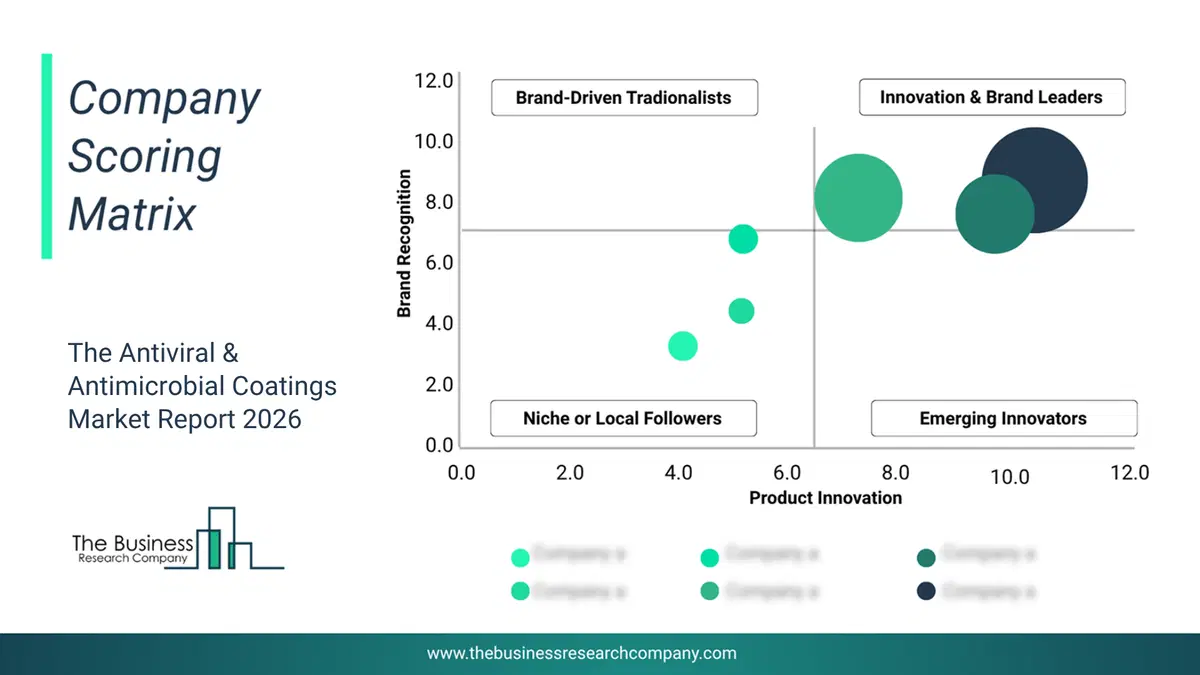
This chart maps companies by product innovation and brand strength, with bubble size indicating relative revenue, helping identify market leaders, challengers, and niche players. This is an illustrative chart; the full report provides a complete and accurate competitive analysis.
Global The Antiviral & Antimicrobial Coatings Market Trends and Insights
Major companies operating in the antiviral and antimicrobial coatings market are focusing on developing advanced, high-performance surface treatments with strong antimicrobial activity, enhanced durability, and easy-application features to meet growing hygiene demands across various industries. For instance, in June 2024, NEI Corporation, a US-based manufacturing company, introduced NANOMYTE AM-100EC, a thin antimicrobial, easy-to-clean coating designed for high-touch surfaces across industries such as healthcare, food service, education, and public transport. The coating bonds strongly to plastics, metals, and ceramics and offers high mechanical durability and abrasion resistance. ISO 22196 testing shows a 4-log (99.99%) reduction in E. coli within 24 hours, highlighting its strong antimicrobial performance. Its hydrophobic and oleophobic properties help repel water and oils, simplifying maintenance and improving long-term surface hygiene. Supplied as a one-part liquid, AM-100EC can be applied through multiple methods and is available in various quantities for different application needs.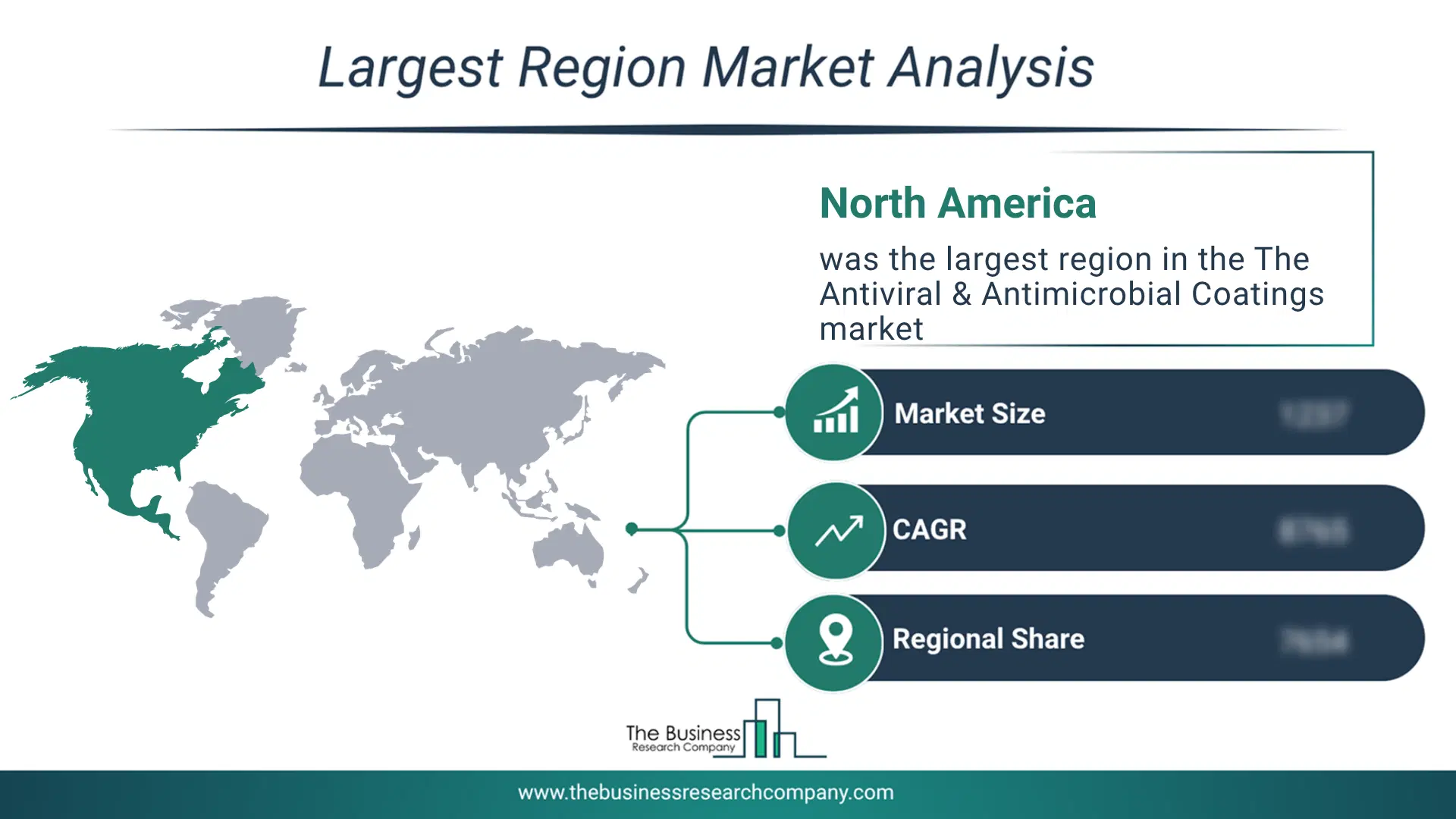
Regional Insights
North America was the largest region in the antiviral and antimicrobial coatings market in 2025.Asia-Pacific is expected to be the fastest-growing region in the global antiviral and antimicrobial coatings market report during the forecast period. The regions covered in this market report are Asia-Pacific, South East Asia, Western Europe, Eastern Europe, North America, South America, Middle East, Africa The countries covered in this market report are Australia, Brazil, China, France, Germany, India, Indonesia, Japan, Taiwan, Russia, South Korea, UK, USA, Canada, Italy, SpainWhat Defines the The Antiviral & Antimicrobial Coatings Market?
The antiviral and antimicrobial coatings market consists of sales of surface protectants, decorative paints and lacquers. Values in this market are ‘factory gate’ values, that is the value of goods sold by the manufacturers or creators of the goods, whether to other entities (including downstream manufacturers, wholesalers, distributors and retailers) or directly to end customers. The value of goods in this market includes related services sold by the creators of the goods.How is Market Value Defined and Measured?
The market value is defined as the revenues that enterprises gain from the sale of goods and/or services within the specified market and geography through sales, grants, or donations in terms of the currency (in USD unless otherwise specified). The revenues for a specified geography are consumption values that are revenues generated by organizations in the specified geography within the market, irrespective of where they are produced. It does not include revenues from resales along the supply chain, either further along the supply chain or as part of other products.
This chart presents market attractiveness based on a quantitative evaluation of growth, competition, strategic alignment, and risk, offering a clear view of opportunity areas for decision-making. This chart is for illustrative purposes; the full report contains the complete analysis.

This chart highlights the Total Addressable Market (TAM) by estimating the maximum revenue opportunity using an assumption-driven approach, supporting strategic planning and opportunity sizing across markets. The chart is illustrative; the full report provides a more comprehensive analysis.
What Key Data and Analysis Are Included in the The Antiviral & Antimicrobial Coatings Market Report 2026?
The the antiviral & antimicrobial coatings market research report is one of a series of new reports from The Business Research Company that provides market statistics, including industry global market size, regional shares, competitors with the market share, detailed market segments, market trends and opportunities, and any further data you may need to thrive in the the antiviral & antimicrobial coatings industry. The market research report delivers a complete perspective of everything you need, with an in-depth analysis of the current and future state of the industry.The Antiviral and Antimicrobial Coatings Market Report Forecast Analysis
| Report Attribute | Details |
|---|---|
| Market Size Value In 2026 | $6.02 billion |
| Revenue Forecast In 2030 | $9.58 billion |
| Growth Rate | CAGR of 12.2% from 2026 to 2030 |
| Base Year For Estimation | 2025 |
| Actual Estimates/Historical Data | 2020-2025 |
| Forecast Period | 2026 - 2030 |
| Market Representation | Revenue in USD Billion and CAGR from 2026 to 2030 |
| Segments Covered | Type, Material, Form, Application |
| Regional Scope | Asia-Pacific, Western Europe, Eastern Europe, North America, South America, Middle East, Africa |
| Country Scope | The countries covered in this market report are Australia, Brazil, China, France, Germany, India, Indonesia, Japan, Taiwan, Russia, South Korea, UK, USA, Canada, Italy, Spain |
| Key Companies Profiled | Axalta Coating Systems Ltd., PPG Industries, Inc., The Sherwin-Williams Company, Akzo Nobel N.V., Hempel A/S, Jotun A/S (Jotun Paints), Nippon Paint Holdings Co., Ltd., RPM International Inc., Lonza Group AG, Clariant AG, Covestro AG, BASF SE, Arkema S.A. (Arkema Group), Huntsman Corporation, TIGER Coatings GmbH & Co. KG, TIGER Drylac U.S.A., Inc., Microban International Ltd., Sanitized AG, Zochem Inc., Nanovere Technologies |
| Customization Scope | Request for Customization |
| Pricing And Purchase Options | Explore Purchase Options |