
Thermal Energy Storage Market Report 2026
Global Outlook – By Product Type (Sensible Heat Storage, Latent Heat Storage, Thermochemical Heat Storage), By Technology (Molten Salt Technology, Electric Thermal Storage Heaters, Solar Energy Storage, Ice-Based Technology, Miscibility Gap Alloy Technology), By Storage Material (Water, Molten Salt, Phase Change Material (PCM), Other Storage Materials), By Application (Power Generation, Heating, Cooling), By End User (Utilities, Commercial, Industrial) – Market Size, Trends, Strategies, and Forecast to 2030
Thermal Energy Storage Market Overview
• Thermal Energy Storage market size has reached to $6.5 billion in 2025 • Expected to grow to $11.97 billion in 2030 at a compound annual growth rate (CAGR) of 12.9% • Growth Driver: Increasing Demand For Renewable Energy Fueling The Growth Of The Market Due To Rising Energy Needs And Sustainability Goals • Market Trend: Advanced Technologies Boost Energy Retention And Sustainability • Europe was the largest region in 2025 and Asia-Pacific is the fastest growing region.What Is Covered Under Thermal Energy Storage Market?
Thermal energy storage (TES) is a technology that captures and stores heat or cold for later use, helping to balance energy demand and supply. It involves using materials or systems methods such as sensible heat storage, latent heat storage with phase change materials, or thermochemical storage to absorb excess thermal energy during periods of low demand and release it when needed. Thermal energy storage (TES) is critical in improving energy efficiency, integrating renewable energy sources, and reducing operational costs in applications ranging from building climate control and industrial processes to large-scale power generation. The main product types in thermal energy storage include sensible heat storage, latent heat storage, and thermochemical heat storage. Sensible heat storage is a method that stores and releases thermal energy by raising or lowering the temperature of a material without changing its phase. Technologies used in thermal energy storage include molten salt technology, electric thermal storage heaters, solar energy storage, ice-based technology, and miscibility gap alloy technology. Common storage materials are water, molten salt, phase change materials (PCMs), and other materials. Thermal energy storage is applied in power generation, heating, and cooling, and is utilized by various end users such as utilities, commercial, and industrial sectors.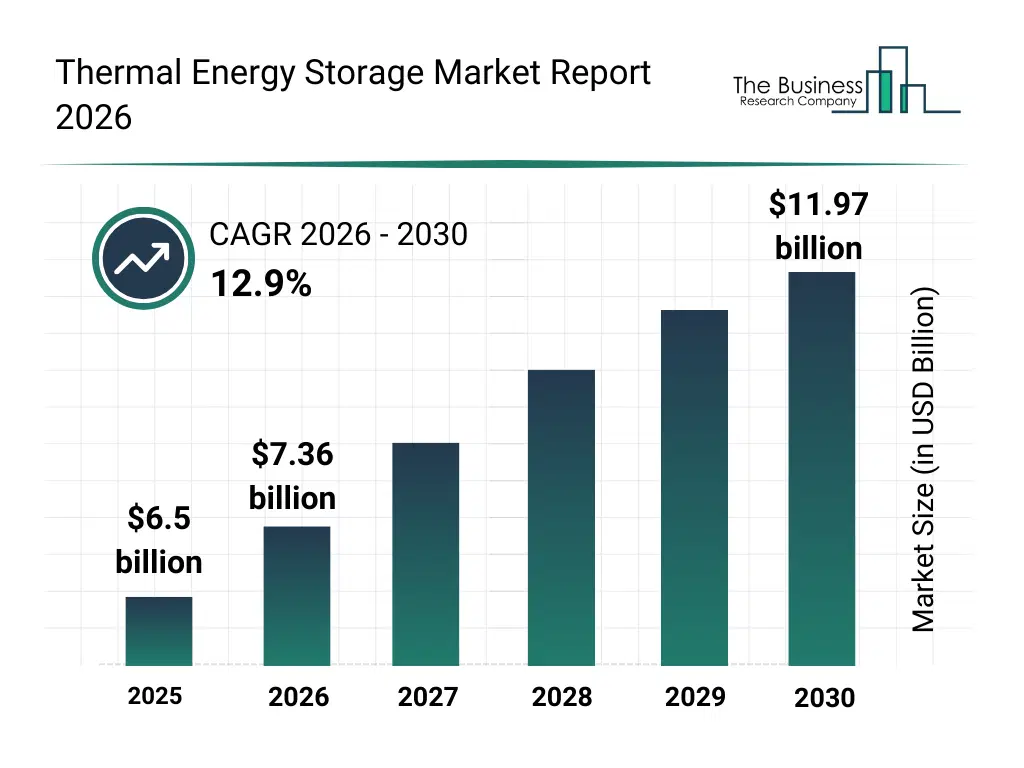
What Is The Thermal Energy Storage Market Size and Share 2026?
The thermal energy storage market size has grown rapidly in recent years. It will grow from $6.5 billion in 2025 to $7.36 billion in 2026 at a compound annual growth rate (CAGR) of 13.2%. The growth in the historic period can be attributed to increasing energy efficiency requirements, early adoption of district cooling systems, growth of concentrated solar power plants, rising industrial heat recovery initiatives, development of thermal storage materials.What Is The Thermal Energy Storage Market Growth Forecast?
The thermal energy storage market size is expected to see rapid growth in the next few years. It will grow to $11.97 billion in 2030 at a compound annual growth rate (CAGR) of 12.9%. The growth in the forecast period can be attributed to increasing integration of tes with renewable energy grids, rising investments in long-duration energy storage, growing demand for grid flexibility solutions, expansion of industrial decarbonization projects, advancements in thermal storage materials. Major trends in the forecast period include increasing deployment of molten salt storage systems, rising adoption of phase change materials, growing integration with renewable power plants, expansion of ice-based cooling storage, enhanced focus on high-temperature industrial storage.
Global Thermal Energy Storage Market Segmentation
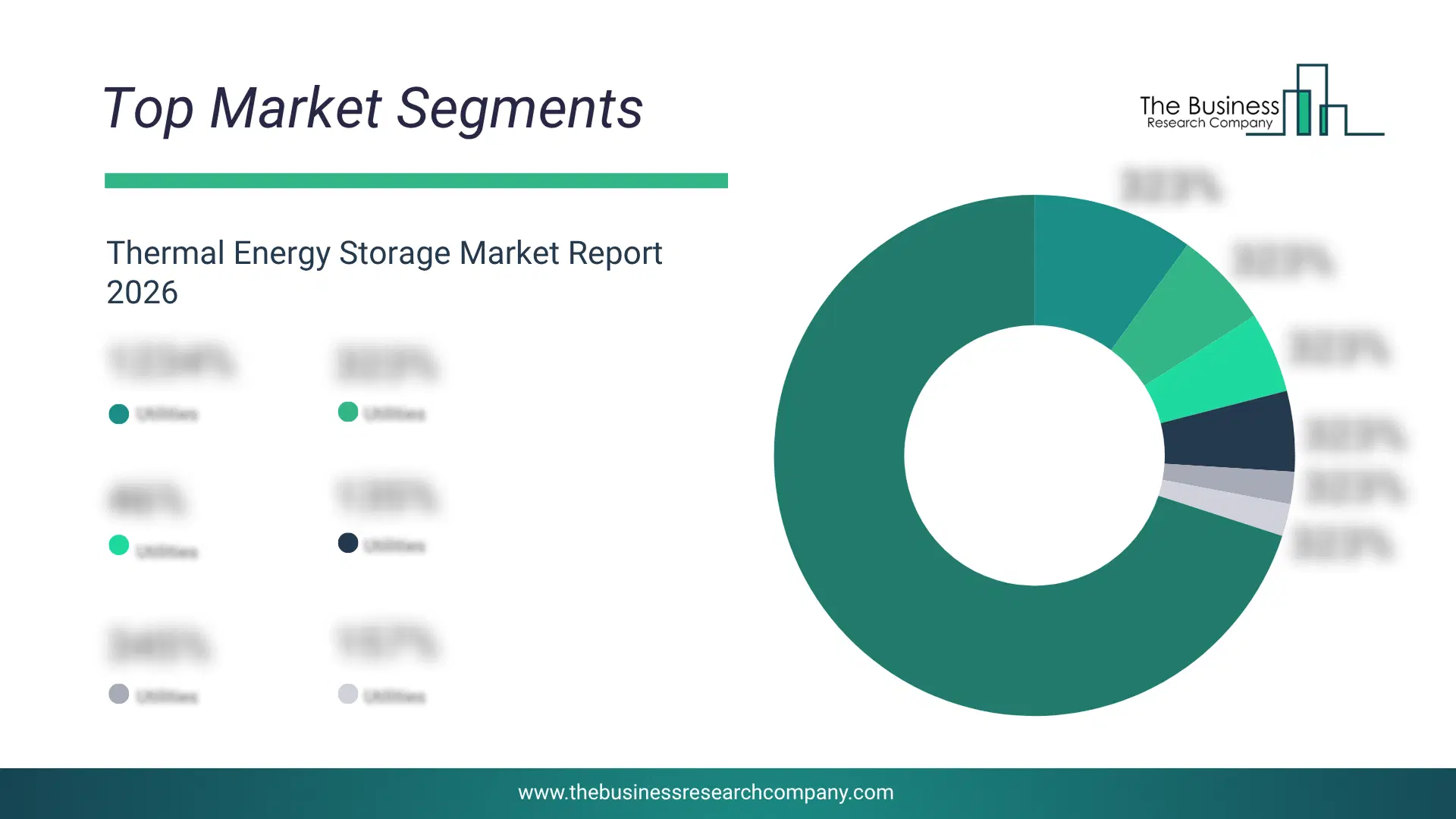
1) By Product Type: Sensible Heat Storage, Latent Heat Storage, Thermochemical Heat Storage 2) By Technology: Molten Salt Technology, Electric Thermal Storage Heaters, Solar Energy Storage, Ice-Based Technology, Miscibility Gap Alloy Technology 3) By Storage Material: Water, Molten Salt, Phase Change Material (PCM), Other Storage Materials 4) By Application: Power Generation, Heating, Cooling 5) By End User: Utilities, Commercial, Industrial Subsegments: 1) By Sensible Heat Storage: Water-Based Storage, Molten Salt Storage, Solid Media Storage 2) By Latent Heat Storage: Phase Change Materials (PCMs), Ice Storage, Molten Salt Phase Change 3) By Thermochemical Heat Storage: Sorption Heat Storage, Chemical Reaction Heat Storage, Reversible Thermochemical MaterialWhat Is The Driver Of The Thermal Energy Storage Market?
The increasing demand for renewable energy is expected to propel the growth of the thermal energy storage market going forward. Renewable energy is energy generated from natural sources that are constantly replenished, such as sunlight, wind, water, geothermal heat, and biomass, offering an eco-friendly alternative that reduces greenhouse gas emissions. The demand for renewable energy is primarily due to the growing need to reduce greenhouse gas emissions, which contribute significantly to climate change, prompting governments and industries to shift toward cleaner, more sustainable energy solutions. Thermal Energy Storage enhances the reliability and efficiency of renewable energy by storing excess heat generated during peak production periods for use when energy demand is high or supply is low. For instance, in December 2024, according to the Eurostat, a Luxembourg-based government agency, in 2023, renewable energy accounted for 24.5% of the energy consumed in the European Union, an increase from 23.0% in 2022. Therefore, the increasing demand for renewable energy is driving the growth of the thermal energy storage industry.Key Players In The Global Thermal Energy Storage Market
Major companies operating in the thermal energy storage market are Siemens Energy AG, Danfoss, Burns & McDonnell, Alfa Laval AB, MAN Energy Solutions SE, Dunham-Bush Limited, EVAPCO Inc., Baltimore Aircoil Company Inc., BrightSource Energy Inc., DN Tanks, Thermofin, Steffes, TEXEL Energy AB, Cox Energy Solar S.A., Malta Inc., Cryogel, Deepchill Solutions Inc., Terrafore Technologies LLC, Caldwell Energy Company, Brenmiller Energy Ltd.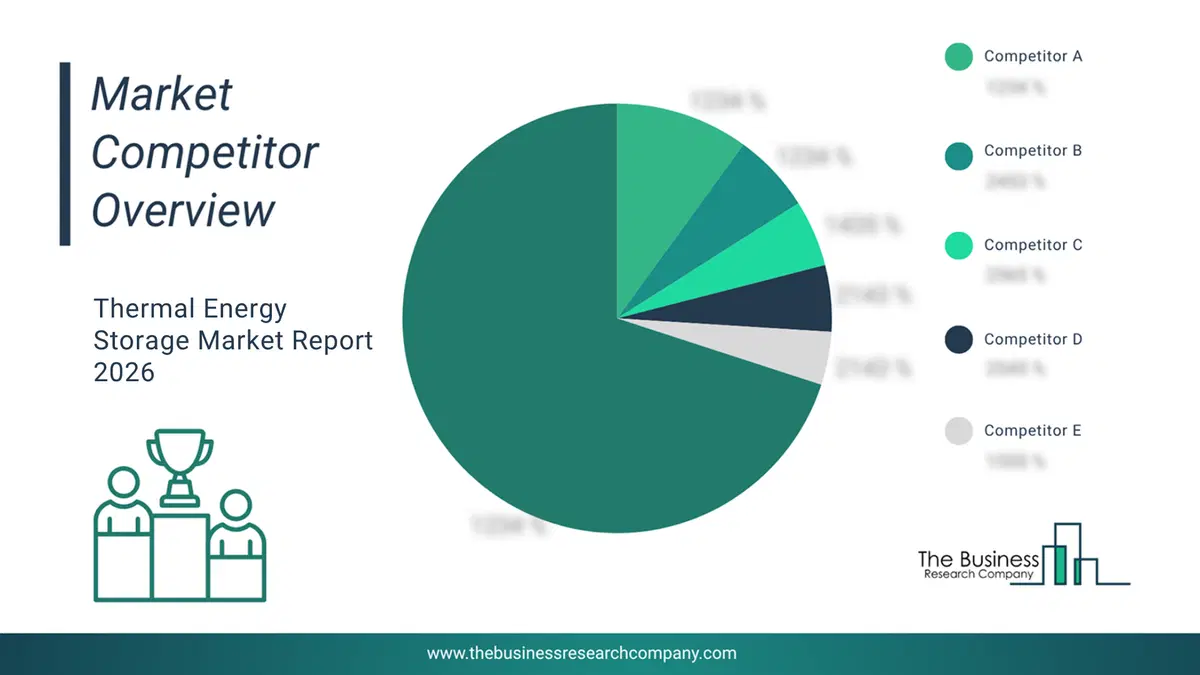
This chart is for illustrative purposes; the full report includes a detailed competitor analysis and comprehensive overview of the top 10 companies in the market.
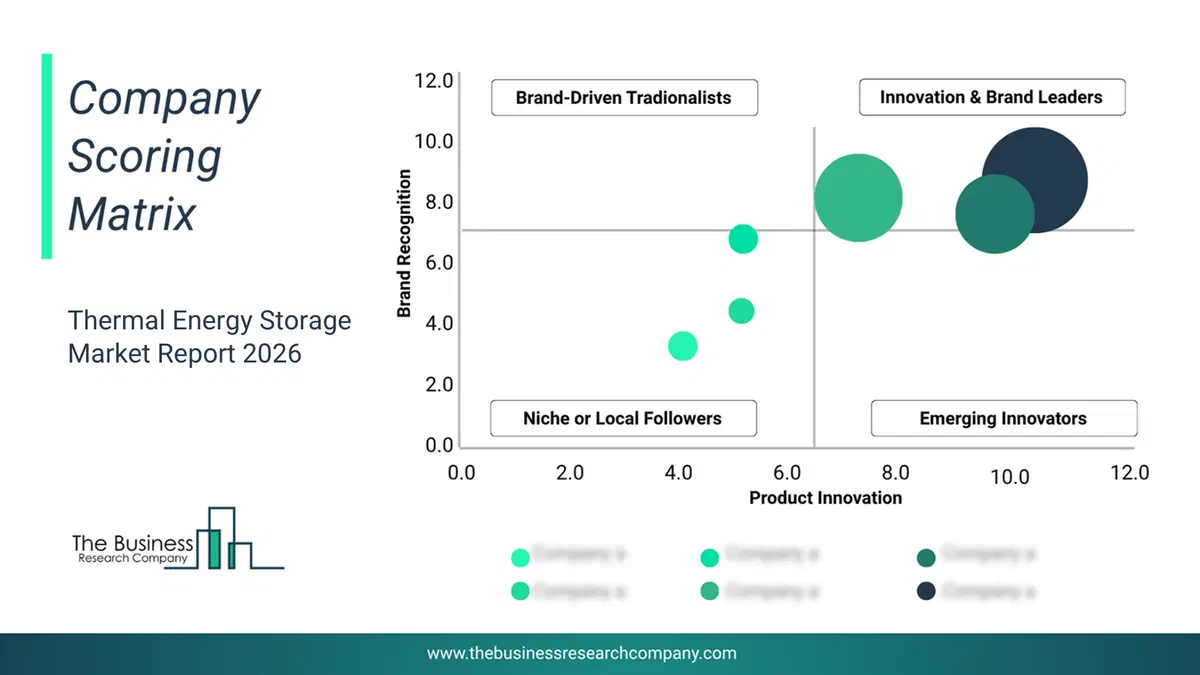
This chart maps companies by product innovation and brand strength, with bubble size indicating relative revenue, helping identify market leaders, challengers, and niche players. This is an illustrative chart; the full report provides a complete and accurate competitive analysis.
Global Thermal Energy Storage Market Trends and Insights
Major companies operating in the thermal energy storage market are focusing on developing innovative solutions, such as next-generation energy storage systems, to enhance energy efficiency, reduce carbon emissions, and support the integration of renewable energy sources into the power grid. Next-generation energy storage systems, including advanced technologies such as solid-state and flow batteries, help support thermal energy applications by efficiently storing excess heat and releasing it when needed, enhancing overall energy efficiency. For instance, in February 2025, Brenmiller Energy Ltd., an Israel-based thermal energy storage company, launched bGen zero thermal oil (ZTO), an advanced thermal energy storage (TES) solution designed to electrify thermal oil heating in industrial applications. It utilizes renewable electricity to charge and store thermal energy in crushed rocks and later transfers it to thermal oil, achieving up to 340°C with high efficiency, enabling a sustainable, zero-emission alternative for industrial heating applications.What Are Latest Mergers And Acquisitions In The Thermal Energy Storage Market?
In October 2024, TEXEL Energy AB, a Sweden-based thermal energy storage company, acquired the all-Stirling engine-related assets and thermal energy technologies from Azelio AB for an undisclosed amount. With this acquisition, TEXEL Energy AB enhances its thermal energy storage capabilities, integrating Stirling engine technology to advance renewable energy solutions. Azelio AB is a Sweden-based thermal energy storage company specializing in long-duration storage solutions, using stirling engine technology to convert stored thermal energy into electricity.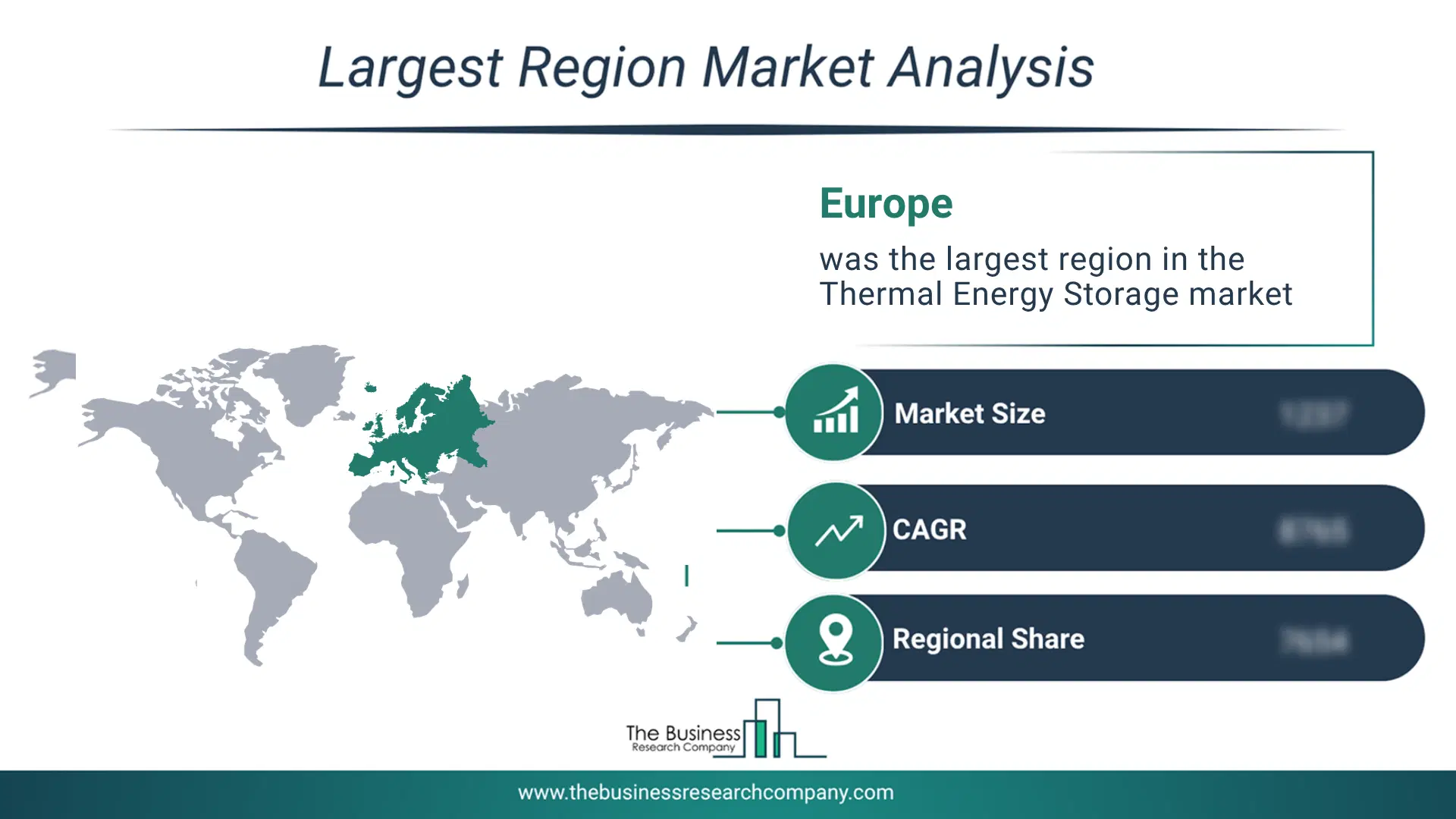
Regional Outlook
Europe was the largest region in the thermal energy storage market in 2025. Asia-Pacific is expected to be the fastest-growing region in the forecast period. The regions covered in this market report are Asia-Pacific, South East Asia, Western Europe, Eastern Europe, North America, South America, Middle East, Africa. The countries covered in this market report are Australia, Brazil, China, France, Germany, India, Indonesia, Japan, Taiwan, Russia, South Korea, UK, USA, Canada, Italy, SpainWhat Defines the Thermal Energy Storage Market?
The thermal energy storage market consists of revenues earned by entities by providing services such as energy load management, renewable energy integration, peak demand reduction and backup thermal energy supply for industrial, commercial and residential applications. The market value includes the value of related goods sold by the service provider or included within the service offering. The thermal energy storage market also includes sales of thermal batteries, molten salt thermal storage, ice-based thermal storage systems, thermochemical storage systems, sensible heat storage systems, and latent heat storage systems. Values in this market are ‘factory gate’ values, that is the value of goods sold by the manufacturers or creators of the goods, whether to other entities (including downstream manufacturers, wholesalers, distributors and retailers) or directly to end customers. The value of goods in this market includes related services sold by the creators of the goods.How is Market Value Defined and Measured?
The market value is defined as the revenues that enterprises gain from the sale of goods and/or services within the specified market and geography through sales, grants, or donations in terms of the currency (in USD unless otherwise specified). The revenues for a specified geography are consumption values that are revenues generated by organizations in the specified geography within the market, irrespective of where they are produced. It does not include revenues from resales along the supply chain, either further along the supply chain or as part of other products.
This chart presents market attractiveness based on a quantitative evaluation of growth, competition, strategic alignment, and risk, offering a clear view of opportunity areas for decision-making. This chart is for illustrative purposes; the full report contains the complete analysis.

This chart highlights the Total Addressable Market (TAM) by estimating the maximum revenue opportunity using an assumption-driven approach, supporting strategic planning and opportunity sizing across markets. The chart is illustrative; the full report provides a more comprehensive analysis.
What Key Data and Analysis Are Included in the Thermal Energy Storage Market Report 2026?
The thermal energy storage market research report is one of a series of new reports from The Business Research Company that provides market statistics, including Market Report 2026?global market size, regional shares, competitors with the market share, detailed market segments, market trends and opportunities, and any further data you may need to thrive in the thermal energy storage Market Report 2026? The market research report delivers a complete perspective of everything you need, with an in-depth analysis of the current and future state of the Market Report 2026?Thermal Energy Storage Market Report Forecast Analysis
| Report Attribute | Details |
|---|---|
| Market Size Value In 2026 | $7.36 billion |
| Revenue Forecast In 2030 | $11.97 billion |
| Growth Rate | CAGR of 13.2% from 2026 to 2030 |
| Base Year For Estimation | 2025 |
| Actual Estimates/Historical Data | 2020-2025 |
| Forecast Period | 2026 - 2030 - 2030 |
| Market Representation | Revenue in USD Billion and CAGR from 2026 to 2030 |
| Segments Covered | Product Type, Technology, Storage Material, Application, End User |
| Regional Scope | Asia-Pacific, Western Europe, Eastern Europe, North America, South America, Middle East, Africa |
| Country Scope | The countries covered in the report are Australia, Brazil, China, France, Germany, India, Indonesia, Japan, Taiwan, Russia, South Korea, UK, USA, Canada, Italy, Spain. |
| Key Companies Profiled | Siemens Energy AG, Danfoss, Burns & McDonnell, Alfa Laval AB, MAN Energy Solutions SE, Dunham-Bush Limited, EVAPCO Inc., Baltimore Aircoil Company Inc., BrightSource Energy Inc., DN Tanks, Thermofin, Steffes, TEXEL Energy AB, Cox Energy Solar S.A., Malta Inc., Cryogel, Deepchill Solutions Inc., Terrafore Technologies LLC, Caldwell Energy Company, Brenmiller Energy Ltd. |
| Customization Scope | Request for Customization |
| Pricing And Purchase Options | Explore Purchase Options |