
Thermal Insulation Material Market Report 2026
Global Outlook – By Product (Roof Insulation, Wall Insulation, Floor Insulation), By Building Type (Residential Building, Non-Residential Building), By Application (Stone Wool, Glass Wool, Plastic Foam, Other Applications), By End Use (Furniture, Automotive, Electronics, Medical, Retail, Appliances, Consumer Goods, Other End Users) – Market Size, Trends, Strategies, and Forecast to 2035
Thermal Insulation Material Market Overview
• Thermal Insulation Material market size has reached to $65.11 billion in 2025 • Expected to grow to $79.57 billion in 2030 at a compound annual growth rate (CAGR) of 4.1% • Growth Driver: Rising Building And Construction Driving Growth Of The Thermal Insulation Material Market • Market Trend: Increasing Focus On Introducing Innovative Solution In The Thermal Insulation Material Market • Asia-Pacific was the largest region and fastest growing region.Market Gains By 2030 – Top Opportunities By Segment
Market Gain identifies the most promising market opportunities by highlighting the segments or products expected to generate the highest incremental revenue growth over the next five years.
What Is Covered Under Thermal Insulation Material Market?
Thermal insulation material refers to substances or products designed to reduce the transmission of heat between objects or areas with different temperatures. Insulation is installed in walls, roofs, floors, and other structural elements to reduce heat transfer, minimize heat loss in winter, and prevent heat gain in summer. The main products of thermal insulation material market covered are roof insulation, wall insulation, and floor insulation. Thermal insulation materials are used in roof insulation to minimize heat transfer through the roof structure. There are two types of buildings such as residential buildings and non-residential buildings. The applications involved are stone wool, glass wool, plastic foam, and other applications that are used by various end-user industries, including furniture, automotive, electronics, medical, retail, appliances, consumer goods, and other end users.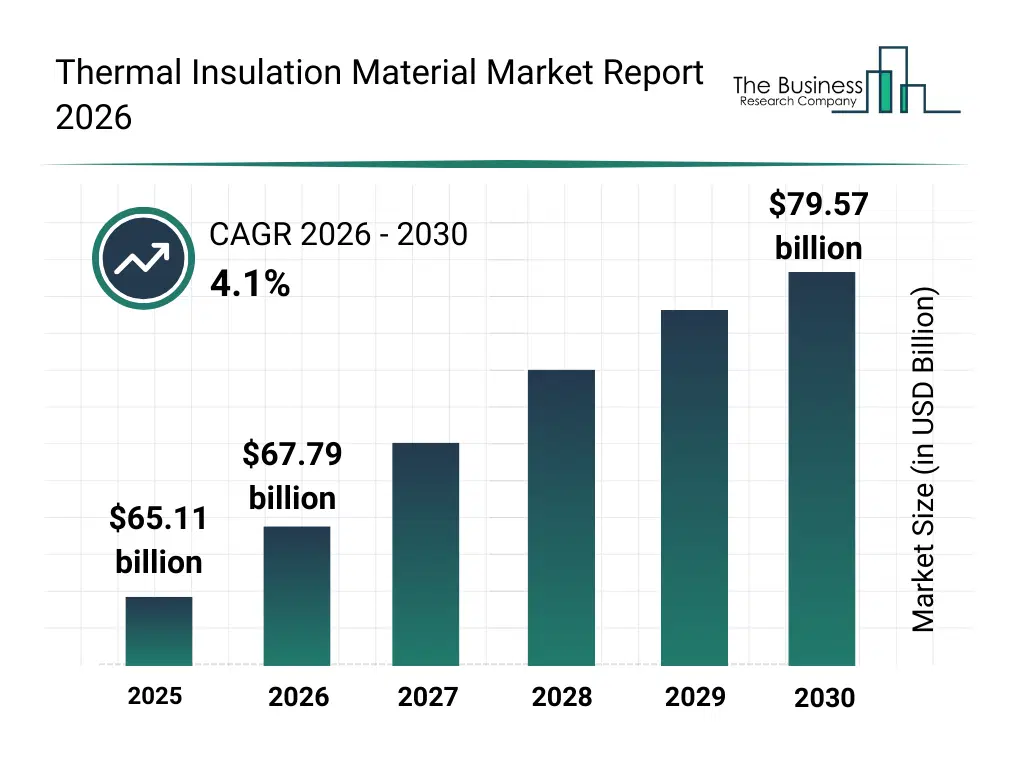
What Is The Thermal Insulation Material Market Size and Share 2026?
The thermal insulation material market size has grown steadily in recent years. It will grow from $65.11 billion in 2025 to $67.79 billion in 2026 at a compound annual growth rate (CAGR) of 4.1%. The growth in the historic period can be attributed to growing construction of energy-efficient buildings, expansion of industrial manufacturing sectors, rise in appliance and automotive production, increased adoption of standard insulation codes, historical demand for low-cost insulation products.What Is The Thermal Insulation Material Market Growth Forecast?
The thermal insulation material market size is expected to see steady growth in the next few years. It will grow to $79.57 billion in 2030 at a compound annual growth rate (CAGR) of 4.1%. The growth in the forecast period can be attributed to increasing demand for sustainable insulation systems, stronger regulatory push for energy efficiency, rising use of smart monitoring in insulation performance, expansion of high-performance foam technologies, growth in urban infrastructure development. Major trends in the forecast period include growing use of high-performance insulation materials, expansion of smart energy-efficient buildings, increased adoption of automated installation equipment, rising use of recyclable and green insulation solutions, growth in precision manufacturing and quality monitoring.
Global Thermal Insulation Material Market Segmentation
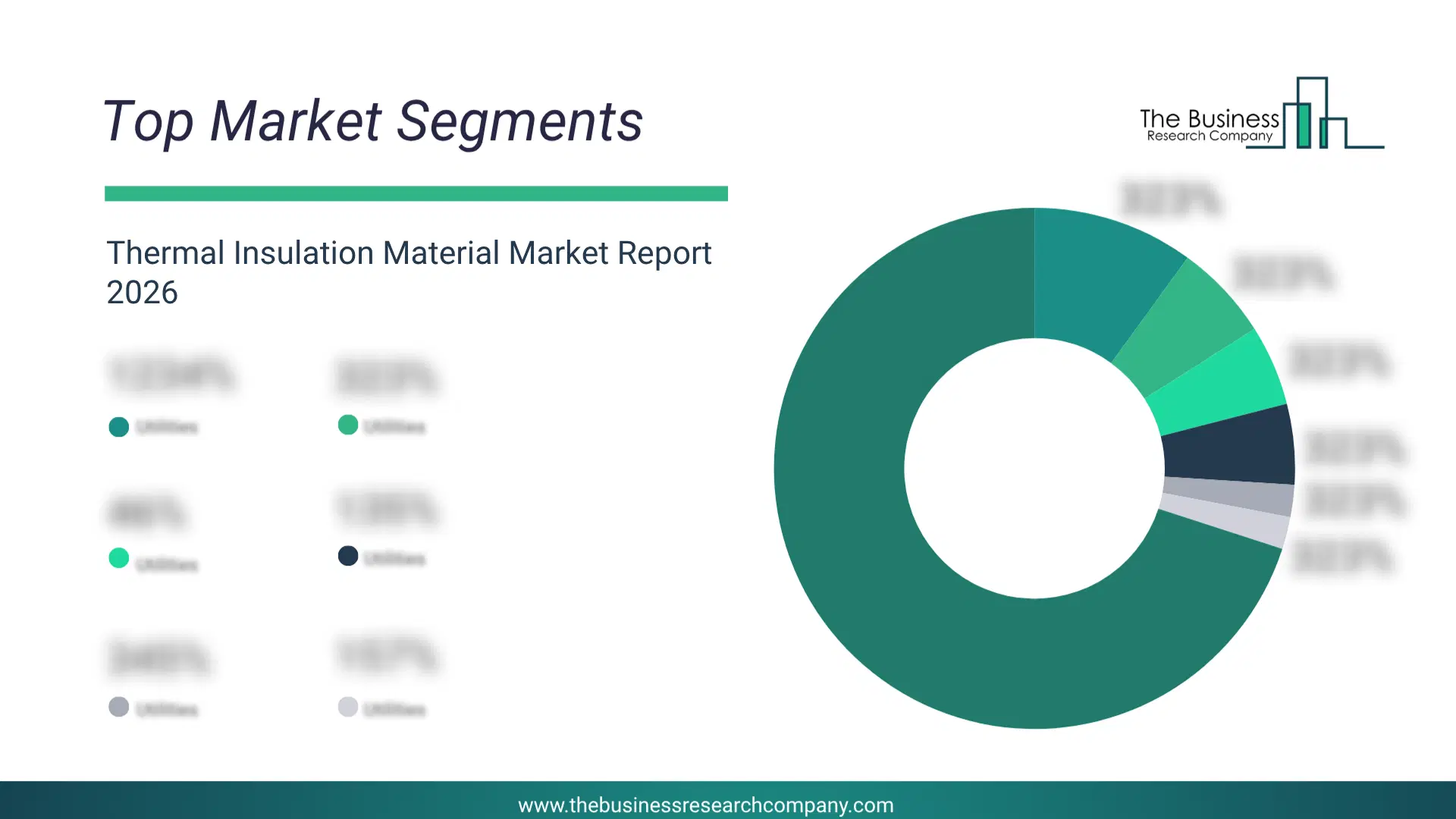
1) By Product: Roof Insulation, Wall Insulation, Floor Insulation 2) By Building Type: Residential Building, Non-Residential Building 3) By Application: Stone Wool, Glass Wool, Plastic Foam, Other Applications 4) By End Use: Furniture, Automotive, Electronics, Medical, Retail, Appliances, Consumer Goods, Other End Users Subsegments: 1) By Roof Insulation: Rigid Foam Insulation, Spray Foam Insulation, Batt And Blanket Insulation, Reflective Or Radiant Barrier Insulation 2) By Wall Insulation: Rigid Board Insulation, Spray Foam Insulation, Batt And Blanket Insulation, Insulated Concrete Forms (ICFs) 3) By Floor Insulation: Rigid Foam Insulation, Batt And Blanket Insulation, Underfloor Heating Systems, Loose-Fill Insulation The top segments in the thermal insulation material market will be: • Residential Building will reach $16947 Million by 2025. • Non-Residential Building will reach $15664.9 Million by 2025. • Roof Insulation will reach $12600.5 Million by 2025. • Wall Insulation will reach $12545.2 Million by 2025. • Plastic Foam will reach $12425.5 Million by 2025.What Is The Driver Of The Thermal Insulation Material Market?
The rising building and construction industry is expected to fuel the growth of the thermal insulation material market going forward. The building and construction industry encompasses a wide range of activities related to the design, development, and erection of structures such as residential buildings, commercial buildings, infrastructure projects, and industrial facilities. The building and construction industries use thermal insulation materials to enhance the energy efficiency, comfort, and sustainability of buildings. For instance, in January 2024, according to the United States Census Bureau, a US-based government agency, an estimated 1,452,500 housing units were completed, representing a 4.5% increase in 2023 compared to the preceding year's number of 1,390,500. Therefore, the rising building and construction industry is driving the thermal insulation material industry.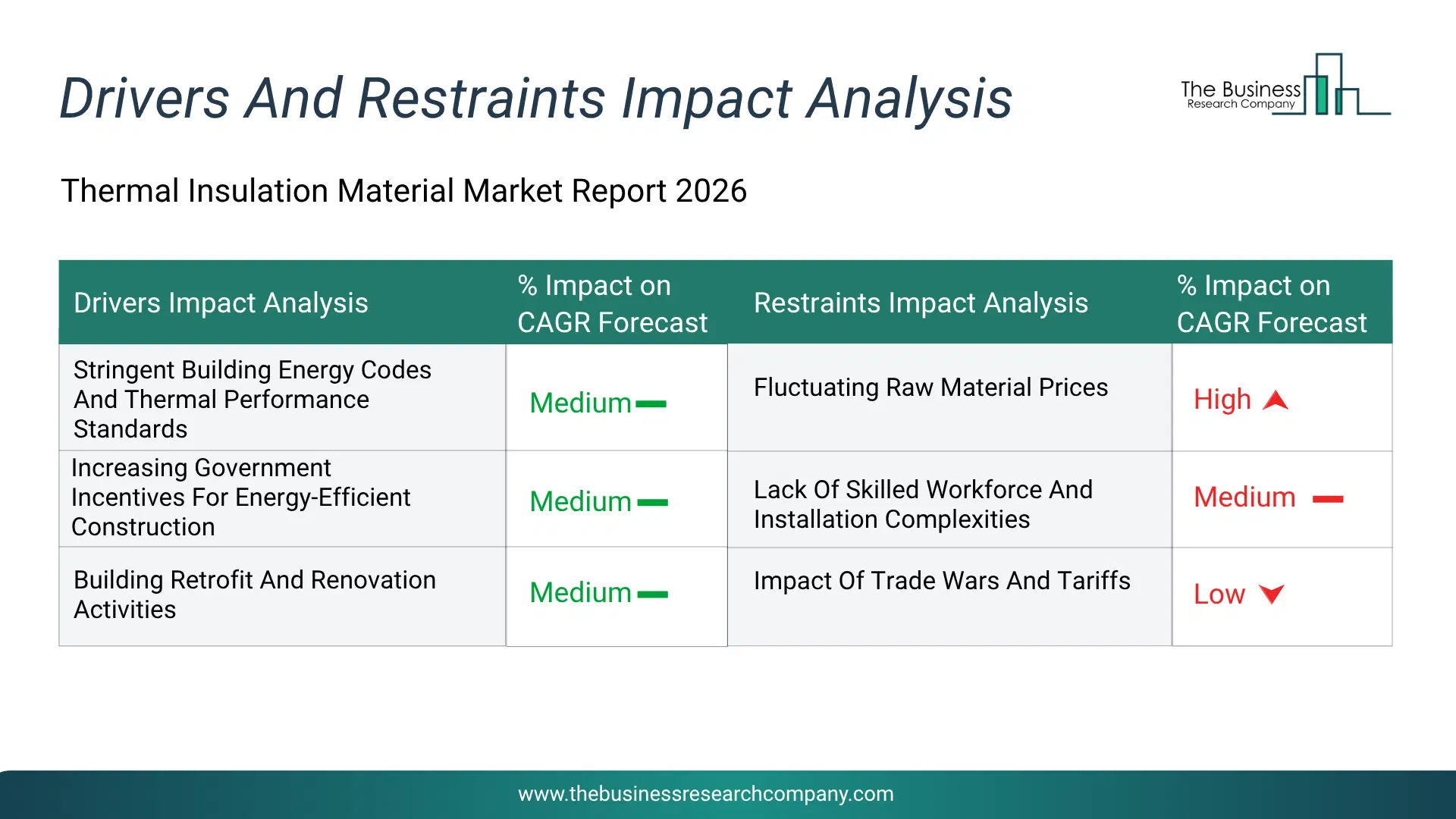
Infographic Chart Showing Key Market Drivers Analysis And Restraints For Thermal Insulation Material Market
The chart presents an impact analysis of key drivers and restraints, quantifying their relative influence on the market's growth rate and helping assess the balance between growth enablers and limiting factors. This chart offers a high-level perspective; the full report contains more detailed insights.
How Will The Drivers Impact Growth In The Global Thermal Insulation Material Market?
• Stringent Building Energy Codes And Thermal Performance Standards (Medium) – The stringent building energy codes and thermal performance standards are expected to propel the growth of the thermal insulation material market. Regulatory authorities are increasingly implementing stricter energy-efficiency standards for residential, commercial, and industrial buildings to reduce greenhouse-gas emissions and improve long-term energy conservation. Therefore, the stringent building energy codes and thermal performance standards will drive the growth of the thermal insulation material market. As a result, stringent building energy codes and thermal performance standards is anticipated to contributing to a 1.5% annual growth in the market. • Increasing Government Incentives For Energy-Efficient Construction (Medium) – The increasing government incentives for energy-efficient construction are expected to propel the growth of the thermal insulation material market in the forecast period. Governments across developed and developing economies are expanding financial incentives, tax credits, green-building programs, and sustainability initiatives to encourage the adoption of energy-efficient construction materials. Therefore, the increasing government incentives for energy-efficient construction will drive the growth of the thermal insulation material market. Consequently, the increasing government incentives for energy-efficient construction is projected to contributing to a 1.3% annual growth in the market. • Building Retrofit And Renovation Activities (Medium) – The building retrofit and renovation activities are expected to propel the growth of the thermal insulation material market. Aging building infrastructure, rising energy costs, and increasing sustainability targets are encouraging property owners and governments to modernize existing residential and non-residential buildings with energy-efficient insulation systems. Therefore, the building retrofit and renovation activities will drive the growth of the thermal insulation material market. Therefore, building retrofit and renovation activities is projected to contributing to a 1.0% annual growth in the market. • Expansion Of Semiconductor And Electronics Manufacturing Facilities (Low) – The expansion of semiconductor and electronics manufacturing facilities is expected to propel the growth of the thermal insulation material market in the forecast period. Increasing investments in semiconductor fabrication plants, electronics assembly units, and advanced manufacturing facilities are generating higher demand for energy-efficient building infrastructure with stable temperature-control environments. Therefore, the expansion of semiconductor and electronics manufacturing facilities will drive the growth of the thermal insulation material market. Consequently, the expansion of semiconductor and electronics manufacturing facilities is projected to contributing to a 0.8% annual growth in the market.How Will The Restraints Impact Growth In The Global Thermal Insulation Material Market?
• Fluctuating Raw Material Prices (Medium) – Fluctuating raw material prices is expected to restrain market growth during the forecast period. It creates operational, financial, regulatory, or commercial challenges that can increase costs, delay projects, reduce investments, or discourage purchasing decisions depending on the market. These challenges can reduce product adoption, affect business confidence, and limit the ability of companies to expand efficiently across key regions. This can reduce operational efficiency, delay expansion plans, and affect the ability of companies to achieve sustainable business growth. • Lack Of Skilled Workforce And Installation Complexities (Medium) – During the forecast period, lack of skilled workforce and installation complexities is likely to limit market expansion. It creates operational, financial, regulatory, or commercial challenges that can increase costs, delay projects, reduce investments, or discourage purchasing decisions depending on the market. These challenges can reduce product adoption, affect business confidence, and limit the ability of companies to expand efficiently across key regions. As a result, businesses may face increased cost pressures, slower commercial adoption, and reduced revenue opportunities. • Impact Of Trade Wars And Tariffs (Medium) – The market is expected to face challenges due to impact of trade wars and tariffs over the forecast period. It creates operational, financial, regulatory, or commercial challenges that can increase costs, delay projects, reduce investments, or discourage purchasing decisions depending on the market. These challenges can reduce product adoption, affect business confidence, and limit the ability of companies to expand efficiently across key regions. This may discourage new investments, delay strategic expansion initiatives, and weaken the overall competitive position of market participants.Key Players In The Global Thermal Insulation Material Market
Major companies operating in the thermal insulation material market are BASF SE, Compagnie de Saint-Gobain S.A., Dow Chemicals Company, Bayer AG, Asahi Kasei Corporation, DuPont de Nemours Inc., Owens Corning, Kingspan Group PLC, Huntsman International LLC, Rockwool International A/S, Fletcher Building Products Ltd., Guardian Building Products Inc., GAF Materials Corporation, Armacell International, Paroc Group, Johns Manville Corporation, Byucksan Corporation, Jushi Group Corporation, Aspen Aerogels Inc., Atlas Roofing Corporation, Cellofoam North America Inc., Isocell GmbH, CertainTeed Corporation, Roxul Inc., ARK Thermal Insulation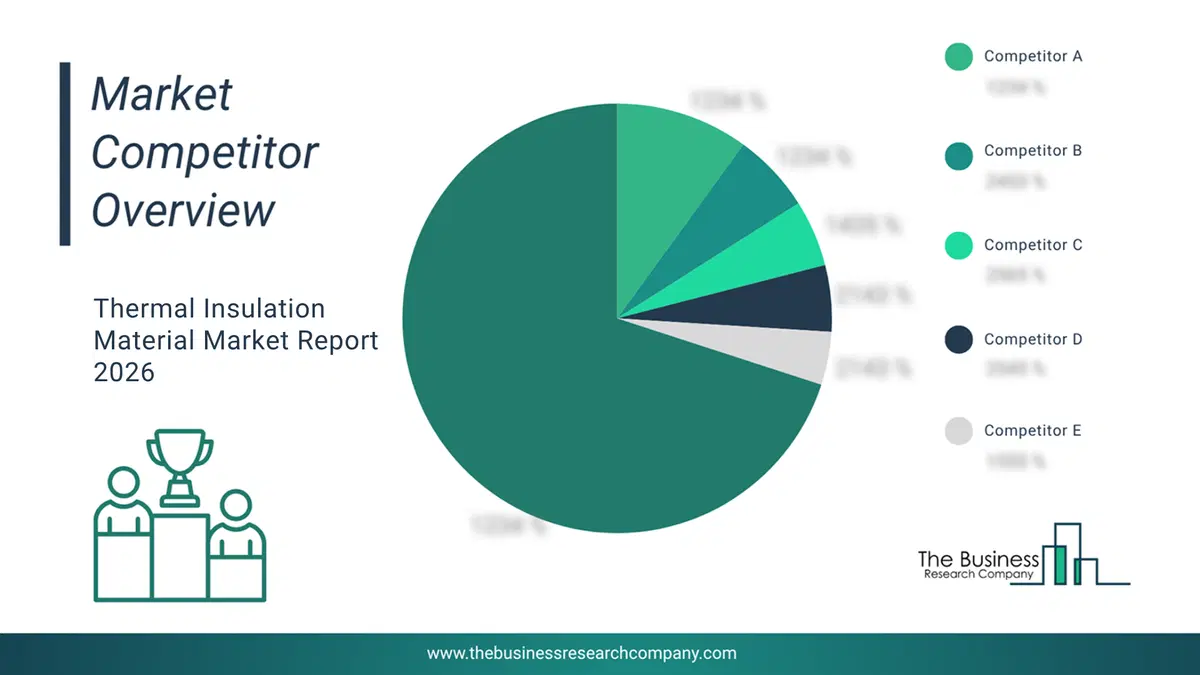
This chart is for illustrative purposes; the full report includes a detailed competitor analysis and comprehensive overview of the top 10 companies in the market.
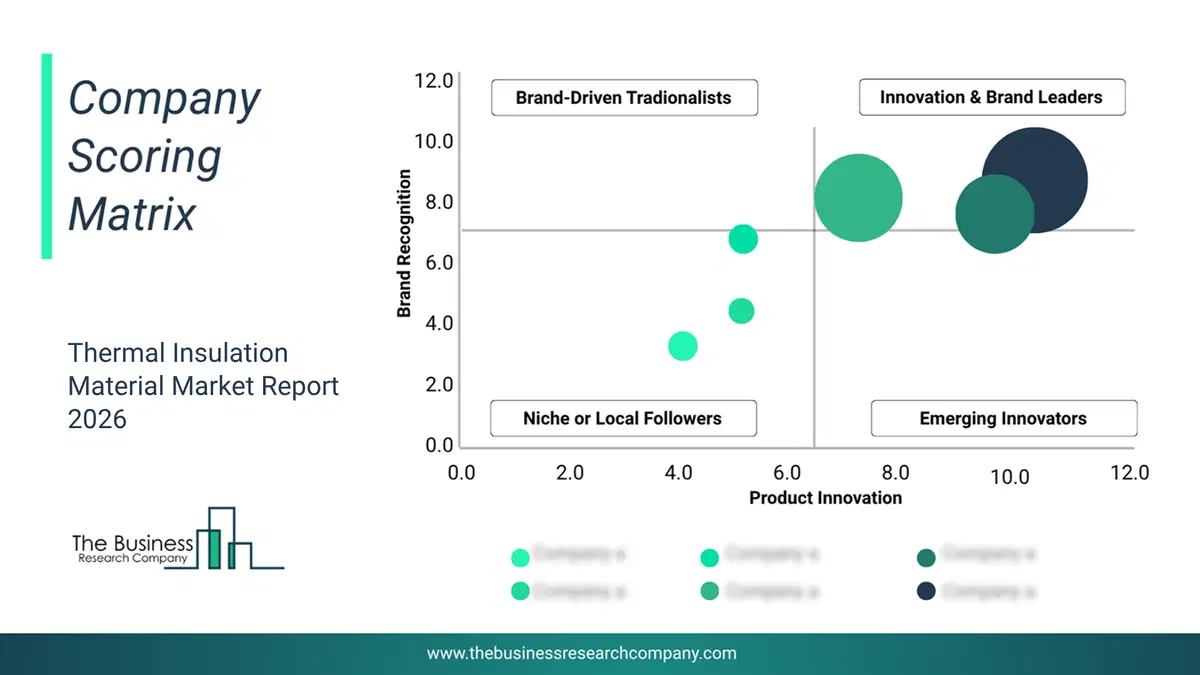
This chart maps companies by product innovation and brand strength, with bubble size indicating relative revenue, helping identify market leaders, challengers, and niche players. This is an illustrative chart; the full report provides a complete and accurate competitive analysis.
Global Thermal Insulation Material Market Trends and Insights
Major companies operating in the thermal insulation material market are focused on developing innovative products with advanced technologies, such as light mineral wool, to increase their profitability in the market. Light mineral wool is a versatile and effective thermal insulation material that contributes to energy efficiency, comfort, and sustainability in buildings. For instance, in May 2023, Isover, part of the Saint-Gobain Group, a France-based manufacturer of thermal and acoustic insulation solutions, launched QTech. QTech is a light mineral wool insulation solution for medium-temperature applications. It offers excellent thermal insulation, shot-free construction for superior heat resistance, and easy handling during installation. Non-combustible and chemically inert, QTech ensures safety and environmental sustainability in industrial, HVAC (Heating, Ventilation, and Air Conditioning), and OEM (Original Equipment Manufacturer) settings.What Are Latest Mergers And Acquisitions In The Thermal Insulation Material Market?
In June 2023, Etex Group, a Belgium-based gypsum product manufacturing company acquired Superglass Insulation Limited for an undisclosed amount. The acquisition was made to expand Etex's sustainable insulation footprint in Europe beyond its current holdings in glass mineral wool and extruded polystyrene producer URSA. With this agreement, Etex strengthens its already robust operations in the UK and adds to its Insulation division's wide-ranging European sales and production network. Superglass Insulation Limited is a UK-based company that manufactures glass mineral wool insulation products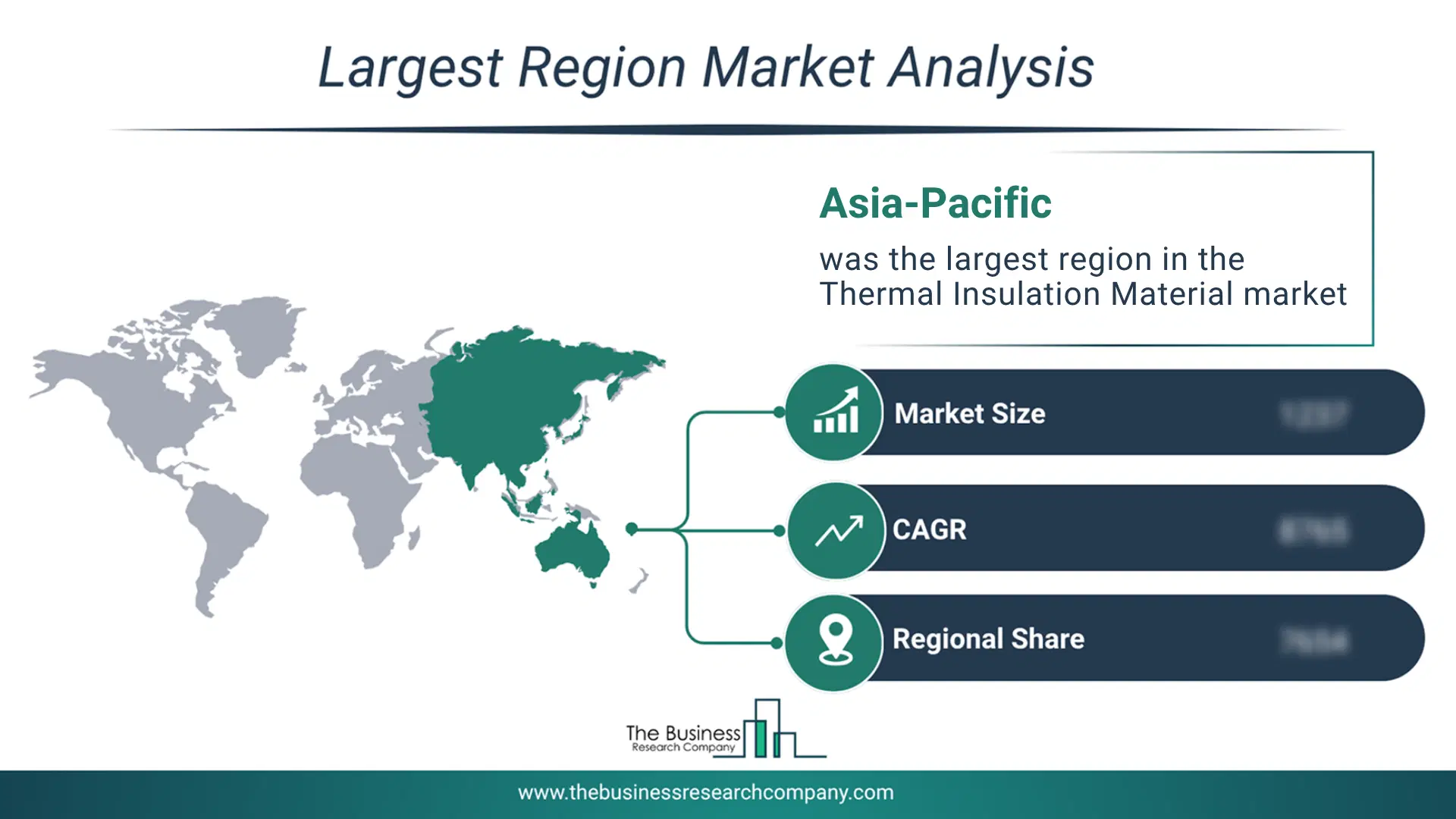
Regional Insights
Asia-Pacific was the largest region in the thermal insulation material market in 2025. The regions covered in this market report are Asia-Pacific, South East Asia, Western Europe, Eastern Europe, North America, South America, Middle East, Africa. The countries covered in this market report are Australia, Brazil, China, France, Germany, India, Indonesia, Japan, Taiwan, Russia, South Korea, UK, USA, Canada, Italy, Spain.What Defines the Thermal Insulation Material Market?
The thermal insulation material market consists of sales of smart lighting systems, daylight harvesting control systems, and energy-efficient outdoor lighting solutions. Values in this market are ‘factory gate’ values, that is the value of goods sold by the manufacturers or creators of the goods, whether to other entities (including downstream manufacturers, wholesalers, distributors and retailers) or directly to end customers. The value of goods in this market includes related services sold by the creators of the goods.How is Market Value Defined and Measured?
The market value is defined as the revenues that enterprises gain from the sale of goods and/or services within the specified market and geography through sales, grants, or donations in terms of the currency (in USD unless otherwise specified). The revenues for a specified geography are consumption values that are revenues generated by organizations in the specified geography within the market, irrespective of where they are produced. It does not include revenues from resales along the supply chain, either further along the supply chain or as part of other products.
This chart presents market attractiveness based on a quantitative evaluation of growth, competition, strategic alignment, and risk, offering a clear view of opportunity areas for decision-making. This chart is for illustrative purposes; the full report contains the complete analysis.

This chart highlights the Total Addressable Market (TAM) by estimating the maximum revenue opportunity using an assumption-driven approach, supporting strategic planning and opportunity sizing across markets. The chart is illustrative; the full report provides a more comprehensive analysis.
What Key Data and Analysis Are Included in theThermal Insulation Material Market Report 2026?
The thermal insulation material market research report is one of a series of new reports from The Business Research Company that provides market statistics, including industry global market size, regional shares, competitors with the market share, detailed market segments, market trends and opportunities, and any further data you may need to thrive in the thermal insulation material industry. The market research report delivers a complete perspective of everything you need, with an in-depth analysis of the current and future state of the industry.Thermal Insulation Material Market Report Forecast Analysis
| Report Attribute | Details |
|---|---|
| Market Size Value In 2026 | $67.79 billion |
| Revenue Forecast In 2035 | $79.57 billion |
| Growth Rate | CAGR of 4.1% from 2026 to 2035 |
| Base Year For Estimation | 2025 |
| Actual Estimates/Historical Data | 2020-2025 |
| Forecast Period | 2026 - 2030 - 2035 |
| Market Representation | Revenue in USD Billion and CAGR from 2026 to 2035 |
| Segments Covered | Product, Building Type, Application, End Use |
| Regional Scope | Asia-Pacific, Western Europe, Eastern Europe, North America, South America, Middle East, Africa |
| Country Scope | The countries covered in the report are Australia, Brazil, China, France, Germany, India, ... |
| Key Companies Profiled | BASF SE, Compagnie de Saint-Gobain S.A., Dow Chemicals Company, Bayer AG, Asahi Kasei Corporation, DuPont de Nemours Inc., Owens Corning, Kingspan Group PLC, Huntsman International LLC, Rockwool International A/S, Fletcher Building Products Ltd., Guardian Building Products Inc., GAF Materials Corporation, Armacell International, Paroc Group, Johns Manville Corporation, Byucksan Corporation, Jushi Group Corporation, Aspen Aerogels Inc., Atlas Roofing Corporation, Cellofoam North America Inc., Isocell GmbH, CertainTeed Corporation, Roxul Inc., ARK Thermal Insulation |
| Customization Scope | Request for Customization |
| Pricing And Purchase Options | Explore Purchase Options |