
Thermosetting Acrylic Adhesive Market Report 2026
Global Outlook – By Type (Flexible Adhesives, Rigid Adhesives, High-Performance Adhesives, Low-Viscosity Adhesives, High-Viscosity Adhesives), By Feature (High Heat Resistance, Flexibility, Fast Curing, UV Stability), By Application (Automotive, Construction, Electronics, Woodworking, Packaging), By End User (Industrial, Commercial, Residential, Healthcare, Aerospace) – Market Size, Trends, Strategies, and Forecast to 2030
Thermosetting Acrylic Adhesive Market Overview
• Thermosetting Acrylic Adhesive market size has reached to $1.24 billion in 2025 • Expected to grow to $1.67 billion in 2030 at a compound annual growth rate (CAGR) of 6.2% • Growth Driver: Surge In Electric Vehicles Fueling The Growth Of The Market Due To Increasing Adoption Of Environmentally Friendly And High-Performance Vehicles • Market Trend: Use Of Two-Part Toughened Acrylic Systems To Enhance Bonding Performance And Manufacturing Efficiency • North America was the largest region in 2025 and Asia-Pacific is the fastest growing region.What Is Covered Under Thermosetting Acrylic Adhesive Market?
Thermosetting acrylic adhesive is a type of adhesive that cures irreversibly when exposed to heat, forming strong, durable bonds. It is composed of acrylic polymers that crosslink during the curing process, enhancing chemical and thermal resistance. Once set, it cannot be remelted or reshaped, providing long-lasting adhesion even under harsh environmental conditions. The main types of thermosetting acrylic adhesives are flexible adhesives, rigid adhesives, high-performance adhesives, low-viscosity adhesives, and high-viscosity adhesives. Flexible adhesives are bonding agents that maintain elasticity and can absorb dynamic stress, vibration, and thermal expansion between dissimilar materials. The product types involved are one-part adhesives, two-part adhesives, and reactive adhesives, and different features include high heat resistance, flexibility, fast curing, and UV stability. It is applied for automotive, construction, electronics, woodworking, and packaging by several end users, including industrial, commercial, residential, healthcare, and aerospace.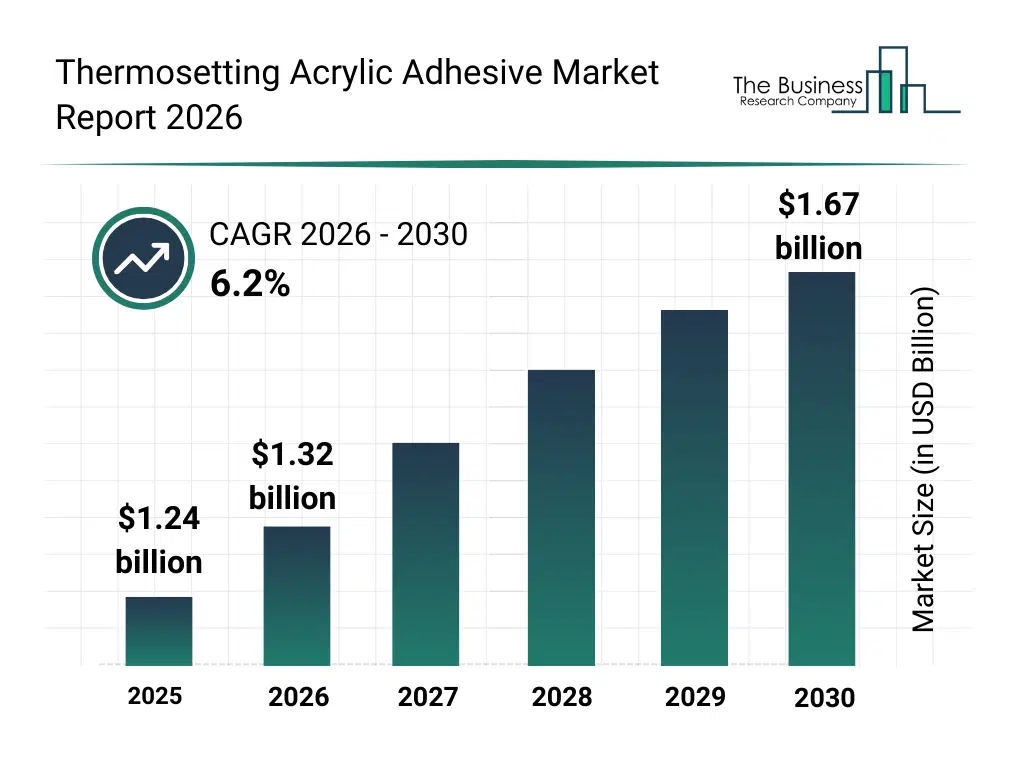
What Is The Thermosetting Acrylic Adhesive Market Size and Share 2026?
The thermosetting acrylic adhesive market size has grown strongly in recent years. It will grow from $1.24 billion in 2025 to $1.32 billion in 2026 at a compound annual growth rate (CAGR) of 6.5%. The growth in the historic period can be attributed to industrial bonding requirements, automotive assembly growth, solvent based adhesive limitations, construction material innovation, electronics miniaturization.What Is The Thermosetting Acrylic Adhesive Market Growth Forecast?
The thermosetting acrylic adhesive market size is expected to see strong growth in the next few years. It will grow to $1.67 billion in 2030 at a compound annual growth rate (CAGR) of 6.2%. The growth in the forecast period can be attributed to electric vehicle production growth, lightweight material adoption, high temperature resistant materials demand, automation in manufacturing, sustainable adhesive development. Major trends in the forecast period include rising demand for high strength structural bonding, growing use in automotive lightweighting, expansion of heat resistant adhesive applications, increased adoption in electronics assembly, focus on long term durability performance.
Global Thermosetting Acrylic Adhesive Market Segmentation
1) By Type: Flexible Adhesives, Rigid Adhesives, High-Performance Adhesives, Low-Viscosity Adhesives, High-Viscosity Adhesives 2) By Feature: High Heat Resistance, Flexibility, Fast Curing, UV Stability 3) By Application: Automotive, Construction, Electronics, Woodworking, Packaging 4) By End User: Industrial, Commercial, Residential, Healthcare, Aerospace Subsegments: 1) By Flexible Adhesives: Single-Part Flexible Adhesives, Two-Part Flexible Adhesives, Uv-Curable Flexible Adhesives, Solvent-Based Flexible Adhesives 2) By Rigid Adhesives: Single-Part Rigid Adhesives, Two-Part Rigid Adhesives, Heat-Curable Rigid Adhesives, Structural Rigid Adhesives 3) By High-Performance Adhesives: Impact-Resistant High-Performance Adhesives, Temperature-Resistant High-Performance Adhesives, Chemical-Resistant High-Performance Adhesives, Structural Bonding High-Performance Adhesives 4) By Low-Viscosity Adhesives: Single-Part Low-Viscosity Adhesives, Two-Part Low-Viscosity Adhesives, Solvent-Free Low-Viscosity Adhesives, Fast-Curing Low-Viscosity Adhesives 5) By High-Viscosity Adhesives: Paste-Form High-Viscosity Adhesives, Gel-Form High-Viscosity Adhesives, Structural High-Viscosity Adhesives, High-Strength High-Viscosity AdhesivesWhat Is The Driver Of The Thermosetting Acrylic Adhesive Market?
The rise of electric vehicles (EVs) is expected to propel the growth of the thermosetting acrylic adhesive market going forward. Electric vehicles refer to automobiles that are powered entirely or partially by electric energy stored in batteries instead of conventional fossil fuels. The rise in electric vehicles is due to the environmental concerns, as they produce zero tailpipe emissions and help reduce air pollution. Thermosetting acrylic adhesive helps electric vehicles by providing strong, durable, and heat-resistant bonding for lightweight components, which enhances structural integrity and overall vehicle performance. For instance, in January 2024, according to the U.S. Department of Energy, a US-based government agency, in December 2023, plug-in electric vehicles accounted for 9.8% of all light-duty vehicle sales, up from 7.8% in December 2022. Throughout 2023, plug-in vehicles consistently made up at least 8% of monthly sales, whereas in 2022 their share ranged between 5.5% and 7.8%. Therefore, the rise of electric vehicles (EVs) is driving the growth of the thermosetting acrylic adhesive industry.Key Players In The Global Thermosetting Acrylic Adhesive Market
Major companies operating in the thermosetting acrylic adhesive market are Dow Inc., 3M Company, Henkel AG & Co. KGaA, Sika AG, Wacker Chemie AG, H.B. Fuller, Bostik SA, Parson Adhesives Inc., ITW Performance Polymers, Permabond LLC, SAF-T-LOK International Corp., Loxeal LLC, WEICON Inc., Lord Corporation, Master Bond Inc., Bondloc UK Ltd., Arkema SA, Avery Dennison Corporation, National Adhesives & Sealants, Adhesive Applications Inc., Panacol-Elosol GmbH, Panacol USA Inc.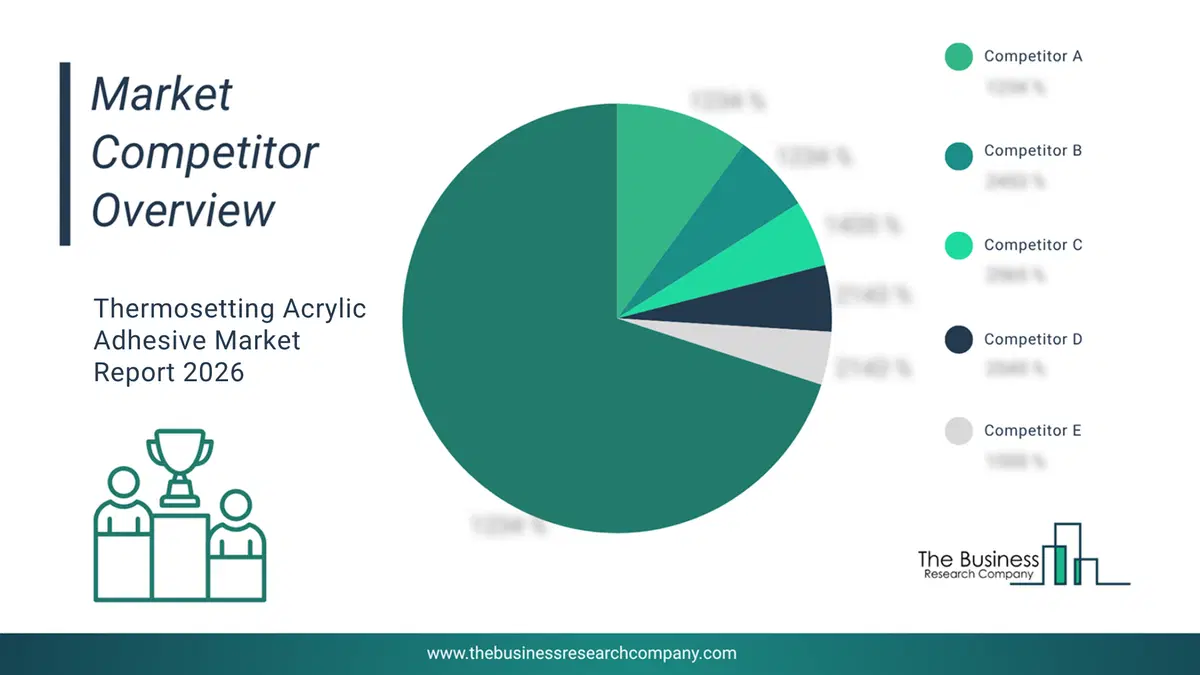
This chart is for illustrative purposes; the full report includes a detailed competitor analysis and comprehensive overview of the top 10 companies in the market.
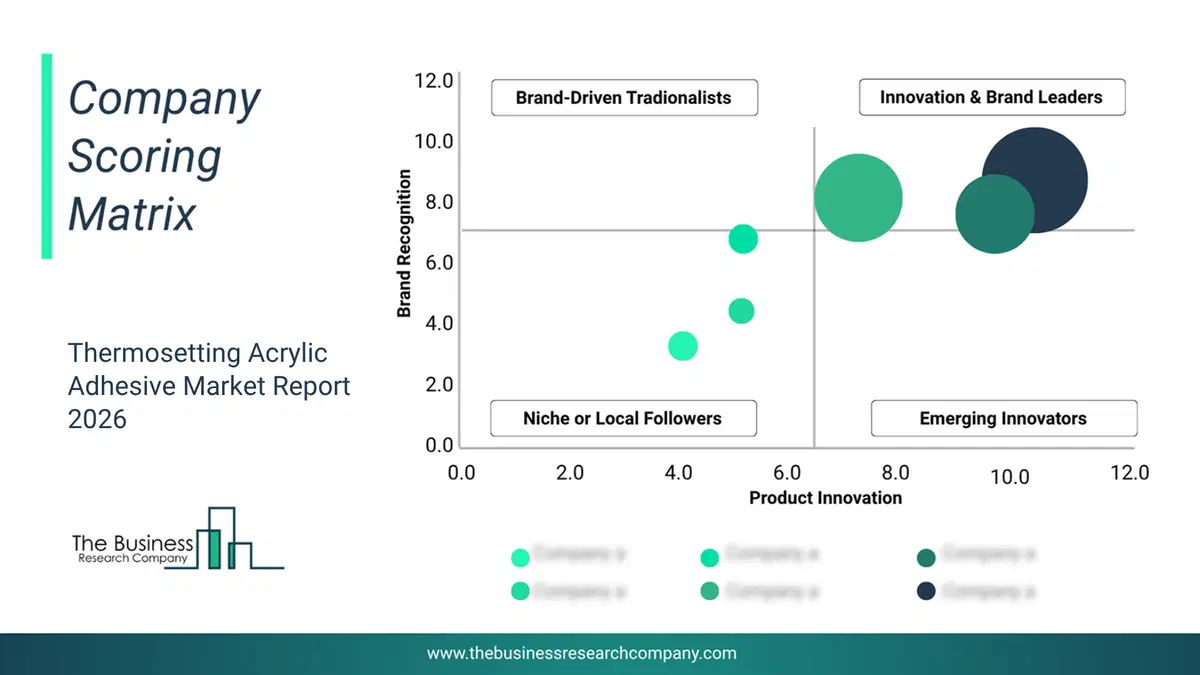
This chart maps companies by product innovation and brand strength, with bubble size indicating relative revenue, helping identify market leaders, challengers, and niche players. This is an illustrative chart; the full report provides a complete and accurate competitive analysis.
Global Thermosetting Acrylic Adhesive Market Trends and Insights
Major companies operating in the thermosetting acrylic adhesive market are focusing on developing innovative products, such as two-part toughened acrylic systems, to enhance bonding performance, reduce surface preparation requirements, and improve production efficiency across automotive, composite, and industrial applications. Two-part toughened acrylic system refers to an adhesive formulation consisting of two reactive components that chemically cure to form a strong, impact-resistant, and durable thermoset bond. For instance, in January 2024, Permabond Engineering Adhesives Limited, a US-based company that provides high-performance bonding and sealing solutions, launched its advanced toughened acrylic adhesive, Permabond TA4208 Black. Designed to meet the growing demand in the composite materials sector, this versatile adhesive serves multiple industrial applications. The two-part, 1:1 formulation offers high viscosity and non-slumping properties, making it ideal for vertical and gap-filling applications. Its innovative surface adhesion technology enables strong bonding even on oily or oxidized surfaces, minimizing the need for surface preparation. Additionally, the adhesive provides rapid strength development, achieving high peel and shear strength within just 20 minutes, enhancing productivity in fast-paced manufacturing environments.What Are Latest Mergers And Acquisitions In The Thermosetting Acrylic Adhesive Market?
In October 2024, Formerra, a US-based performance materials distributor, entered into a strategic partnership with H.B. Fuller for an undisclosed value. Through this partnership, Formerra aims to expand the distribution of H.B. Fuller’s Cilbond bonding agents across North America, enhancing manufacturing efficiency and technical support for customers. H.B. Fuller is a US-based manufacturer of thermosetting acrylic adhesives.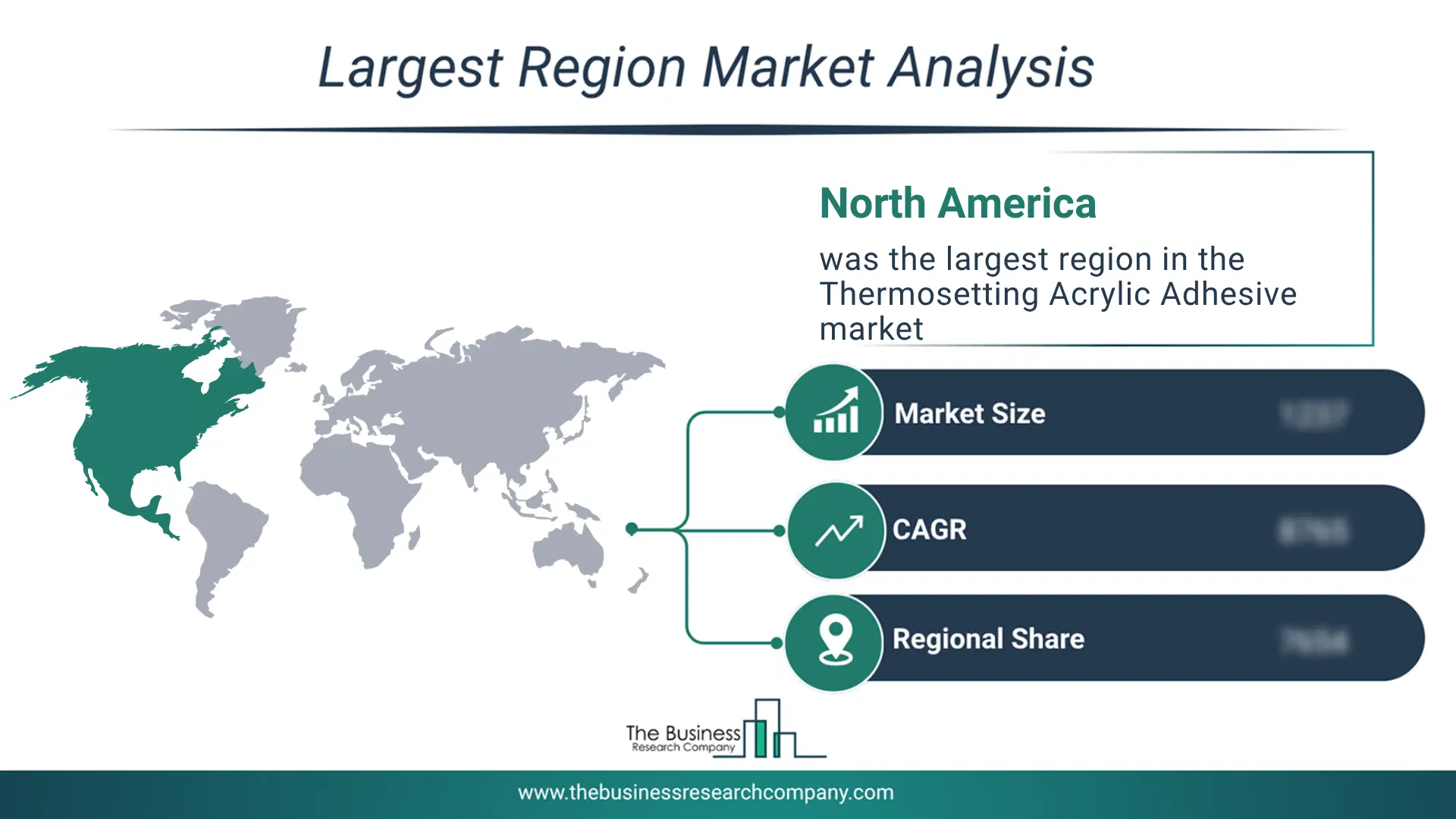
Regional Insights
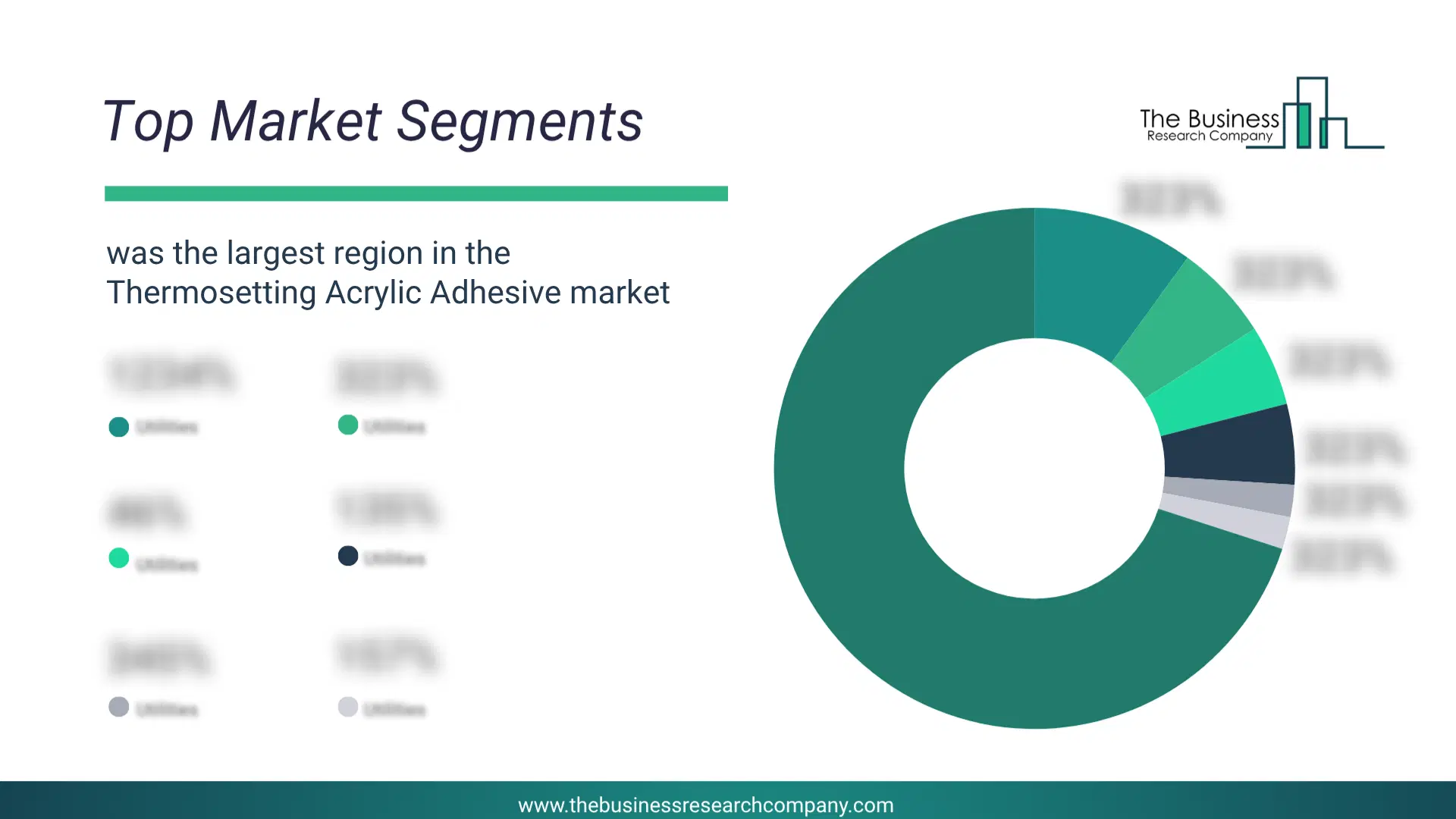
North America was the largest region in the thermosetting acrylic adhesive market in 2025. Asia-Pacific is expected to be the fastest-growing region in the forecast period. The regions covered in this market report are Asia-Pacific, South East Asia, Western Europe, Eastern Europe, North America, South America, Middle East, Africa The countries covered in this market report are Australia, Brazil, China, France, Germany, India, Indonesia, Japan, Taiwan, Russia, South Korea, UK, USA, Canada, Italy, SpainWhat Defines the Thermosetting Acrylic Adhesive Market?
The thermosetting acrylic adhesive market consists of sales of non flammable adhesive, structural adhesive, bead on bead dual component adhesive, and gap filling adhesives. Values in this market are ‘factory gate’s values, that is, the value of goods sold by the manufacturers or creators of the goods, whether to other entities (including downstream manufacturers, wholesalers, distributors, and retailers) or directly to end customers. The value of goods in this market includes related services sold by the creators of the goods.How is Market Value Defined and Measured?
The market value is defined as the revenues that enterprises gain from the sale of goods and/or services within the specified market and geography through sales, grants, or donations in terms of the currency (in USD unless otherwise specified). The revenues for a specified geography are consumption values that are revenues generated by organizations in the specified geography within the market, irrespective of where they are produced. It does not include revenues from resales along the supply chain, either further along the supply chain or as part of other products.
This chart presents market attractiveness based on a quantitative evaluation of growth, competition, strategic alignment, and risk, offering a clear view of opportunity areas for decision-making. This chart is for illustrative purposes; the full report contains the complete analysis.

This chart highlights the Total Addressable Market (TAM) by estimating the maximum revenue opportunity using an assumption-driven approach, supporting strategic planning and opportunity sizing across markets. The chart is illustrative; the full report provides a more comprehensive analysis.
What Key Data and Analysis Are Included in the Thermosetting Acrylic Adhesive Market Report 2026?
The thermosetting acrylic adhesive market research report is one of a series of new reports from The Business Research Company that provides market statistics, including industry global market size, regional shares, competitors with the market share, detailed market segments, market trends and opportunities, and any further data you may need to thrive in the thermosetting acrylic adhesive industry. The market research report delivers a complete perspective of everything you need, with an in-depth analysis of the current and future state of the industry.Thermosetting Acrylic Adhesive Market Report Forecast Analysis
| Report Attribute | Details |
|---|---|
| Market Size Value In 2026 | $1.32 billion |
| Revenue Forecast In 2030 | $1.67 billion |
| Growth Rate | CAGR of 6.5% from 2026 to 2030 |
| Base Year For Estimation | 2025 |
| Actual Estimates/Historical Data | 2020-2025 |
| Forecast Period | 2026 - 2030 |
| Market Representation | Revenue in USD Billion and CAGR from 2026 to 2030 |
| Segments Covered | Type, Feature, Application, End User |
| Regional Scope | Asia-Pacific, Western Europe, Eastern Europe, North America, South America, Middle East, Africa |
| Country Scope | The countries covered in this market report are Australia, Brazil, China, France, Germany, India, Indonesia, Japan, Taiwan, Russia, South Korea, UK, USA, Canada, Italy, Spain |
| Key Companies Profiled | Dow Inc., 3M Company, Henkel AG & Co. KGaA, Sika AG, Wacker Chemie AG, H.B. Fuller, Bostik SA, Parson Adhesives Inc., ITW Performance Polymers, Permabond LLC, SAF-T-LOK International Corp., Loxeal LLC, WEICON Inc., Lord Corporation, Master Bond Inc., Bondloc UK Ltd., Arkema SA, Avery Dennison Corporation, National Adhesives & Sealants, Adhesive Applications Inc., Panacol-Elosol GmbH, Panacol USA Inc. |
| Customization Scope | Request for Customization |
| Pricing And Purchase Options | Explore Purchase Options |