
Thin Boiling Starch Market Report 2026
Global Outlook – By Product (Potato Starch, Maize Starch, Wheat Starch, Other Products), By Form (Dry, Liquid), By Application (Food And Beverages, Textile, Paper And Packaging, Pharmaceuticals, Personal Care, Other Applications) – Market Size, Trends, Strategies, and Forecast to 2030
Thin Boiling Starch Market Overview
• Thin Boiling Starch market size has reached to $14.75 billion in 2025 • Expected to grow to $18.09 billion in 2030 at a compound annual growth rate (CAGR) of 4.4% • Growth Driver: Rising Food And Beverage Industry To Drive Market Growth • Market Trend: Product Innovations Transforming The Thin Boiling Starch Market • North America was the largest region in 2025.What Is Covered Under Thin Boiling Starch Market?
Thin boiling starch is a type of starch that can thicken liquids and form a smooth consistency when cooked in hot water because it quickly dissolves and thickens without forming lumps or becoming too thick and gelatinous. These are often used in cooking and food preparation to achieve desired textures and consistencies in sauces, soups, desserts, and other culinary applications. The main types of products included in thin boiling starch are potato starch, maize starch, wheat starch, and others. Potato starch refers to a fine white powder that is extracted from the tubers of the potato plant. It comes in dry and liquid forms, which are used for several applications, including food and beverages, textiles, paper and packaging, pharmaceuticals, personal care, and others.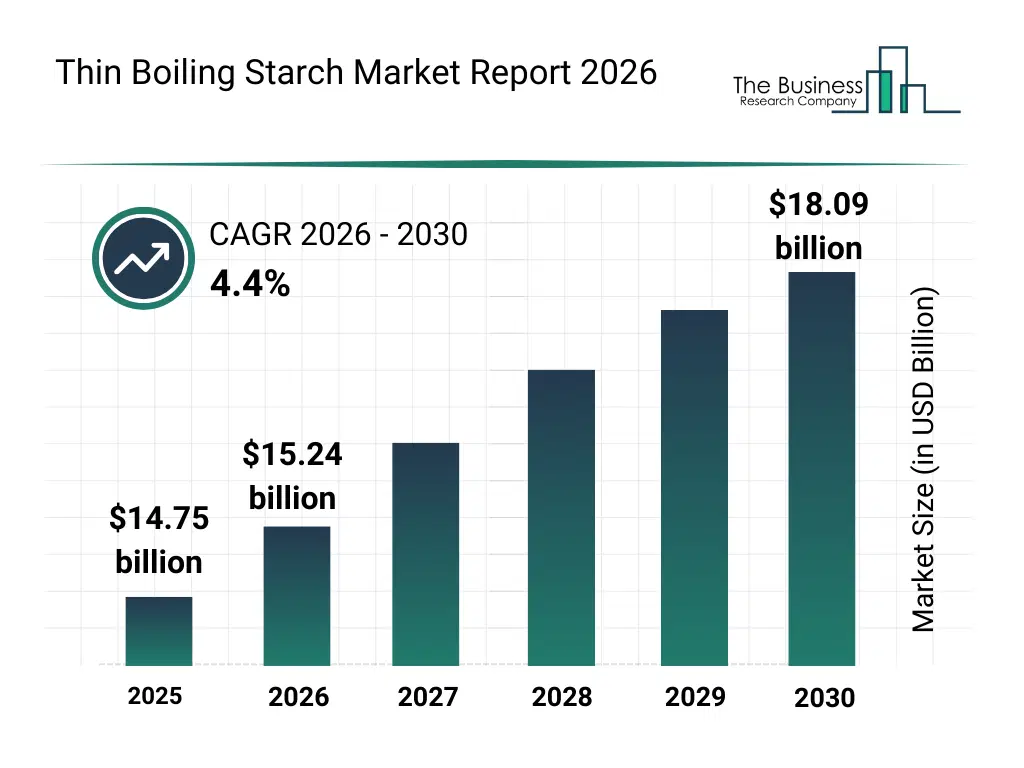
What Is The Thin Boiling Starch Market Size and Share 2026?
The thin boiling starch market size has grown steadily in recent years. It will grow from $14.75 billion in 2025 to $15.24 billion in 2026 at a compound annual growth rate (CAGR) of 3.3%. The growth in the historic period can be attributed to expansion of processed food consumption, rising demand for texture-enhancing ingredients, growth of convenience food manufacturing, increasing use in paper and textile processing, availability of diverse starch raw materials.What Is The Thin Boiling Starch Market Growth Forecast?
The thin boiling starch market size is expected to see steady growth in the next few years. It will grow to $18.09 billion in 2030 at a compound annual growth rate (CAGR) of 4.4%. The growth in the forecast period can be attributed to increasing adoption of clean-label ingredients, rising demand from pharmaceutical excipient applications, expansion of plant-based food formulations, innovation in starch modification technologies, growing demand for multifunctional thickening agents. Major trends in the forecast period include increasing demand for modified food-grade starches, rising use in clean-label food applications, growing adoption in pharmaceutical formulations, expansion of specialty starch applications, enhanced focus on consistent thickening performance.
Global Thin Boiling Starch Market Segmentation
1) By Product: Potato Starch, Maize Starch, Wheat Starch, Other Products 2) By Form: Dry, Liquid 3) By Application: Food And Beverages, Textile, Paper And Packaging, Pharmaceuticals, Personal Care, Other Applications Subsegments: 1) By Potato Starch: Native Potato Starch, Modified Potato Starch 2) By Maize Starch: Native Maize Starch, Modified Maize Starch 3) By Wheat Starch: Native Wheat Starch, Modified Wheat Starch 4) By Other Products: Tapioca Starch, Rice Starch, Pea StarchWhat Are The Drivers Of The Thin Boiling Starch Market?
Increasing demand from the food and beverage industry is expected to propel the growth of the thin boiling starch market going forward. The food and beverage industry are the economic sector that involves producing, processing, distributing, and selling food and drink products. It encompasses various businesses and activities, including agriculture, food manufacturing, food service, retailing, and catering. Thin boiling starches are primarily used in the food and beverage industry as versatile ingredients for thickening, stabilizing emulsions, and enhancing the texture of various food products. For instance, in July 2025, according to the Government of Canada, a Canada-based federal government, in 2024, exports of processed food and beverage products reached a record $59.8 billion, marking a 3.8% rise compared with 2023. Therefore, the increasing demand from the food and beverage industry is driving the growth of the thin boiling starch industry. The increasing expansion of textile industry is expected to propel the growth of thin boiling starch market going forward. The textile industry encompasses the production of fibers, fabrics, and finished goods related to textiles. Thin boiling starch is utilized in the textile industry as a sizing agent during the weaving process. It is applied to warp yarns to enhance their strength, smoothness, and overall performance, contributing to improved weaving efficiency and the quality of the finished fabric. For instance, in June 2025, according to Textile World, a US-based magazine that covers the textile industry, in 2024, U.S. shipments of man-made fibers, textiles, and apparel were estimated at $63.9 billion. Therefore, increasing expansion of textile industry is driving the thin boiling starch industry.Key Players In The Global Thin Boiling Starch Market
Major companies operating in the thin boiling starch market are Cargill Incorporated, Archer Daniels Midland Company, Ingredion Incorporated, Roquette Frères, Tate and Lyle plc, Tereos SCA, Agrana Group, Avebe U.A., Emsland Group, Grain Processing Corporation, Beneo GmbH, Banpong Tapioca Flour Industrial Co. Ltd., Sanstar Bio-Polymers Ltd., Spac Starch Products India Ltd., Universal Biopolymers, Angel Starch and Food Pvt. Ltd., Everest Starch India Pvt. Ltd., Sheekharr Starch Pvt. Ltd., Qingdao CBH Co. Ltd., Tapioca Development Corporation
This chart is for illustrative purposes; the full report includes a detailed competitor analysis and comprehensive overview of the top 10 companies in the market.
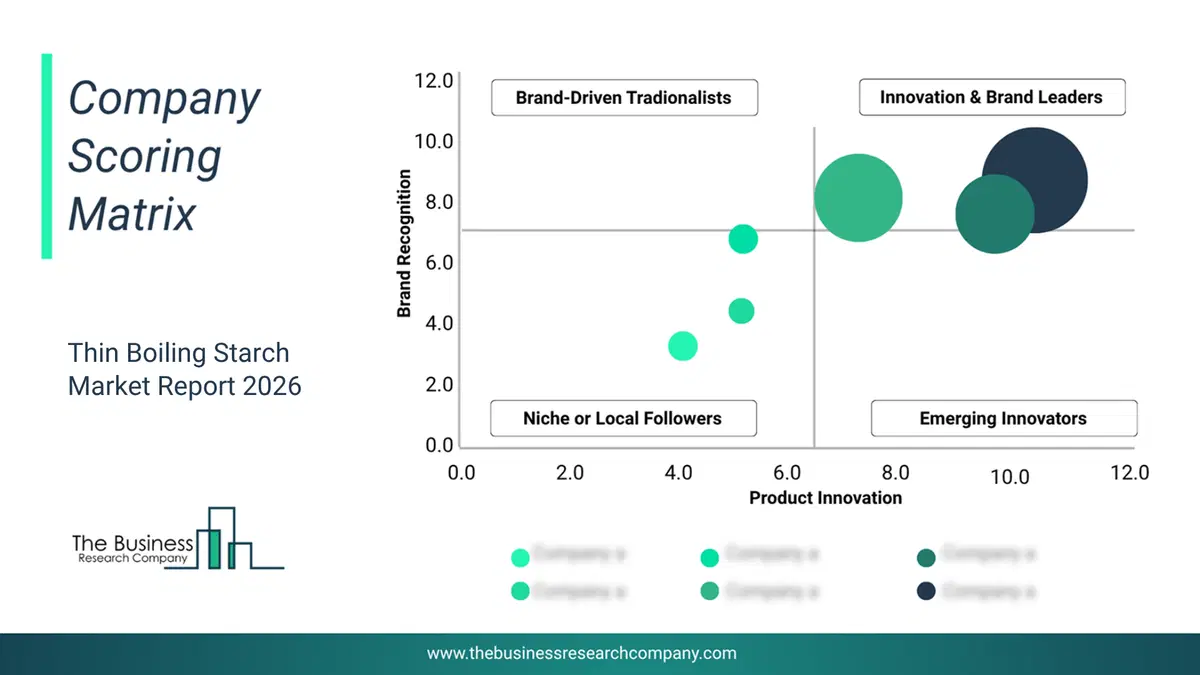
This chart maps companies by product innovation and brand strength, with bubble size indicating relative revenue, helping identify market leaders, challengers, and niche players. This is an illustrative chart; the full report provides a complete and accurate competitive analysis.
What Are Latest Mergers And Acquisitions In The Thin Boiling Starch Market?
Regional Outlook
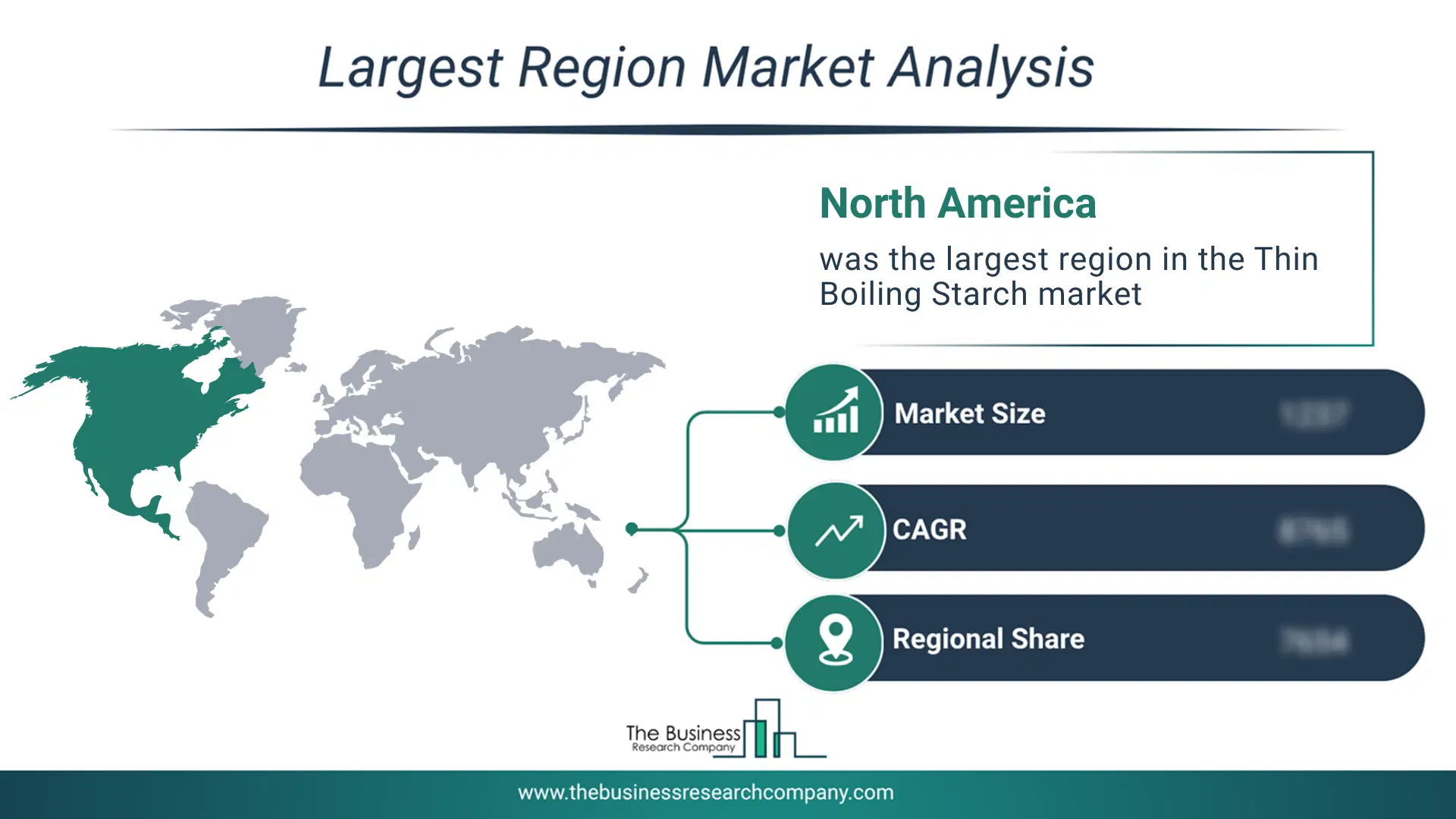
North America was the largest region in the thin boiling starch market in 2025. The regions covered in this market report are Asia-Pacific, South East Asia, Western Europe, Eastern Europe, North America, South America, Middle East and Africa. The countries covered in this market report are Australia, Brazil, China, France, Germany, India, Indonesia, Japan, Taiwan, Russia, South Korea, UK, USA, Italy, Spain, CanadaWhat Defines the Thin Boiling Starch Market?
The thin boiling starch market consists of sales of arrowroot starch, tapioca starch, rice starch, sago starch, cornstarch, and cassava starch. Values in this market are ‘factory gate’ values, that is, the value of goods sold by the manufacturers or creators of the goods, whether to other entities (including downstream manufacturers, wholesalers, distributors, and retailers) or directly to end customers. The value of goods in this market includes related services sold by the creators of the goods.How is Market Value Defined and Measured?
The market value is defined as the revenues that enterprises gain from the sale of goods and/or services within the specified market and geography through sales, grants, or donations in terms of the currency (in USD unless otherwise specified). The revenues for a specified geography are consumption values that are revenues generated by organizations in the specified geography within the market, irrespective of where they are produced. It does not include revenues from resales along the supply chain, either further along the supply chain or as part of other products.
This chart presents market attractiveness based on a quantitative evaluation of growth, competition, strategic alignment, and risk, offering a clear view of opportunity areas for decision-making. This chart is for illustrative purposes; the full report contains the complete analysis.

This chart highlights the Total Addressable Market (TAM) by estimating the maximum revenue opportunity using an assumption-driven approach, supporting strategic planning and opportunity sizing across markets. The chart is illustrative; the full report provides a more comprehensive analysis.
What Key Data and Analysis Are Included in the Thin Boiling Starch Market Report 2026?
The thin boiling starch market research report is one of a series of new reports from The Business Research Company that provides market statistics, including industry global market size, regional shares, competitors with the market share, detailed market segments, market trends and opportunities, and any further data you may need to thrive in the thin boiling starch industry. The market research report delivers a complete perspective of everything you need, with an in-depth analysis of the current and future state of the industry.Thin Boiling Starch Market Report Forecast Analysis
| Report Attribute | Details |
|---|---|
| Market Size Value In 2026 | $15.24 billion |
| Revenue Forecast In 2030 | $18.09 billion |
| Growth Rate | CAGR of 3.3% from 2026 to 2030 |
| Base Year For Estimation | 2025 |
| Actual Estimates/Historical Data | 2020-2025 |
| Forecast Period | 2026 - 2030 |
| Market Representation | Revenue in USD Billion and CAGR from 2026 to 2030 |
| Segments Covered | Product, Form, Application |
| Regional Scope | Asia-Pacific, Western Europe, Eastern Europe, North America, South America, Middle East, Africa |
| Country Scope | The countries covered in the report are Australia, Brazil, China, France, Germany, India, Indonesia, Japan, Taiwan, Russia, South Korea, UK, USA, Canada, Italy, Spain. |
| Key Companies Profiled | Cargill Incorporated, Archer Daniels Midland Company, Ingredion Incorporated, Roquette Frères, Tate and Lyle plc, Tereos SCA, Agrana Group, Avebe U.A., Emsland Group, Grain Processing Corporation, Beneo GmbH, Banpong Tapioca Flour Industrial Co. Ltd., Sanstar Bio-Polymers Ltd., Spac Starch Products India Ltd., Universal Biopolymers, Angel Starch and Food Pvt. Ltd., Everest Starch India Pvt. Ltd., Sheekharr Starch Pvt. Ltd., Qingdao CBH Co. Ltd., Tapioca Development Corporation |
| Customization Scope | Request for Customization |
| Pricing And Purchase Options | Explore Purchase Options |