

Thoracic Drainage Devices Market 2026
By Type (Digital, Traditional), By Product (Thoracic Drainage Systems, Thoracic Drainage Kits, Pleural Drainage Catheters, Other Products), By Application (Cardiac Surgery, Thoracic and Pulmonary Surgery, Other Applications), By End-Users (Hospitals, Ambulatory Surgical Centers, Other End-Users), And By Region, Opportunities And Strategies – Global Forecast To 2035
Thoracic Drainage Devices Market Definition
Thoracic drainage devices are medical tools used to remove air, fluid, or pus from the pleural space or mediastinum to enable proper lung expansion and restore normal intrathoracic pressure. These devices are commonly employed in the treatment of pneumothorax, pleural effusion, hemothorax, empyema and during the postoperative management of thoracic and cardiac surgeries. The thoracic drainage devices market consists of sales by entities (organizations, sole traders and partnerships) of thoracic drainage devices that are used by thoracic surgeons, cardiothoracic surgeons, pulmonologists, emergency physicians and intensive care specialists. These devices are typically used during surgical interventions, post-surgical recovery, emergency procedures, or in chronic care management of pleural conditions.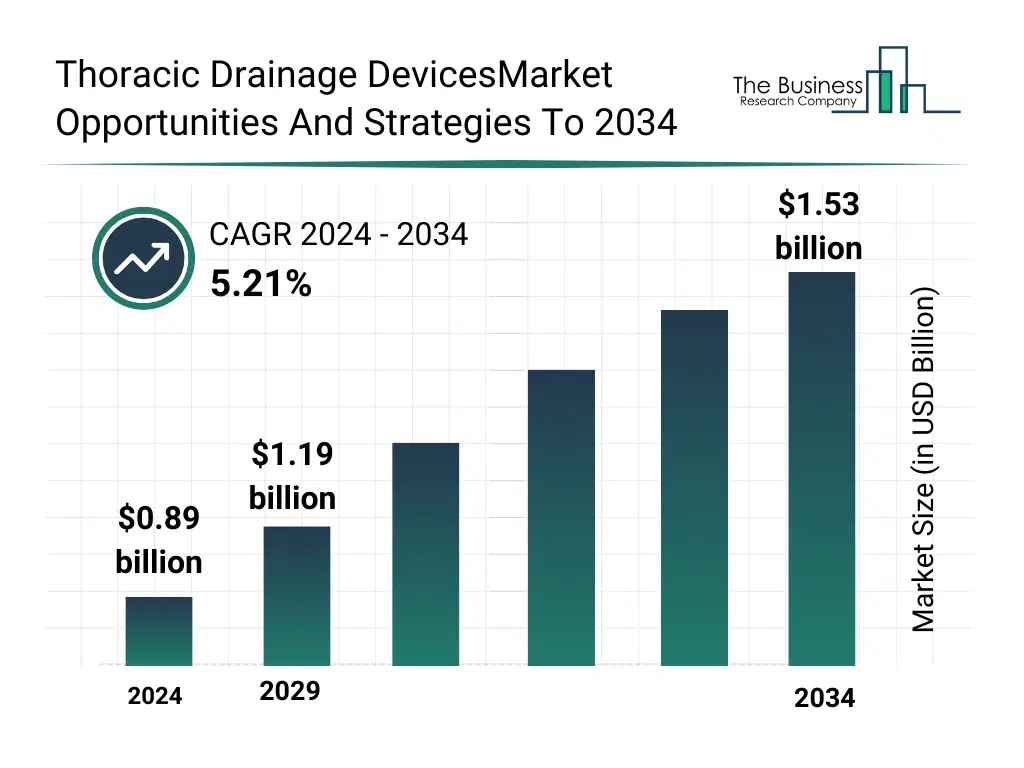
Thoracic Drainage Devices Market Size
The global thoracic drainage devices market reached a value of nearly $890.00 million in 2024, having grown at a compound annual growth rate (CAGR) of 7.06% since 2019. The market is expected to grow from $890.00 million in 2024 to $1,186.83 million in 2029 at a rate of 5.93%. The market is then expected to grow at a CAGR of 5.21% from 2029 and reach $1,530.03 million in 2034. Growth in the historic period resulted from the rising prevalence of smoking and air pollution, increasing cardiovascular and pulmonary disorders, growing preference for minimally invasive surgeries and rising prevalence of lung cancer. Factors that negatively affected growth in the historic period were lack of skilled healthcare professionals and risk of complications and device-related infections. Going forward, the increasing research and development in healthcare, favorable reimbursement and government healthcare spending, expansion of critical care and intensive care units (ICUs) and rising incidence of respiratory diseases will drive the growth. Factors that could hinder the growth of the thoracic drainage devices market in the future include high cost of advanced thoracic drainage systems, stringent regulatory requirements and impact of trade war and tariff.Thoracic Drainage Devices Market Drivers
The key drivers of the thoracic drainage devices market include: Rising Incidence Of Respiratory Diseases During the forecast period, the rising incidence of respiratory diseases will propel the growth of the thoracic drainage devices market. Conditions such as chronic obstructive pulmonary disease, pleural effusion, pneumothorax and other respiratory complications often require drainage intervention to restore normal lung function and relieve intrathoracic pressure. As these diseases become more prevalent due to environmental, lifestyle and occupational factors, the need for effective thoracic drainage solutions continues to grow. Healthcare facilities are likely to witness higher demand for both traditional and digital drainage systems capable of precise monitoring and long-term management of respiratory complications. The persistent rise in respiratory illnesses will ensure consistent use of thoracic drainage devices across emergency care, post-surgical recovery and intensive care settings, reinforcing market growth throughout the forecast period. The rising incidence of respiratory diseases growth contribution during the forecast period in 2024 is 1.50%.Thoracic Drainage Devices Market Restraints
The key restraints on the thoracic drainage devices market include: High Cost Of Advanced Thoracic Drainage Systems High cost of advanced thoracic drainage systems is restricting the growth of the thoracic drainage devices market during the forecast period. Modern digital and automated devices incorporate electronic sensors, real-time monitoring capabilities and advanced materials, which significantly increase their manufacturing and procurement costs. These elevated prices make adoption difficult for smaller healthcare facilities and hospitals in cost-sensitive regions, particularly where budget allocations for medical equipment are limited. Additionally, the need for ongoing maintenance and periodic calibration further adds to the overall operational expenses. Growth affected by high cost of advanced thoracic drainage systems across regions during the forecast period in 2024 is -2.00%.Thoracic Drainage Devices Market Trends
Major trends shaping the thoracic drainage devices market include: Development Of Smart Monitoring Systems To Enhance Post-Operative Care Major companies in the thoracic drainage devices market are focusing on the development of smart monitoring systems that enable continuous tracking of pleural-space metrics, integrate with hospital digital workflows and support earlier patient mobilization in post-thoracic and cardiothoracic surgeries. These innovations shift drainage systems from passive collection devices to active, data-enabled tools for optimizing post-operative care. For example, in February 2025, Getinge AB, a Sweden-based med-tech company, launched a new thoracic drainage platform described as “Leading Innovation in Thoracic Drainagse”, featuring enhanced sensor integration, streamlined collection chambers and a user interface aimed at real-time monitoring and chest-tube management for cardiac, thoracic and pediatric patients. These systems are designed to support clinical decisions (e.g., when to remove tubes), reduce complications, standardize postoperative workflows and contribute to shorter hospital stays in high-acuity settings. Adoption Of Portable And Compact Thoracic Drainage Solutions For Improved Mobility Companies operating in the thoracic drainage devices are increasingly focusing on developing and commercializing portable and compact drainage systems that enable patient mobility post-surgery or during ambulatory care settings, thereby supporting faster recovery and earlier discharge. These compact systems reduce dependence on wall-vacuum infrastructure, facilitate patient ambulation and allow transitions from hospital wards to lower-acuity units or home environments. For example, in September 2024, Bearpac Medical, LLC, a US-based privately held start-up medical technology company, launched the clinical trial for its Passio™ Pump Drainage System at North Bristol NHS (national health service) Trust in the UK. The system consists of a hand-held control unit, a disposable collection kit and an electronically controlled fluid and vacuum pump allowing patients with recurrent pleural effusions to manage drainage with greater mobility and flow control relative to traditional bottle systems.Opportunities And Recommendations In The Thoracic Drainage Devices Market
Opportunities – The top opportunities in the thoracic drainage devices market segmented by type will arise in the traditional segment, which will gain $169.14 million of global annual sales by 2029. The top opportunities in the thoracic drainage devices market segmented by product will arise in the pleural drainage catheters segment, which will gain $123.04 million of global annual sales by 2029. The top opportunities in the thoracic drainage devices market segmented by application will arise in the thoracic and pulmonary surgery segment, which will gain $154.96 million of global annual sales by 2029. The top opportunities in the thoracic drainage devices market segmented by end users will arise in the hospital segment, which will gain $181.76 million of global annual sales by 2029. The thoracic drainage devices market size will gain the most in the USA at $87.91 million. Recommendations- To take advantage of the opportunities, the business research company recommends the thoracic drainage devices companies to focus on integrating smart monitoring into thoracic drainage systems, focus on expanding portable and compact thoracic drainage solutions, focus on expanding home based and ambulatory chest drainage models, focus on scaling single use and sustainable drainage systems, focus on advancing digital drainage systems with real time analytics, focus on accelerating growth in digital thoracic drainage systems, focus on accelerating expansion in pleural drainage catheters, expand in emerging markets, continue to focus on developed markets, provide competitively priced offerings, continue to use B2b promotions, participate in trade shows and events, focus on expanding solutions for thoracic and pulmonary surgery.
Thoracic Drainage Devices Market Segmentation
The thoracic drainage devices market is segmented by type, by product, by applications and by end-users.By Type–
The thoracic drainage devices market is segmented by type into:
- a) Digital
- b) Traditional
By Product –
The thoracic drainage devices market is segmented by product into:
- a) Thoracic Drainage Systems
- b) Thoracic Drainage Kits
- c) Pleural Drainage Catheters
- d) Other Products
By Applications–
The thoracic drainage devices market is segmented by applications into:
- a) Cardiac Surgery
- b) Thoracic And Pulmonary Surgery
- c) Other Applications
By End-Users–
The thoracic drainage devices market is segmented by end-users into:
- a) Hospitals
- b) Ambulatory Surgical Centers
- c) Other End-Users
By Geography - The thoracic drainage devices market is segmented by geography into:
- • China
- • India
- • Japan
- • Australia
- • Indonesia
- • South Korea
- • USA
- • Canada
- • Brazil
- • France
- • Germany
- • UK
- • Italy
- • Spain
- • Russia
-
o Asia Pacific
o Africa