
Threat Detection Equipment Market Report 2026
Global Outlook – By Type (Chemical Detection Equipment, Biological Detection Equipment, Radiological Detection Equipment, Explosive Detection Equipment), By Installation Type (Fixed, Portable, Mobile), By Technology (Optical Sensing, Mass Spectrometry, X-Ray Technology, Infrared Spectroscopy), By End-User (Aviation And Airport Operators, Government Security And Regulatory Agencies, Defense And Military Organizations, Corrections And Justice System Operators, Critical Infrastructure Operators, Transportation And Logistics Operators, Commercial And Private Sector) – Market Size, Trends, Strategies, and Forecast to 2035
Threat Detection Equipment Market Overview
• Threat Detection Equipment market size has reached to $54.97 billion in 2025 • Expected to grow to $80.1 billion in 2030 at a compound annual growth rate (CAGR) of 7.9% • Growth Driver: Rising Global Terrorism Threats Driving The Market Growth Due To Increasing Frequency And Complexity Of Violent Attacks Worldwide • Market Trend: Advancements In Millimeter Wave Body Scanning Technology For Enhanced Security Screening • North America was the largest region in 2025 and Asia-Pacific is the fastest growing region.What Is Covered Under Threat Detection Equipment Market?
Threat detection equipment refers to electronic and sensor-based systems designed to identify, detect, and alert users to potential security threats or unauthorized activities. These systems leverage advanced sensing technologies, imaging, scanning, and analytical capabilities to enhance situational awareness and support timely response. They are engineered to strengthen security monitoring and risk prevention across environments where continuous detection and verification of objects or activities is required. The main types of threat detection equipment include chemical detection equipment, biological detection equipment, radiological detection equipment, and explosive detection equipment. Chemical detection equipment refers to systems designed to identify hazardous chemical substances in various environments to ensure safety and security.They are available in installation types such as fixed, portable, and mobile. They utilize technologies optical sensing, mass spectrometry, x-ray technology and infrared spectroscopy, serving end users including aviation and airport operators, government security and regulatory agencies, defense and military organizations, corrections and justice system operators, critical infrastructure operators, transportation and logistics operators, and commercial and private sector.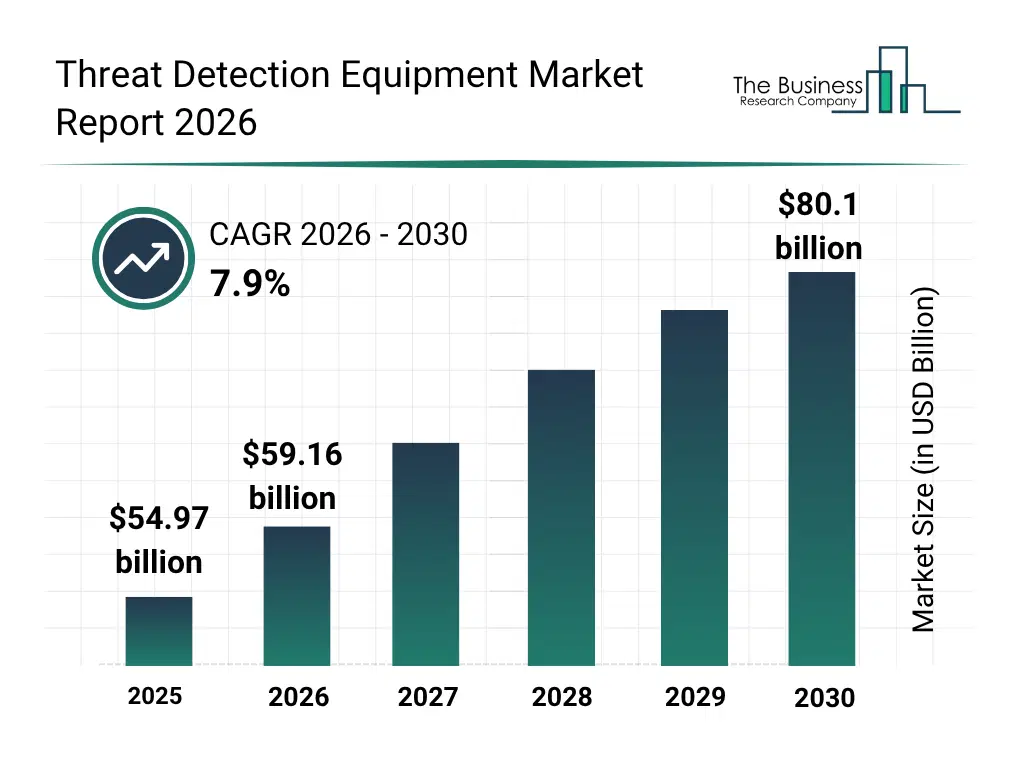
What Is The Threat Detection Equipment Market Size and Share 2026?
The threat detection equipment market size has grown strongly in recent years. It will grow from $54.97 billion in 2025 to $59.16 billion in 2026 at a compound annual growth rate (CAGR) of 7.6%. The growth in the historic period can be attributed to rise in aviation and border security threats, expansion of airport and transportation security infrastructure, increased defense and homeland security investments, adoption of x-ray screening systems in public venues, emergence of basic metal and manual detection systems.What Is The Threat Detection Equipment Market Growth Forecast?
The threat detection equipment market size is expected to see strong growth in the next few years. It will grow to $80.1 billion in 2030 at a compound annual growth rate (CAGR) of 7.9%. The growth in the forecast period can be attributed to integration of AI-based predictive threat analytics, miniaturization of advanced sensing technologies, growth of autonomous security and surveillance robotics, expansion of smart city surveillance networks, rising demand for multi-modal integrated detection platforms. Major trends in the forecast period include multi-sensor fusion based threat detection systems, portable and handheld screening solutions, biometric integrated identification and verification systems, real-time perimeter intrusion detection and monitoring systems, advanced non-invasive imaging and scanning technologies.
Global Threat Detection Equipment Market Segmentation
1) By Type: Chemical Detection Equipment, Biological Detection Equipment, Radiological Detection Equipment, Explosive Detection Equipment 2) By Installation Type: Fixed, Portable, Mobile 3) By Technology: Optical Sensing, Mass Spectrometry, X-Ray Technology, Infrared Spectroscopy 4) By End-User: Aviation And Airport Operators, Government Security And Regulatory Agencies, Defense And Military Organizations, Corrections And Justice System Operators, Critical Infrastructure Operators, Transportation And Logistics Operators, Commercial And Private Sector Subsegments: 1) By Chemical Detection Equipment: Gas Detectors, Liquid Chemical Analyzers, Chemical Agent Monitors, Ion Mobility Spectrometers, Flame Ionization Detectors, Photoionization Detectors, Colorimetric Detection Systems 2) By Biological Detection Equipment: Polymerase Chain Reaction Based Detection Systems, Immunoassay Based Detection Systems, Biosensors, Bioaerosol Detection Systems, Deoxyribonucleic Acid Sequencing Systems, Microbial Detection Kits, Lab On A Chip Devices 3) By Radiological Detection Equipment: Geiger Müller Counters, Scintillation Detectors, Semiconductor Detectors, Dosimeters, Radiation Portal Monitors, Spectroscopic Radiation Detectors, Personal Radiation Detectors 4) By Explosive Detection Equipment: Trace Explosive Detectors, Bulk Explosive Detection Systems, X-Ray Screening Systems, Computed Tomography Scanners, Explosive Vapor Detectors, Ground Penetrating Radar SystemsWhat Is The Driver Of The Threat Detection Equipment Market?
The rising global terrorism threats is expected to propel the growth of the threat detection equipment market going forward. Terrorism threats refer to the potential or actual risk of violent acts carried out by individuals or groups intending to intimidate or harm civilians, governments, or infrastructure to achieve political, ideological, or religious objectives. Terrorism threats are growing due to rising geopolitical conflicts, as tensions between countries and regions create instability that can be exploited by extremist groups to plan or carry out attacks. Threat detection equipment helps to mitigate terrorism threats by enabling early identification of weapons, explosives, and suspicious activities through advanced screening, surveillance, and sensing technologies, allowing security forces to respond quickly and prevent potential attacks before they occur. For instance, in December 2024, according to the Armed Conflict Location & Event Data Project (ACLED), a US-based non-profit organization, bombings accounted for over 0.09 million events (90,000 events) in 2024, nearly twice the rate of battles and about three times the level of direct violence against civilians. Additionally, 2024 recorded a 25% rise in political violence events compared to 2023, while bombing and other forms of remote violence have nearly doubled since 2022, increasing by over 25% annually. Therefore, the rising global terrorism threats is driving the growth of the threat detection equipment industry.Key Players In The Global Threat Detection Equipment Market
Major companies operating in the threat detection equipment market are Raytheon Technologies Corporation, Lockheed Martin Corporation, Thermo Fisher Scientific Inc., L3Harris Technologies Inc., Leidos Holdings Inc., Adani Group, Drägerwerk AG & Co. KGaA, Smiths Detection Group Limited, Bruker Corporation, OSI Systems Inc., Teledyne FLIR LLC, Chemring Group PLC, Nuctech Company Limited, Rapiscan Systems Inc., NetWitness LLC, Xtralis Pty Ltd., Vectra AI Inc., American Innovations Ltd., Ion Science Limited, TrapWire Inc.Global Threat Detection Equipment Market Trends and Insights
Major companies operating in the threat detection equipment market are focusing on developing innovative products such as, millimeter wave security scanners to enhance real-time detection of concealed threats and improve the efficiency and accuracy of security screening processes. Millimeter wave security scanners are advanced screening devices that use high-frequency electromagnetic waves to detect concealed objects under clothing without physical contact, and they help improve security by enabling fast, accurate, and non-invasive identification of both metallic and non-metallic threats in high-traffic areas. For instance, in February 2026, Hikvision Digital Technology Co., Ltd., a China-based security technology company, launched its Millimeter Wave Body Scanning Security System, an innovative threat detection solution designed for modern security checkpoints. The system uses electromagnetic waves in the 30–300 GHz range to scan the human body and identify both metallic and non-metallic threats, including explosives, ceramic weapons, and plastic items. It operates on a passive reflection mechanism, ensuring safe screening without ionizing radiation while maintaining high-resolution imaging that preserves privacy by displaying only anomaly-based detections.What Are Latest Mergers And Acquisitions In The Threat Detection Equipment Market?
In January 2025, Bertin Technologies, a France-based European industrial group specializing in high-technology instrumentation for critical applications, acquired VF Nuclear s.r.o. for an undisclosed amount. With this acquisition, Bertin Technologies aimed to strengthen its global leadership in radiation detection and nuclear measurement systems by expanding its portfolio of high-precision radiation monitoring solutions and enhancing its presence in the civil nuclear and radiological safety markets across Europe and beyond. VF Nuclear s.r.o. is a Czech Republic-based technology company that specializes in designing, manufacturing, and maintaining radiation protection and monitoring systems used in nuclear power plants.Regional Outlook/Insights
North America was the largest region in the threat detection equipment market in 2025. Asia-Pacific is expected to be the fastest-growing region in the forecast period. The regions covered in this market report are Asia-Pacific, South East Asia, Western Europe, Eastern Europe, North America, South America, Middle East, Africa. The countries covered in this market report are Australia, Brazil, China, France, Germany, India, Indonesia, Japan, Taiwan, Russia, South Korea, UK, USA, Canada, Italy, Spain.What Defines the Threat Detection Equipment Market?
The threat detection equipment market consists of sales of metal detectors, X-ray screening systems, intrusion detection systems, perimeter security sensors, thermal imaging systems, handheld scanners, walk-through screening systems, surveillance-integrated detection devices, and related monitoring and detection equipment. Values in this market are ‘factory gate’ values, that is, the value of goods sold by the manufacturers or creators of the goods, whether to other entities (including downstream manufacturers, wholesalers, distributors, and retailers) or directly to end customers. The value of goods in this market includes related services sold by the creators of the goods.How is Market Value Defined and Measured?
The market value is defined as the revenues that enterprises gain from the sale of goods and/or services within the specified market and geography through sales, grants, or donations in terms of the currency (in USD unless otherwise specified). The revenues for a specified geography are consumption values that are revenues generated by organizations in the specified geography within the market, irrespective of where they are produced. It does not include revenues from resales along the supply chain, either further along the supply chain or as part of other products.What Key Data and Analysis Are Included in the Threat Detection Equipment Market Report 2026?
The threat detection equipment market research report is one of a series of new reports from The Business Research Company that provides market statistics, including industry global market size, regional shares, competitors with the market share, detailed market segments, market trends and opportunities, and any further data you may need to thrive in the threat detection equipment industry. The market research report delivers a complete perspective of everything you need, with an in-depth analysis of the current and future state of the industry.Threat Detection Equipment Market Report Forecast Analysis
| Report Attribute | Details |
|---|---|
| Market Size Value In 2026 | $59.16 billion |
| Revenue Forecast In 2035 | $80.1 billion |
| Growth Rate | CAGR of 7.9% from 2026 to 2035 |
| Base Year For Estimation | 2025 |
| Actual Estimates/Historical Data | 2020-2025 |
| Forecast Period | 2026 - 2030 - 2035 |
| Market Representation | Revenue in USD Billion and CAGR from 2026 to 2035 |
| Segments Covered | Type, Installation Type, Technology, End-User |
| Regional Scope | Asia-Pacific, Western Europe, Eastern Europe, North America, South America, Middle East, Africa |
| Country Scope | The countries covered in the report are Australia, Brazil, China, France, Germany, India, Indonesia, Japan, Taiwan, Russia, South Korea, UK, USA, Canada, Italy, Spain. |
| Key Companies Profiled | Raytheon Technologies Corporation, Lockheed Martin Corporation, Thermo Fisher Scientific Inc., L3Harris Technologies Inc., Leidos Holdings Inc., Adani Group, Drägerwerk AG & Co. KGaA, Smiths Detection Group Limited, Bruker Corporation, OSI Systems Inc., Teledyne FLIR LLC, Chemring Group PLC, Nuctech Company Limited, Rapiscan Systems Inc., NetWitness LLC, Xtralis Pty Ltd., Vectra AI Inc., American Innovations Ltd., Ion Science Limited, TrapWire Inc. |
| Customization Scope | Request for Customization |
| Pricing And Purchase Options | Explore Purchase Options |