
Three-Dimensional (3D) And Four-Dimensional (4D) Military Radars Market Report 2026
Global Outlook – By Type Of Radar Technology (3D Military Radars, 4D Military Radars, Phased Array Radars, Conventional Radars), By Range (Short Range Radar, Medium Range Radar, Long Range Radar), By Frequency Band (L Band Radar, S Band Radar, C Band Radar, X Band Radar, Ku Band Radar, Ka Band Radar, Very High Frequency, Other Frequency Bands), By Application (Surveillance, Weapon Guidance, Air Traffic Control, Navigation And Collision Avoidance, Weather Monitoring, Other Applications) – Market Size, Trends, Strategies, and Forecast to 2030
Three-Dimensional (3D) And Four-Dimensional (4D) Military Radars Market Overview
• Three-Dimensional (3D) And Four-Dimensional (4D) Military Radars market size has reached to $10.93 billion in 2025 • Expected to grow to $15.99 billion in 2030 at a compound annual growth rate (CAGR) of 7.8% • Growth Driver: Rising Military Expenditure Worldwide Fueling The Growth Of The Market Due To Increasing Defense Modernization And Security Threats • Market Trend: Advancements In Precision Jewelry Manufacturing Enhance Aesthetic Customization And Piercing Compatibility • North America was the largest region in 2025 and Asia-Pacific is the fastest growing region.What Is Covered Under Three-Dimensional (3D) And Four-Dimensional (4D) Military Radars Market?
Three-dimensional (3D) and four-dimensional (4D) military radars refer to advanced radar systems that detect, track, and monitor targets by measuring parameters such as range, azimuth, elevation, and, in the case of 4D radars, velocity. These systems use sophisticated signal processing, phased array technology, and digital beamforming to provide accurate target detection, tracking, and situational awareness. They enhance defense capabilities by enabling real-time surveillance, threat identification, target tracking, and battlefield monitoring in complex operational environments. The main types of radar technology for three-dimensional (3D) and four-dimensional (4D) military radars include 3D military radars, 4D military radars, phased array radars, and conventional radars. 3D military radars refer to radar systems that detect and track targets by determining their range, azimuth, and elevation, providing three-dimensional information for military operations. These radars are available in short range radar, medium range radar, and long range radar configurations. The various frequency bands involved are L band radar, S band radar, C band radar, X band radar, Ku band radar, Ka band radar, very high frequency, and others, and they are used for applications including surveillance, weapon guidance, air traffic control, navigation and collision avoidance, weather monitoring, and others.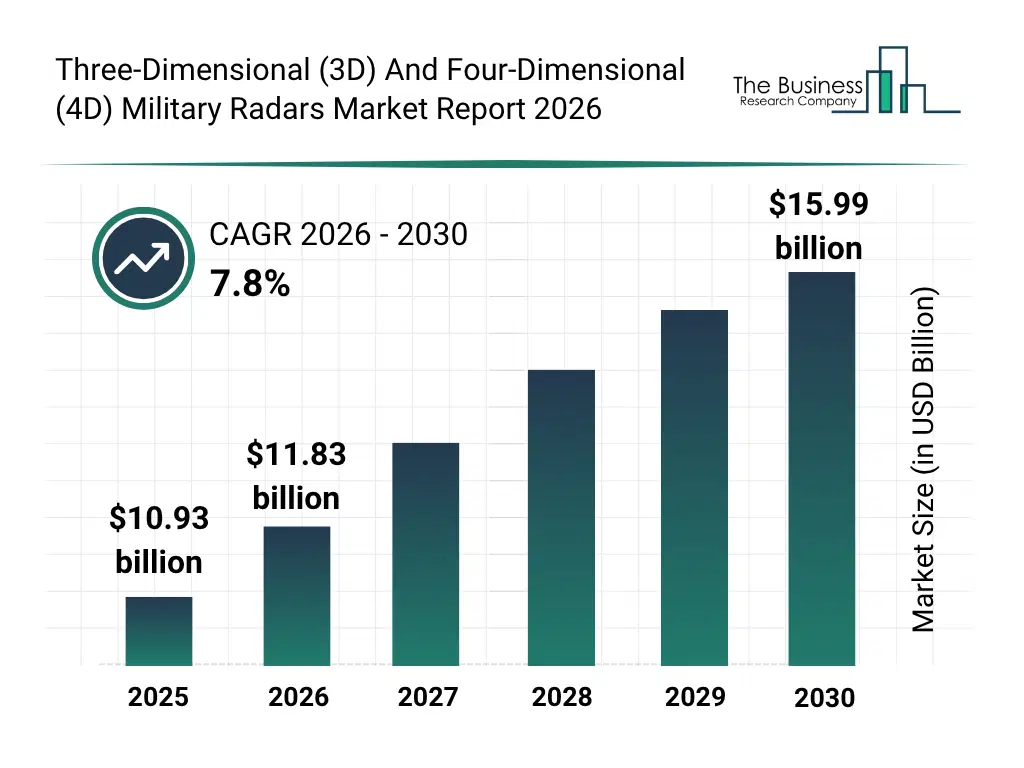
What Is The Three-Dimensional (3D) And Four-Dimensional (4D) Military Radars Market Size and Share 2026?
The three-dimensional (3d) and four-dimensional (4d) military radars market size has grown strongly in recent years. It will grow from $10.93 billion in 2025 to $11.83 billion in 2026 at a compound annual growth rate (CAGR) of 8.2%. The growth in the historic period can be attributed to growing demand for real-time military surveillance, increasing modernization of defense radar infrastructure, rising adoption of phased array radar technology, increasing focus on battlefield situational awareness, growing demand for accurate target detection and tracking.What Is The Three-Dimensional (3D) And Four-Dimensional (4D) Military Radars Market Growth Forecast?
The three-dimensional (3d) and four-dimensional (4d) military radars market size is expected to see strong growth in the next few years. It will grow to $15.99 billion in 2030 at a compound annual growth rate (CAGR) of 7.8%. The growth in the forecast period can be attributed to rising demand for next-generation multifunction radar systems, increasing deployment of high-frequency radar technologies, growing adoption of gallium nitride radar components, rising demand for enhanced low-observable target detection, increasing integration of advanced electronic warfare capabilities. Major trends in the forecast period include increasing adoption of active electronically scanned array radar systems, growing demand for advanced digital beamforming capabilities, rising use of gallium nitride based radar transmitters, increasing development of multifunction radar systems, growing demand for high-precision target detection and tracking.
Global Three-Dimensional (3D) And Four-Dimensional (4D) Military Radars Market Segmentation
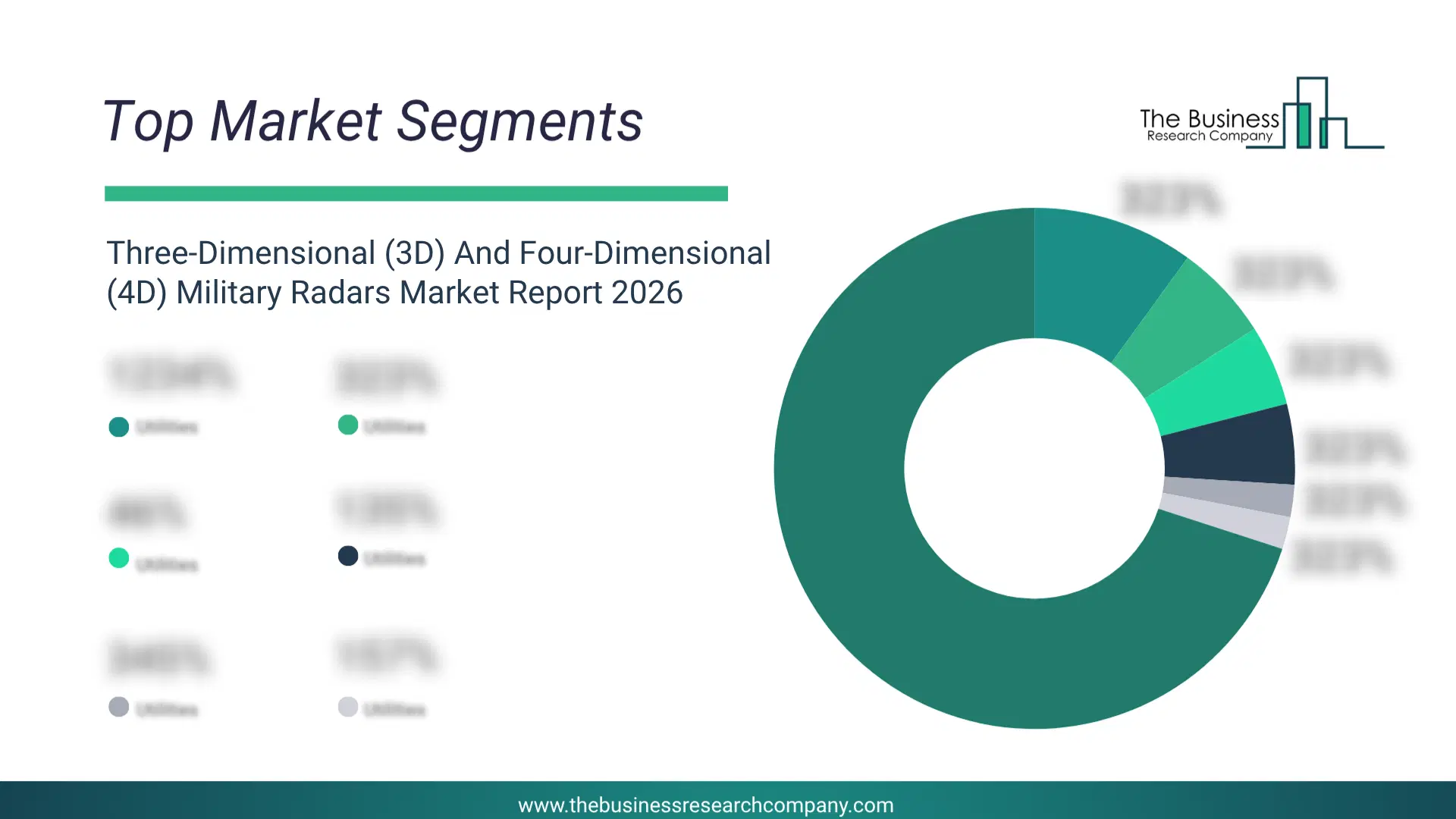
1) By Type Of Radar Technology: 3D Military Radars, 4D Military Radars, Phased Array Radars, Conventional Radars 2) By Range: Short Range Radar, Medium Range Radar, Long Range Radar 3) By Frequency Band: L Band Radar, S Band Radar, C Band Radar, X Band Radar, Ku Band Radar, Ka Band Radar, Very High Frequency, Other Frequency Bands 4) By Application: Surveillance, Weapon Guidance, Air Traffic Control, Navigation And Collision Avoidance, Weather Monitoring, Other Applications Subsegments: 1) By 3D Military Radars: Ground Based Three Dimensional Military Radars, Naval Three Dimensional Military Radars, Airborne Three Dimensional Military Radars, Mobile Three Dimensional Military Radars, Long Range Three Dimensional Military Radars 2) By 4D Military Radars: Active Electronically Scanned Array Four Dimensional Military Radars, Passive Electronically Scanned Array Four Dimensional Military Radars, Multi Function Four Dimensional Military Radars, Long Range Four Dimensional Military Radars, Target Tracking Four Dimensional Military Radars 3) By Phased Array Radars: Active Electronically Scanned Array Radars, Passive Electronically Scanned Array Radars, Fixed Phased Array Radars, Mobile Phased Array Radars, Multi Function Phased Array Radars 4) By Conventional Radars: Pulse Doppler Radars, Continuous Wave Radars, Monopulse Tracking Radars, Search And Surveillance Radars, Fire Control RadarsWhat Is The Driver Of The Three-Dimensional (3D) And Four-Dimensional (4D) Military Radars Market?
The rising military expenditure worldwide is expected to propel the growth of the 3D and 4D military radars market going forward. Military expenditure refers to government spending on armed forces, defense equipment, military operations, research and development, and other defense-related activities aimed at maintaining national security and military readiness. The military expenditure is increasing due to increasing geopolitical tensions, as nations allocate greater defense budgets to strengthen military readiness, modernize armed forces, and enhance national security capabilities. Military expenditure growth supports the development and adoption of 3D and 4D military radars by enabling greater investments in advanced radar technologies that improve air surveillance, target detection, missile defense capabilities, and battlefield situational awareness. For instance, in April 2025, according to the Stockholm International Peace Research Institute (SIPRI), a Sweden-based independent international institute, global military expenditure reached $2.72 trillion in 2024, representing a 9.4% increase in real terms compared to 2023. Therefore, the rising military expenditure worldwide is driving the growth of the 3D and 4D military radars market.Key Players In The Global Three-Dimensional (3D) And Four-Dimensional (4D) Military Radars Market
Major companies operating in the three-dimensional (3D) and four-dimensional (4D) military radars market are RTX Corporation, Lockheed Martin Corporation, Northrop Grumman Corporation, Airbus Defence and Space GmbH, Mitsubishi Electric Corporation, BAE Systems plc, Thales SA, General Dynamics Mission Systems Inc, Leonardo SpA, L3Harris Technologies Inc, Fujitsu Limited, Rheinmetall AG, Saab AB, Israel Aerospace Industries Ltd, Elbit Systems Ltd, Indra Sistemas SA, HENSOLDT AG, EDGE Group PJSC, ASELSAN Elektronik Sanayi ve Ticaret AS, Bharat Electronics Limited, Hanwha Systems Co Ltd, Terma AS, Data Patterns India Limited, SRC Inc, Electronics Corporation of India Limited, Reutech Radar Systems, Weibel Scientific AS, Blighter Surveillance Systems Limited, Echodyne Corp, Fraunhofer-Institut fur Hochfrequenzphysik und Radartechnik FHR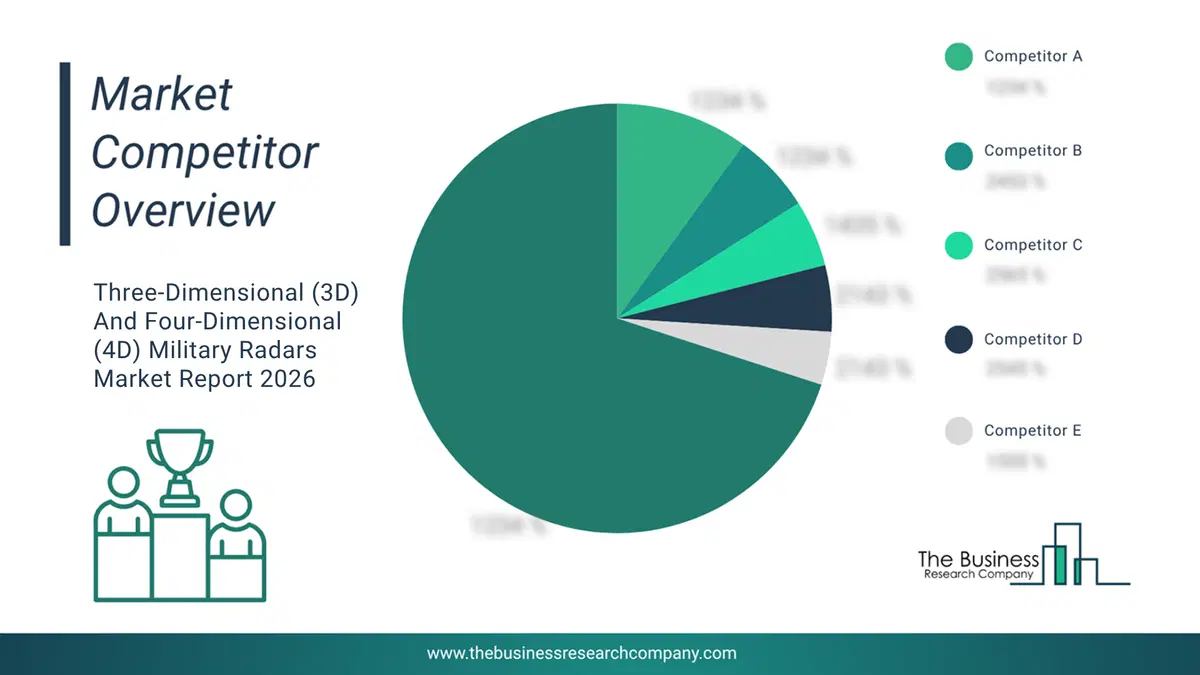
This chart is for illustrative purposes; the full report includes a detailed competitor analysis and comprehensive overview of the top 10 companies in the market.
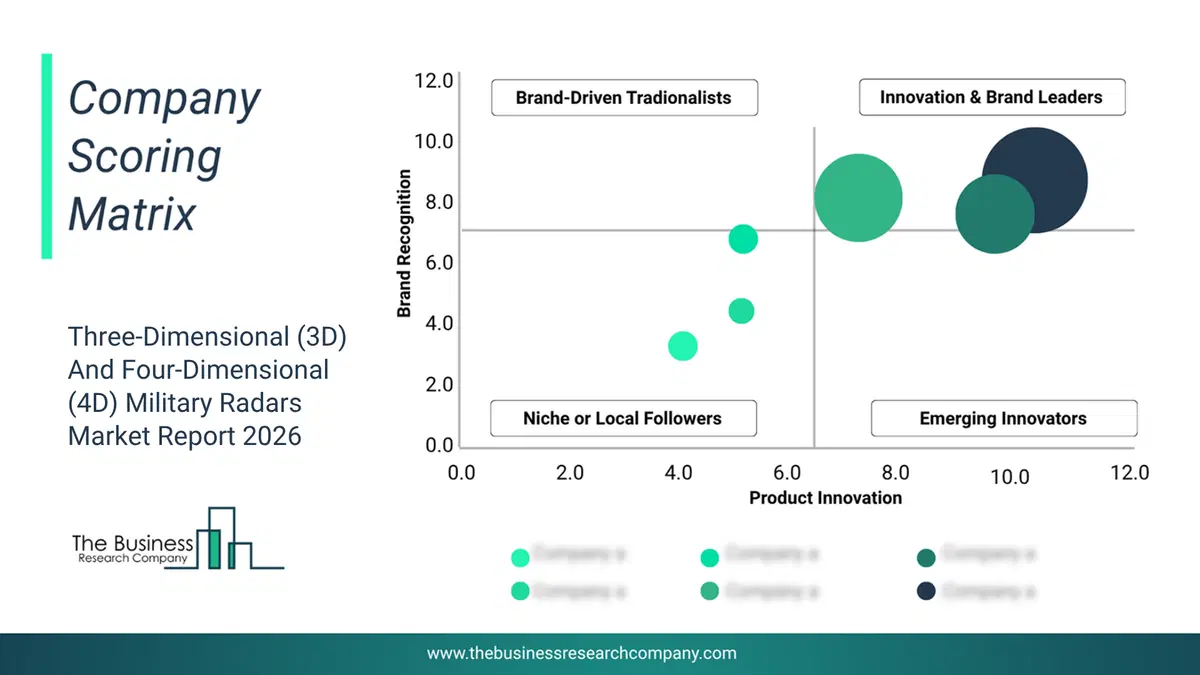
This chart maps companies by product innovation and brand strength, with bubble size indicating relative revenue, helping identify market leaders, challengers, and niche players. This is an illustrative chart; the full report provides a complete and accurate competitive analysis.
Global Three-Dimensional (3D) And Four-Dimensional (4D) Military Radars Market Trends and Insights
Major companies operating in the 3D and 4D military radars market are focusing on developing innovative solutions such as, 4D multi-mode radar systems to enhance multi-domain surveillance, drone detection capabilities, target tracking accuracy, and border security operations. 4D multi-mode radar systems are advanced electronic scanning array (ESA)-based radar technologies that provide three-dimensional target information, including range, direction, and altitude, along with an additional dimension such as target movement characteristics or velocity analysis, enabling more precise detection and classification of complex threats compared with traditional radar systems. For instance, in June 2026, Blighter Surveillance Systems, a UK-based radar technology company, received a follow-on contract from an undisclosed Eastern European Army to supply Blighter A800 Mk 2 4D Multi-Mode Radars for protecting vulnerable land and sea borders against ground incursions and low-flying drones. The radar system integrates advanced Ku-band sensing, electronic beam scanning, monopulse elevation measurement, and micro-Doppler signature analysis to detect, classify, and track ground, maritime, and aerial targets simultaneously at ranges of up to 20 km. The system is designed to identify challenging low-altitude threats, including small drones with low radar cross-sections, by using sophisticated clutter suppression technologies and AI-assisted software integration. The radar solution also incorporates BlighterNexus software to connect with command-and-control networks and third-party sensors, providing a unified operational view for enhanced battlefield awareness.What Are Latest Mergers And Acquisitions In The Three-Dimensional (3D) And Four-Dimensional (4D) Military Radars Market?
In May 2025, Thales S.A., a France-based provider of both 3D and 4D military radars, partnered with Tawazun Council to establish a local production facility for Ground Master air surveillance radars in the United Arab Emirates. With this partnership, Thales S.A. and Tawazun Council aim to strengthen the UAE’s defense manufacturing capabilities by locally producing, assembling, testing, and qualifying advanced Ground Master air surveillance radars, while enhancing national self-sufficiency, developing local industrial capabilities, and fostering Emirati talent in advanced radar technologies. Tawazun Council is a UAE-based government entity responsible for advancing the national defense and security industry.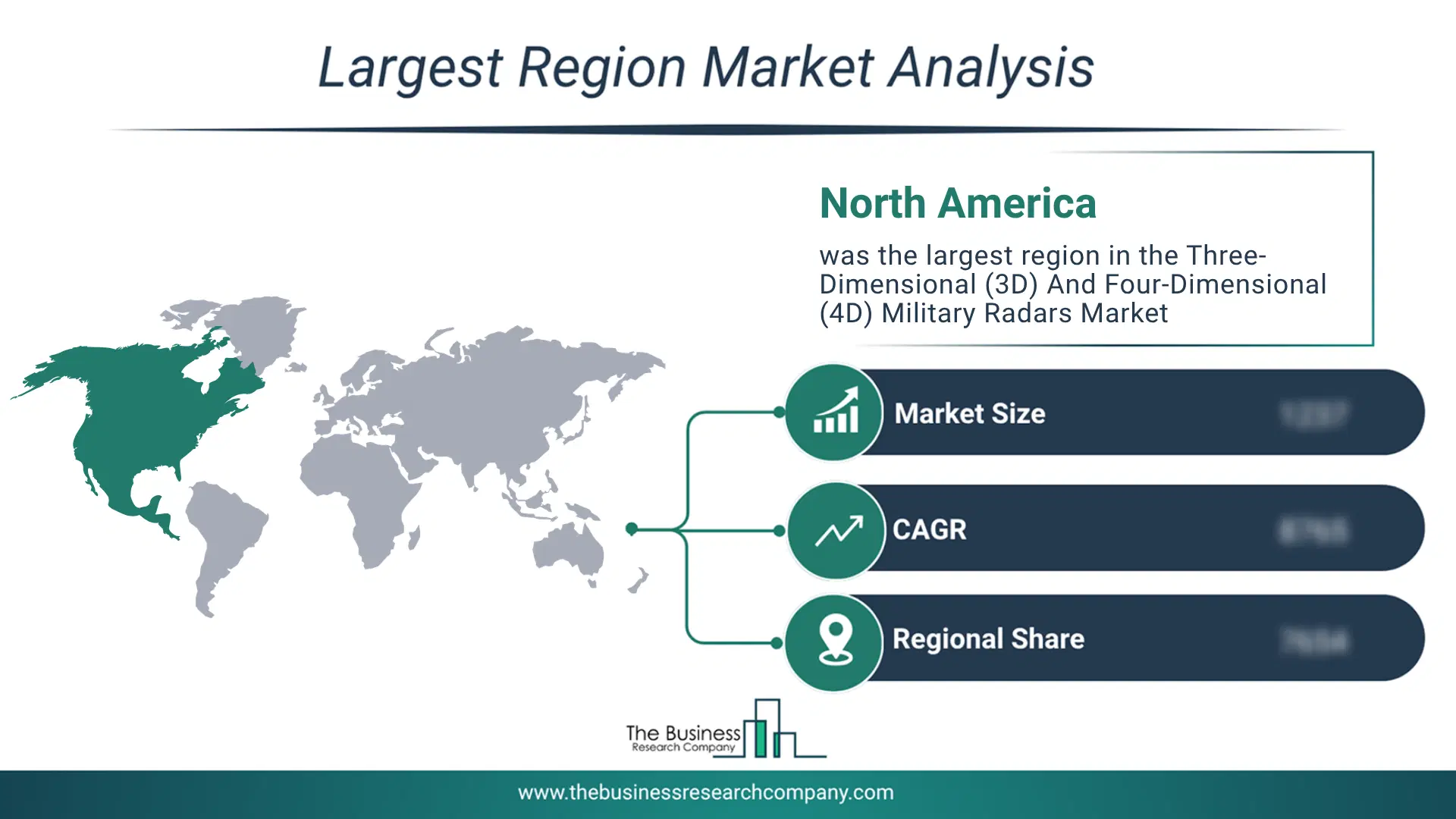
Regional Outlook
North America was the largest region in the three-dimensional (3D) and four-dimensional (4D) military radars market in 2025. Asia-Pacific is expected to be the fastest-growing region in the forecast period. The regions covered in this market report are Asia-Pacific, South East Asia, Western Europe, Eastern Europe, North America, South America, Middle East, Africa. The countries covered in this market report are Australia, Brazil, China, France, Germany, India, Indonesia, Japan, Taiwan, Russia, South Korea, UK, USA, Canada, Italy, Spain.What Defines the Three-Dimensional (3D) And Four-Dimensional (4D) Military Radars Market?
The three-dimensional (3D) and four-dimensional (4D) military radars market consists of revenues earned by entities by providing services such as radar system integration, installation, calibration, maintenance and support, modernization and upgrades, training, software development, signal processing, and system testing. The market value includes the value of related goods sold by the service provider or included within the service offering. The three-dimensional (3D) and four-dimensional (4D) military radars market also includes sales of phased array radar systems, surveillance radars, air defense radars, fire control radars, multifunction radar systems, radar antennas, transmit/receive modules, radar processors, and radar control units. Values in this market are ‘factory gate’ values, that is, the value of goods sold by the manufacturers or creators of the goods, whether to other entities (including downstream manufacturers, wholesalers, distributors, and retailers) or directly to end customers. The value of goods in this market includes related services sold by the creators of the goods.How is Market Value Defined and Measured?
The market value is defined as the revenues that enterprises gain from the sale of goods and/or services within the specified market and geography through sales, grants, or donations in terms of the currency (in USD unless otherwise specified). The revenues for a specified geography are consumption values that are revenues generated by organizations in the specified geography within the market, irrespective of where they are produced. It does not include revenues from resales along the supply chain, either further along the supply chain or as part of other products.
This chart presents market attractiveness based on a quantitative evaluation of growth, competition, strategic alignment, and risk, offering a clear view of opportunity areas for decision-making. This chart is for illustrative purposes; the full report contains the complete analysis.

This chart highlights the Total Addressable Market (TAM) by estimating the maximum revenue opportunity using an assumption-driven approach, supporting strategic planning and opportunity sizing across markets. The chart is illustrative; the full report provides a more comprehensive analysis.
What Key Data and Analysis Are Included in the Three-Dimensional (3D) And Four-Dimensional (4D) Military Radars Market Report 2026?
The three-dimensional (3d) and four-dimensional (4d) military radars market research report is one of a series of new reports from The Business Research Company that provides market statistics, including industry global market size, regional shares, competitors with the market share, detailed market segments, market trends and opportunities, and any further data you may need to thrive in the three-dimensional (3d) and four-dimensional (4d) military radars industry. The market research report delivers a complete perspective of everything you need, with an in-depth analysis of the current and future state of the industry.Three-Dimensional (3D) And Four-Dimensional (4D) Military Radars Market Report Forecast Analysis
| Report Attribute | Details |
|---|---|
| Market Size Value In 2026 | $11.83 billion |
| Revenue Forecast In 2030 | $15.99 billion |
| Growth Rate | CAGR of 7.8% from 2026 to 2030 |
| Base Year For Estimation | 2025 |
| Actual Estimates/Historical Data | 2020-2025 |
| Forecast Period | 2026 - 2030 |
| Market Representation | Revenue in USD Billion and CAGR from 2026 to 2030 |
| Segments Covered | Type Of Radar Technology, Range, Frequency Band, Application |
| Regional Scope | Asia-Pacific, Western Europe, Eastern Europe, North America, South America, Middle East, Africa |
| Country Scope | The countries covered in the report are Australia, Brazil, China, France, Germany, India, Indonesia, Japan, Taiwan, Russia, South Korea, UK, USA, Canada, Italy, Spain. |
| Key Companies Profiled | RTX Corporation, Lockheed Martin Corporation, Northrop Grumman Corporation, Airbus Defence and Space GmbH, Mitsubishi Electric Corporation, BAE Systems plc, Thales SA, General Dynamics Mission Systems Inc, Leonardo SpA, L3Harris Technologies Inc, Fujitsu Limited, Rheinmetall AG, Saab AB, Israel Aerospace Industries Ltd, Elbit Systems Ltd, Indra Sistemas SA, HENSOLDT AG, EDGE Group PJSC, ASELSAN Elektronik Sanayi ve Ticaret AS, Bharat Electronics Limited, Hanwha Systems Co Ltd, Terma AS, Data Patterns India Limited, SRC Inc, Electronics Corporation of India Limited, Reutech Radar Systems, Weibel Scientific AS, Blighter Surveillance Systems Limited, Echodyne Corp, Fraunhofer-Institut fur Hochfrequenzphysik und Radartechnik FHR |
| Customization Scope | Request for Customization |
| Pricing And Purchase Options | Explore Purchase Options |