

Three Dimensional (3D) Integrated Circuits (IC) Market Report 2026
Global Outlook – By Components ( Through Glass Vias (TGVs), Through Silicon Vias (TSVs), Other Components), By Technology ( 3D Stacked Integrated Circuit (ICs), Monolithic 3D Integrated Circuit (ICs), Integration And Packaging Type), By Application ( Aerospace And Industrial, Telecommunication And Information Technology (IT), Automotive, Consumer Electronics, Medical, Industrial, Other Applications) – Market Size, Trends, Strategies, and Forecast to 2030
Three Dimensional (3D) Integrated Circuits (IC) Market Overview
• Three Dimensional (3D) Integrated Circuits (IC) market size has reached to $14.19 billion in 2025 • Expected to grow to $28.83 billion in 2030 at a compound annual growth rate (CAGR) of 15.3% • Growth Driver: Growth Of The 3D IC Market Driven By The Rising Demand In The Semiconductor Industry • Market Trend: Advancements In 3D IC Technology For 5G With Breakthrough in RFSOI Solutions • North America was the largest region in 2025 and Asia-Pacific is the fastest growing region.Market Gains By 2030 – Top Opportunities By Segment
Market Gain identifies the most promising market opportunities by highlighting the segments or products expected to generate the highest incremental revenue growth over the next five years.
What Is Covered Under Three Dimensional (3D) Integrated Circuits (IC) Market?
Three-dimensional (3D) integrated circuits (ICs) refer to semiconductor devices where multiple layers of integrated circuits are stacked vertically to form a single, compact package. This stacking of layers allows for higher integration density, improved performance, and reduced footprint compared to traditional two-dimensional (2D) ICs. The main component types of three dimensional (3D) integrated circuit (IC) include through glass vias (TGVs), silicon vias (TSVs), and others. Through glass vias are tiny holes or channels made through a glass substrate to allow electrical signals to pass between different layers of a 3D IC, and they are used to create connections between chips in a stacked configuration, utilizing glass as a dielectric material due to its insulating properties. The technology types include 3D stacked integrated circuits (ICs), monolithic 3D integrable circuits (ICs), and integration and packaging types for applications such as aerospace and industrial, telecommunication and information technology (IT), automotive, consumer electronics, medical, industrial, and others.
What Is The Three Dimensional (3D) Integrated Circuits (IC) Market Size 2026 And Growth Rate?
The three dimensional (3d) integrated circuits (ic) market size has grown rapidly in recent years. It will grow from $14.19 billion in 2025 to $16.34 billion in 2026 at a compound annual growth rate (CAGR) of 15.1%. The growth in the historic period can be attributed to growth in consumer electronics demand, limitations of 2D IC scaling, rising data processing requirements, advancements in semiconductor fabrication techniques, early adoption in high-performance computing.What Is The Three Dimensional (3D) Integrated Circuits (IC) Market Growth Forecast?
The three dimensional (3d) integrated circuits (ic) market size is expected to see rapid growth in the next few years. It will grow to $28.83 billion in 2030 at a compound annual growth rate (CAGR) of 15.3%. The growth in the forecast period can be attributed to expansion of AI and machine learning hardware, rising demand for advanced automotive electronics, increasing investments in heterogeneous integration, growth of high-speed data centers, demand for compact and energy-efficient devices. Major trends in the forecast period include increasing adoption of vertical chip stacking technologies, rising demand for high-density and high-performance semiconductor packaging, growing use of through silicon vias and advanced interconnects, miniaturization of electronic devices driving compact IC designs, increasing focus on thermal management in multi-layer ICs.
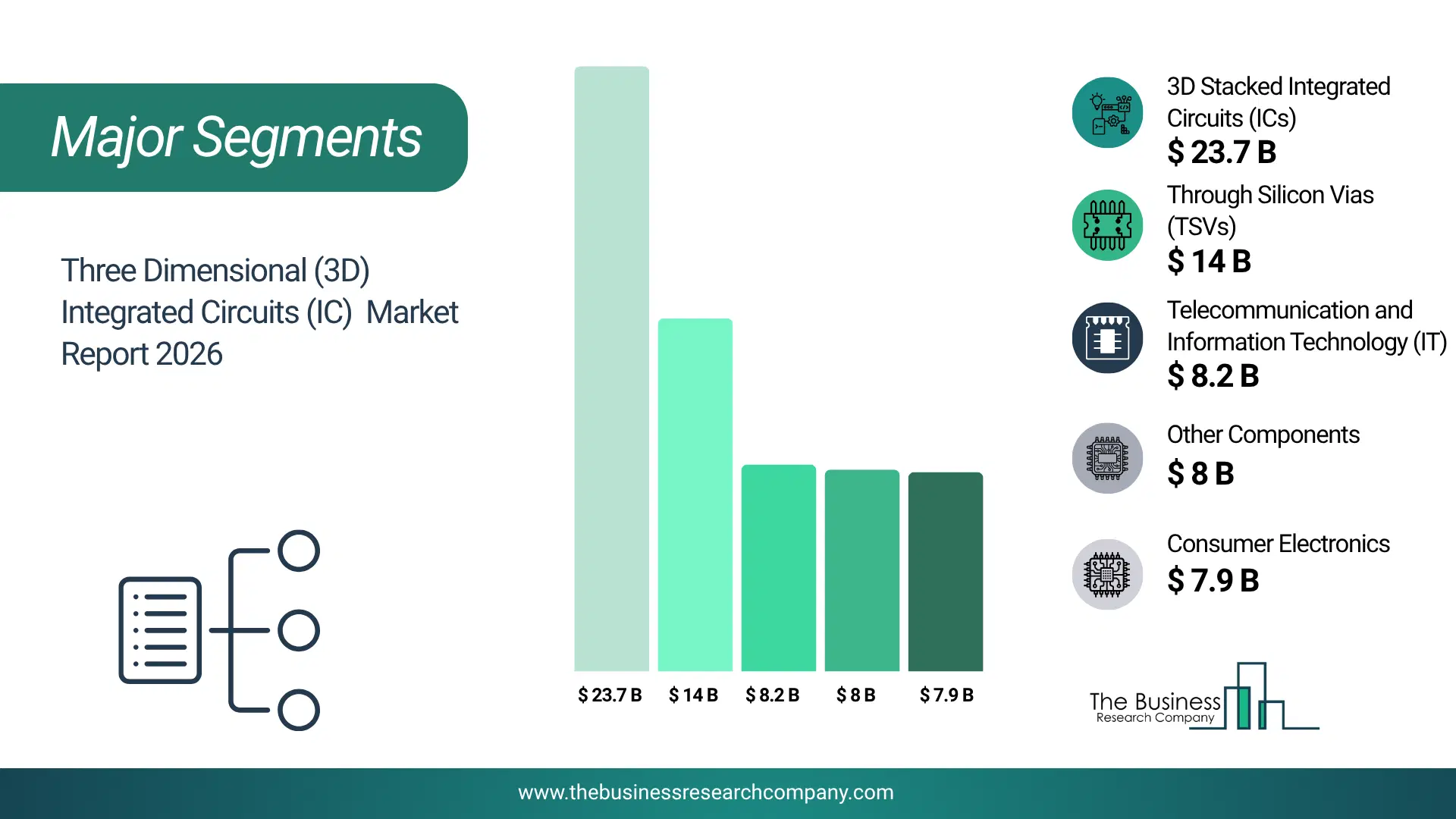
Global Three Dimensional (3D) Integrated Circuits (IC) Market Segmentation
1) By Components: Through Glass Vias (TGVs), Through Silicon Vias (TSVs), Other Components 2) By Technology: 3D Stacked Integrated Circuit (ICs), Monolithic 3D Integrated Circuit (ICs), Integration And Packaging Type 3) By Application: Aerospace And Industrial, Telecommunication And Information Technology (IT), Automotive, Consumer Electronics, Medical, Industrial, Other Applications Subsegments: 1) By Through Glass Vias (TGVs): Glass Substrate For 3D ICs, TGV Fabrication Process, TGV Interconnects, High-Performance Glass For IC Packaging 2) By Through Silicon Vias (TSVs): Silicon Wafer For TSV Fabrication, TSV Interconnects and Via Formation, Copper TSVs, TSV Packaging Solutions, High-Density Tsvs For 3D ICs 3) By Other Components: Microbumps, Interposers, Microelectromechanical Systems (MEMS), Passive Components (Resistors, Capacitors), Thermal Management Components, Power Delivery Network (PDN) Components, Wafer Bonding Materials, Test And Inspection Components The top segments in the three dimensional (3d) integrated circuits (ic) market will be: • 3D Stacked Integrated Circuits (ICs) will reach $23785.71 Million by 2030. • Through Silicon Vias (TSVs) will reach $14055.37 Million by 2030. • Other Components will reach $8048.23 Million by 2030. • Consumer Electronics will reach $7967.38 Million by 2030. • Telecommunication and Information Technology (IT) will reach $8205.45 Million by 2030.What Is The Driver Of The Three Dimensional (3D) Integrated Circuits (IC) Market?
The growing semiconductor industry is expected to propel the growth of the three-dimensional (3D) integrated circuit (IC) market going forward. The semiconductor industry encompasses companies engaged in designing, manufacturing, and selling semiconductor devices, which are essential components in a wide range of electronic products such as computers, smartphones, and industrial machinery. The semiconductor industry is experiencing significant growth due to the proliferation of consumer electronics, such as smartphones, tablets, and wearable devices, which drives the demand for advanced semiconductor components. Moreover, the rollout of 5G networks requires new semiconductor technologies for improved communication, faster data transfer, and enhanced connectivity. 3D ICs offer several advantages for semiconductor applications, including enhanced performance, improved power efficiency, space optimization, and effective thermal management. For instance, in July 2024, according to the Semiconductor Industry Association (SIA), a US-based trade association and lobbying group that represents the United States semiconductor industry, global semiconductor industry sales hit $49.1 billion during May 2024, an increase of 19.3% compared to the May 2023 total of $41.2 billion and an increase of 4.1% compared to the April 2024 total of $47.2 billion. Therefore, the growing need for semiconductor industries drives the growth of the three-dimensional (3D) integrated circuit (IC) market.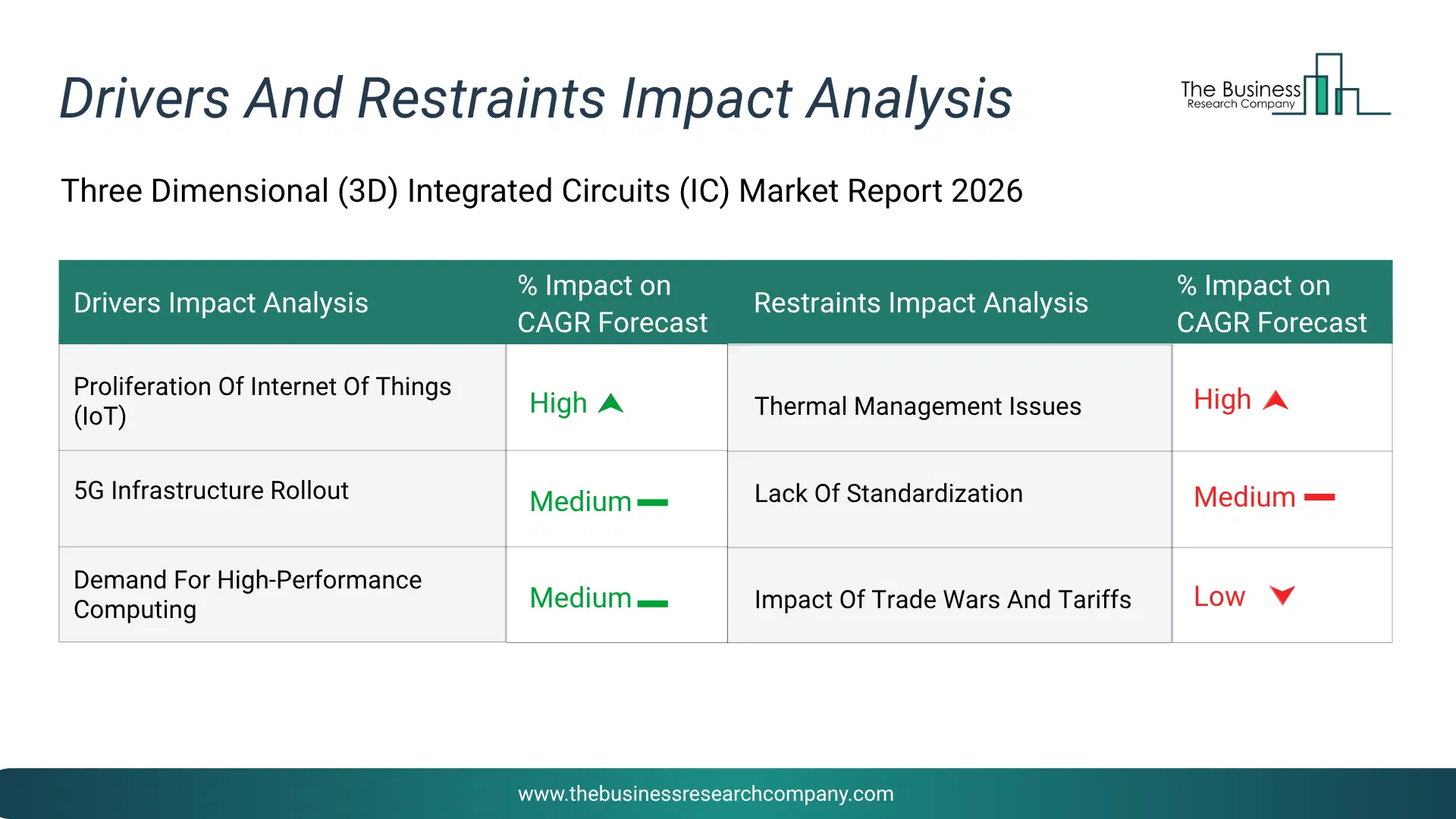
Infographic Chart Showing Key Market Drivers Analysis And Restraints For Three Dimensional (3D) Integrated Circuits (Ic) Market
The chart presents an impact analysis of key drivers and restraints, quantifying their relative influence on the market's growth rate and helping assess the balance between growth enablers and limiting factors. This chart offers a high-level perspective; the full report contains more detailed insights.
How Will The Drivers Impact Growth In The Global Three Dimensional (3D) Integrated Circuits (IC) Market?
• Proliferation Of Internet Of Things (IoT) (High) – During the forecast period, the proliferation of Internet of Things (IoT) devices is expected to be a key driver propelling growth in the three dimensional (3D) integrated circuits (ICs) market. As digital transformation accelerates, organizations increasingly deploy connected sensors and smart devices to enable real-time monitoring and data-driven operations. The growing adoption of IoT technologies is expanding the number of connected devices across edge computing and cloud networks, increasing demand for high-performance semiconductor architectures. The expansion of IoT ecosystems increases real-time data across networks, driving demand for high-density and faster 3D integrated circuits (IC). The proliferation of Internet of Things (IoT) devices growth contribution during the forecast period in 2025 is 2.5%. • 5G Infrastructure Rollout (Medium) – During the forecast period, the rollout of 5G infrastructure is expected to be a key driver propelling growth in the three dimensional (3D) integrated circuits (ICs) market. As digital connectivity expands, telecom operators and governments are investing in 5G networks to enable ultra-fast, low-latency communication. The growing deployment of 5G is increasing connected devices across mobile networks and smart infrastructure, driving demand for high-performance semiconductor architectures. The expansion of 5G ecosystems is expected to boost demand for advanced 3D integrated circuits (ICs) that enable higher chip density and faster data processing. The rollout of 5G infrastructure growth contribution during the forecast period in 2025 is 1.5%. • Demand For High-Performance Computing (Medium) – During the forecast period, the growing demand for high-performance computing (HPC) is expected to be a key driver propelling growth in the three dimensional (3D) integrated circuits (ICs) market. As artificial intelligence, advanced analytics and large-scale data processing expand, organizations increasingly require powerful computing infrastructure to handle complex workloads and massive datasets. The growing investment in AI data centers and supercomputing platforms is increasing demand for high-bandwidth, energy-efficient semiconductor architectures. The growing demand for high-performance computing (HPC) growth contribution during the forecast period in 2025 is 1.3%. • Rise In Miniaturization Of Devices (Medium) – During the forecast period, the rise in the miniaturization of electronic devices is expected to be a key driver propelling growth in the three dimensional (3D) integrated circuits (ICs) market. As consumer electronics, wearables and smart devices evolve, manufacturers increasingly seek compact semiconductor architectures with higher functionality and performance. The growing focus on miniaturization is expanding the use of high-density chip technologies in smartphones, wearables and compact computing systems. The rise in the miniaturization of electronic devices growth contribution during the forecast period in 2025 is 1.0%.How Will The Restraints Impact Growth In The Global Three Dimensional (3D) Integrated Circuits (IC) Market?
• Thermal Management Issues (High) – During the forecast period, thermal management issues are expected to restrict the growth of the three dimensional (3D) integrated circuits (ICs) market. As semiconductor manufacturers increasingly adopt vertically stacked chip architectures to achieve higher performance and integration density, heat dissipation becomes more difficult due to the compact structure of multi-layer chips. The growing complexity of 3D IC designs increases power density and heat accumulation within stacked layers, making thermal control a critical challenge in advanced semiconductor systems. The presence of excessive heat and limited heat dissipation pathways can reduce chip reliability and performance, thereby slowing the large-scale adoption of 3D integrated circuits (ICs). Growth affected by the thermal management issues during the forecast period in 2025 is -2.5%. • Lack Of Standardization (Medium) – During the forecast period, lack of standardization in 3D IC design and packaging is restricting the growth of the three dimensional (3D) integrated circuits (ICs) market by creating interoperability challenges and increasing design complexity. Developing 3D integrated circuits involves complex multi-vendor integration and design workflows and the lack of consistent standards leads to compatibility issues and fragmented development ecosystems. These challenges, along with evolving manufacturing processes and diverse chiplet integration methods, increase uncertainty and slow the large-scale adoption of 3D IC technologies. Growth affected by the lack of standardization in 3D IC design and packaging during the forecast period in 2025 is -1.5%. • Impact Of Trade Wars And Tariffs (Medium) – During the forecast period, the impact of trade wars and tariffs is expected to restrict the growth of the three dimensional (3D) integrated circuits (ICs) market. As geopolitical tensions intensify, governments increasingly impose tariffs, export controls and trade restrictions on semiconductor technologies and manufacturing equipment. These policies disrupt global semiconductor supply chains and increase costs for companies operating across international markets. The escalation of trade conflicts across major economies increases uncertainty in cross-border semiconductor trade, slowing investment and adoption of advanced 3D integrated circuits (ICs). Growth affected by the impact of trade wars and tariffs during the forecast period in 2025 is -0.3%.Key Players In The Global Three Dimensional (3D) Integrated Circuits (IC) Market
Major companies operating in the three dimensional (3d) integrated circuits (ic) market are Samsung Electronics Co. Ltd., Taiwan Semiconductor Manufacturing Company (TSMC), Intel Corporation, International Business Machines Corporation, Qualcomm Incorporated, SK Hynix Inc., Broadcom Inc., Micron Technology Inc., NVIDIA Corporation, Toshiba Corporation, Advanced Micro Devices Inc. (AMD), ASML Holding N.V., Texas Instruments Incorporated, MediaTek Inc., STMicroelectronics N.V., Infineon Technologies AG, NXP Semiconductors N.V., Analog Devices Inc., Renesas Electronics Corporation, United Microelectronics Corporation, ON Semiconductor Corporation, GlobalFoundries Inc., Microchip Technology Incorporated, Marvell Technology Group Ltd., JCET Group, Xilinx Inc., Silicon Labs Inc., Rambus Inc.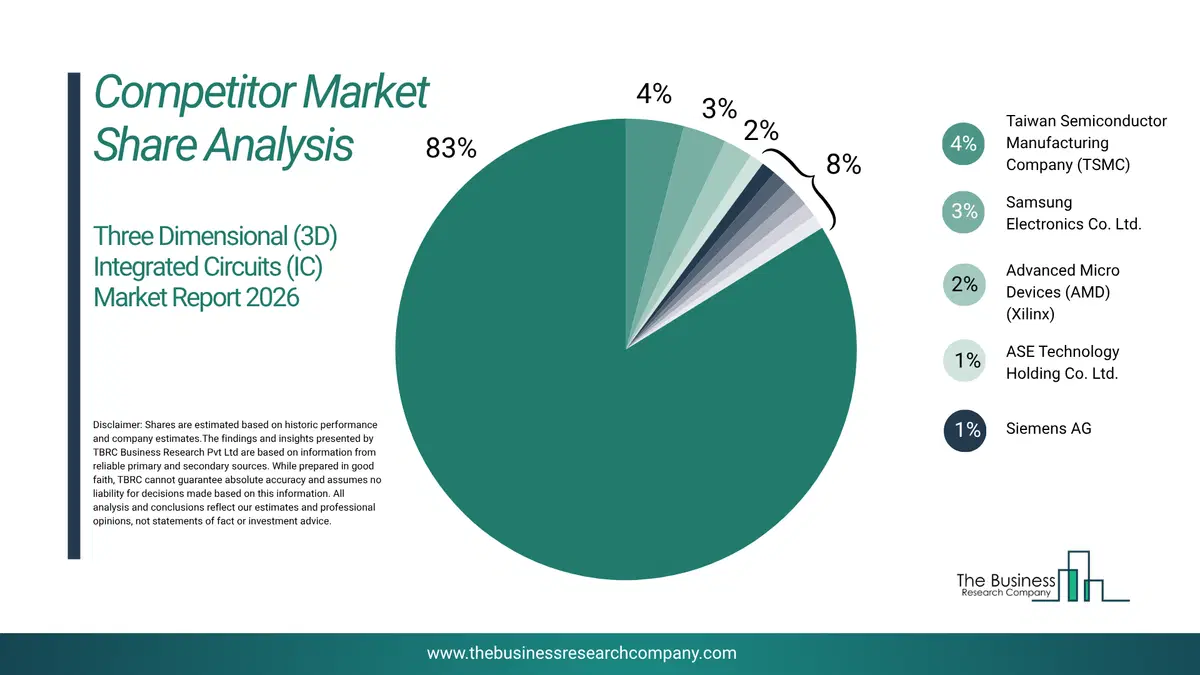
This chart is for illustrative purposes; the full report includes a detailed competitor analysis and comprehensive overview of the top 10 companies in the market.
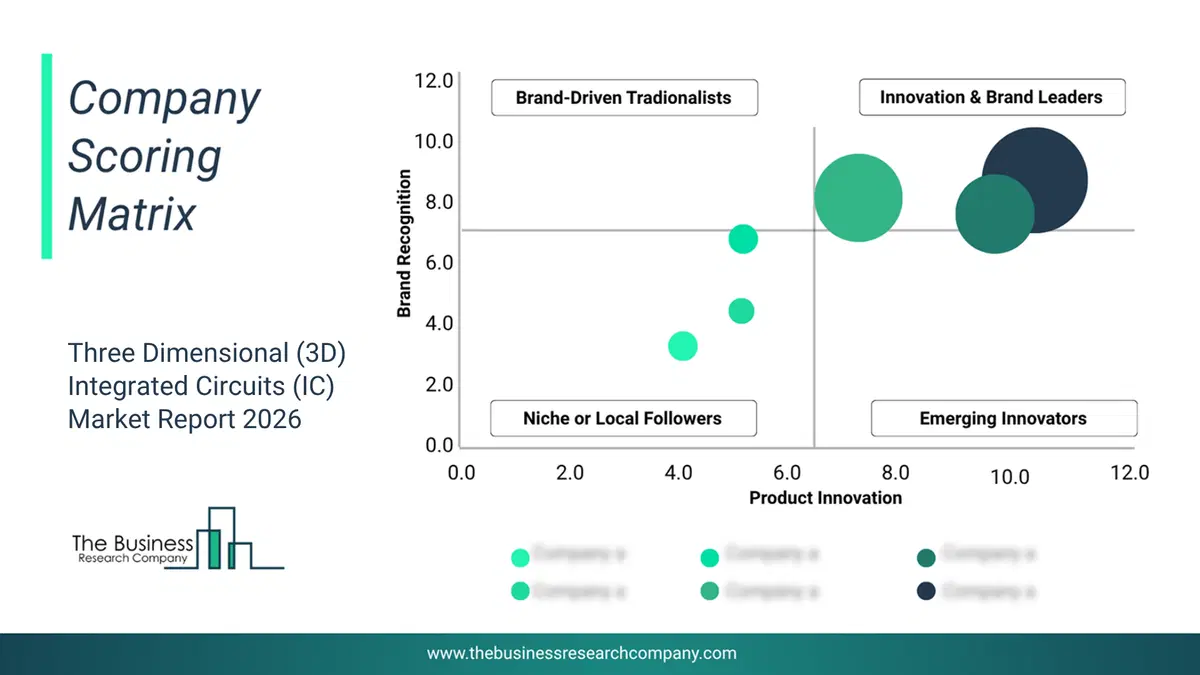
This chart maps companies by product innovation and brand strength, with bubble size indicating relative revenue, helping identify market leaders, challengers, and niche players. This is an illustrative chart; the full report provides a complete and accurate competitive analysis.
Global Three Dimensional (3D) Integrated Circuits (IC) Market Trends and Insights
Major companies operating in the Three Dimensional (3D) Integrated Circuits (IC) market are focusing on developing custom 3D ICs tailored to specific applications or customer requirements such as 5G radio frequency performance, to gain competitive advantage, meet precise market needs, and drive higher revenue through specialized solutions. 3D IC technology enhances 5G by integrating multiple high-speed components into a single package, improving performance, reducing latency, and enabling more compact and efficient network infrastructure and devices. For instance, in May 2024, United Microelectronics Corporation, a Taiwan-based multinational corporation and semiconductor company, launched the industry’s first 3D IC solution for radio frequency silicon on insulator (RFSOI) technology, marking a significant advancement in the 5G era. This pioneering technology, available on UMC’s 55nm RFSOI platform, reduces circuit footprint by over 45%, allowing for integrating more RF components into 5G devices. The innovative 3D IC solution addresses the challenge of radio frequency (RF) interference and sets the stage for future developments in 5G millimeter-wave (mmWave) technology.What Are Latest Mergers And Acquisitions In The Three Dimensional (3D) Integrated Circuits (IC) Market?
In September 2024, Siemens Digital Industries Software, a US-based industrial software solution company, extended its partnership with Taiwan Semiconductor Manufacturing Company Limited (TSMC) to advance integrated circuit and systems design. Through this strategic partnership, Siemens aims to enhance its technological capabilities and deliver optimized design solutions by aligning its EDA tools with TSMC’s advanced silicon process and packaging technologies, empowering customers to develop next-generation semiconductor products with higher power efficiency and performance. Taiwan Semiconductor Manufacturing Company Limited (TSMC) is a Taiwan-based semiconductor manufacturing company that specializes in manufacturing advanced process nodes and 3D integrated circuits (IC) design.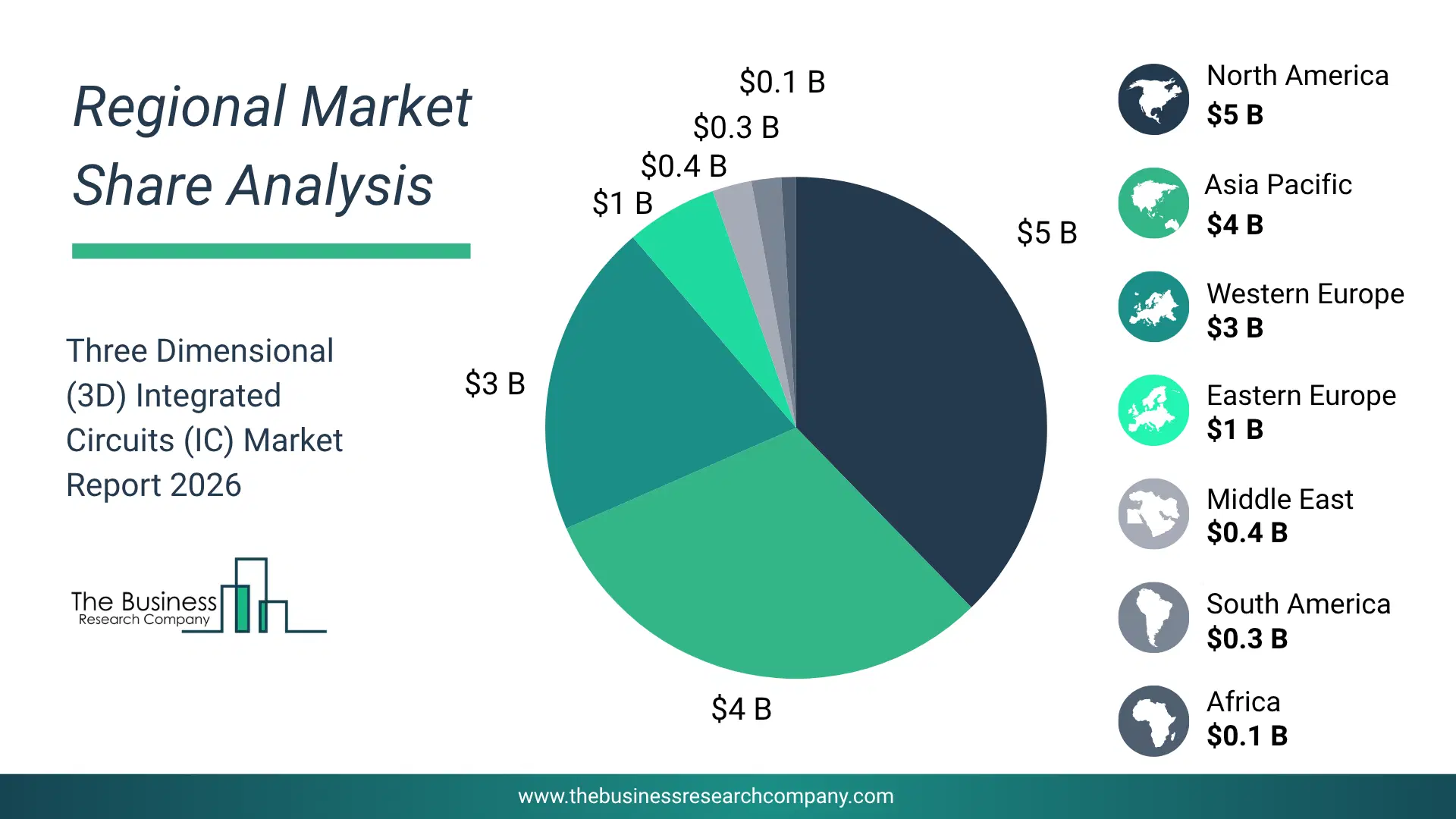
Regional Outlook
North America was the largest region in the three dimensional (3D) integrated circuit (IC) market in 2025. Asia-Pacific is expected to be the fastest-growing region in the forecast period. The regions covered in this market report are Asia-Pacific, South East Asia, Western Europe, Eastern Europe, North America, South America, Middle East, Africa. The countries covered in this market report are Australia, Brazil, China, France, Germany, India, Indonesia, Japan, Taiwan, Russia, South Korea, UK, USA, Canada, Italy, Spain.What Defines the Three Dimensional (3D) Integrated Circuits (IC) Market?
The three-dimensional (3D) integrated circuit (IC) market consists of sales of chip-on-chip (CoC), wafer-on-wafer (WoW), and chip-on-wafer (CoW). Values in this market are ‘factory gate’ values, that is, the value of goods sold by the manufacturers or creators of the goods, whether to other entities (including downstream manufacturers, wholesalers, distributors, and retailers) or directly to end customers. The value of goods in this market includes related services sold by the creators of the goods.How is Market Value Defined and Measured?
The market value is defined as the revenues that enterprises gain from the sale of goods and/or services within the specified market and geography through sales, grants, or donations in terms of the currency (in USD unless otherwise specified). The revenues for a specified geography are consumption values that are revenues generated by organizations in the specified geography within the market, irrespective of where they are produced. It does not include revenues from resales along the supply chain, either further along the supply chain or as part of other products.
This chart presents market attractiveness based on a quantitative evaluation of growth, competition, strategic alignment, and risk, offering a clear view of opportunity areas for decision-making. This chart is for illustrative purposes; the full report contains the complete analysis.

This chart highlights the Total Addressable Market (TAM) by estimating the maximum revenue opportunity using an assumption-driven approach, supporting strategic planning and opportunity sizing across markets. The chart is illustrative; the full report provides a more comprehensive analysis.
What Key Data and Analysis Are Included in the Three Dimensional (3D) Integrated Circuits (IC) Market Report 2026?
The three dimensional (3d) integrated circuits (ic) market research report is one of a series of new reports from The Business Research Company that provides market statistics, including industry global market size, regional shares, competitors with the market share, detailed market segments, market trends and opportunities, and any further data you may need to thrive in the three dimensional (3d) integrated circuits (ic) industry. The market research report delivers a complete perspective of everything you need, with an in-depth analysis of the current and future state of the industry.Three Dimensional (3D) Integrated Circuits (IC) Market Report 2026 Market Report Forecast Analysis
| Report Attribute | Details |
|---|---|
| Market Size Value In 2026 | $16.34 billion |
| Revenue Forecast In 2030 | $28.83 billion |
| Growth Rate | CAGR of 15.1% from 2026 to 2030 |
| Base Year For Estimation | 2025 |
| Actual Estimates/Historical Data | 2020-2025 |
| Forecast Period | 2026 - 2030 - 2035 |
| Market Representation | Revenue in USD Billion and CAGR from 2026 to 2030 |
| Segments Covered | Components, Technology, Application |
| Regional Scope | Asia-Pacific, Western Europe, Eastern Europe, North America, South America, Middle East, Africa |
| Country Scope | The countries covered in the report are Australia, Brazil, China, France, Germany, India, Indonesia, Japan, Taiwan, Russia, South Korea, UK, USA, Canada, Italy, Spain. |
| Key Companies Profiled | Samsung Electronics Co. Ltd., Taiwan Semiconductor Manufacturing Company (TSMC), Intel Corporation, International Business Machines Corporation, Qualcomm Incorporated, SK Hynix Inc., Broadcom Inc., Micron Technology Inc., NVIDIA Corporation, Toshiba Corporation, Advanced Micro Devices Inc. (AMD), ASML Holding N.V., Texas Instruments Incorporated, MediaTek Inc., STMicroelectronics N.V., Infineon Technologies AG, NXP Semiconductors N.V., Analog Devices Inc., Renesas Electronics Corporation, United Microelectronics Corporation, ON Semiconductor Corporation, GlobalFoundries Inc., Microchip Technology Incorporated, Marvell Technology Group Ltd., JCET Group, Xilinx Inc., Silicon Labs Inc., Rambus Inc. |
| Customization Scope | Request for Customization |
| Pricing And Purchase Options | Explore Purchase Options |