
Three-Dimensional (3D) Printed Drugs Market Report 2026
Global Outlook – By Technology (Inkjet Printing, Fused Deposition Modeling (FDM), Stereolithography (SLA), Selective Laser Sintering (SLS), Other Technologies), By Drug Type (Immediate Release, Sustained Release, Personalized Medicines, Other Drug Types), By Application (Oncology, Neurology, Infectious Diseases, Cardiovascular, Other Applications), By End-User (Hospitals, Pharmaceutical Companies, Research Institutes, Other End-Users) – Market Size, Trends, Strategies, and Forecast to 2035
Three-Dimensional (3D) Printed Drugs Market Overview
• Three-Dimensional (3D) Printed Drugs market size has reached to $0.36 billion in 2025 • Expected to grow to $0.81 billion in 2030 at a compound annual growth rate (CAGR) of 17.6% • Growth Driver: Rising Adoption Of Personalized Medicine Driving The Growth Of The Market Due To Increasing Demand For Patient-specific Therapies And Advancements In Genomics • Market Trend: Next-Generation Pharmaceutical Facilities Enable Personalized Medicine At Scale • North America was the largest region in 2025 and Asia-Pacific is the fastest growing region.What Is Covered Under Three-Dimensional (3D) Printed Drugs Market?
3D printed drugs are pharmaceutical products manufactured using additive manufacturing techniques that build dosage forms layer by layer based on digital designs. This approach enables precise control over drug composition, release profiles, and complex structures that are difficult to achieve with traditional manufacturing methods. It supports the development of personalized medications and innovative dosage forms with improved efficacy, safety, and patient compliance. The main technologies of 3D printed drugs include inkjet printing, fused deposition modeling (FDM), stereolithography (SLA), selective laser sintering (SLS), and other technologies. Inkjet printing refers to a pharmaceutical 3D printing technique where precise droplets of drug formulation are deposited layer by layer to create accurate and customizable dosage forms. The different drug types include immediate release, sustained release, personalized medicines, and other drug types. The various applications involved are oncology, neurology, infectious diseases, cardiovascular, and other applications, and they are used by several end users such as hospitals, pharmaceutical companies, research institutes, and other end-users.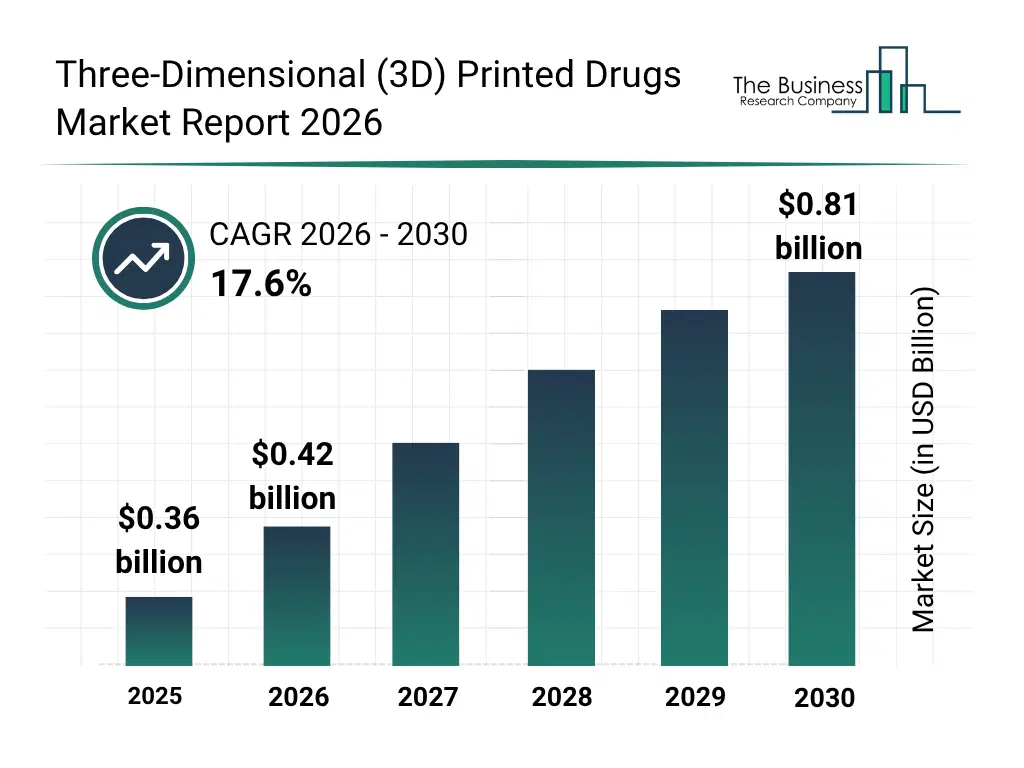
What Is The Three-Dimensional (3D) Printed Drugs Market Size and Share 2026?
The three-dimensional (3D) printed drugs market size has grown rapidly in recent years.It will grow from $0.36 billion in 2025 to $0.42 billion in 2026 at a compound annual growth rate (CAGR) of 17.4%. The growth in the historic period can be attributed to growing demand for personalized medicine solutions, increasing advancements in additive manufacturing technologies, rising prevalence of chronic diseases requiring customized therapies, expansion of pharmaceutical research and development activities, increasing focus on improving patient adherence and dosage accuracy.What Is The Three-Dimensional (3D) Printed Drugs Market Growth Forecast?
The three-dimensional (3D) printed drugs market size is expected to see rapid growth in the next few years.It will grow to $0.81 billion by 2030 at a compound annual growth rate (CAGR) of 17.6%. The growth in the forecast period can be attributed to growing investment in digital pharmaceutical manufacturing platforms, rising adoption of AI-assisted drug formulation technologies, increasing demand for on-demand drug production in healthcare facilities, expansion of precision medicine applications in oncology and neurology, growing innovation in multi-material pharmaceutical printing technologies.Major trends in the forecast period include increasing adoption of personalized dosage formulations through 3D printing technologies, rising development of complex multi-drug release structures for targeted therapies, growing use of layer-by-layer drug fabrication for improved patient compliance, expanding research on rapid prototyping of customized oral dosage forms, increasing demand for precise low-volume pharmaceutical manufacturing solutions.
Global Three-Dimensional (3D) Printed Drugs Market Segmentation
1) By Technology: Inkjet Printing, Fused Deposition Modeling (FDM), Stereolithography (SLA), Selective Laser Sintering (SLS), Other Technologies 2) By Drug Type: Immediate Release, Sustained Release, Personalized Medicines, Other Drug Types 3) By Application: Oncology, Neurology, Infectious Diseases, Cardiovascular, Other Applications 4) By End-User: Hospitals, Pharmaceutical Companies, Research Institutes, Other End-Users Subsegments: 1) By Inkjet Printing: Continuous Inkjet Printing, Drop-On-Demand Inkjet Printing, Thermal Inkjet Printing, Piezoelectric Inkjet Printing, Electrohydrodynamic Inkjet Printing 2) By Fused Deposition Modeling (FDM): Filament Extrusion Deposition, Hot Melt Extrusion Deposition, Multi-Material Extrusion, High Precision Layer Deposition, Continuous Filament Deposition 3) By Stereolithography (SLA): Digital Light Processing Stereolithography, Two-Photon Polymerization Stereolithography, Mask Stereolithography, High Speed Stereolithography, Laser Scanning Stereolithography 4) By Selective Laser Sintering (SLS): Polymer Powder Laser Sintering, Metal Powder Laser Sintering, Ceramic Powder Laser Sintering, Composite Powder Laser Sintering, High Precision Laser Sintering 5) By Other Technologies: Binder Jetting Technology, Electron Beam Melting, Laminated Object Manufacturing, Direct Energy Deposition, Continuous Liquid Interface ProductionWhat Is The Driver Of The Three-Dimensional (3D) Printed Drugs Market?
The increasing adoption of personalized medicine approaches is expected to propel the growth of the 3D printed drugs market going forward.Personalized medicine approaches refer to medical strategies that tailor drug formulation and treatment based on individual patient characteristics, including genetic profile, age, disease condition, and therapeutic response.The rise in personalized medicine adoption is driven mainly by the growing demand for patient-specific therapies, increasing prevalence of chronic diseases, and advancements in genomics and digital health technologies.3D printed drugs support this trend by enabling precise dose customization, polypill formulation, and controlled drug release profiles tailored to individual patient needs.For instance, in February 2024, Personalized Medicine Coalition, a US-based non-profit organization, in 2023, the FDA approved 16 new personalized treatments for patients with rare diseases, a significant increase from the six approved in 2022.Therefore, the increasing adoption of personalized medicine approaches is driving the growth of the 3D printed drugs market.Key Players In The Global Three-Dimensional (3D) Printed Drugs Market
Major companies operating in the three-dimensional (3d) printed drugs market are Merck KGaA, Adare Pharma Solutions Inc., Aprecia Pharmaceuticals Company, Multiply Labs Inc., FabRx Ltd, Laxxon Medical AG, CurifyLabs Oy, MB Therapeutics SAS, Doser Ltd, DiHeSys Digital Health Systems GmbH, Craft Health Pte. Ltd., Triastek Inc., Cycle Pharmaceuticals Ltd, Amply Discovery Inc.Global Three-Dimensional (3D) Printed Drugs Market Trends and Insights
Major companies operating in the 3D printed drugs market are focusing on developing fully automated digital pharmaceutical production facilities, such as precision 3D-printed drug factories, to print tablets layer by layer based on digital drug designs, enabling complex internal geometries and customized release profiles while greatly reducing production stages. Precision 3D-printed drug factories refer to advanced, often small-scale pharmaceutical manufacturing units that use 3D printing technologies to produce personalized medicines with high accuracy, flexibility, and on-demand capability. For instance, in October 2025, Triastek, a China‑based pharmaceutical technology company, opened a 3D‑printed drug factory in Nanjing, capable of producing up to 300 million tablets annually using its digital systems that replace traditional granulation and coating steps, enable internal channels for controlled release, and integrate over 100,000 monitoring points for quality control. This facility also holds China’s first pharmaceutical production license for 3D‑printed drugs and supports pipelines for anticoagulants and hormone therapies; however, regulatory validation and consistency in printing quality remain essential as the industry scales.What Are Latest Mergers And Acquisitions In The Three-Dimensional (3D) Printed Drugs Market?
In September 2025, Aprecia Pharmaceuticals Company, a US-based pharmaceutical company, partnered with Apprentice. io to scale pharmaceutical 3D printing manufacturing. The partnership aims to integrate AI-driven manufacturing execution systems to enhance production efficiency, ensure quality compliance, and accelerate the commercialization of 3D printed drugs. Apprentice. io is a US-based company specializing in cloud-based software solutions for pharmaceutical manufacturing and digital production management.Regional Insights
North America was the largest region in the 3D printed drugs market in 2025. Asia-Pacific is expected to be the fastest-growing region in the forecast period. The regions covered in this market report are Asia-Pacific, South East Asia, Western Europe, Eastern Europe, North America, South America, Middle East and Africa. The countries covered in this market report are Australia, Brazil, China, France, Germany, India, Indonesia, Japan, Taiwan, Russia, South Korea, UK, USA, Canada, Italy, Spain.What Defines the Three-Dimensional (3D) Printed Drugs Market?
The 3D printed drugs market consists of revenues earned by entities by providing services such as formulation design, customized drug manufacturing, dosage personalization, rapid prototyping of drug delivery systems, and contract research and development. The market value includes the value of related goods sold by the service provider or included within the service offering. The 3D printed drugs market also includes sales of tablets, capsules, and personalized dosage forms. Values in this market are ‘factory gate’ values, that is, the value of goods sold by the manufacturers or creators of the goods, whether to other entities (including downstream manufacturers, wholesalers, distributors, and retailers) or directly to end customers. The value of goods in this market includes related services sold by the creators of the goods.What is the Market Assessment and Strategic Outlook for the Three-Dimensional (3D) Printed Drugs Industry?
The three-dimensional (3d) printed drugs market research report is one of a series of new reports from The Business Research Company that provides market statistics, including industry global market size, regional shares, competitors with the market share, detailed market segments, market trends and opportunities, and any further data you may need to thrive in the three-dimensional (3d) printed drugs industry. The market research report delivers a complete perspective of everything you need, with an in-depth analysis of the current and future state of the industry.What is the Market Assessment and Strategic Outlook for the Three-Dimensional (3D) Printed Drugs Market Report 2026?
The three-dimensional (3D) printed drugs market research report is one of a series of new reports from The Business Research Company that provides three-dimensional (3D) printed drugs market statistics, including three-dimensional (3D) printed drugs industry global market size, regional shares, competitors with a three-dimensional (3D) printed drugs market share, detailed three-dimensional (3D) printed drugs market segments, market trends and opportunities, and any further data you may need to thrive in the three-dimensional (3D) printed drugs industry. This three-dimensional (3D) printed drugs market research report delivers a complete perspective of everything you need, with an in-depth analysis of the current and future scenario of the industry.Three-Dimensional (3D) Printed Drugs Market Report Forecast Analysis
| Report Attribute | Details |
|---|---|
| Market Size Value In 2026 | $0.42 billion |
| Revenue Forecast In 2035 | $0.81 billion |
| Growth Rate | CAGR of 17.6% from 2026 to 2035 |
| Base Year For Estimation | 2025 |
| Actual Estimates/Historical Data | 2020-2025 |
| Forecast Period | 2026 - 2030 - 2035 |
| Market Representation | Revenue in USD Billion and CAGR from 2026 to 2035 |
| Segments Covered | Technology, Drug Type, Application, End-User |
| Regional Scope | Asia-Pacific, Western Europe, Eastern Europe, North America, South America, Middle East, Africa |
| Country Scope | The countries covered in the report are Australia, Brazil, China, France, Germany, India, Indonesia, Japan, Taiwan, Russia, South Korea, UK, USA, Canada, Italy, Spain. |
| Key Companies Profiled | Merck KGaA, Adare Pharma Solutions Inc., Aprecia Pharmaceuticals Company, Multiply Labs Inc., FabRx Ltd, Laxxon Medical AG, CurifyLabs Oy, MB Therapeutics SAS, Doser Ltd, DiHeSys Digital Health Systems GmbH, Craft Health Pte. Ltd., Triastek Inc., Cycle Pharmaceuticals Ltd, Amply Discovery Inc. |
| Customization Scope | Request for Customization |
| Pricing And Purchase Options | Explore Purchase Options |