
Three Dimensional (3D) Printed Rocket Engine Market Report 2026
Global Outlook – By Engine Type (Liquid Rocket Engines, Solid Rocket Engines, Hybrid Rocket Engines, Air-Breathing Engines, Electric Propulsion Systems), By Material Type (Metal Alloys, Thermoplastics, Ceramics), By Technology (Fused Deposition Modeling (FDM), Stereolithography (SLA), Selective Laser Sintering (SLS), Binder Jetting, Direct Energy Deposition (DED)), By End User (Commercial Space Companies, Government Agencies, Aerospace And Defense Contractors, Research Institutions, Educational Institutions) – Market Size, Trends, Strategies, and Forecast to 2030
Three Dimensional (3D) Printed Rocket Engine Market Overview
• Three Dimensional (3D) Printed Rocket Engine market size has reached to $0.68 billion in 2025 • Expected to grow to $1.81 billion in 2030 at a compound annual growth rate (CAGR) of 21.6% • Growth Driver: Increasing Investments In Space Exploration Fueling The Growth Of The Market Due To Advancements In Propulsion Technologies And Additive Manufacturing • Market Trend: Innovative Additive Manufacturing Transforms Rocket Engine Production • North America was the largest region in 2025 and Asia-Pacific is the fastest growing region.What Is Covered Under Three Dimensional (3D) Printed Rocket Engine Market?
A three-dimensional (3D) printed rocket engine is a rocket propulsion system manufactured using additive manufacturing techniques, where layers of metal or high-performance materials are built to form complex engine components. Its primary purpose is to reduce manufacturing time and cost, enable lightweight and intricate designs, and improve performance by allowing geometries that are difficult or impossible with traditional methods. The main engine types of three-dimensional (3D) printed rocket engine are liquid rocket engines, solid rocket engines, hybrid rocket engines, air-breathing engines, and electric propulsion systems. Liquid rocket engines are a type of rocket engine that uses liquid propellants for thrust. It uses different materials such as metal alloys, thermoplastics, and ceramics, and utilizes various technologies including fused deposition modeling (FDM), stereolithography (SLA), selective laser sintering (SLS), binder jetting, and direct energy deposition (DED). The key end users include commercial space companies, government agencies, aerospace and defense contractors, research institutions, and educational institutions.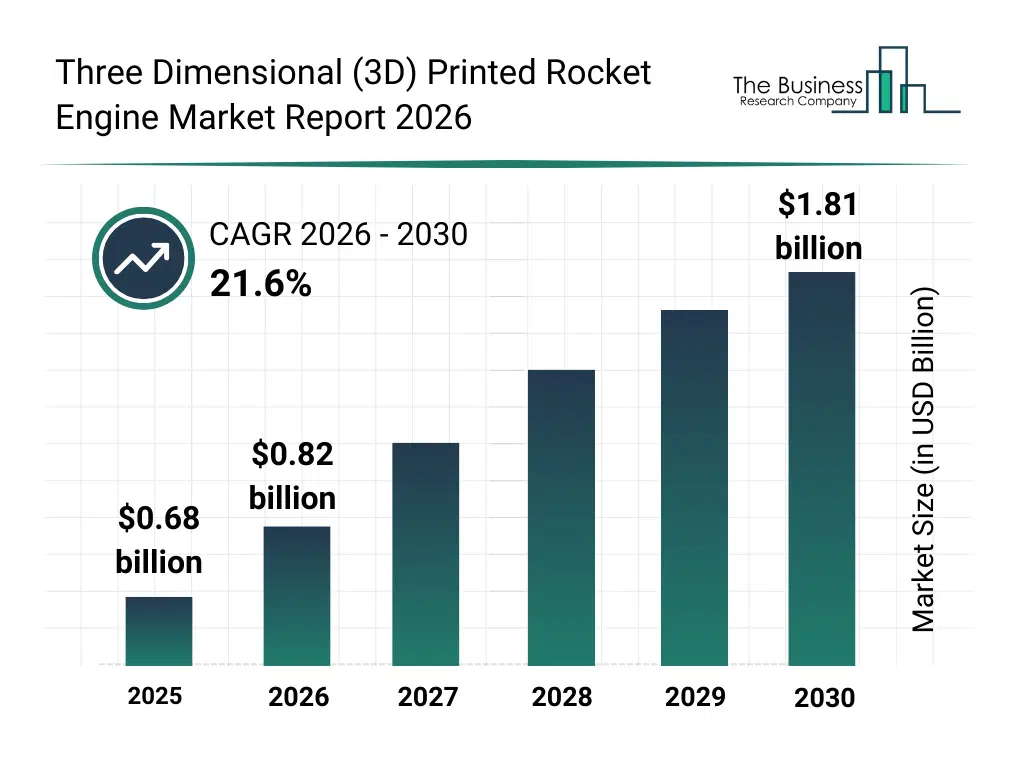
What Is The Three Dimensional (3D) Printed Rocket Engine Market Size and Share 2026?
The three dimensional (3d) printed rocket engine market size has grown exponentially in recent years. It will grow from $0.68 billion in 2025 to $0.82 billion in 2026 at a compound annual growth rate (CAGR) of 21.9%. The growth in the historic period can be attributed to adoption of additive manufacturing in aerospace, cost reduction in rocket engine production, early use of 3d-printed engine components for testing, development of lightweight metal alloys for 3d printing, integration of rapid prototyping in rocket engine design.What Is The Three Dimensional (3D) Printed Rocket Engine Market Growth Forecast?
The three dimensional (3d) printed rocket engine market size is expected to see exponential growth in the next few years. It will grow to $1.81 billion in 2030 at a compound annual growth rate (CAGR) of 21.6%. The growth in the forecast period can be attributed to increasing production of fully 3d-printed rocket engines, adoption of advanced materials for high-thrust engines, expansion of consulting and technical support services, growth in testing and validation services for 3d-printed propulsion systems, acceleration of commercialization of 3D-printed engine kits. Major trends in the forecast period include rising adoption of additive manufacturing for rapid engine iteration, increased demand for lightweight and complex propulsion geometries, growth in full-engine 3d printing capabilities, advances in high-temperature 3d printable materials, expansion of in-house propulsion prototyping by private space firms.
Global Three Dimensional (3D) Printed Rocket Engine Market Segmentation
1) By Engine Type: Liquid Rocket Engines, Solid Rocket Engines, Hybrid Rocket Engines, Air-Breathing Engines, Electric Propulsion Systems 2) By Material Type: Metal Alloys, Thermoplastics, Ceramics 3) By Technology: Fused Deposition Modeling (FDM), Stereolithography (SLA), Selective Laser Sintering (SLS), Binder Jetting, Direct Energy Deposition (DED) 4) By End User: Commercial Space Companies, Government Agencies, Aerospace And Defense Contractors, Research Institutions, Educational Institutions Subsegments: 1) Liquid Rocket Engines: Cryogenic Engines, Hypergolic Engines, Kerosene (RP-1) Engines, Methalox (Methane + LOX) Engines 2) Solid Rocket Engines: Composite Propellant Engines, Double-Base Propellant Engines, High-Energy Solid Propellant Engines 3) Hybrid Rocket Engines: Liquid Oxidizer + Solid Fuel Engines, Paraffin-Based Hybrid Engines, Polymer-Based Hybrid Engines 4) Air-Breathing Engines: Ramjet Engines, Scramjet Engines, Pulse Detonation Engines 5) Electric Propulsion Systems: Hall Effect Thrusters, Ion Thrusters, Electrospray Thrusters, Magnetoplasmadynamic (MPD) ThrustersWhat Is Driver Of The Three Dimensional (3D) Printed Rocket Engine Market?
The increasing investments in space exploration are expected to propel the growth of the three-dimensional (3D) printed rocket engine market going forward. Space exploration is the discovery and study of outer space through the use of spacecraft, satellites, and advanced technology. The increasing investments in space exploration are rising due to the growing demand for advanced satellite-based communication and data services, as they enable faster, more reliable communication. Investments in space exploration enhance three-dimensional (3D) printed rocket engines by driving the development of advanced propulsion technologies and manufacturing techniques. They accelerate the adoption of additive manufacturing, enabling lighter, more efficient, and cost-effective rocket engines, and support innovative designs for next-generation space missions. For instance, in January 2025, according to the Space Foundation, a US-based nonprofit organization, the international government spending on space programs reached $125 billion in 2023, an 11% increase compared to 2022. Therefore, the increasing investments in space exploration are driving the growth of the three-dimensional (3D) printed rocket engine market.Key Players In The Global Three Dimensional (3D) Printed Rocket Engine Market
Major companies operating in the three dimensional (3d) printed rocket engine market are Lockheed Martin Corporation, Northrop Grumman Corporation, IHI Corporation, Space Exploration Technologies Corp., Blue Origin LLC, ArianeGroup SAS, Sierra Nevada Corporation, Stratasys Ltd., EOS GmbH, Relativity Space Inc., Rocket Lab USA Inc., AgniKul Cosmos Pvt. Ltd., Gilmour Space Technologies Pty Ltd, Firefly Aerospace Inc., Ursa Major Technologies Inc., Orbex Space Ltd., Morpheus Space GmbH & Co. KG, Skyrora Ltd, Skyroot Aerospace Pvt. Ltd., iRocket Pvt. Ltd.
This chart is for illustrative purposes; the full report includes a detailed competitor analysis and comprehensive overview of the top 10 companies in the market.
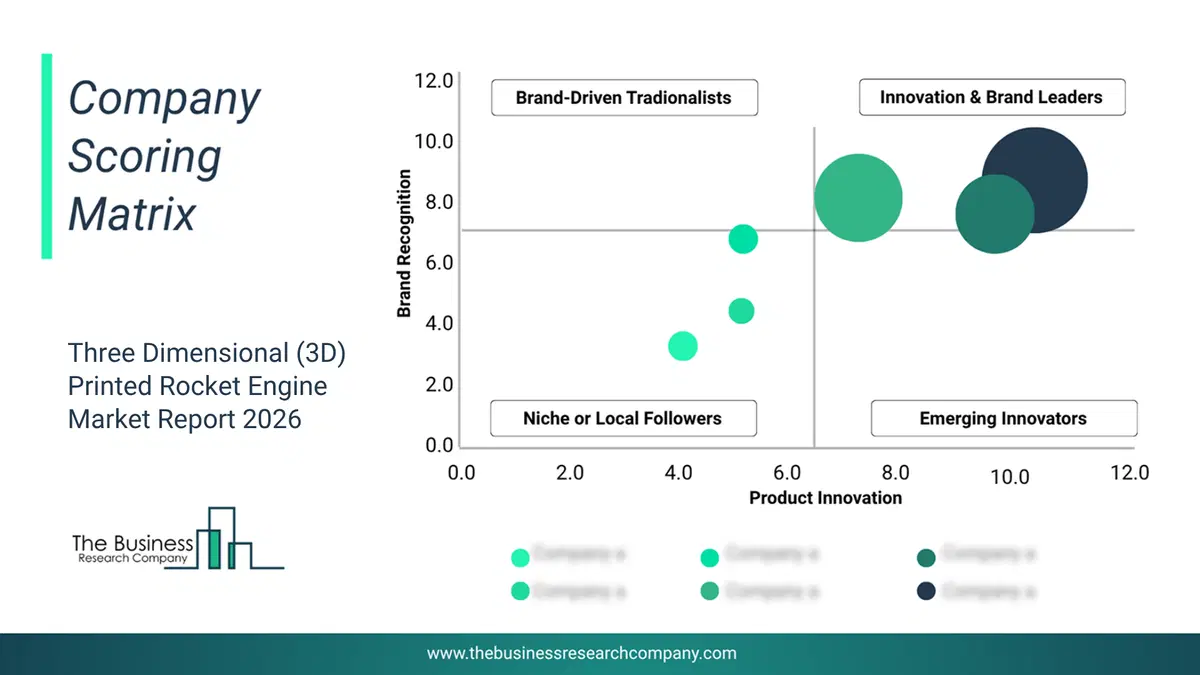
This chart maps companies by product innovation and brand strength, with bubble size indicating relative revenue, helping identify market leaders, challengers, and niche players. This is an illustrative chart; the full report provides a complete and accurate competitive analysis.
Global Three Dimensional (3D) Printed Rocket Engine Market Trends and Insights
Major companies operating in the three-dimensional (3D) printed rocket engine market are focusing on developing innovative manufacturing techniques, such as additive manufacturing, to gain a competitive advantage. Additive manufacturing refers to the process of fabricating metal engine components layer by layer from digital designs, which enables part consolidation, reduces weight, and shortens production timelines compared to traditional manufacturing. For instance, in March 2023, Relativity Space Inc., a US-based launch vehicle manufacturer, launched Terran 1, the first 3D-printed rocket. It utilizes massive custom 3D printers, named Stargate, to additively manufacture rockets from proprietary metal alloys, aiming to dramatically simplify the production process and infrastructure required for spaceflight. Terran 1 is an expendable, two-stage launch vehicle for small satellite missions, standing 110 feet tall and being approximately 85% 3D-printed by mass, including engines and structural components. The rocket is powered by nine Aeon 1 engines on the first stage and a single Aeon Vac engine on the second stage, utilizing liquid natural gas (LNG) and liquid oxygen (LOX) as propellants.What Are Latest Mergers And Acquisitions In The Three Dimensional (3D) Printed Rocket Engine Market? L3Harris Technologies Acquired Aerojet Rocketdyne to Enhance Propulsion Capabilities
In July 2023, L3Harris Technologies Inc., a US-based aerospace and defense technology company, acquired Aerojet Rocketdyne Inc. for $4.7 billion. With this acquisition, L3Harris strengthened its position in the space and missile propulsion market, expanding its capabilities in high-thrust upper-stage engines and enhancing support for national security and space exploration missions. Aerojet Rocketdyne Inc. is a US aerospace and defense company specializing in the manufacture of 3D-printed, high-performance rocket engine components.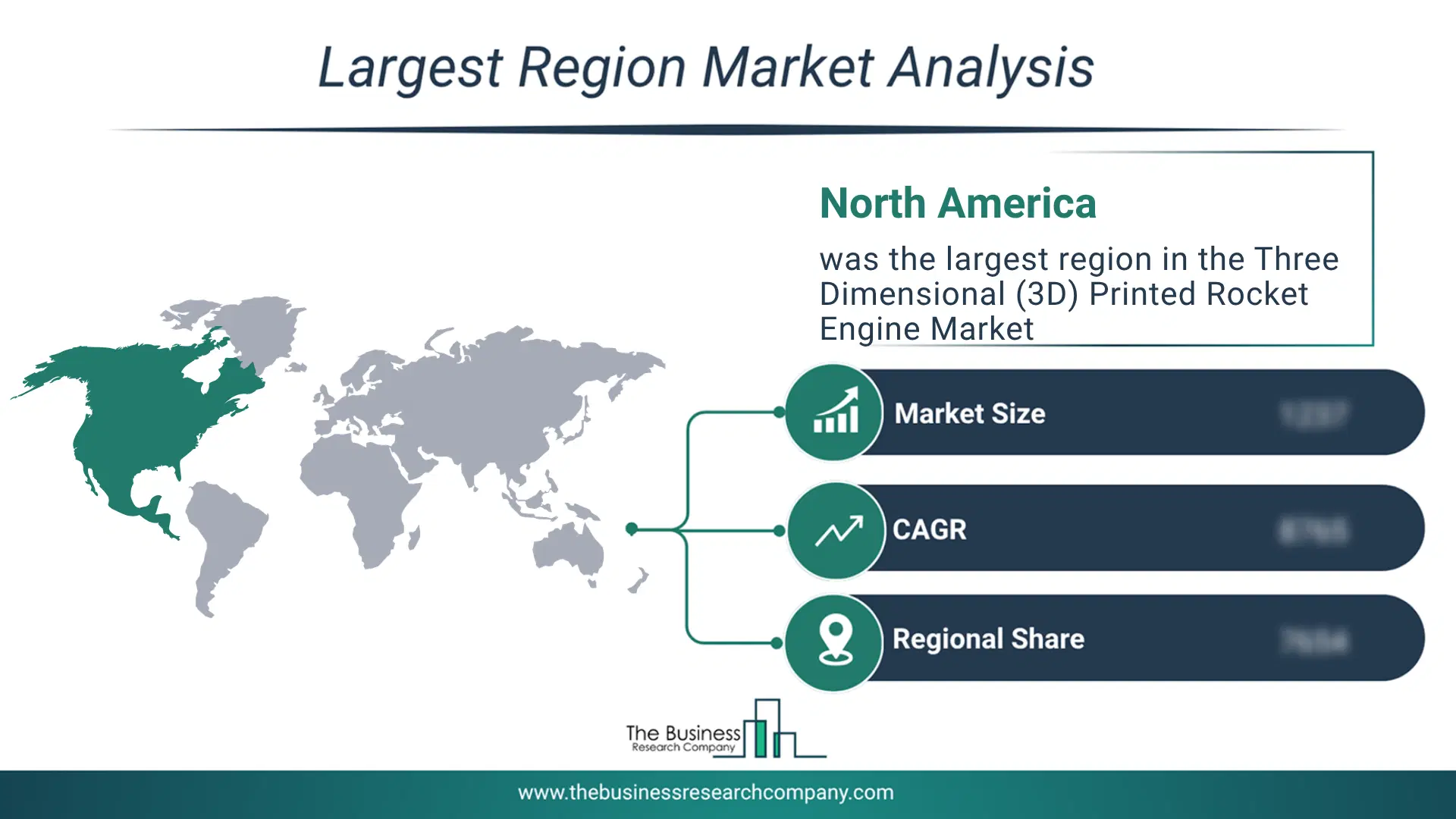
Regional Insights
North America was the largest region in the three-dimensional (3D) printed rocket engine market in 2025. Asia-Pacific is expected to be the fastest-growing region in the forecast period. The regions covered in this market report are Asia-Pacific, South East Asia, Western Europe, Eastern Europe, North America, South America, Middle East, Africa. The countries covered in this market report are Australia, Brazil, China, France, Germany, India, Indonesia, Japan, Taiwan, Russia, South Korea, UK, USA, Canada, Italy, SpainWhat Defines the Three Dimensional (3D) Printed Rocket Engine Market?
The three-dimensional (3D) printed rocket engine market consists of revenues earned by entities by providing services such as design and engineering of rocket engines, rapid prototyping of engine components, testing and validation of propulsion systems, and consulting or technical support related to 3D-printed rocket engines. The market value includes the value of related goods sold by the service provider or included within the service offering. The three-dimensional (3D) printed rocket engine market also includes sales of fully 3D-printed rocket engines, individual 3D-printed engine components, and propulsion system kits. Values in this market are ‘factory gate’ values; that is, the value of goods sold by the manufacturers or creators of the goods, whether to other entities (including downstream manufacturers, wholesalers, distributors, and retailers) or directly to end customers. The value of goods in this market includes related services sold by the creators of the goods.How is Market Value Defined and Measured?
The market value is defined as the revenues that enterprises gain from the sale of goods and/or services within the specified market and geography through sales, grants, or donations in terms of the currency (in USD unless otherwise specified). The revenues for a specified geography are consumption values that are revenues generated by organizations in the specified geography within the market, irrespective of where they are produced. It does not include revenues from resales along the supply chain, either further along the supply chain or as part of other products.
This chart presents market attractiveness based on a quantitative evaluation of growth, competition, strategic alignment, and risk, offering a clear view of opportunity areas for decision-making. This chart is for illustrative purposes; the full report contains the complete analysis.

This chart highlights the Total Addressable Market (TAM) by estimating the maximum revenue opportunity using an assumption-driven approach, supporting strategic planning and opportunity sizing across markets. The chart is illustrative; the full report provides a more comprehensive analysis.
What Key Data and Analysis Are Included in the Three Dimensional (3D) Printed Rocket Engine Market Report 2026?
The three dimensional (3d) printed rocket engine market research report is one of a series of new reports from The Business Research Company that provides market statistics, including industry global market size, regional shares, competitors with the market share, detailed market segments, market trends and opportunities, and any further data you may need to thrive in the three dimensional (3d) printed rocket engine industry. The market research report delivers a complete perspective of everything you need, with an in-depth analysis of the current and future state of the industry.Three Dimensional (3D) Printed Rocket Engine Market Report Forecast Analysis
| Report Attribute | Details |
|---|---|
| Market Size Value In 2026 | $0.82 billion |
| Revenue Forecast In 2030 | $1.81 billion |
| Growth Rate | CAGR of 21.6% from 2026 to 2030 |
| Base Year For Estimation | 2025 |
| Actual Estimates/Historical Data | 2020-2025 |
| Forecast Period | 2026 - 2030 |
| Market Representation | Revenue in USD Billion and CAGR from 2026 to 2030 |
| Segments Covered | Engine Type, Material Type, Technology, End User |
| Regional Scope | Asia-Pacific, Western Europe, Eastern Europe, North America, South America, Middle East, Africa |
| Country Scope | The countries covered in the three dimensional (3d) printed rocket engine market report are Australia, Brazil, China, France, Germany, India, Indonesia, Japan, Taiwan, Russia, South Korea, UK, USA, Canada, Italy, Spain |
| Key Companies Profiled | Lockheed Martin Corporation, Northrop Grumman Corporation, IHI Corporation, Space Exploration Technologies Corp., Blue Origin LLC, ArianeGroup SAS, Sierra Nevada Corporation, Stratasys Ltd., EOS GmbH, Relativity Space Inc., Rocket Lab USA Inc., AgniKul Cosmos Pvt. Ltd., Gilmour Space Technologies Pty Ltd, Firefly Aerospace Inc., Ursa Major Technologies Inc., Orbex Space Ltd., Morpheus Space GmbH & Co. KG, Skyrora Ltd, Skyroot Aerospace Pvt. Ltd., iRocket Pvt. Ltd. |
| Customization Scope | Request for Customization |
| Pricing And Purchase Options | Explore Purchase Options |