
Three-Dimensional (3D) Printing In Aerospace And Defense Market Report 2026
Global Outlook – By Component (Hardware, Software, Services), By Material (Metals, Polymers, Ceramics, Composite Materials), By Technology (Fused Deposition Modeling (FDM), Selective Laser Sintering (SLS), Selective Laser Melting (SLM), Direct Metal Laser Sintering (DMLS), Electron Beam Melting (EBM), Stereolithography (SLA), Digital Light Processing (DLP), Binder Jetting, Other Technologies), By Platform (Aircraft, Spacecraft, Unmanned Aerial Vehicle, Missiles), By End User (Commercial Aerospace, Military And Defense, Space Agencies, Aircraft Manufacturers, Defense Contractors, Research And Academic Institutions) – Market Size, Trends, Strategies, and Forecast to 2030
Three-Dimensional (3D) Printing In Aerospace And Defense Market Overview
• Three-Dimensional (3D) Printing In Aerospace And Defense market size has reached to $4.18 billion in 2025 • Expected to grow to $11.27 billion in 2030 at a compound annual growth rate (CAGR) of 21.9% • Growth Driver: Rising Defense Modernization Programs Driving The Market Growth Due To Increasing Demand For Advanced Additive Manufacturing Solutions • Market Trend: Technological Advancements In Industrial Metal Additive Manufacturing For Enhanced Production Scalability, Design Flexibility, And Supply Chain Efficiency • North America was the largest region in 2025 and Asia-Pacific is the fastest growing region.What Is Covered Under Three-Dimensional (3D) Printing In Aerospace And Defense Market?
Three-dimensional (3D) printing in aerospace and defense refers to the use of additive manufacturing technologies to produce complex components, parts, and prototypes by depositing materials layer by layer based on digital designs. It enables the production of lightweight, high-strength, and geometrically complex structures while reducing material waste, improving design flexibility, and accelerating manufacturing processes. These technologies support rapid prototyping, component customization, and the development of advanced aerospace and defense equipment. The main components in the three-dimensional (3D) printing in aerospace and defense market include hardware, software, and services. Hardware refers to the physical additive manufacturing systems, equipment, and supporting components used to produce complex aerospace parts and structures. These solutions process metals, polymers, ceramics, and composite materials and use technologies including fused deposition modeling (FDM), selective laser sintering (SLS), selective laser melting (SLM), direct metal laser sintering (DMLS), electron beam melting (EBM), stereolithography (SLA), digital light processing (DLP), binder jetting, and other technologies. They are deployed across aircraft, spacecraft, unmanned aerial vehicles, and missiles and are used by end users including commercial aerospace, military and defense, space agencies, aircraft manufacturers, defense contractors, and research and academic institutions.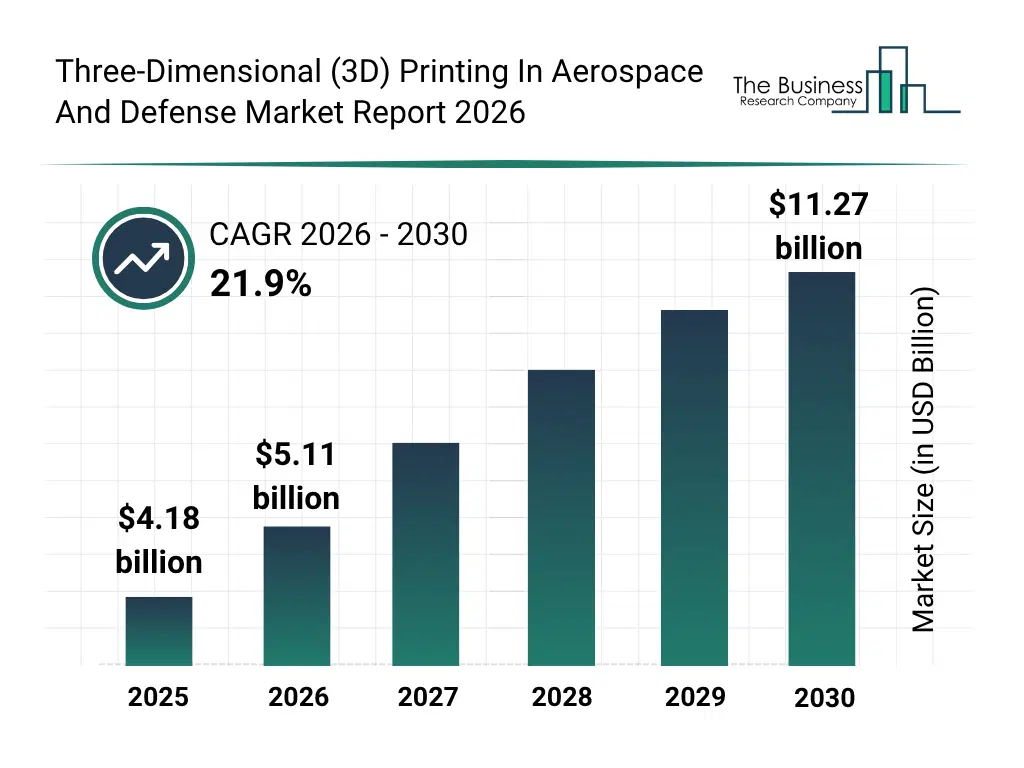
What Is The Three-Dimensional (3D) Printing In Aerospace And Defense Market Size and Share 2026?
The three-dimensional (3d) printing in aerospace and defense market size has grown exponentially in recent years. It will grow from $4.18 billion in 2025 to $5.11 billion in 2026 at a compound annual growth rate (CAGR) of 22.3%. The growth in the historic period can be attributed to increasing adoption of additive manufacturing for aerospace prototyping, rising demand for lightweight aircraft components, growing defense spending on advanced manufacturing capabilities, increasing use of 3D printing for complex component production, reduction in material waste compared with conventional manufacturing.What Is The Three-Dimensional (3D) Printing In Aerospace And Defense Market Growth Forecast?
The three-dimensional (3d) printing in aerospace and defense market size is expected to see exponential growth in the next few years. It will grow to $11.27 billion in 2030 at a compound annual growth rate (CAGR) of 21.9%. The growth in the forecast period can be attributed to increasing production of additively manufactured flight-qualified components, expansion of 3D printing applications in spacecraft manufacturing, rising adoption of additive manufacturing for UAVs and missiles, growing demand for localized and on-demand part production, increasing use of advanced materials in aerospace and defense applications. Major trends in the forecast period include increasing adoption of metal additive manufacturing, growing use of lightweight 3D printed components, rising demand for complex geometries and topology optimization, increasing qualification of additive manufactured parts for flight applications, growing use of additive manufacturing for rapid prototyping and customized components.Tariff Impact On Three-Dimensional (3D) Printing In Aerospace And Defense Market
Tariffs are impacting the three-dimensional (3D) printing in aerospace and defense market by increasing the cost of imported 3D printers, printing materials, metal powders, polymers, software, and specialized equipment used for additive manufacturing. This is raising production and procurement costs for aerospace and defense manufacturers, particularly in regions dependent on imported additive manufacturing technologies and materials, while hardware-intensive segments and metal-based printing technologies face greater exposure to international supply-chain pressures. North America, Europe, and Asia-Pacific are affected through cross-border sourcing of specialized equipment and materials for aircraft, spacecraft, UAV, and missile applications. However, tariffs are also encouraging domestic additive manufacturing capabilities, regional sourcing, localized production of critical components, and greater investment in resilient aerospace and defense supply chains.
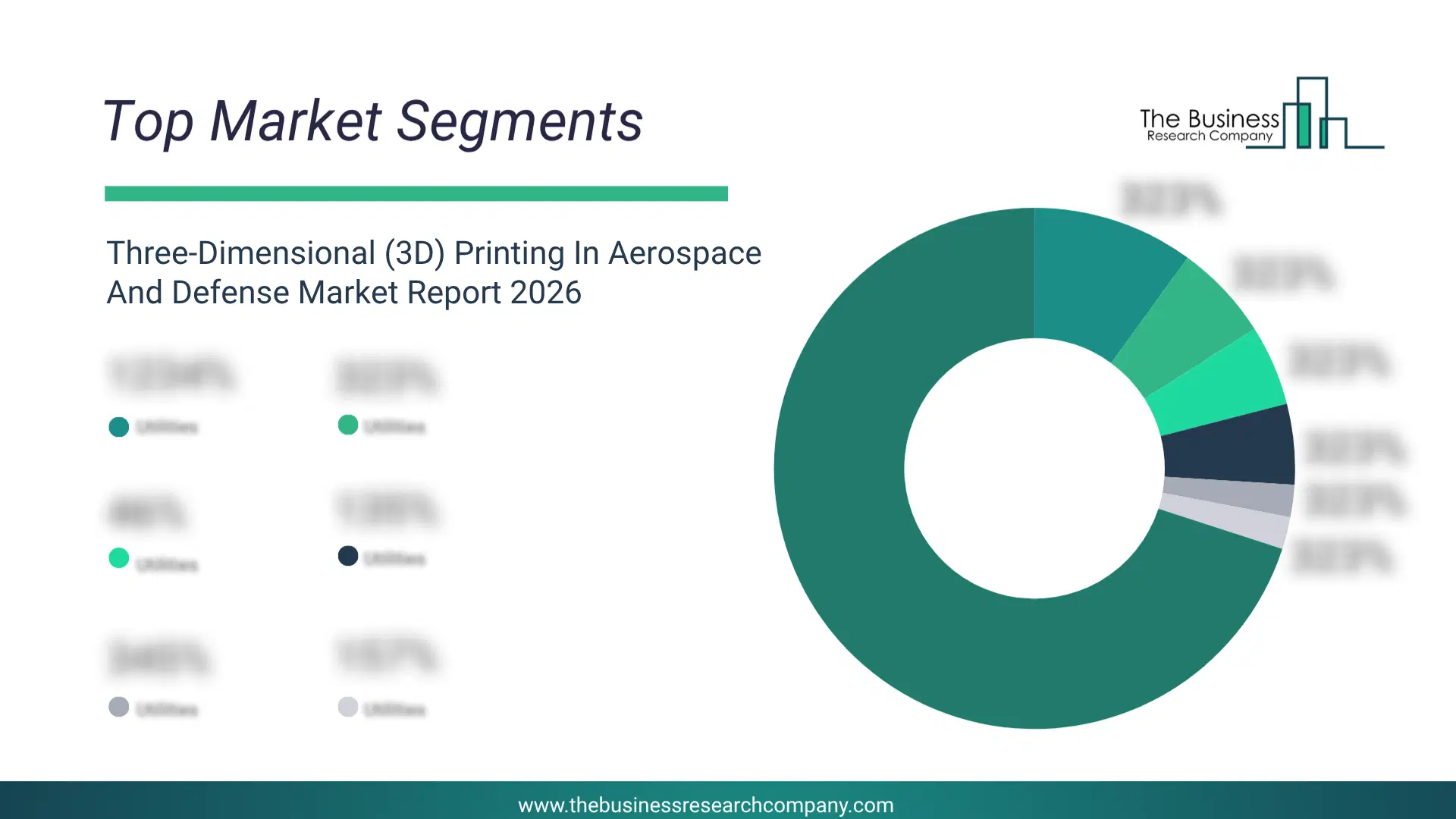
Global Three Dimensional 3D Printing In Aerospace And Defense Market Segmentation
1) By Component: Hardware, Software, Services 2) By Material: Metals, Polymers, Ceramics, Composite Materials 3) By Technology: Fused Deposition Modeling (FDM), Selective Laser Sintering (SLS), Selective Laser Melting (SLM), Direct Metal Laser Sintering (DMLS), Electron Beam Melting (EBM), Stereolithography (SLA), Digital Light Processing (DLP), Binder Jetting, Other Technologies 4) By Platform: Aircraft, Spacecraft, Unmanned Aerial Vehicle, Missiles 5) By End User: Commercial Aerospace, Military And Defense, Space Agencies, Aircraft Manufacturers, Defense Contractors, Research And Academic Institutions Subsegments: 1) By Hardware: Three-Dimensional (3D) Printers, Printing Equipment Components, Post-Processing Equipment, Inspection And Quality Control Equipment 2) By Software: Three-Dimensional (3D) Design Software, Additive Manufacturing Software, Simulation And Modeling Software, Process Monitoring Software, Production Management Software 3) By Services: Design And Engineering Services, Printing And Manufacturing Services, Post-Processing Services, Testing And Certification Services, Maintenance And Support ServicesWhat Is The Driver Of The Three-Dimensional (3D) Printing In Aerospace And Defense Market?
The rising defense modernization programs are expected to propel the growth of the three-dimensional (3D) printing in aerospace and defense market going forward. Defense modernization programs refer to initiatives undertaken by governments and defense organizations to upgrade military capabilities through the adoption of advanced technologies, improved equipment, and next-generation systems. Defense modernization programs are increasing due to reducing equipment production timelines, as governments and defense organizations are adopting advanced manufacturing technologies to accelerate the development and deployment of military systems. Rising defense modernization programs drive demand for three-dimensional (3D) printing solutions by enabling the rapid production of lightweight components, customized parts, complex geometries, and mission-critical aerospace structures while reducing manufacturing costs and supply chain dependencies. For instance, in June 2025, according to the U.S. Department of Defense, a US-based government department, the FY 2026 defense budget request emphasized modernization of military capabilities and expansion of advanced technology investments. The request included approximately $20.3 billion for science and technology (S&T) activities, representing an 8% increase compared with FY 2025, to support emerging capabilities such as artificial intelligence, advanced manufacturing, hypersonics, and other defense innovation priorities. Therefore, the rising defense modernization programs are driving the growth of the three-dimensional (3D) printing in aerospace and defense industry.Key Players In The Global Three-Dimensional (3D) Printing In Aerospace And Defense Market
Major companies operating in the three-dimensional (3d) printing in aerospace and defense market are GE Aerospace, The Boeing Company, RTX Corporation, Airbus SE, Lockheed Martin Corporation, Northrop Grumman Corporation, Honeywell International Inc., Rolls-Royce Holdings plc, BAE Systems plc, Safran S.A., HP Inc., TRUMPF SE + Co. KG, Melrose Industries plc, MTU Aero Engines AG, Moog Inc., 3D Systems Corporation, Stratasys Ltd., Materialise NV, Electro Optical Systems GmbH, Renishaw plc, Nikon SLM Solutions AG, Velo3D Inc., Hunan Farsoon High-Tech Co. Ltd., Sciaky Inc., AML3D Limited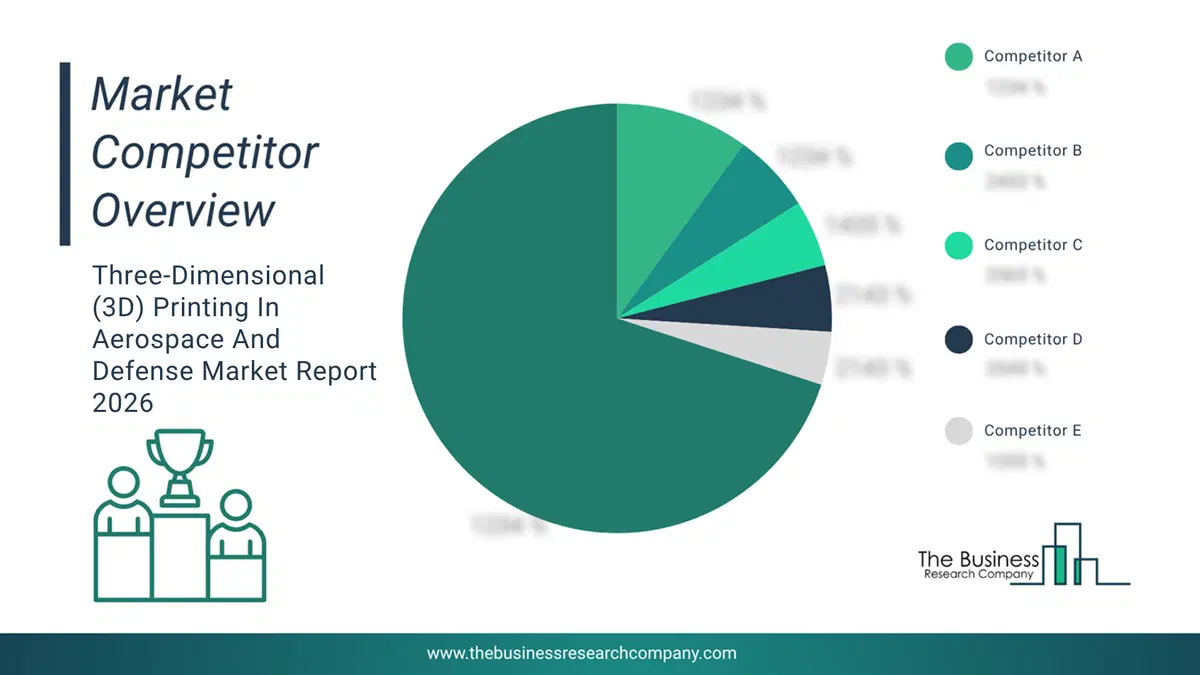
This chart is for illustrative purposes; the full report includes a detailed competitor analysis and comprehensive overview of the top 10 companies in the market.
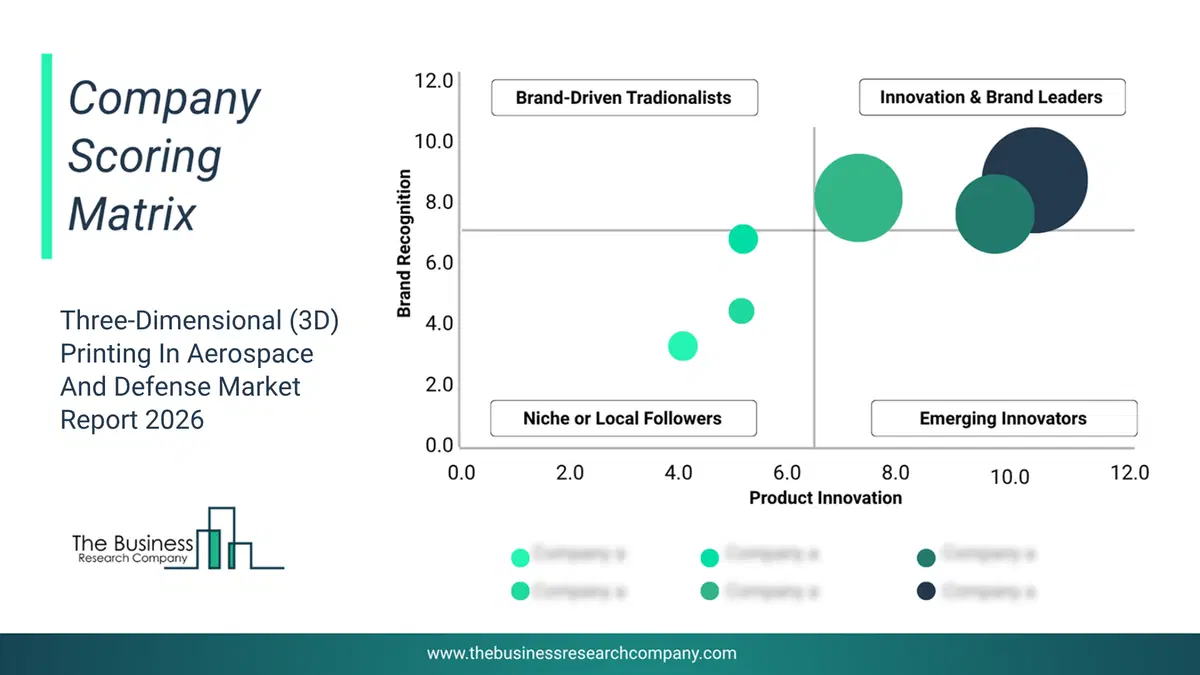
This chart maps companies by product innovation and brand strength, with bubble size indicating relative revenue, helping identify market leaders, challengers, and niche players. This is an illustrative chart; the full report provides a complete and accurate competitive analysis.
Global Three-Dimensional (3D) Printing In Aerospace And Defense Market Trends and Insights
Major companies operating in the three-dimensional (3D) printing in aerospace and defense market are focusing on developing advanced products such as, industrial metal 3D printing systems, to enhance advanced manufacturing capabilities, production scalability, supply chain efficiency, and the rapid production of complex aerospace and defense components. Industrial metal 3D printing systems are advanced additive manufacturing technologies that use high-powered lasers to fuse metal powders layer by layer, enabling the production of lightweight, complex, and high-performance components compared with traditional subtractive manufacturing methods that often involve longer production timelines, higher material waste, and limitations in design flexibility. For instance, in June 2026, Divergent Technologies, Inc., a US-based advanced manufacturing technology company, launched Monolith One, an industrial metal 3D printer designed as part of its DAPS™ (Divergent Adaptive Production System) manufacturing platform for aerospace, defense, and commercial applications. The Monolith One is a laser powder bed fusion (LPBF) metal 3D printer featuring 24kW of laser power through 12 integrated 2kW lasers and an expanded build volume of 700 × 700 × 835 mm, enabling high-throughput production of complex metal structures. The system supports multiple industry-standard alloys, including aluminum, nickel, steel, and titanium, providing manufacturing flexibility for mission-critical components. It incorporates advanced features such as dynamic optical control, closed-loop powder handling, active thermal control, and enhanced gas flow management to improve print quality, reliability, and operational efficiency.What Are Latest Mergers And Acquisitions In The Three-Dimensional (3D) Printing In Aerospace And Defense Market?
In March 2026, AFM Capital Partners Inc., a US-based private investment firm, acquired a majority ownership interest in Incodema3D Holdings Inc. for an undisclosed amount. With this acquisition, AFM Capital Partners Inc. aimed to expand its advanced manufacturing platform by investing in Incodema3D’s metal additive manufacturing capabilities, increasing production capacity, accelerating the adoption of large-format additive technologies, and strengthening its presence in mission-critical defense, aerospace, space, energy, and industrial markets. Incodema3D Holdings Inc. is a US-based additive manufacturing technology company that specializes in providing metal 3D printing and additive manufacturing specifically for the aerospace and defense industries.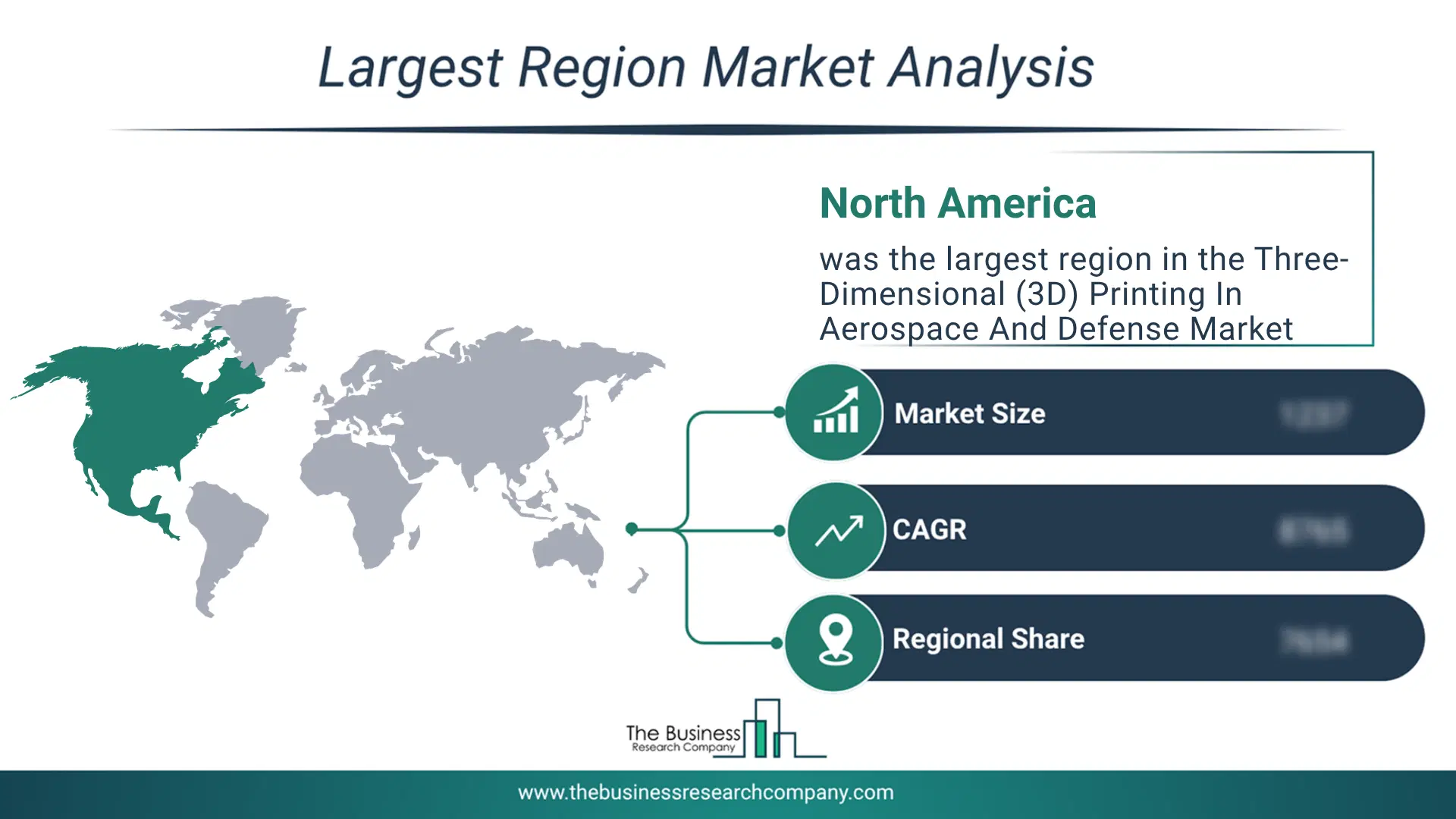
Regional Outlook
North America was the largest region in the three-dimensional (3d) printing in aerospace and defense market in 2025. Asia-Pacific is expected to be the fastest-growing region in the forecast period. The regions covered in this market report are Asia-Pacific, South East Asia, Western Europe, Eastern Europe, North America, South America, Middle East, Africa. The countries covered in this market report are Australia, Brazil, China, France, Germany, India, Indonesia, Japan, Taiwan, Russia, South Korea, UK, USA, Canada, Italy, Spain.What Defines the Three-Dimensional (3D) Printing In Aerospace And Defense Market?
The three-dimensional (3D) printing in aerospace and defense market consists of revenues earned by entities by providing services such as additive manufacturing design, 3D printing production, prototyping, material development, component testing, and post-processing. The market value includes the value of related goods sold by the service provider or included within the service offering. The three-dimensional (3D) printing in aerospace and defense market also includes sales of 3D printers, additive manufacturing systems, metal and polymer printing materials, printing software, and specialized aerospace and defense components. Values in this market are ‘factory gate’ values, that is, the value of goods sold by the manufacturers or creators of the goods, whether to other entities (including downstream manufacturers, wholesalers, distributors, and retailers) or directly to end customers. The value of goods in this market includes related services sold by the creators of the goods.How is Market Value Defined and Measured?
The market value is defined as the revenues that enterprises gain from the sale of goods and/or services within the specified market and geography through sales, grants, or donations in terms of the currency (in USD unless otherwise specified). The revenues for a specified geography are consumption values that are revenues generated by organizations in the specified geography within the market, irrespective of where they are produced. It does not include revenues from resales along the supply chain, either further along the supply chain or as part of other products.
This chart presents market attractiveness based on a quantitative evaluation of growth, competition, strategic alignment, and risk, offering a clear view of opportunity areas for decision-making. This chart is for illustrative purposes; the full report contains the complete analysis.

This chart highlights the Total Addressable Market (TAM) by estimating the maximum revenue opportunity using an assumption-driven approach, supporting strategic planning and opportunity sizing across markets. The chart is illustrative; the full report provides a more comprehensive analysis.
What Key Data and Analysis Are Included in the Three-Dimensional (3D) Printing In Aerospace And Defense Market Report 2026?
The three-dimensional (3d) printing in aerospace and defense market research report is one of a series of new reports from The Business Research Company that provides market statistics, including industry global market size, regional shares, competitors with the market share, detailed market segments, market trends and opportunities, and any further data you may need to thrive in the three-dimensional (3d) printing in aerospace and defense industry. The market research report delivers a complete perspective of everything you need, with an in-depth analysis of the current and future state of the industry.Three-Dimensional (3D) Printing In Aerospace And Defense Market Report Forecast Analysis
| Report Attribute | Details |
|---|---|
| Market Size Value In 2026 | $5.11 billion |
| Revenue Forecast In 2030 | $11.27 billion |
| Growth Rate | CAGR of 21.9% from 2026 to 2030 |
| Base Year For Estimation | 2025 |
| Actual Estimates/Historical Data | 2020-2025 |
| Forecast Period | 2026 - 2030 |
| Market Representation | Revenue in USD Billion and CAGR from 2026 to 2030 |
| Segments Covered | Component, Material, Technology, Platform, End User |
| Regional Scope | Asia-Pacific, Western Europe, Eastern Europe, North America, South America, Middle East, Africa |
| Country Scope | The countries covered in the report are Australia, Brazil, China, France, Germany, India, Indonesia, Japan, Taiwan, Russia, South Korea, UK, USA, Canada, Italy, Spain. |
| Key Companies Profiled | GE Aerospace, The Boeing Company, RTX Corporation, Airbus SE, Lockheed Martin Corporation, Northrop Grumman Corporation, Honeywell International Inc., Rolls-Royce Holdings plc, BAE Systems plc, Safran S.A., HP Inc., TRUMPF SE + Co. KG, Melrose Industries plc, MTU Aero Engines AG, Moog Inc., 3D Systems Corporation, Stratasys Ltd., Materialise NV, Electro Optical Systems GmbH, Renishaw plc, Nikon SLM Solutions AG, Velo3D Inc., Hunan Farsoon High-Tech Co. Ltd., Sciaky Inc., AML3D Limited |
| Customization Scope | Request for Customization |
| Pricing And Purchase Options | Explore Purchase Options |