
Three-Dimensional (3D) Projector Market Report 2026
Global Outlook – By Type ( Laser, Light Emitting Diode (LED), Hybrid, Metal Halide, Other Types), By Technology ( Digital Light Processing (DLP), Liquid Crystal Display (LCD), Liquid Crystal On Silicon (LCoS)), By Brightness Level ( Low (Less Than 1000 Lumens), Medium (1000-3000 Lumens), High (More Than 3000 Lumens)), By Distribution Channel ( Direct Sales, Retail Stores, Online Retailers, Wholesale Distributors, Rental Companies), By Application ( Cinema, Education, Corporate, Home Theater And Gaming, Events And Large Venues, Other Applications) – Market Size, Trends, Strategies, and Forecast to 2030
Three-Dimensional (3D) Projector Market Overview
• Three-Dimensional (3D) Projector market size has reached to $4.97 billion in 2025 • Expected to grow to $8.12 billion in 2030 at a compound annual growth rate (CAGR) of 10.3% • Growth Driver: Rising Home Entertainment Demand Driving The Market Growth Due To Streaming Adoption And On-Demand Content • Market Trend: Developemnt In Ultra-Short-Throw 4K Laser Projectors Redefining Immersive Home Entertainment • Asia-Pacific was the largest region in 2025 and North America is the fastest growing region.What Is Covered Under Three-Dimensional (3D) Projector Market?
A three-dimensional (3D) projector is a device that displays images or videos with depth perception, making visuals appear more realistic and immersive. Its main purpose is to elevate visual experiences across entertainment, education, simulations, and professional presentations by delivering engaging and lifelike imagery. The main types of three-dimensional (3D) projectors are laser, light-emitting diode, hybrid, metal halide, and others. A laser 3D projector is a projection device that uses laser light sources to display high-resolution three-dimensional images, creating depth perception for immersive viewing experiences. These are based on various technologies such as digital light processing (DLP), liquid crystal display (LCD), and liquid crystal on silicon (LCoS), offering several brightness levels, including low (less than 1000 lumens), medium (1000-3000 lumens), and high (more than 3000 lumens). These are distributed through multiple distribution channels, such as direct sales, retail stores, online retailers, wholesale distributors, and rental companies, catering to diverse applications such as cinema, education, corporate environments, home theater and gaming, events and large venues, and others.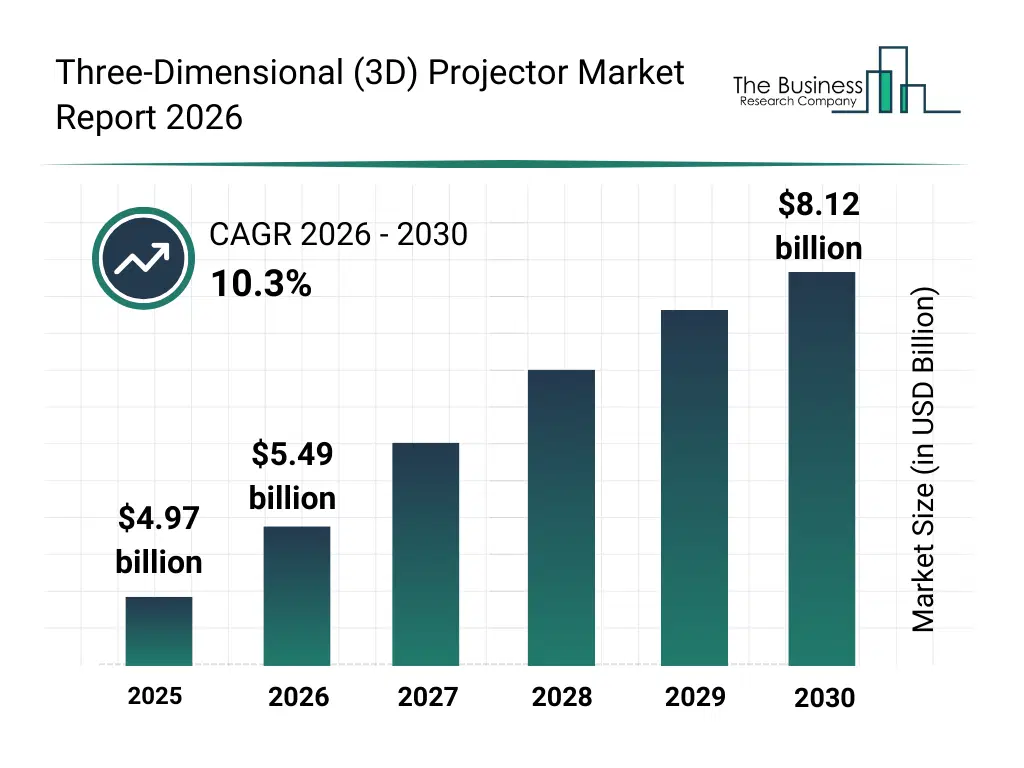
What Is The Three-Dimensional (3D) Projector Market Size 2026 And Growth Rate?
The three-dimensional (3d) projector market size has grown rapidly in recent years. It will grow from $4.97 billion in 2025 to $5.49 billion in 2026 at a compound annual growth rate (CAGR) of 10.5%. The growth in the historic period can be attributed to cinema digitization adoption, declining cost of projection hardware, growing demand for immersive entertainment, expansion of corporate presentation infrastructure, increased use of projectors in education.What Is The Three-Dimensional (3D) Projector Market Growth Forecast?
The three-dimensional (3d) projector market size is expected to see rapid growth in the next few years. It will grow to $8.12 billion in 2030 at a compound annual growth rate (CAGR) of 10.3%. The growth in the forecast period can be attributed to rising demand for immersive visual experiences, growth in gaming and home theater setups, advancements in laser and led light sources, increasing large venue and event installations, demand for high-resolution and high-brightness displays. Major trends in the forecast period include AI-enhanced depth rendering and real-time image optimization, ar/vr-compatible 3d projection systems, cloud-enabled content management and remote calibration, smart connected projectors with iot-based monitoring, automated manufacturing and precision assembly of projection components.
Global Three-Dimensional (3D) Projector Market Segmentation
1) By Type: Laser, Light Emitting Diode (LED), Hybrid, Metal Halide, Other Types 2) By Technology: Digital Light Processing (DLP), Liquid Crystal Display (LCD), Liquid Crystal On Silicon (LCoS) 3) By Brightness Level: Low (Less Than 1000 Lumens), Medium (1000-3000 Lumens), High (More Than 3000 Lumens) 4) By Distribution Channel: Direct Sales, Retail Stores, Online Retailers, Wholesale Distributors, Rental Companies 5) By Application: Cinema, Education, Corporate, Home Theater And Gaming, Events And Large Venues, Other Applications Subsegments: 1) By Laser: Single Laser, Dual Laser, Red, Green, Blue (RGB) Laser 2) By Light Emitting Diode: Red, Green, Blue (RGB) Light Emitting Diode, White Light Emitting Diode, Light Emitting Diode With Phosphor 3) By Hybrid: Laser Light Emitting Diode Hybrid, Light Emitting Diode Phosphor Hybrid 4) By Metal Halide: Ultra High Performance, Ultra High Pressure 5) By Other Types: Xenon, Halogen, Cathode Ray TubeWhat Is The Driver Of The Three-Dimensional (3D) Projector Market?
The growing demand for home entertainment is expected to propel the growth of the 3D projector market going forward. Home entertainment refers to products and services that provide audio-visual enjoyment, gaming, and interactive experiences within a household. Home entertainment demand is increasing due to the rising adoption of streaming services, offering convenient, on-demand, and diverse content at home. A 3D projector boosts home entertainment by delivering immersive, lifelike visuals for movies, games, and sports, creating a cinematic experience that makes content more engaging and realistic for viewers. For instance, in June 2025, according to Nielsen Holdings plc, a US-based media company, in May 2025, streaming captured 44.8 percent of total TV viewing, surpassing the combined 44.2 percent of broadcast (20.1 percent) and cable (24.1 percent), with platforms such as YouTube, Netflix, and FAST services. Therefore, the growing demand for home entertainment is driving the growth of the 3D projector market.Key Players In The Global Three-Dimensional (3D) Projector Market
Major companies operating in the three-dimensional (3d) projector market are Dell Technologies Inc., Hitachi Ltd., Sony Group Corporation, LG Electronics Inc., Panasonic Holdings Corporation, Canon Inc., NEC Corporation, Sharp Corporation, Ricoh Company Ltd., Seiko Epson Corporation, Acer Inc., Casio Computer Co. Ltd., ViewSonic Corporation, BenQ Corporation, Boxlight Corporation, InFocus Corporation, Optoma Corporation, Digital Projection Ltd., Futurotec Solutions Pvt. Ltd., Wolf Cinema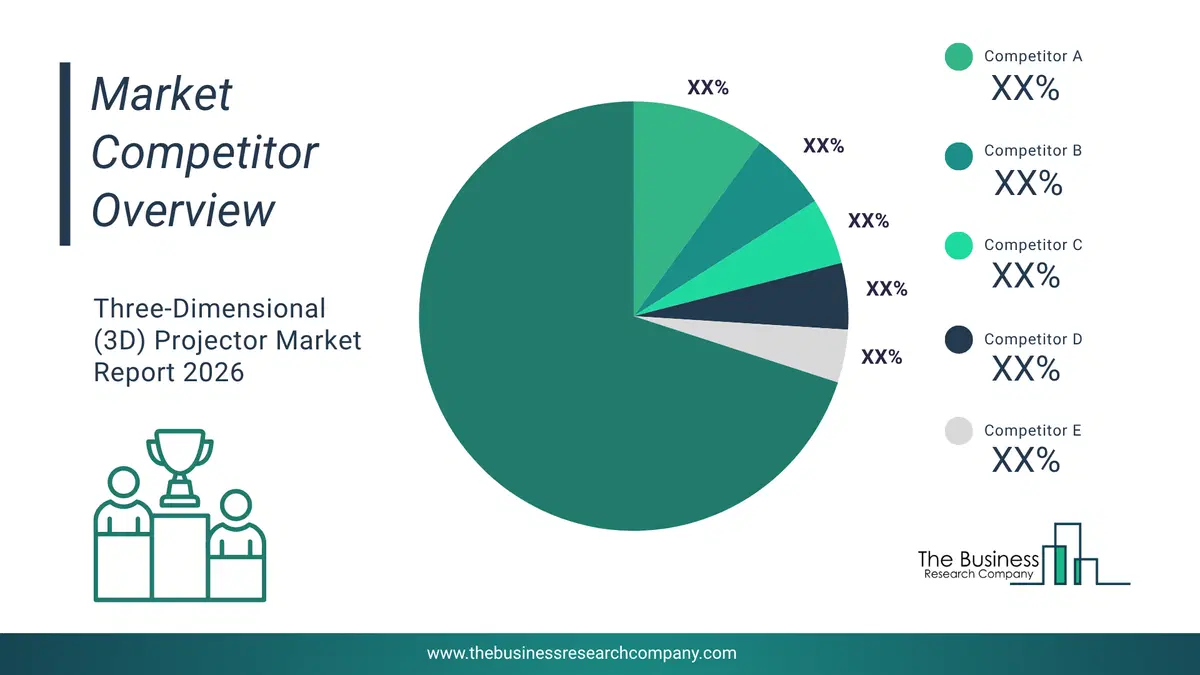
This chart is for illustrative purposes; the full report includes a detailed competitor analysis and comprehensive overview of the top 10 companies in the market.
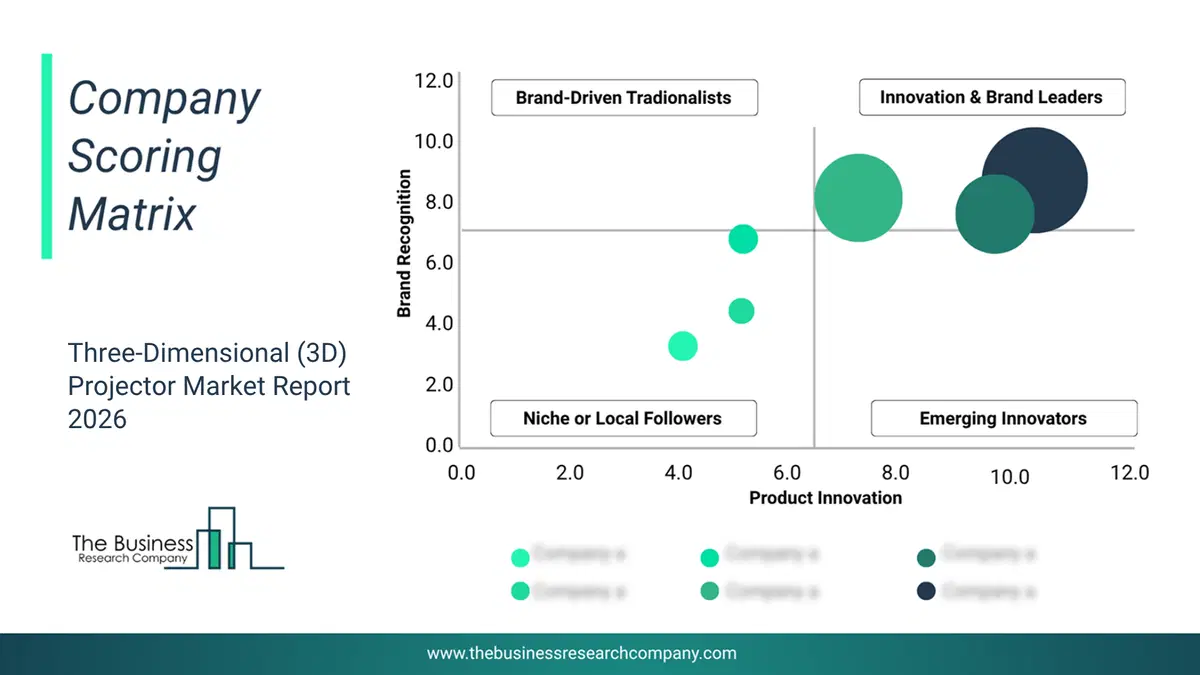
This chart maps companies by product innovation and brand strength, with bubble size indicating relative revenue, helping identify market leaders, challengers, and niche players. This is an illustrative chart; the full report provides a complete and accurate competitive analysis.
Global Three-Dimensional (3D) Projector Market Trends and Insights
Major companies operating in the 3D projector market are focusing on developing advanced products such as ultra-short-throw 4K laser projectors to provide consumers with space-efficient, high-quality home entertainment solutions. An ultra-short-throw 4K laser projector is a high-resolution projection system that uses laser light technology to produce bright, detailed images from a tiny distance, often supporting advanced features such as 3D viewing. For instance, in May 2023, WZATCO, an India-based manufacturing company, launched the WZATCO Bliss projectors, offering immersive home cinema with advanced laser display technology. It delivers stunning cinematic visuals with native 4K resolution, vibrant colors, and powerful 60W Dolby audio. Its ultra-short throw design allows large, immersive images in small spaces, making it ideal for modern homes. With built-in Android TV and versatile connectivity, it offers seamless streaming and flexible use for both entertainment and professional presentations.What Are Latest Mergers And Acquisitions In The Three-Dimensional (3D) Projector Market?
In July 2025, AMETEK, Inc., a US-based technology company, acquired FARO Technologies Inc. for an undisclosed amount. With this acquisition, AMETEK, Inc., aims to strengthen its leadership in precision 3D metrology and digital reality solutions, expand into high-growth markets, accelerate innovation, and drive long-term revenue and margin growth. FARO Technologies Inc. is a US-based imaging company that offers 3D projectors.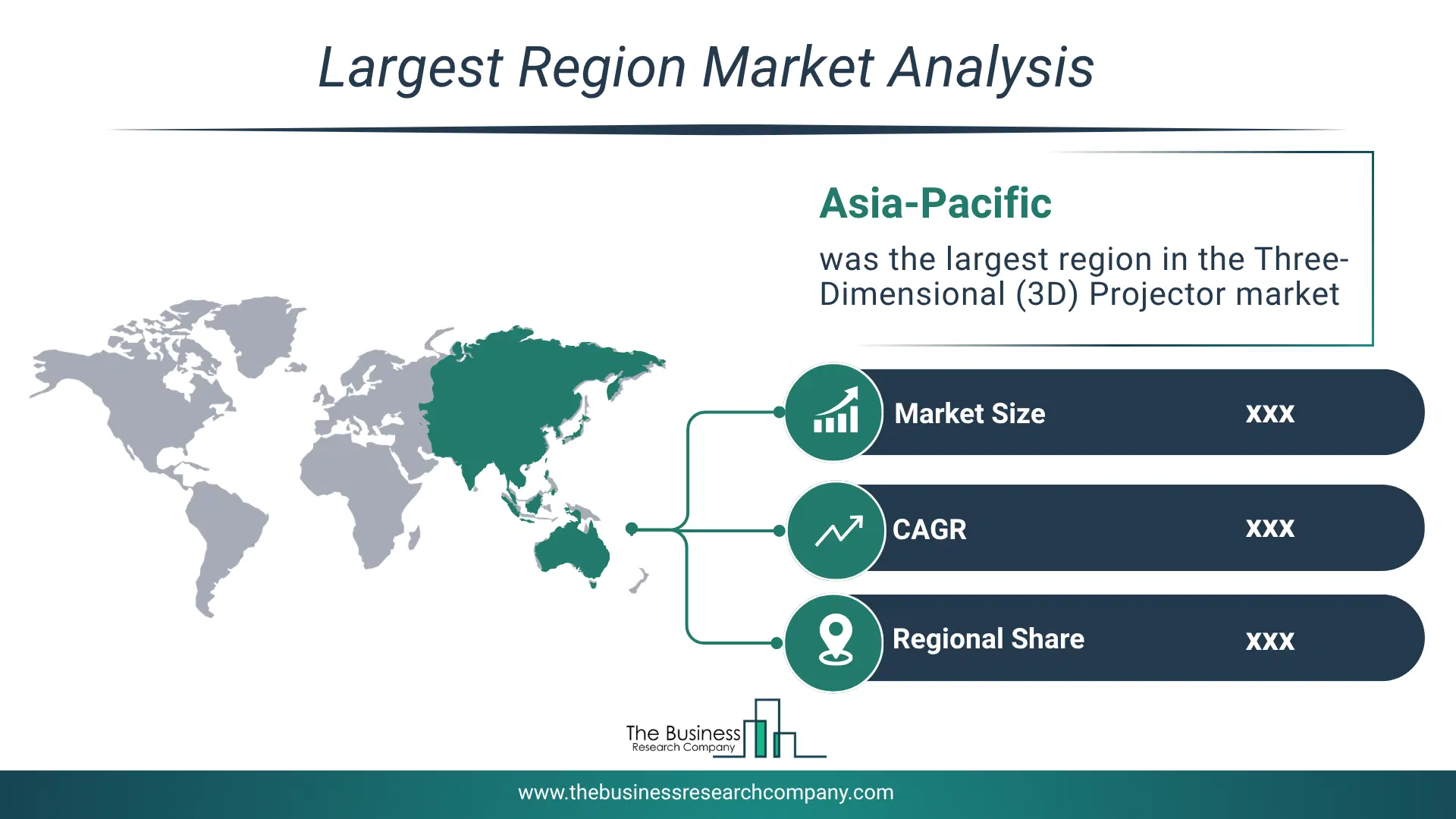
Regional Outlook
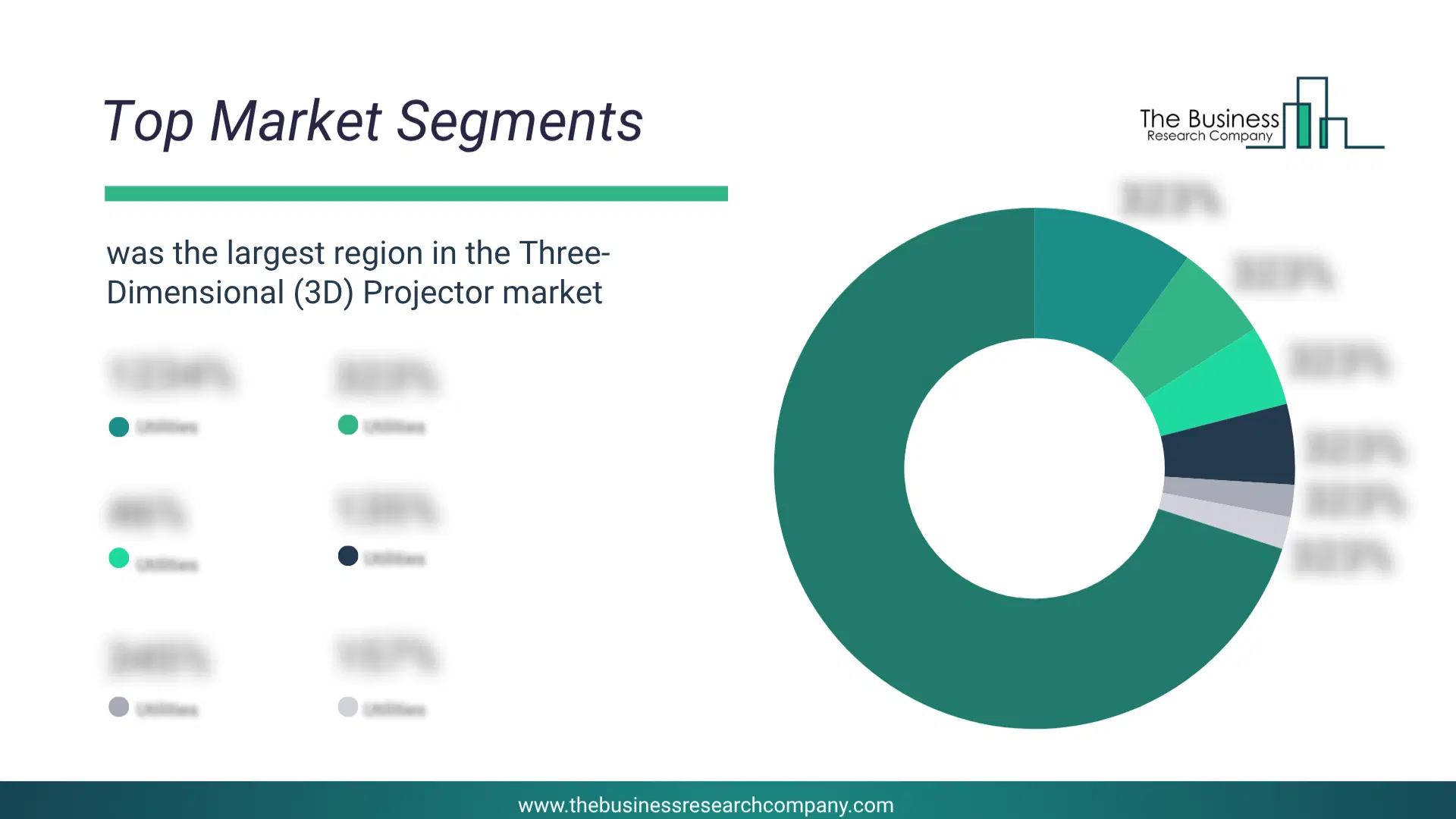
Asia-Pacific was the largest region in the three-dimensional (3D) projector market in 2025. North America is expected to be the fastest-growing region in the forecast period. The regions covered in this market report are Asia-Pacific, South East Asia, Western Europe, Eastern Europe, North America, South America, Middle East, Africa. The countries covered in this market report are Australia, Brazil, China, France, Germany, India, Indonesia, Japan, Taiwan, Russia, South Korea, UK, USA, Canada, Italy, Spain.What Defines the Three-Dimensional (3D) Projector Market?
The three-dimensional (3D) projector market consists of revenues earned by entities by providing services such as immersive entertainment services, educational and training services, and event and exhibition services. The market value includes the value of related goods sold by the service provider or included within the service offering. The three-dimensional (3D) projector market also includes sales of 3D home theater projectors, 3D cinema projectors, and 3D gaming projectors. Values in this market are ‘factory gate’ values; that is, the value of goods sold by the manufacturers or creators of the goods, whether to other entities (including downstream manufacturers, wholesalers, distributors, and retailers) or directly to end customers. The value of goods in this market includes related services sold by the creators of the goods.How is Market Value Defined and Measured?
The market value is defined as the revenues that enterprises gain from the sale of goods and/or services within the specified market and geography through sales, grants, or donations in terms of the currency (in USD unless otherwise specified). The revenues for a specified geography are consumption values that are revenues generated by organizations in the specified geography within the market, irrespective of where they are produced. It does not include revenues from resales along the supply chain, either further along the supply chain or as part of other products.
This chart presents market attractiveness based on a quantitative evaluation of growth, competition, strategic alignment, and risk, offering a clear view of opportunity areas for decision-making. This chart is for illustrative purposes; the full report contains the complete analysis.

This chart highlights the Total Addressable Market (TAM) by estimating the maximum revenue opportunity using an assumption-driven approach, supporting strategic planning and opportunity sizing across markets. The chart is illustrative; the full report provides a more comprehensive analysis.
What Key Data and Analysis Are Included in the Three-Dimensional (3D) Projector Market Report 2026?
The three-dimensional (3d) projector market research report is one of a series of new reports from The Business Research Company that provides market statistics, including industry global market size, regional shares, competitors with the market share, detailed market segments, market trends and opportunities, and any further data you may need to thrive in the three-dimensional (3d) projector industry. The market research report delivers a complete perspective of everything you need, with an in-depth analysis of the current and future state of the industry.Three-Dimensional (3D) Projector Market Report Forecast Analysis
| Report Attribute | Details |
|---|---|
| Market Size Value In 2026 | $5.49 billion |
| Revenue Forecast In 2030 | $8.12 billion |
| Growth Rate | CAGR of 10.3% from 2026 to 2030 |
| Base Year For Estimation | 2025 |
| Actual Estimates/Historical Data | 2020-2025 |
| Forecast Period | 2026 - 2030 |
| Market Representation | Revenue in USD Billion and CAGR from 2026 to 2030 |
| Segments Covered | Type, Technology, Brightness Level, Distribution Channel, Application |
| Regional Scope | Asia-Pacific, Western Europe, Eastern Europe, North America, South America, Middle East, Africa |
| Country Scope | The countries covered in the report are Australia, Brazil, China, France, Germany, India, Indonesia, Japan, Taiwan, Russia, South Korea, UK, USA, Canada, Italy, Spain. |
| Key Companies Profiled | Dell Technologies Inc., Hitachi Ltd., Sony Group Corporation, LG Electronics Inc., Panasonic Holdings Corporation, Canon Inc., NEC Corporation, Sharp Corporation, Ricoh Company Ltd., Seiko Epson Corporation, Acer Inc., Casio Computer Co. Ltd., ViewSonic Corporation, BenQ Corporation, Boxlight Corporation, InFocus Corporation, Optoma Corporation, Digital Projection Ltd., Futurotec Solutions Pvt. Ltd., Wolf Cinema |
| Customization Scope | Request for Customization |
| Pricing And Purchase Options | Explore Purchase Options |