
Three Wheeler (3W) Goods Carrier Market Report 2026
Global Outlook – By Type (Electric Three-Wheeler Goods Carrier, Diesel Three-Wheeler Goods Carrier, Petrol Three-Wheeler Goods Carrier, Compressed Natural Gas Three-Wheeler Goods Carrier), By Vehicle Design (Open Body, Closed Body, Refrigerated Cargo, Flatbed), By Load Capacity (Below 500 Kilograms, 500 Kilograms To 1,000 Kilograms, Above 1,000 Kilograms), By Sales Channel (Original Equipment Manufacturer Sales, Dealer Network, Online Sales), By End User (Agriculture, Construction, Manufacturing, Retail And E-Commerce, Logistics And Courier Services, Municipal And Utility Services, Other End Users) – Market Size, Trends, Strategies, and Forecast to 2035
Three Wheeler (3W) Goods Carrier Market Overview
• Three Wheeler (3W) Goods Carrier market size has reached to $5.98 billion in 2025 • Expected to grow to $8.82 billion in 2030 at a compound annual growth rate (CAGR) of 8% • Growth Driver: E-Commerce And Last-Mile Delivery Services Driving Growth Of The Market Due To Increasing Demand For Efficient Urban Delivery Solutions • Market Trend: Sustainable Electric Three-Wheelers Improve Last-Mile Delivery Efficiency And Urban Logistics • Asia-Pacific was the largest region and fastest growing region.What Is Covered Under Three Wheeler (3W) Goods Carrier Market?
A three-wheeler (3W) goods carrier is a compact commercial vehicle with three wheels that is specifically designed for the transportation of goods and cargo, offering an efficient and cost-effective solution for freight movement. It is engineered to provide high maneuverability, fuel efficiency, and load-carrying capability while supporting reliable commercial transportation operations. The main types of three wheeler (3W) goods carriers include electric three-wheeler goods carriers, diesel three-wheeler goods carriers, petrol three-wheeler goods carriers, and compressed natural gas three-wheeler goods carriers. Electric three-wheeler goods carriers refer to cargo vehicles powered by electric motors and batteries that are designed to transport goods over short and medium distances. These vehicles are available in open body, closed body, refrigerated cargo, and flatbed designs and offer load capacities of below 500 kilograms, 500 kilograms to 1,000 kilograms, and above 1,000 kilograms. They are sold through original equipment manufacturer sales, dealer networks, and online sales, and are used end users by agriculture, construction, manufacturing, retail and e-commerce, logistics and courier services, municipal and utility services, and others.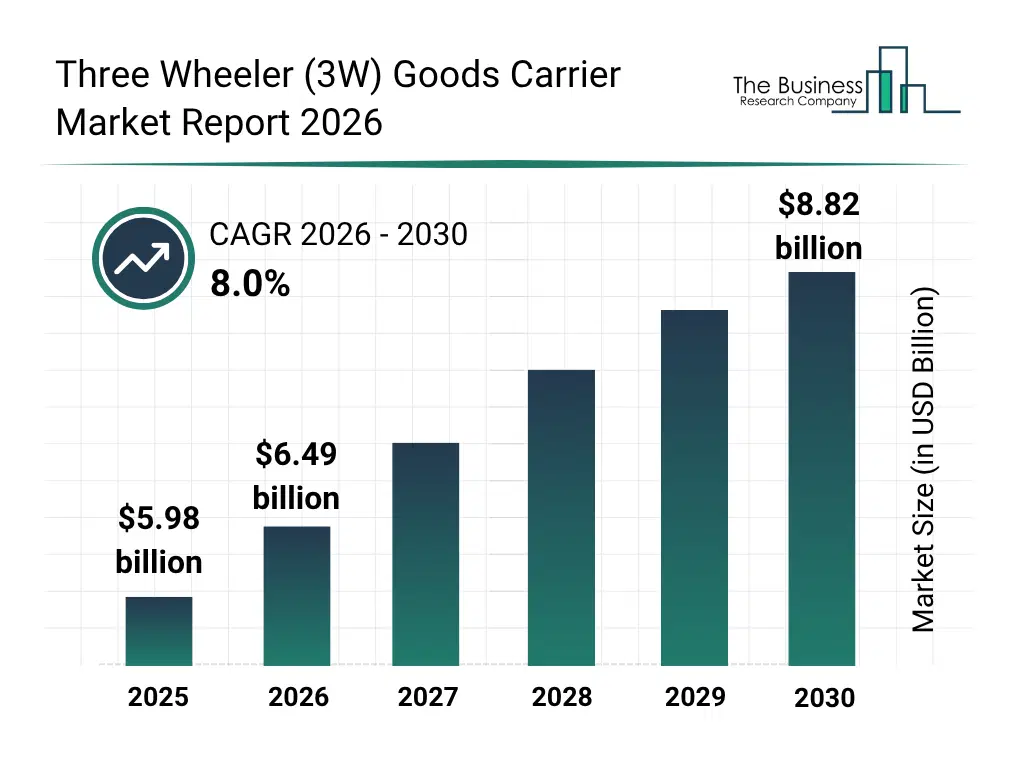
What Is The Three Wheeler (3W) Goods Carrier Market Size and Share 2026?
The three wheeler (3w) goods carrier market size has grown strongly in recent years. It will grow from $5.98 billion in 2025 to $6.49 billion in 2026 at a compound annual growth rate (CAGR) of 8.4%. The growth in the historic period can be attributed to increasing demand for cost-effective last-mile transportation, rising urban freight movement, growing e-commerce delivery activities, increasing demand for fuel-efficient commercial vehicles, expansion of small-scale commercial enterprises.What Is The Three Wheeler (3W) Goods Carrier Market Growth Forecast?
The three wheeler (3w) goods carrier market size is expected to see strong growth in the next few years. It will grow to $8.82 billion in 2030 at a compound annual growth rate (CAGR) of 8.0%. The growth in the forecast period can be attributed to increasing adoption of electric goods carriers, rising demand for sustainable urban logistics, expansion of organized last-mile delivery networks, growing demand for refrigerated and specialized cargo transport, increasing deployment of connected fleet management solutions. Major trends in the forecast period include expansion of electric three-wheeler goods carriers, development of lightweight cargo vehicle designs, increasing adoption of swappable battery systems, growth of high-payload three-wheeler models, expansion of specialized cargo configurations.Tariff Impact On Three Wheeler (3W) Goods Carrier Market
Tariffs are impacting the three-wheeler goods carrier market by increasing the cost of imported vehicle components, batteries, powertrain systems, electronics, and raw materials used in commercial vehicle manufacturing. Electric three-wheeler goods carriers and higher-capacity models may face greater cost pressures, particularly in Asia-Pacific, North America, and Europe where manufacturers depend on international component supply chains. However, tariffs can encourage localized component manufacturing, domestic battery production, supplier diversification, and investments in regional vehicle assembly, potentially strengthening local production capabilities and supply-chain resilience.
Global Three Wheeler (3W) Goods Carrier Market Segmentation
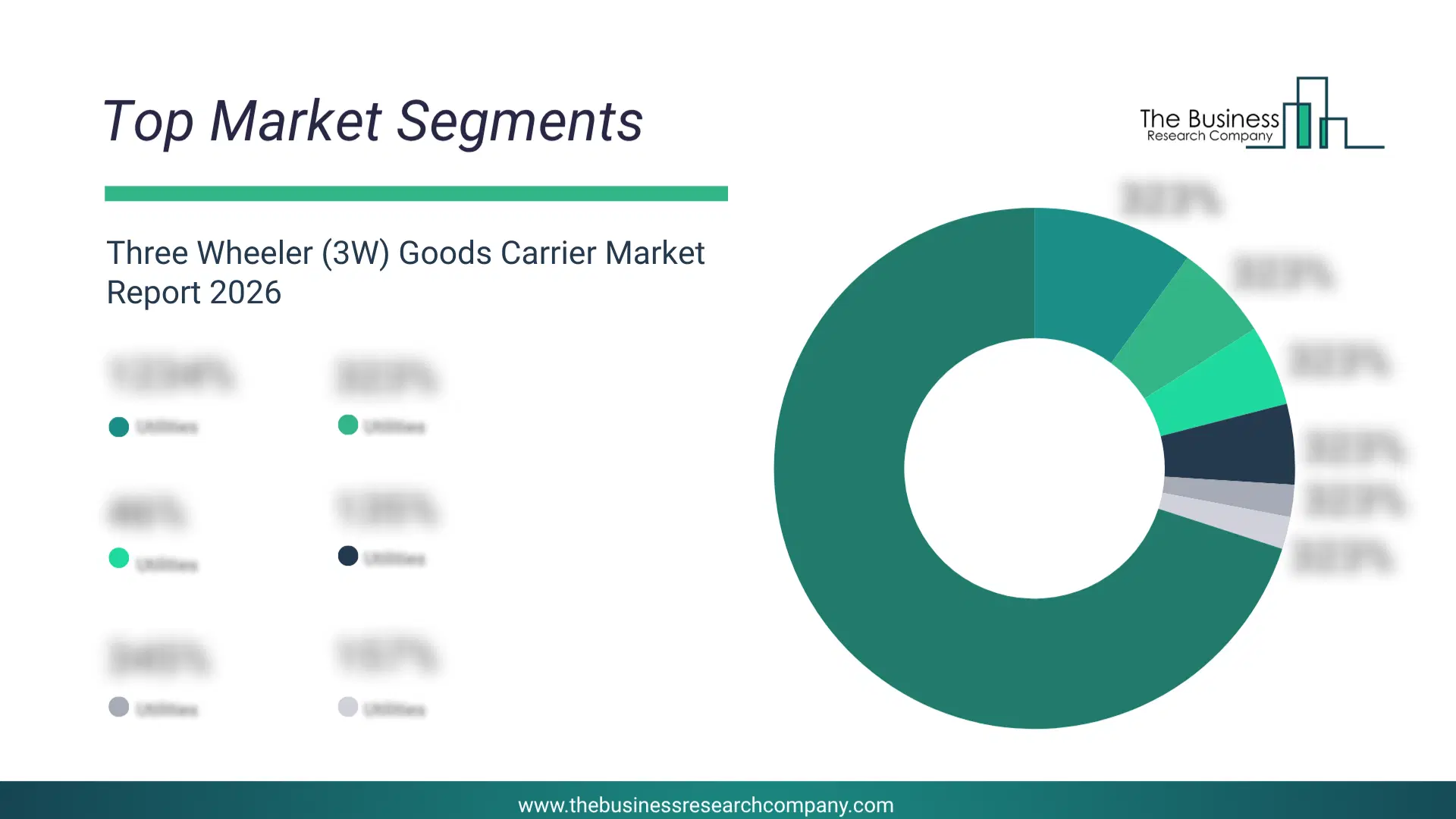
2) By Vehicle Design: Open Body, Closed Body, Refrigerated Cargo, Flatbed 3) By Load Capacity: Below 500 Kilograms, 500 Kilograms To 1,000 Kilograms, Above 1,000 Kilograms 4) By Sales Channel: Original Equipment Manufacturer Sales, Dealer Network, Online Sales 5) By End User: Agriculture, Construction, Manufacturing, Retail And E-Commerce, Logistics And Courier Services, Municipal And Utility Services, Other End Users Subsegments: 1) By Electric Three-Wheeler Goods Carrier: Battery Electric Goods Carrier, Lead-Acid Battery Goods Carrier, Lithium-Ion Battery Goods Carrier, Swappable Battery Goods Carrier, Fixed Battery Goods Carrier, High-Payload Electric Goods Carrier 2) By Diesel Three-Wheeler Goods Carrier: Single-Cylinder Diesel Goods Carrier, Twin-Cylinder Diesel Goods Carrier, Naturally Aspirated Diesel Goods Carrier, Turbocharged Diesel Goods Carrier, Heavy-Duty Diesel Goods Carrier, Long-Range Diesel Goods Carrier 3) By Petrol Three-Wheeler Goods Carrier: Carbureted Petrol Goods Carrier, Fuel-Injected Petrol Goods Carrier, Single-Cylinder Petrol Goods Carrier, High-Fuel-Efficiency Petrol Goods Carrier, Light-Duty Petrol Goods Carrier, Long-Range Petrol Goods Carrier 4) By Compressed Natural Gas Three-Wheeler Goods Carrier: Factory-Fitted Compressed Natural Gas Goods Carrier, Bi-Fuel Petrol And Compressed Natural Gas Goods Carrier, Dedicated Compressed Natural Gas Goods Carrier, Sequential Compressed Natural Gas Injection Goods Carrier, High-Payload Compressed Natural Gas Goods Carrier, Long-Range Compressed Natural Gas Goods CarrierWhat Is The Driver Of The Three Wheeler (3W) Goods Carrier Market?
The growth in e-commerce and last-mile delivery services is expected to propel the growth of the three-wheeler (3W) goods carrier market going forward. E-commerce and last-mile delivery services refer to the online sale of goods and the final transportation of purchased products from fulfillment centers or distribution hubs to the end customer's location. E-commerce and last-mile delivery services are increasing due to rising smartphone and internet penetration, which enables more consumers to shop online conveniently and drives higher demand for fast and efficient doorstep deliveries. E-commerce and last-mile delivery services drive the growth of the three-wheeler (3W) goods carrier by increasing the demand for compact, cost-effective, and maneuverable vehicles that can efficiently transport goods through congested urban and suburban areas for timely deliveries. For instance, in February 2026, according to the European Commission, a Belgium-based governing body, in 2025, 95% of individuals aged 16 to 74 years in the European Union (EU) used the internet during the previous 12 months, and 78% of these users purchased or ordered goods and services online. Therefore, the growth in e-commerce and last-mile delivery services is driving the growth of the three-wheeler (3W) goods carrier market.Key Players In The Global Three Wheeler (3W) Goods Carrier Market
Major companies operating in the three wheeler (3w) goods carrier market are Bajaj Auto Ltd, Mahindra & Mahindra Ltd, Piaggio & C SpA, TVS Motor Company Ltd, Jiangsu Jinpeng Group Co Ltd, Shandong Wuzheng Group Co Ltd, Chongqing Zongshen Tricycle Manufacturing Co Ltd, Greaves Electric Mobility Pvt Ltd, Kinetic Green Energy & Power Solutions Ltd, Atul Auto Ltd, Euler Motors Pvt Ltd, Altigreen Propulsion Labs Pvt Ltd, Omega Seiki Mobility Pvt Ltd, Terra Motors Corporation, Changzhou Yufeng Vehicle Co Ltd, Lohia Auto Industries, YC Electric Vehicle, Saera Electric Auto Pvt Ltd, Deltic Electric, Gayam Motor Works Pvt Ltd, Biliti Electric Inc, Etrio Automobiles Pvt Ltd, Xianghe Qiangsheng Electric Tricycle Factory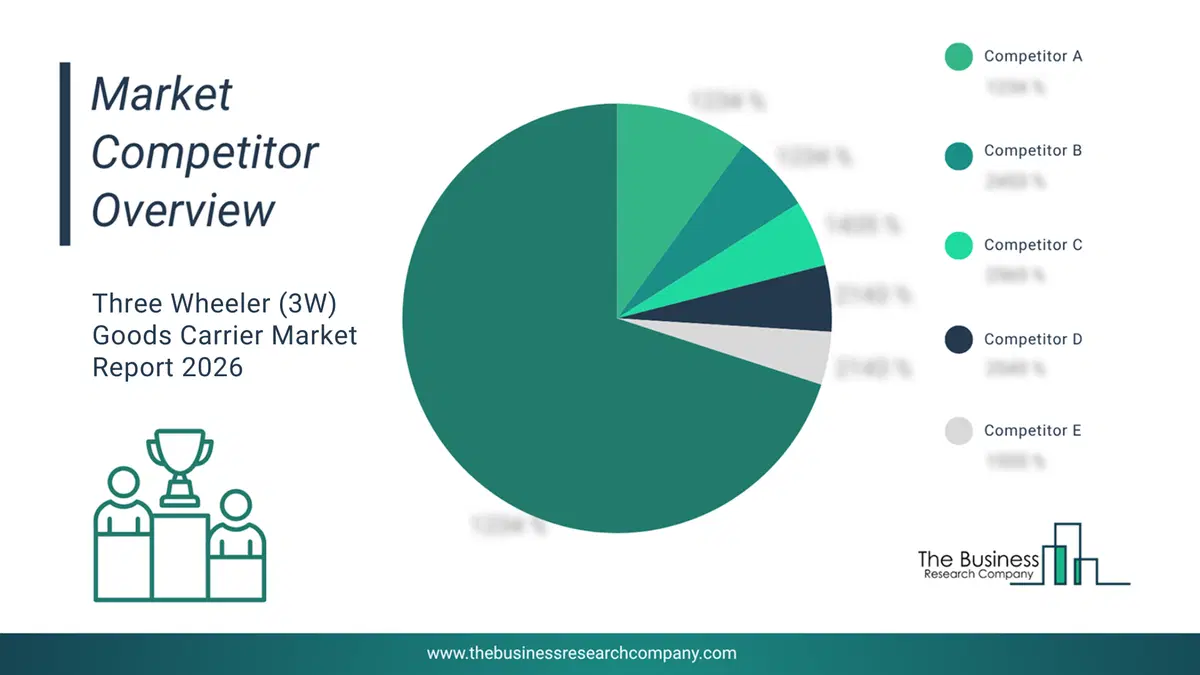
This chart is for illustrative purposes; the full report includes a detailed competitor analysis and comprehensive overview of the top 10 companies in the market.
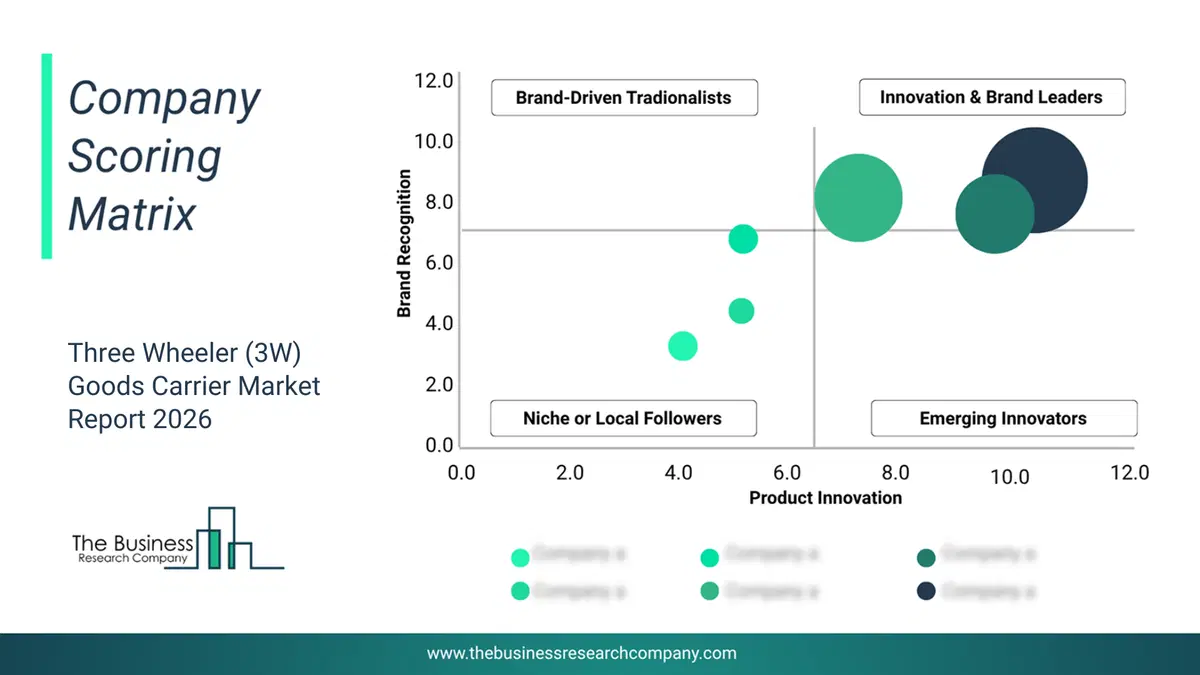
This chart maps companies by product innovation and brand strength, with bubble size indicating relative revenue, helping identify market leaders, challengers, and niche players. This is an illustrative chart; the full report provides a complete and accurate competitive analysis.
Global Three Wheeler (3W) Goods Carrier Market Trends and Insights
Major companies operating in the three-wheeler (3W) goods carrier market are focusing on developing innovative solutions such as sustainable logistics vehicles to improve delivery efficiency, reduce operating costs, and support sustainable urban transportation. Sustainable logistics vehicles are transport vehicles that utilize low-emission or zero-emission technologies, energy-efficient systems, and sustainable fuels to reduce environmental impact while improving freight efficiency and lowering greenhouse gas emissions. For instance, in January 2025, Borzo, an India-based logistics technology company, launched electric three-wheelers for last-mile deliveries in India. The product is designed to provide efficient and eco-friendly vehicles for last-mile delivery operations. It offers benefits such as reduced fuel costs, lower carbon emissions, and improved urban delivery efficiency. The launch aims to help customers achieve cost-effective and sustainable delivery operations while supporting the transition toward electric mobility and cleaner transportation solutions.What Are Latest Mergers And Acquisitions In The Three Wheeler (3W) Goods Carrier Market?
In April 2026, Hyundai Motor Company, a South Korea-based automotive manufacturer, partnered with TVS Motor Company to develop and commercialize electric three-wheelers designed specifically to address India's last-mile mobility needs. Through this partnership, the companies aim to accelerate electric vehicle adoption in the commercial mobility sector by leveraging Hyundai’s global electric vehicle expertise and TVS Motor’s local market capabilities. TVS Motor Company is an India-based automotive manufacturer that provides three-wheel (3W) goods carriers.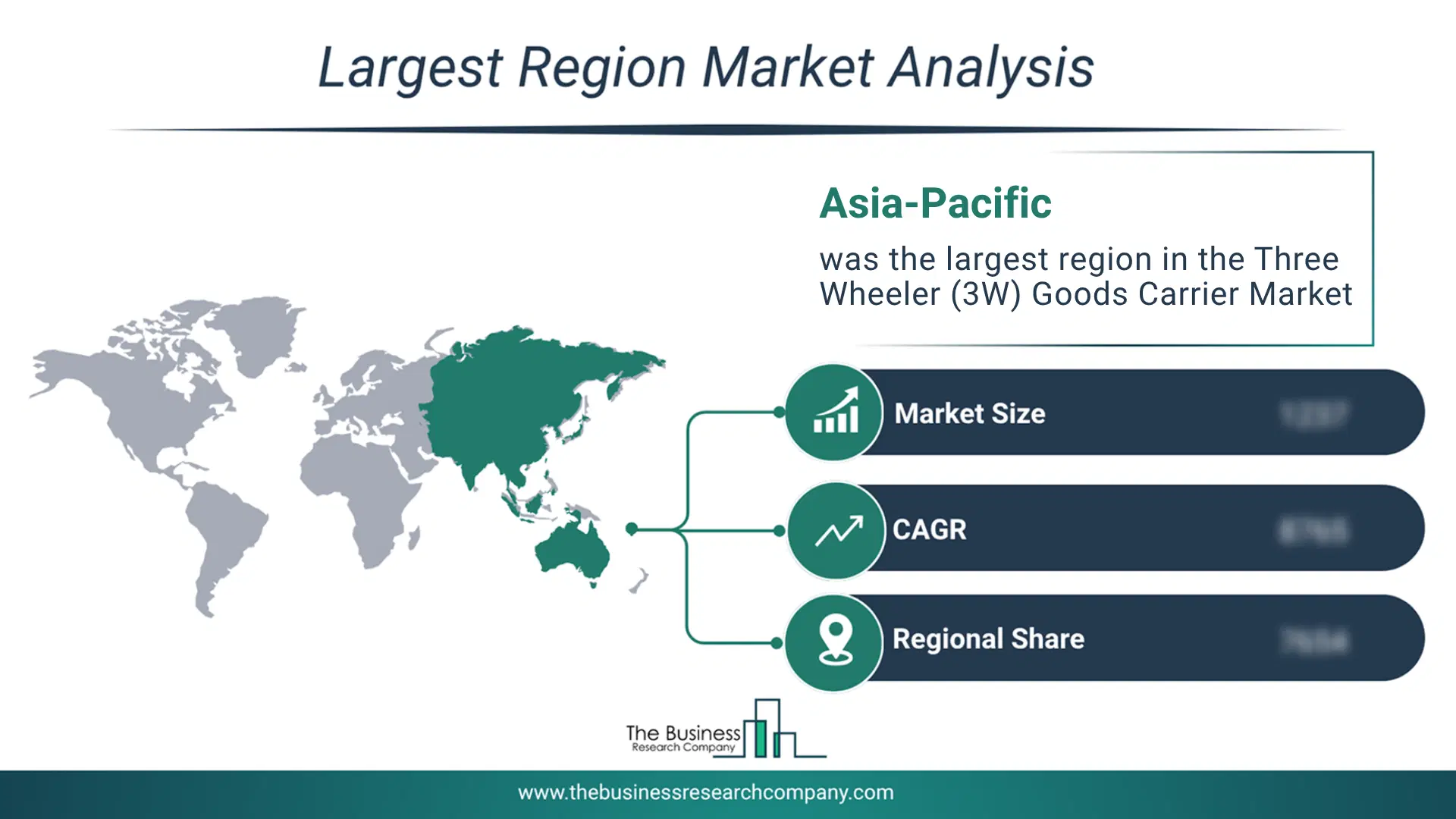
Regional Outlook/Insights
Asia-Pacific was the largest region in the three-wheeler (3W) goods carrier market in 2025. Asia-Pacific is expected to be the fastest-growing region in the forecast period. The regions covered in this market report are Asia-Pacific, South East Asia, Western Europe, Eastern Europe, North America, South America, Middle East, Africa. The countries covered in this market report are Australia, Brazil, China, France, Germany, India, Indonesia, Japan, Taiwan, Russia, South Korea, UK, USA, Canada, Italy, Spain.What Defines the Three Wheeler (3W) Goods Carrier Market?
The three-wheeler (3W) goods carrier market consists of sales of hybrid three-wheeler goods carriers, hydrogen fuel cell three-wheeler goods carriers, refrigerated three-wheeler goods carriers, and flatbed three-wheeler goods carriers. Values in this market are 'factory gate' values, that is, the value of goods sold by manufacturers or creators of the goods, whether to fleet operators, logistics companies, distributors, dealers, government organizations, commercial enterprises, or directly to end-users. The value of goods in this market includes related services sold by the creators of the goods.How is Market Value Defined and Measured?
The market value is defined as the revenues that enterprises gain from the sale of goods and/or services within the specified market and geography through sales, grants, or donations in terms of the currency (in USD unless otherwise specified). The revenues for a specified geography are consumption values that are revenues generated by organizations in the specified geography within the market, irrespective of where they are produced. It does not include revenues from resales along the supply chain, either further along the supply chain or as part of other products.
This chart presents market attractiveness based on a quantitative evaluation of growth, competition, strategic alignment, and risk, offering a clear view of opportunity areas for decision-making. This chart is for illustrative purposes; the full report contains the complete analysis.

This chart highlights the Total Addressable Market (TAM) by estimating the maximum revenue opportunity using an assumption-driven approach, supporting strategic planning and opportunity sizing across markets. The chart is illustrative; the full report provides a more comprehensive analysis.
What Key Data and Analysis Are Included in the Three Wheeler (3W) Goods Carrier Market Report 2026?
The three wheeler (3w) goods carrier market research report is one of a series of new reports from The Business Research Company that provides market statistics, including industry global market size, regional shares, competitors with the market share, detailed market segments, market trends and opportunities, and any further data you may need to thrive in the three wheeler (3w) goods carrier industry. The market research report delivers a complete perspective of everything you need, with an in-depth analysis of the current and future state of the industry.Three Wheeler (3W) Goods Carrier Market Report Forecast Analysis
| Report Attribute | Details |
|---|---|
| Market Size Value In 2026 | $6.49 billion |
| Revenue Forecast In 2030 | $8.82 billion |
| Growth Rate | CAGR of 8.0% from 2026 to 2035 |
| Base Year For Estimation | 2025 |
| Actual Estimates/Historical Data | 2020-2025 |
| Forecast Period | 2026 - 2030 |
| Market Representation | Revenue in USD Billion and CAGR from 2026 to 2030 |
| Segments Covered | Type, Vehicle Design, Load Capacity, Sales Channel, End User |
| Regional Scope | Asia-Pacific, Western Europe, Eastern Europe, North America, South America, Middle East, Africa |
| Country Scope | The countries covered in the report are Australia, Brazil, China, France, Germany, India, Indonesia, Japan, Taiwan, Russia, South Korea, UK, USA, Canada, Italy, Spain. |
| Customization Scope | Request for Customization |
| Pricing And Purchase Options | Explore Purchase Options |