

Thrombocytopenia Market Report 2026
Global Outlook – By Type (Idiopathic Thrombocytopenic, Thrombotic Thrombocytopenic, Drug-Induced Thrombocytopenia ), By Drugs (Danazol, Intravenous Immune Globulin, Rituximab, Eltrombopag, Romiplostim, Splenectomy, Corticosteroid, Other Drugs), By Route Of Administration (Oral, Parenteral, Other Routes Of Administration), By End User (Hospitals, Specialty Clinics, Homecare, Other End Users) - Market Size, Trends, Strategies, and Forecast to 2030
Thrombocytopenia Market Overview
• Thrombocytopenia market size has reached to $4.67 billion in 2025 • Expected to grow to $6.59 billion in 2030 at a compound annual growth rate (CAGR) of 7.1% • Growth Driver: Impact Of Rising Autoimmune Disease Prevalence On Treatment Demand • Market Trend: Advancements In Intravenous Therapies For Autoimmune Disease Management • North America was the largest region in 2025 and Asia-Pacific is the fastest growing region.What Is Covered Under Thrombocytopenia Market?
Thrombocytopenia refers to a medical condition characterized by an abnormally low platelet count in the blood, which increases the risk of excessive bleeding. Causes include bone marrow disorders, autoimmune diseases, and certain medications. Symptoms involve easy bruising, prolonged bleeding, and petechiae (small red spots on the skin). The main types of thrombocytopenia are idiopathic thrombocytopenic, thrombotic thrombocytopenic, and drug-induced thrombocytopenia. Idiopathic thrombocytopenic is a condition where the immune system mistakenly attacks and destroys platelets, which play a crucial role in blood clotting. The key drugs used include danazol, intravenous immune globulin, rituximab, eltrombopag, romiplostim, splenectomy, corticosteroids, and others. The various routes of administration are oral, parenteral, and others and are used by several end users, such as hospitals, specialty clinics, homecare, and others.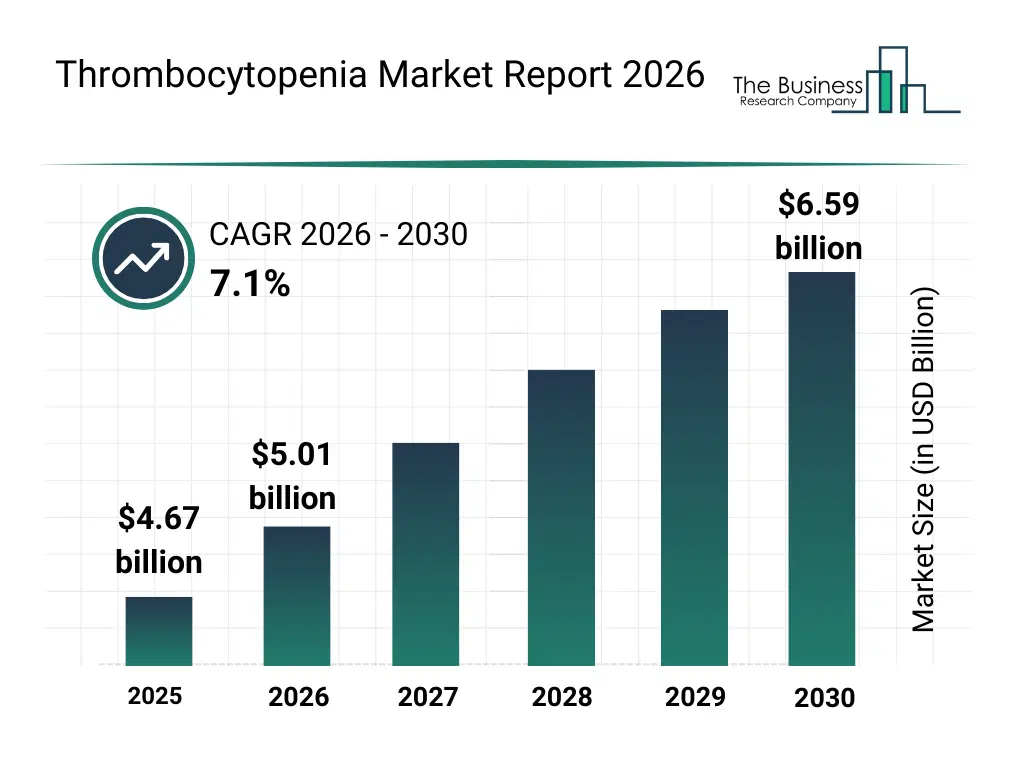
What Is The Thrombocytopenia Market Size and Share 2026?
The thrombocytopenia market size has grown strongly in recent years. It will grow from $4.67 billion in 2025 to $5.01 billion in 2026 at a compound annual growth rate (CAGR) of 7.2%. The growth in the historic period can be attributed to increasing incidence of autoimmune disorders, rising use of chemotherapy treatments, improved diagnostic capabilities for platelet disorders, greater clinical awareness of bleeding conditions, expansion of hospital-based hematology services.What Is The Thrombocytopenia Market Growth Forecast?
The thrombocytopenia market size is expected to see strong growth in the next few years. It will grow to $6.59 billion in 2030 at a compound annual growth rate (CAGR) of 7.1%. The growth in the forecast period can be attributed to increasing development of novel thrombopoietin receptor agonists, rising adoption of personalized medicine approaches, expansion of outpatient treatment options, growing investments in rare disease therapies, increasing focus on early intervention strategies. Major trends in the forecast period include increasing adoption of targeted drug therapies, rising use of immunomodulatory treatments, growing focus on early disease diagnosis, expansion of personalized treatment protocols, enhanced monitoring of platelet disorders.
Global Thrombocytopenia Market Segmentation
1) By Type: Idiopathic Thrombocytopenic, Thrombotic Thrombocytopenic, Drug-Induced Thrombocytopenia 2) By Drugs: Danazol, Intravenous Immune Globulin, Rituximab, Eltrombopag, Romiplostim, Splenectomy, Corticosteroid, Other Drugs 3) By Route Of Administration: Oral, Parenteral, Other Routes Of Administration 4) By End User: Hospitals, Specialty Clinics, Homecare, Other End Users Subsegments: 1) By Idiopathic Thrombocytopenic (ITP): Acute ITP, Chronic ITP 2) By Thrombotic Thrombocytopenic (TTP): Congenital TTP (Hereditary ADAMTS13 Deficiency), Acquired TTP (Immune-Mediated) 3) By Drug-Induced Thrombocytopenia (DITP): Heparin-Induced Thrombocytopenia (HIT), Chemotherapy-Induced ThrombocytopeniaWhat Is The Driver Of The Thrombocytopenia Market?
The growing prevalence of autoimmune diseases is expected to drive the growth of the thrombocytopenia market going forward. Autoimmune diseases occur when the immune system mistakenly attacks the body's healthy cells and tissues, treating them as foreign threats. This abnormal response leads to inflammation and damage in various organs and systems. The rise in autoimmune diseases is linked to genetic predispositions, environmental factors, lifestyle changes, and increased awareness leading to better diagnosis. Autoimmune diseases cause thrombocytopenia by triggering the immune system to attack and destroy the body's platelets or impair their production in the bone marrow. For instance, in August 2024, according to the data from Public Health Scotland, a Scotland-based national organization, reported that in 2023, the Scottish Multiple Sclerosis Register (SMSR) recorded 455 newly diagnosed MS patients. Therefore, the growing prevalence of autoimmune diseases is driving the growth of the thrombocytopenia industry.Key Players In The Global Thrombocytopenia Market
Major companies operating in the thrombocytopenia market are Pfizer Inc., Johnson & Johnson, Bayer AG, Sanofi S.A., Novartis AG, GSK Plc, Takeda Pharmaceutical Company Limited, Eli Lilly and Company, Amgen Inc., Merck & Co. Inc., Swedish Orphan Biovitrum AB, Argenx SE, GC Pharma, Biotest AG, UCB Biopharma, Rigel Pharmaceuticals, Keros Therapeutics Inc., Dova Pharmaceuticals (Sobi), F Hoffmann‑La Roche Ltd, Eisai Co Ltd, Biogen Inc, Bristol‑Myers Squibb Company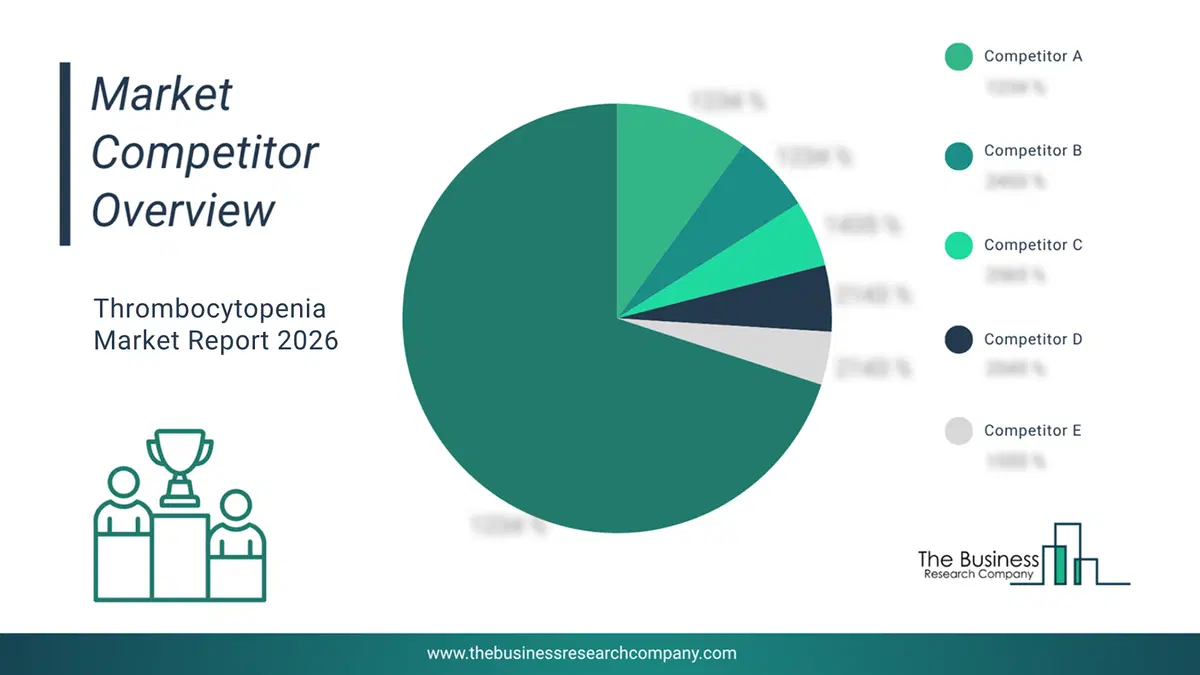
This chart is for illustrative purposes; the full report includes a detailed competitor analysis and comprehensive overview of the top 10 companies in the market.
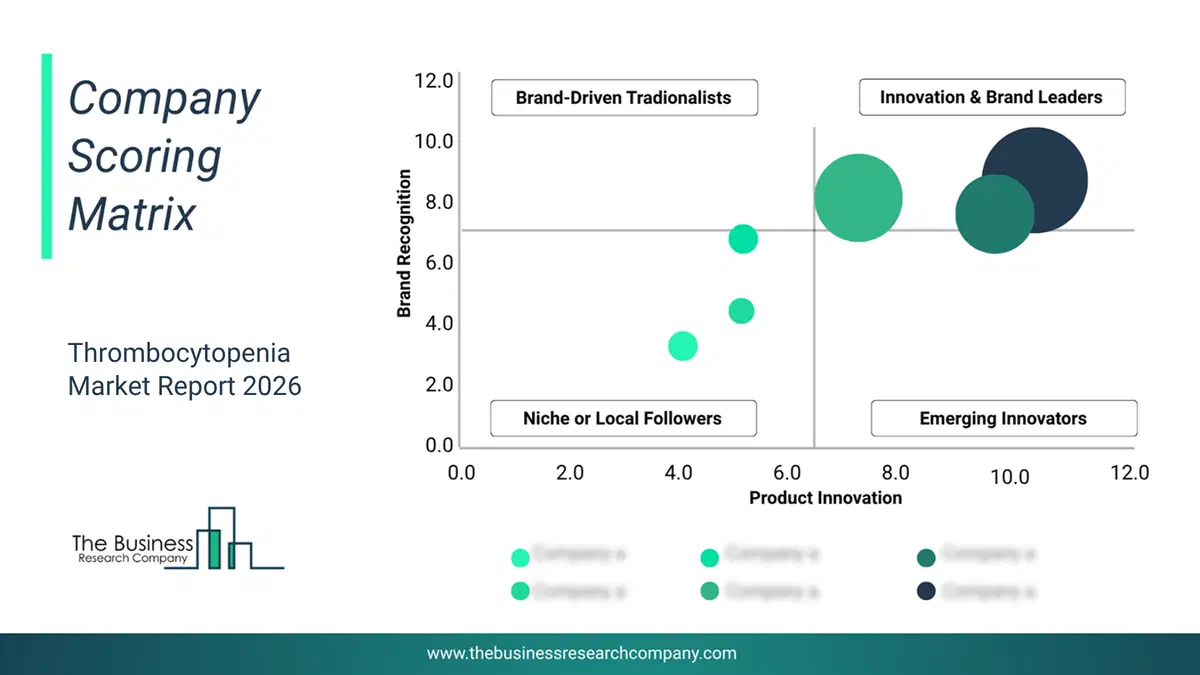
This chart maps companies by product innovation and brand strength, with bubble size indicating relative revenue, helping identify market leaders, challengers, and niche players. This is an illustrative chart; the full report provides a complete and accurate competitive analysis.
Global Thrombocytopenia Market Trends and Insights
Major companies operating in the thrombocytopenia market are prioritizing advancements, including the development of intravenous therapy, to improve treatment effectiveness, accelerate response time, enhance patient adherence, and meet unmet medical needs. Intravenous therapy in thrombocytopenia offers rapid platelet count improvement, ensuring quick symptom relief and reducing the risk of bleeding complications. It also enhances treatment precision, providing controlled and effective platelet support for patients with severe or chronic cases. For instance, in March 2024, Argenx SE, a Netherlands-based biotechnology company, received approval from Japan’s Ministry of Health, Labor, and Welfare (MHLW) for VYVGART for intravenous use in adults with primary immune thrombocytopenia (ITP). This approval represents a major advancement, offering a targeted treatment with rapid effectiveness and sustained platelet response, addressing unmet needs in autoimmune disease management.What Are Latest Mergers And Acquisitions In The Thrombocytopenia Market?
In December 2024, Keros Therapeutics Inc., a US-based biopharmaceutical company, partnered with Takeda Pharmaceutical Industries Ltd. to develop and commercialize elritercept, a therapy targeting disorders linked to dysfunctional TGF-β signaling, including thrombocytopenia and other rare diseases. Takeda Pharmaceutical Industries Ltd. is a Japan-based biopharmaceutical company specializing in innovative treatments for thrombocytopenia.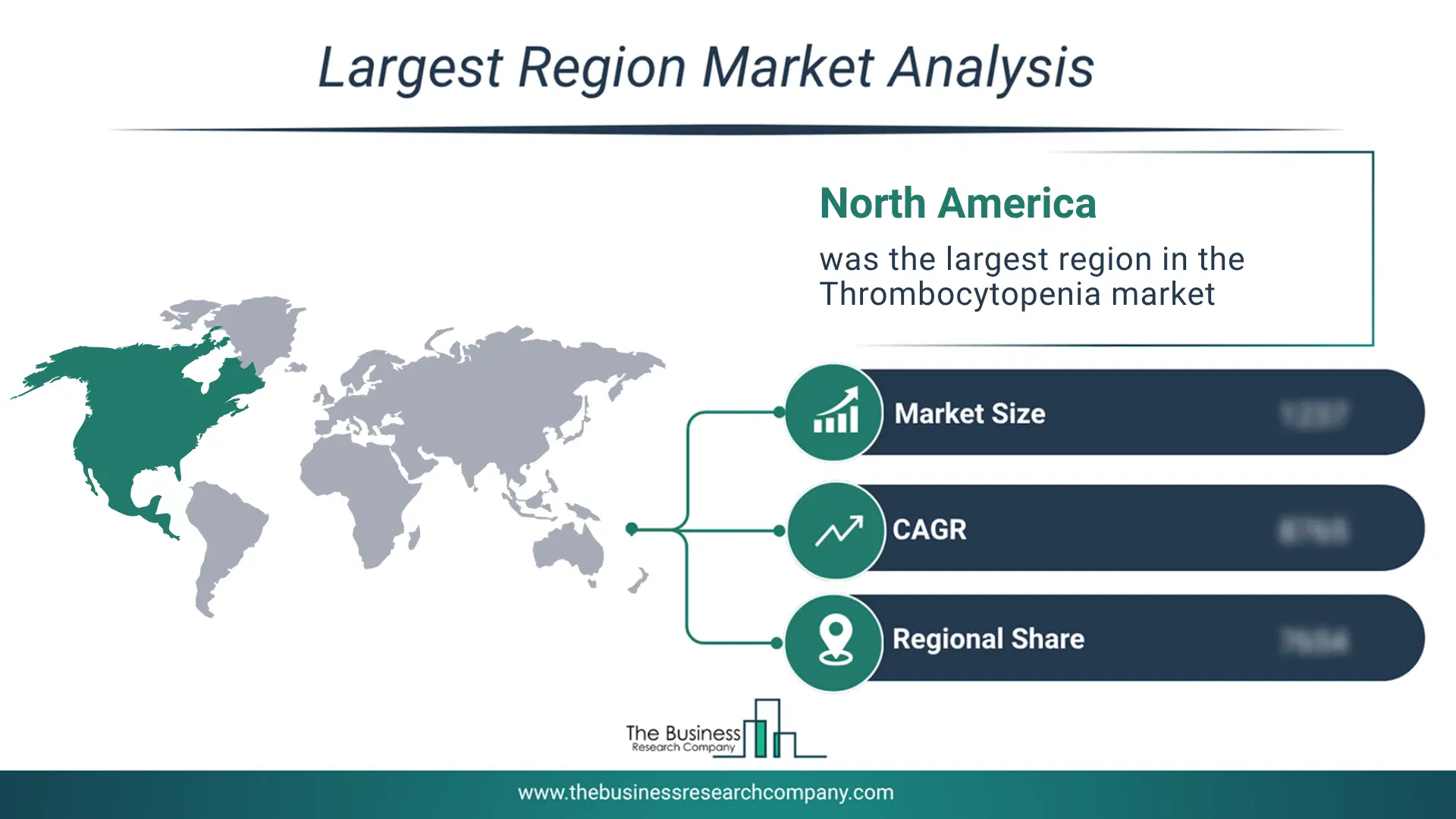
Regional Outlook
North America was the largest region in the thrombocytopenia market in 2025. Asia-Pacific is expected to be the fastest-growing region in the forecast period. The regions covered in this market report are Asia-Pacific, South East Asia, Western Europe, Eastern Europe, North America, South America, Middle East, Africa. The countries covered in this market report are Australia, Brazil, China, France, Germany, India, Indonesia, Japan, Taiwan, Russia, South Korea, UK, USA, Canada, Italy, Spain.What Defines the Thrombocytopenia Market?
The thrombocytopenia market consists of revenues earned by entities by providing services such as blood or platelet transfusions, splenectomy, plasma exchange, monitoring, and support services. The market value includes the value of related goods sold by the service provider or included within the service offering. The thrombocytopenia market also includes sales of pharmaceutical drugs, diagnostic kits, supportive care products, and research and development products. Values in this market are ‘factory gate’ values, that is, the value of goods sold by the manufacturers or creators of the goods, whether to other entities (including downstream manufacturers, wholesalers, distributors, and retailers) or directly to end customers. The value of goods in this market includes related services sold by the creators of the goods.How is Market Value Defined and Measured?
The market value is defined as the revenues that enterprises gain from the sale of goods and/or services within the specified market and geography through sales, grants, or donations in terms of the currency (in USD unless otherwise specified). The revenues for a specified geography are consumption values that are revenues generated by organizations in the specified geography within the market, irrespective of where they are produced. It does not include revenues from resales along the supply chain, either further along the supply chain or as part of other products.
This chart presents market attractiveness based on a quantitative evaluation of growth, competition, strategic alignment, and risk, offering a clear view of opportunity areas for decision-making. This chart is for illustrative purposes; the full report contains the complete analysis.

This chart highlights the Total Addressable Market (TAM) by estimating the maximum revenue opportunity using an assumption-driven approach, supporting strategic planning and opportunity sizing across markets. The chart is illustrative; the full report provides a more comprehensive analysis.
What Key Data and Analysis Are Included in the Thrombocytopenia Market Report 2026?
The thrombocytopenia market research report is one of a series of new reports from The Business Research Company that provides market statistics, including industry global market size, regional shares, competitors with the market share, detailed market segments, market trends and opportunities, and any further data you may need to thrive in the thrombocytopenia industry. The market research report delivers a complete perspective of everything you need, with an in-depth analysis of the current and future state of the industry.Thrombocytopenia Market Report Forecast Analysis
| Report Attribute | Details |
|---|---|
| Market Size Value In 2026 | $5.01 billion |
| Revenue Forecast In 2030 | $6.59 billion |
| Growth Rate | CAGR of 7.1% from 2026 to 2030 |
| Base Year For Estimation | 2025 |
| Actual Estimates/Historical Data | 2020-2025 |
| Forecast Period | 2026 - 2030 |
| Market Representation | Revenue in USD Billion and CAGR from 2026 to 2030 |
| Segments Covered | Type, Drugs, Route Of Administration, End User |
| Regional Scope | Asia-Pacific, Western Europe, Eastern Europe, North America, South America, Middle East, Africa |
| Country Scope | The countries covered in the report are Australia, Brazil, China, France, Germany, India, Indonesia, Japan, Taiwan, Russia, South Korea, UK, USA, Canada, Italy, Spain |
| Key Companies Profiled | Pfizer Inc., Johnson & Johnson, Bayer AG, Sanofi S.A., Novartis AG, GSK Plc, Takeda Pharmaceutical Company Limited, Eli Lilly and Company, Amgen Inc., Merck & Co. Inc., Swedish Orphan Biovitrum AB, Argenx SE, GC Pharma, Biotest AG, UCB Biopharma, Rigel Pharmaceuticals, Keros Therapeutics Inc., Dova Pharmaceuticals (Sobi), F Hoffmann‑La Roche Ltd, Eisai Co Ltd, Biogen Inc, Bristol‑Myers Squibb Company |
| Customization Scope | Request for Customization |
| Pricing And Purchase Options | Explore Purchase Options |