
Timber Construction Market Report 2026
Global Outlook – By Product Type (Mass Timber, Cross-Laminated Timber, Glue-Laminated Timber, Laminated Veneer Lumber, Nail-Laminated Timber, Dowel-Laminated Timber, Timber Frames, Prefabricated Timber Components), By Timber Type (Softwood, Hardwood, Engineered Wood Products), By Construction Type (New Construction, Renovation And Remodeling, Modular Construction, Hybrid Construction), By Application (Residential, Commercial, Institutional, Industrial, Infrastructure), By End User (Developers And Contractors, Government Bodies, Architects, Modular Builders) – Market Size, Trends, Strategies, and Forecast to 2030
Timber Construction Market Overview
• Timber Construction market size has reached to $28.67 billion in 2025 • Expected to grow to $47.2 billion in 2030 at a compound annual growth rate (CAGR) of 10.5% • Growth Driver: Increasing Focus On Sustainable Building Practices Is Driving The Market Growth Due To Rising Demand For Low-Carbon, Energy-Efficient Building Materials • Market Trend: Integrated On-Site Wood Construction Solutions Advancing Sustainable And Low-Carbon Building Practices • Europe was the largest region in 2025 and Asia-Pacific is the fastest growing region.What Is Covered Under Timber Construction Market?
Timber construction is a building method where wood and engineered wood products are used to form the structural framework of a structure. It is valued for its sustainability, flexibility in design, and ability to reduce construction time compared to conventional materials. It is also increasingly used in modern architecture as a low-carbon alternative to steel and concrete. The main product types of timber construction include mass timber, cross-laminated timber, glue-laminated timber, laminated veneer lumber, nail-laminated timber, dowel-laminated timber, timber frames, and prefabricated timber components. Mass timber refers to large structural wood elements engineered for high strength, durability, and use in modern sustainable construction systems. These products are categorized by timber type including softwood, hardwood, and engineered wood products and are used across construction types such as new construction, renovation and remodeling, modular construction, and hybrid construction. The various applications involved are residential, commercial, institutional, industrial, and infrastructure, and they are used by several end users such as developers and contractors, government bodies, architects, and modular builders.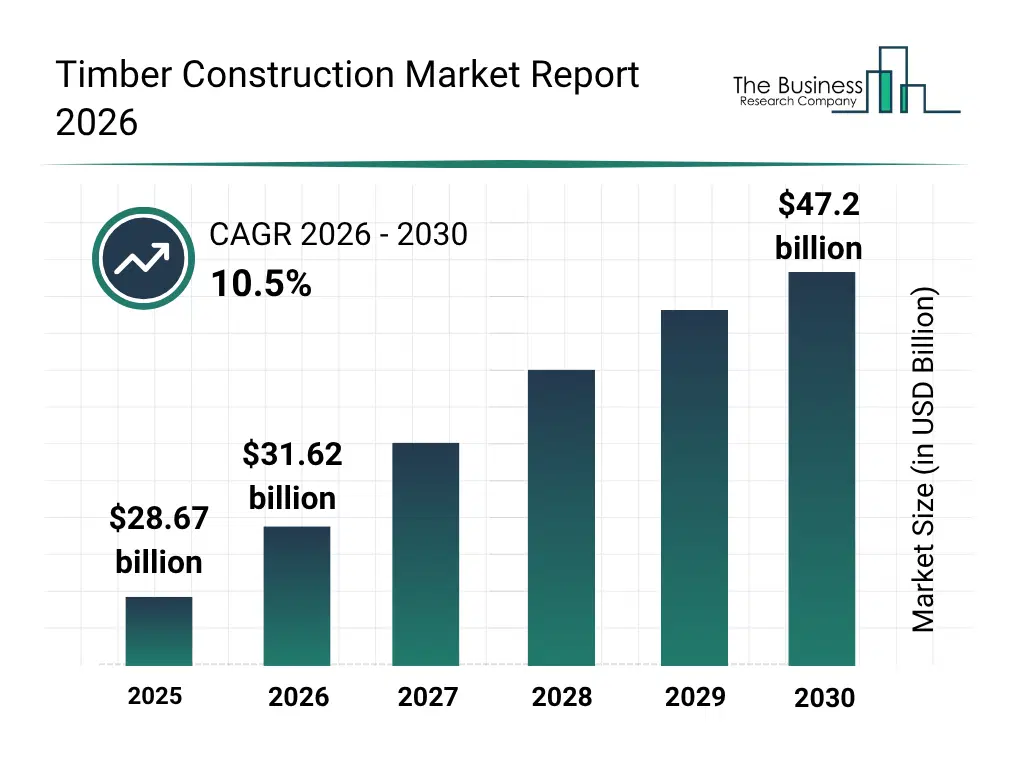
What Is The Timber Construction Market Size and Share 2026?
The timber construction market size has grown rapidly in recent years. It will grow from $28.67 billion in 2025 to $31.62 billion in 2026 at a compound annual growth rate (CAGR) of 10.3%. The growth in the historic period can be attributed to traditional timber framing usage in residential housing, availability of abundant forest resources, advancements in engineered wood products development, rising urbanization and housing demand, regulatory acceptance of wood construction codes.What Is The Timber Construction Market Growth Forecast?
The timber construction market size is expected to see rapid growth in the next few years. It will grow to $47.2 billion in 2030 at a compound annual growth rate (CAGR) of 10.5%. The growth in the forecast period can be attributed to increasing demand for low-carbon building materials, expansion of modular and prefabricated construction adoption, growth in mid-rise and high-rise timber buildings, technological improvement in mass timber engineering, supportive government policies for sustainable construction. Major trends in the forecast period include growth of mass timber and engineered wood adoption in mid-rise construction, expansion of cross-laminated timber usage in commercial buildings, increasing deployment of prefabricated timber construction components, rising adoption of hybrid timber-steel structural systems, development of advanced bio-based adhesives and engineered wood materials.
Global Timber Construction Market Segmentation
1) By Product Type: Mass Timber; Cross-Laminated Timber; Glue-Laminated Timber; Laminated Veneer Lumber; Nail-Laminated Timber; Dowel-Laminated Timber; Timber Frames; Prefabricated Timber Components 2) By Timber Type: Softwood; Hardwood; Engineered Wood Products 3) By Construction Type: New Construction; Renovation And Remodeling; Modular Construction; Hybrid Construction 4) By Application: Residential; Commercial; Institutional; Industrial; Infrastructure 5) By End User: Developers And Contractors; Government Bodies; Architects; Modular Builders Subsegments: 1) By Mass Timber: Structural Wall Panels; Floor And Roof Systems; Load-Bearing Building Components 2) By Cross-Laminated Timber: Solid Wall Panels; Floor Slabs; Roof Panels 3) By Glue-Laminated Timber: Structural Beams; Columns And Posts; Arches 4) By Laminated Veneer Lumber: Beams; Headers And Lintels; Rim Boards 5) By Nail-Laminated Timber: Floor Decks; Roof Decks; Wall Panels 6) By Dowel-Laminated Timber: Floor Panels; Roof Panels; Wall Elements 7) By Timber Frames: Post And Beam Structures; Heavy Timber Frames; Hybrid Timber Steel Frames 8) By Prefabricated Timber Components: Pre Cut Wall Panels; Pre Assembled Floor Cassettes; Roof Trusses And ModulesWhat Is The Driver Of The Timber Construction Market?
The increasing focus on sustainable building practices is expected to propel the growth of the timber construction market going forward. Sustainable building practices involve designing and constructing buildings in ways that conserve resources, reduce pollution, and improve long-term environmental and operational efficiency. Sustainable building practices are increasing mainly due to rising energy costs, which push builders and owners to adopt energy-efficient designs and materials to reduce long-term operational expenses. Timber construction supports sustainable building practices by using renewable, low-carbon materials that store carbon, require less energy to produce than steel or concrete, and improve overall resource efficiency in buildings. For instance, in July 2024, according to the Green Building Council, a US-based non-profit organization, over 46,000 residential projects earned LEED green building certification, showing nearly a 5% rise in new registrations compared to 2023. Therefore, the increasing focus on sustainable building practices is driving the growth of the timber construction industry.Key Players In The Global Timber Construction Market
Major companies operating in the timber construction market are Stora Enso Oyj; Sekisui House Ltd.; Weyerhaeuser; Binderholz GmbH; Mayr-Melnhof Holz Holding AG; Pfeifer Holz; Boise Cascade; Hasslacher Holding GmbH; Rubner Holzbau GmbH; Kalesnikoff Lumber Co. Ltd.; Baufritz GmbH & Co. KG; Huf Haus GmbH & Co. KG; B&K Structures Ltd.; Theurl Austrian Premium Timber GmbH; Schilliger Holz AG; SmartLam North America LLC; Lignotrend; Freres Engineered Wood Inc.; Vermont Timber Works Inc.; KLH Massivholz GmbH; Eugen Decker Wood Solutions GmbH; Lancaster County Timber Frames Inc.; Blue Ridge Timberwrights Inc.; Shelter Institute Inc.; Honest Abe Log Homes Inc.; Bensonwood Homes Inc.Global Timber Construction Market Trends and Insights
Major companies operating in the timber construction market are focusing on developing innovative solutions such as timber on-site installation services to enhance construction efficiency, reduce carbon emissions, and accelerate the adoption of sustainable building practices. Timber on-site installation services involve the assembly and structural placement of timber components at construction sites to ensure accurate installation of wooden frameworks, panels, flooring, and other timber structures. For instance, in March 2024, Mercer Mass Timber LLC, a US-based manufacturing company, launched a dedicated mass timber installation services division, branded as Mercer Mass Timber Construction Services. It aims to provide end-to-end onsite installation and project consultancy support for mass timber buildings. The offering integrates design assist, prefabrication, logistics, and site assembly under one vendor, positioning the company as a vertically integrated timber construction partner that streamlines mass timber projects across North America.What Are Latest Mergers And Acquisitions In The Timber Construction Market?
In January 2026, Premier Forest Products Ltd., a UK-based timber company, acquired National Timber Systems for an undisclosed amount. With this acquisition, Premier Forest Products aims to strengthen its engineered timber capabilities, expand manufacturing capacity, and enhance its position in delivering integrated timber construction solutions across the UK market. National Timber Systems is a UK-based company that offers engineered timber systems and off-site timber fabrication solutions for the construction and housing sectors.Regional Outlook
Europe was the largest region in the timber construction market in 2025. Asia-Pacific is expected to be the fastest-growing region in the forecast period. The regions covered in this market report are Asia-Pacific, South East Asia, Western Europe, Eastern Europe, North America, South America, Middle East, Africa. The countries covered in this market report are Australia, Brazil, China, France, Germany, India, Indonesia, Japan, Taiwan, Russia, South Korea, UK, USA, Canada, Italy, Spain.What Defines the Timber Construction Market?
The timber construction market consists of sales of timber cladding and façade systems, wood joists and rafters, and timber connectors and fasteners. Values in this market are ‘factory gate’ values, that is, the value of goods sold by the manufacturers or creators of the goods, whether to other entities (including downstream manufacturers, wholesalers, distributors, and retailers) or directly to end customers. The value of goods in this market includes related services sold by the creators of the goods.How is Market Value Defined and Measured?
The market value is defined as the revenues that enterprises gain from the sale of goods and/or services within the specified market and geography through sales, grants, or donations in terms of the currency (in USD unless otherwise specified). The revenues for a specified geography are consumption values that are revenues generated by organizations in the specified geography within the market, irrespective of where they are produced. It does not include revenues from resales along the supply chain, either further along the supply chain or as part of other products.What Key Data and Analysis Are Included in the Timber Construction Market Report 2026?
The timber construction market research report is one of a series of new reports from The Business Research Company that provides market statistics, including industry global market size, regional shares, competitors with the market share, detailed market segments, market trends and opportunities, and any further data you may need to thrive in the timber construction industry. The market research report delivers a complete perspective of everything you need, with an in-depth analysis of the current and future state of the industry.Timber Construction Market Report Forecast Analysis
| Report Attribute | Details |
|---|---|
| Market Size Value In 2026 | $31.62 billion |
| Revenue Forecast In 2030 | $47.2 billion |
| Growth Rate | CAGR of 10.5% from 2026 to 2030 |
| Base Year For Estimation | 2025 |
| Actual Estimates/Historical Data | 2020-2025 |
| Forecast Period | 2026 - 2030 |
| Market Representation | Revenue in USD Billion and CAGR from 2026 to 2030 |
| Segments Covered | Product Type, Timber Type, Construction Type, Application, End User |
| Regional Scope | Asia-Pacific, Western Europe, Eastern Europe, North America, South America, Middle East, Africa |
| Country Scope | The countries covered in the report are Australia, Brazil, China, France, Germany, India, ... |
| Key Companies Profiled | Stora Enso Oyj; Sekisui House Ltd.; Weyerhaeuser; Binderholz GmbH; Mayr-Melnhof Holz Holding AG; Pfeifer Holz; Boise Cascade; Hasslacher Holding GmbH; Rubner Holzbau GmbH; Kalesnikoff Lumber Co. Ltd.; Baufritz GmbH & Co. KG; Huf Haus GmbH & Co. KG; B&K Structures Ltd.; Theurl Austrian Premium Timber GmbH; Schilliger Holz AG; SmartLam North America LLC; Lignotrend; Freres Engineered Wood Inc.; Vermont Timber Works Inc.; KLH Massivholz GmbH; Eugen Decker Wood Solutions GmbH; Lancaster County Timber Frames Inc.; Blue Ridge Timberwrights Inc.; Shelter Institute Inc.; Honest Abe Log Homes Inc.; Bensonwood Homes Inc. |
| Customization Scope | Request for Customization |
| Pricing And Purchase Options | Explore Purchase Options |