
Time-Sensitive Networking (TSN) Market Report 2026
Global Outlook – By Type (IEEE 802.1 AS, IEEE 8021 Qbv, IEEE 802.1 CB, IEEE 8021 Qbu, IEEE 8021 Qc, Other Types), By Component (Controllers And Processors, Power Supply Devices, Connectors, Memory, Switches, Routers And Gateways), By Application (Industrial Automation, Power And Energy, Automotive And Transportation, Oil And Gas, Aerospace, Other Applications) – Market Size, Trends, Strategies, and Forecast to 2030
Time-Sensitive Networking (TSN) Market Overview
• Time-Sensitive Networking (TSN) market size has reached to $0.81 billion in 2025 • Expected to grow to $2.55 billion in 2030 at a compound annual growth rate (CAGR) of 25.6% • Growth Driver: Rising Demand For Industrial Internet Of Things (IIoT) Driving Growth Of The Time-Sensitive Networking (TSN) Market • Market Trend: Innovations In Time-Sensitive Networking (TSN) Technology Enable Deterministic And Low-Latency Communication In Industrial Automation • North America was the largest region in 2025 and Asia-Pacific is the fastest growing region.What Is Covered Under Time-Sensitive Networking (TSN) Market?
Time-sensitive networking (TSN) is a set of standards developed to enhance ethernet networks, making them capable of handling time-sensitive data with precise timing and low latency. It aims to provide reliable, deterministic performance in network communications, which is crucial for applications that require high levels of synchronization and minimal delay, such as industrial automation, automotive systems, and professional audio/video streaming. The main types of time-sensitive networking are IEEE 802.1 AS, IEEE 8021 Qbv, IEEE 802.1 CB, IEEE 8021 Qbu, IEEE 8021 QC, and others. IEEE 802.1Qbv specifies enhancements to ethernet frames for time-sensitive traffic using time-aware scheduling. The various components include controllers and processors, power supply devices, connectors, memory, switches, hubs, routers, and gateways. These are used in various applications such as industrial automation, power and energy, automotive and transportation, oil and gas, aerospace, and others.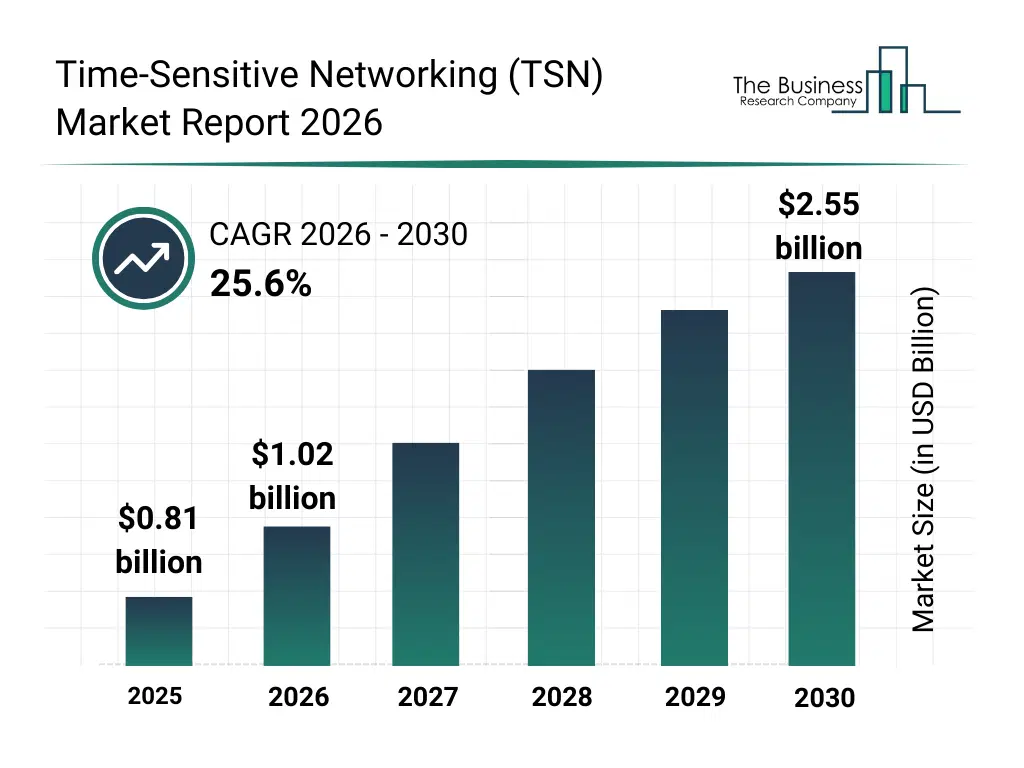
What Is The Time-Sensitive Networking (TSN) Market Size and Share 2026?
The time-sensitive networking (tsn) market size has grown exponentially in recent years. It will grow from $0.81 billion in 2025 to $1.02 billion in 2026 at a compound annual growth rate (CAGR) of 25.6%. The growth in the historic period can be attributed to industrial automation demand for low latency communication, evolution of ethernet standards for real time control, early adoption in professional audio and video systems, need for precise synchronization in control networks, growth of factory automation infrastructure.What Is The Time-Sensitive Networking (TSN) Market Growth Forecast?
The time-sensitive networking (tsn) market size is expected to see exponential growth in the next few years. It will grow to $2.55 billion in 2030 at a compound annual growth rate (CAGR) of 25.6%. The growth in the forecast period can be attributed to expansion of smart factories and industry 4.0 adoption, rising deployment of autonomous and connected vehicles, growth of time critical iot applications, integration of TSN with 5G and edge computing, increasing need for converged deterministic networks. Major trends in the forecast period include deterministic ethernet adoption, it and ot network convergence, automotive in vehicle tsn networks, ethernet replacing fieldbus protocols, high precision network synchronization.
Global Time-Sensitive Networking (TSN) Market Segmentation
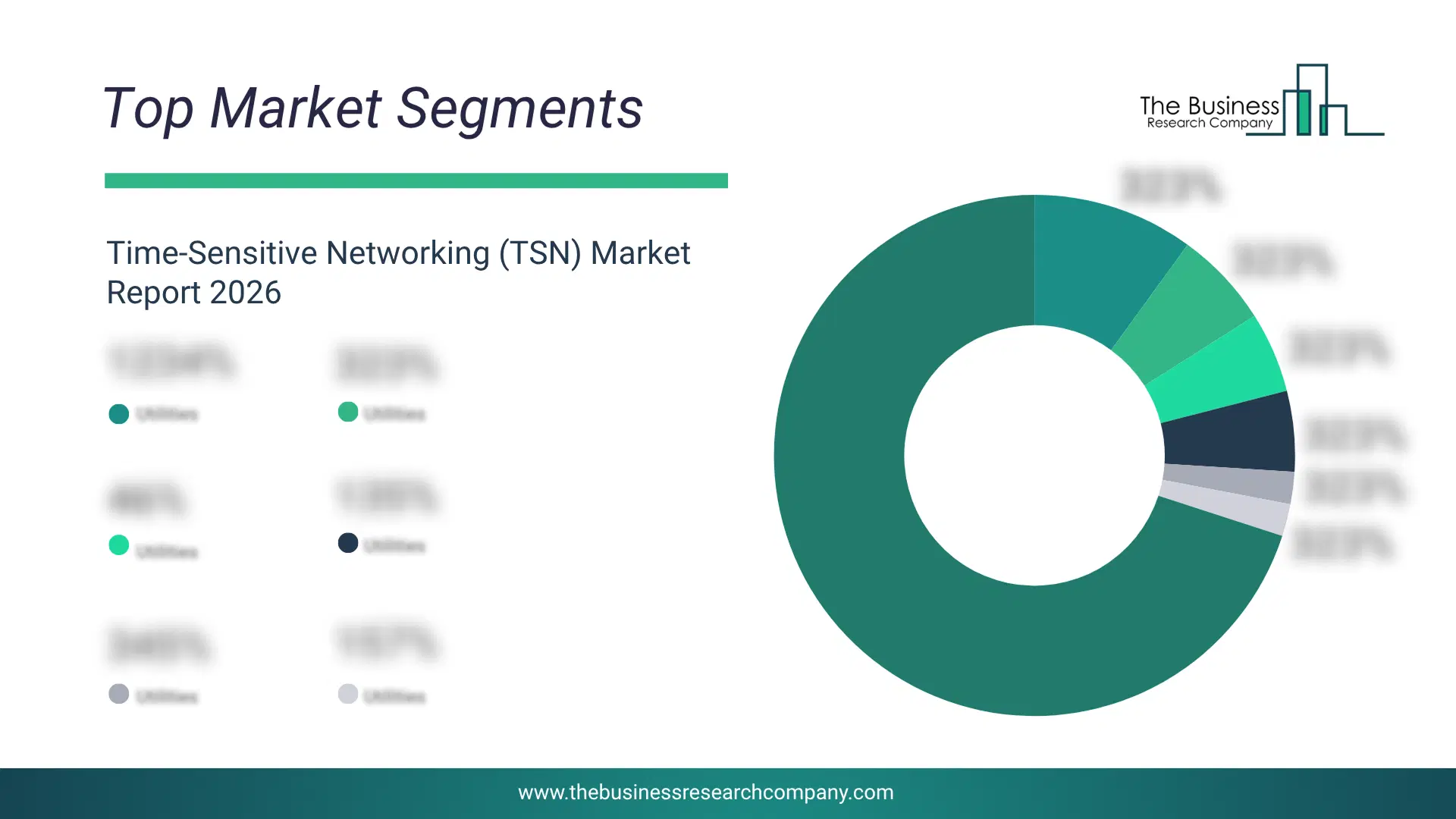
1) By Type: IEEE 802.1 AS, IEEE 8021 Qbv, IEEE 802.1 CB, IEEE 8021 Qbu, IEEE 8021 Qc, Other Types 2) By Component: Controllers And Processors, Power Supply Devices, Connectors, Memory, Switches, Routers And Gateways 3) By Application: Industrial Automation, Power And Energy, Automotive And Transportation, Oil And Gas, Aerospace, Other Applications Subsegments: 1) By IEEE 802.1 AS: Timing And Synchronization For Time-Sensitive Applications, Network Time Protocol (NTP) Support 2) By IEEE 802.1 Qbv: Time-Aware Queuing, Scheduled Traffic Control 3) By IEEE 802.1 CB: Frame Replication And Elimination, Redundant Stream Handling 4) By IEEE 802.1 Qbu: Priority-Based Flow Control, Enhanced Frame Handling 5) By IEEE 802.1 Qc: Stream Reservation Protocol (SRP), Resource Reservation For Time-Sensitive Traffic 6) By Other Types: Custom TSN Solutions, Industry-Specific TSN ProtocolsWhat Is The Driver Of The Time-Sensitive Networking (TSN) Market?
The growing demand for industrial internet of things (IIoT) is expected to propel the growth of the time-sensitive networking (TSN) market going forward. The industrial internet of things (IIoT) refers to integrating connected devices, sensors, and machines with industrial systems and processes to enable real-time data collection, monitoring, and control across manufacturing, energy, transportation, and other industrial sectors. The demand for the industrial internet of things (IIoT) is attributed to industries seeking to enhance operational efficiency, reduce downtime through predictive maintenance, improve safety, and gain real-time insights into their production processes. Time-sensitive networking (TSN) plays a critical role in the industrial internet of things (IIoT) by enabling real-time communication between devices in industrial networks. It ensures that time-critical data is transmitted reliably and predictably, essential for industrial automation, robotics, and smart manufacturing systems. For instance, in June 2024, according to IOT Analytics, a Germany-based company that provides information on the IoT sector, mobile operators globally generated $15 billion from 3.56 billion cellular IoT connections, with 5G and 5G RedCap expected to fuel an 18% compound annual growth rate (CAGR) in the global cellular IoT market between 2024 and 2030. Therefore, the growing demand for the industrial internet of things is driving the growth of the time-sensitive networking (TSN) industry.Key Players In The Global Time-Sensitive Networking (TSN) Market
Major companies operating in the time-sensitive networking (tsn) market are Mitsubishi Electric Corporation, Siemens AG , Intel Corporation, Cisco Systems Inc., Broadcom Limited, Nokia Corporation Inc., Texas Instruments Inc., Emerson Electric Co., NXP Semiconductors, Analog Devices Inc., Renesas Electronics Corporation, Microchip Technology Inc., Marvell Technology Group Ltd., Mouser Electronics Inc., Belden Inc., Advantech Co. Ltd., Microsemi Corporation, Spirent Communications PLC, TTTech Computertechnik AG, HMS Networks AB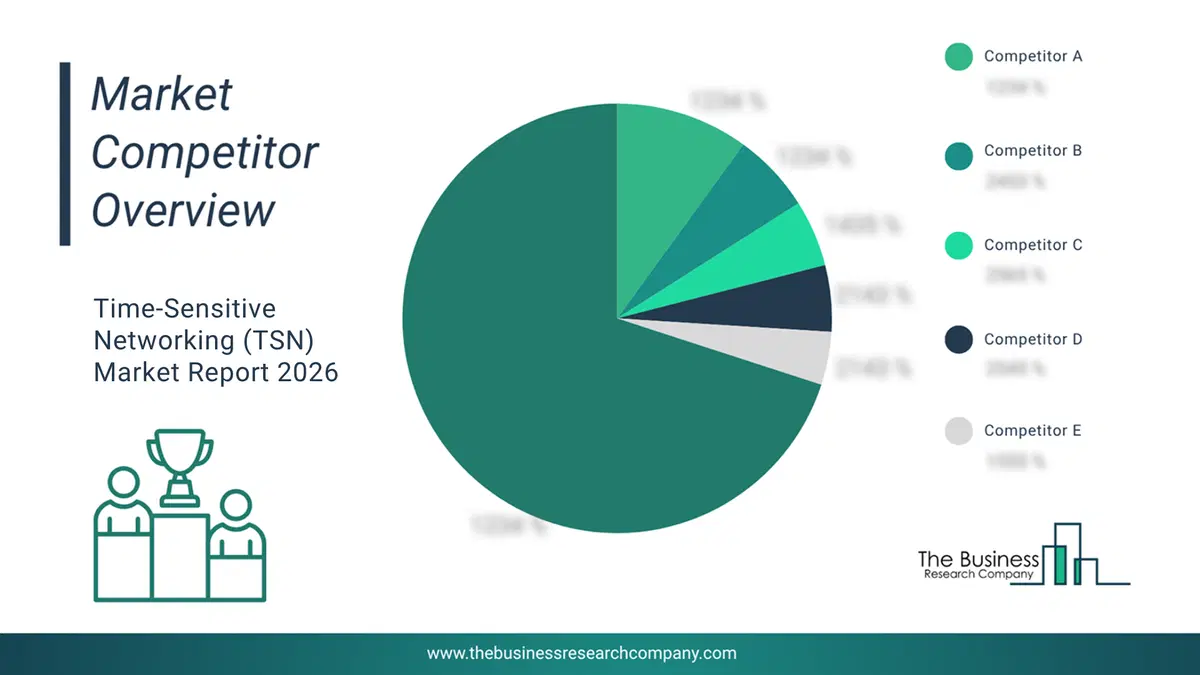
This chart is for illustrative purposes; the full report includes a detailed competitor analysis and comprehensive overview of the top 10 companies in the market.
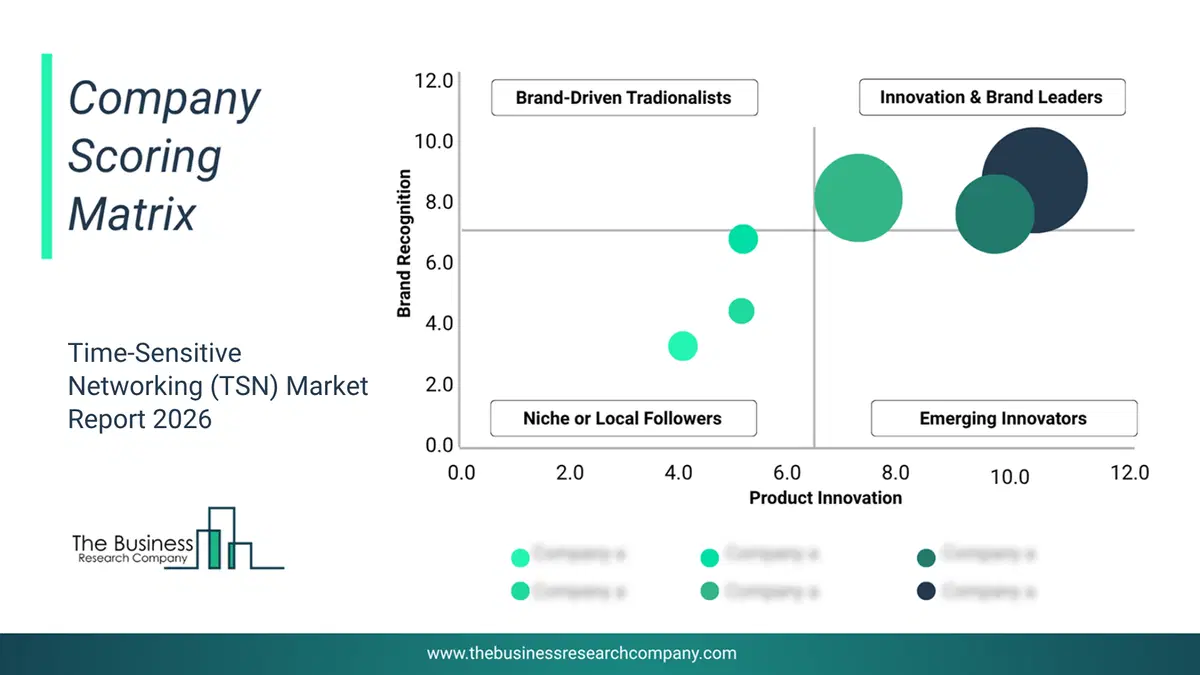
This chart maps companies by product innovation and brand strength, with bubble size indicating relative revenue, helping identify market leaders, challengers, and niche players. This is an illustrative chart; the full report provides a complete and accurate competitive analysis.
Global Time-Sensitive Networking (TSN) Market Trends and Insights
Major companies operating in the industrial networking market are focusing on developing advanced solutions, such as real-time data processing engines, to enhance communication reliability, reduce latency, and improve automation performance. Real-time engines refer to technological features in network switches that process high-speed cyclical data in flight, ensuring deterministic and time-critical transmission of information for industrial applications. For instance, in August 2023, Microchip Technology Incorporated, a US-based semiconductor company, launched the LAN9662 Gigabit Ethernet Switch with Audio-Video Bridging (AVB) and Time-Sensitive Networking (TSN) support, along with integrated PHYs and a 600 MHz Arm Cortex-A7 CPU subsystem. Designed to enable deterministic and low-latency communication, the switch supports high-speed industrial automation applications and integrates a real-time engine to optimize data flow and enhance network performance.What Are Latest Mergers And Acquisitions In The Time-Sensitive Networking (TSN) Market?
In October 2023, Emerson Electric Co., a US-based technology, software, and engineering company, acquired National Instruments Corporation for $8.2 billion. With this acquisition, Emerson Electric Co. aims to enhance its position as a global leader in automation and capitalize on key trends such as nearshoring, digital transformation, and sustainability. National Instruments Corporation is a US-based company that offers time-sensitive networking (TSN).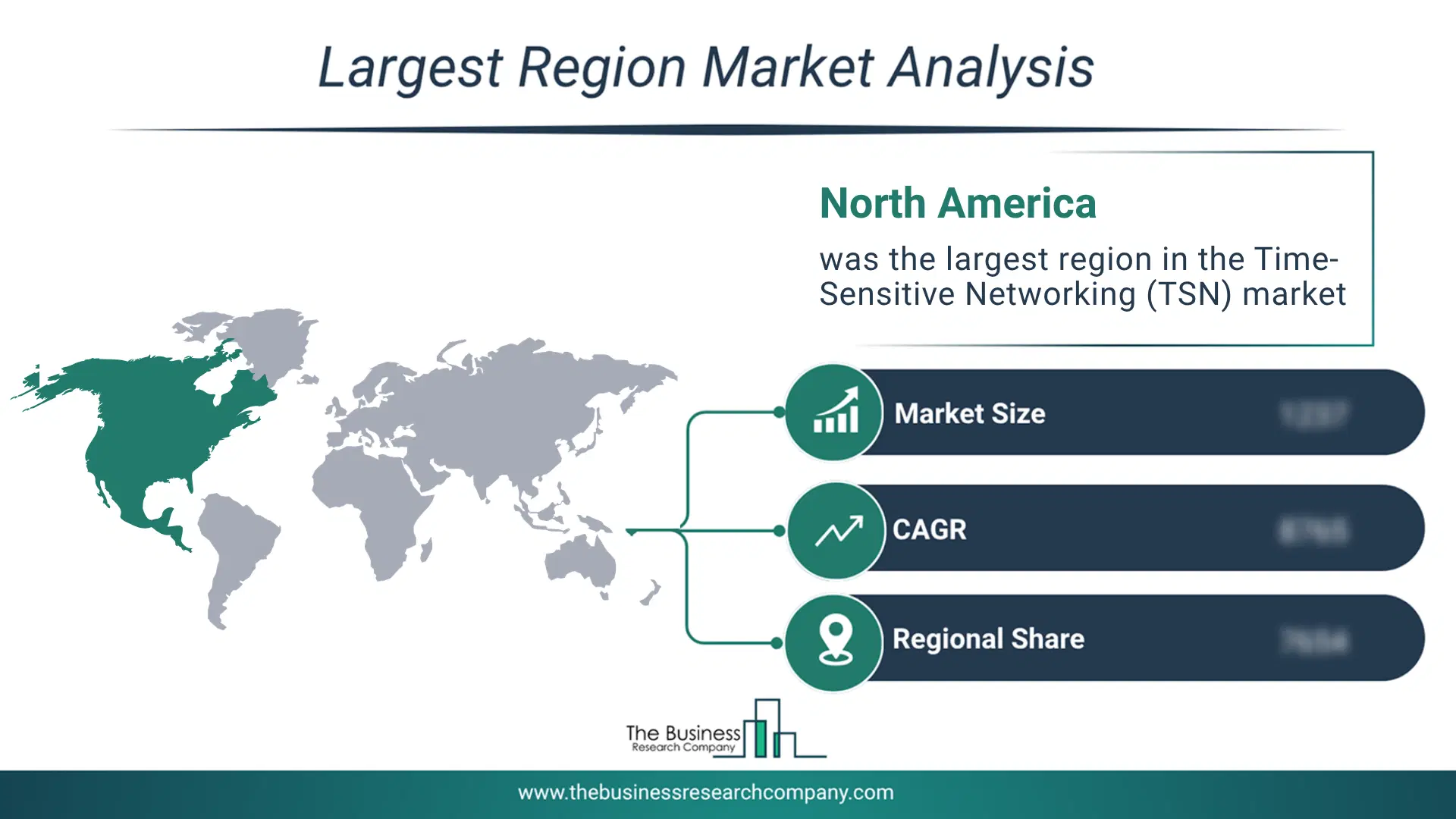
Regional Insights
North America was the largest region in the time-sensitive networking (TSN) market in 2025. Asia-Pacific is expected to be the fastest-growing region in the forecast period. The regions covered in this market report are Asia-Pacific, South East Asia, Western Europe, Eastern Europe, North America, South America, Middle East, Africa. The countries covered in this market report are Australia, Brazil, China, France, Germany, India, Indonesia, Japan, Taiwan, Russia, South Korea, UK, USA, Canada, Italy, Spain.What Defines the Time-Sensitive Networking (TSN) Market?
The time-sensitive networking (TSN) market consists of revenues earned by entities by providing services such as time-sensitive networking training, integration services, and security services. The market value includes the value of related goods sold by the service provider or included within the service offering. Only goods and services traded between entities or sold to end consumers are included. The time-sensitive networking (TSN) market also includes sales of network interface cards, configuration tools, and evaluation kits. Values in this market are ‘factory gate’ values, that is the value of goods sold by the manufacturers or creators of the goods, whether to other entities (including downstream manufacturers, wholesalers, distributors, and retailers) or directly to end customers. The value of goods in this market includes related services sold by the creators of the goods.How is Market Value Defined and Measured?
The market value is defined as the revenues that enterprises gain from the sale of goods and/or services within the specified market and geography through sales, grants, or donations in terms of the currency (in USD unless otherwise specified). The revenues for a specified geography are consumption values that are revenues generated by organizations in the specified geography within the market, irrespective of where they are produced. It does not include revenues from resales along the supply chain, either further along the supply chain or as part of other products.
This chart presents market attractiveness based on a quantitative evaluation of growth, competition, strategic alignment, and risk, offering a clear view of opportunity areas for decision-making. This chart is for illustrative purposes; the full report contains the complete analysis.

This chart highlights the Total Addressable Market (TAM) by estimating the maximum revenue opportunity using an assumption-driven approach, supporting strategic planning and opportunity sizing across markets. The chart is illustrative; the full report provides a more comprehensive analysis.
What Key Data and Analysis Are Included in the Time-Sensitive Networking (TSN) Market Report 2026?
The time-sensitive networking (tsn) market research report is one of a series of new reports from The Business Research Company that provides market statistics, including industry global market size, regional shares, competitors with the market share, detailed market segments, market trends and opportunities, and any further data you may need to thrive in the time-sensitive networking (tsn) industry. The market research report delivers a complete perspective of everything you need, with an in-depth analysis of the current and future state of the industry.Time-Sensitive Networking (TSN) Market Report Forecast Analysis
| Report Attribute | Details |
|---|---|
| Market Size Value In 2026 | $1.02 billion |
| Revenue Forecast In 2030 | $2.55 billion |
| Growth Rate | CAGR of 25.6% from 2026 to 2030 |
| Base Year For Estimation | 2025 |
| Actual Estimates/Historical Data | 2020-2025 |
| Forecast Period | 2026 - 2030 |
| Market Representation | Revenue in USD Billion and CAGR from 2026 to 2030 |
| Segments Covered | Type, Component, Application |
| Regional Scope | Asia-Pacific, Western Europe, Eastern Europe, North America, South America, Middle East, Africa |
| Country Scope | The Countries Covered In This Market Report Are Australia, Brazil, China, France, Germany, India, Indonesia, Japan, Taiwan, Russia, South Korea, Uk, Usa, Canada, Italy, Spain. |
| Key Companies Profiled | Mitsubishi Electric Corporation, Siemens AG , Intel Corporation, Cisco Systems Inc., Broadcom Limited, Nokia Corporation Inc., Texas Instruments Inc., Emerson Electric Co., NXP Semiconductors, Analog Devices Inc., Renesas Electronics Corporation, Microchip Technology Inc., Marvell Technology Group Ltd., Mouser Electronics Inc., Belden Inc., Advantech Co. Ltd., Microsemi Corporation, Spirent Communications PLC, TTTech Computertechnik AG, HMS Networks AB |
| Customization Scope | Request for Customization |
| Pricing And Purchase Options | Explore Purchase Options |