
Time Sensitive Networking (TSN) Motion Controller Market Report 2026
Global Outlook – By Component (Hardware, Software, Services), By Communication Protocol (Ethernet Or IP, PROFINET, EtherCAT, Sercos III, Other Communication Protocols), By Deployment Mode (On Premise, Cloud Based), By Application (Robotics Motion Control, Machine Tools And Computer Numerical Control Systems, Packaging And Printing Machinery, Material Handling And Conveyor Systems, Process Automation And Drives, Vision Guided Motion Systems), By End Use Industry (Automotive Manufacturing, Electronics And Semiconductor Manufacturing, Food And Beverages Processing, Pharmaceuticals And Biotechnology, Metals And Mining, Oil And Gas, Power Generation And Utilities, Aerospace And Defense, Logistics And Warehousing) – Market Size, Trends, Strategies, and Forecast to 2030
Time Sensitive Networking (TSN) Motion Controller Market Overview
• Time Sensitive Networking (TSN) Motion Controller market size has reached to $1.80 billion in 2025 • Expected to grow to $3.73 billion in 2030 at a compound annual growth rate (CAGR) of 15.7% • Growth Driver: Expansion Of 5G Networks Driving The Market Due To Ultra-Low-Latency, Deterministic Wireless Communication • Market Trend: • Asia-Pacific was the largest region in 2025 and North America is the fastest growing region.What Is Covered Under Time Sensitive Networking (TSN) Motion Controller Market?
A time sensitive networking motion controller is a control device that uses time sensitive networking standards to coordinate motion tasks with deterministic, low-latency communication. It integrates precise timing, synchronized data exchange, and real-time control functions to manage complex motion operations reliably. It improves system responsiveness and stability by ensuring that critical control signals are transmitted with guaranteed timing accuracy across an Ethernet-based network. The main components of TSN motion controller include hardware, software, and services. Hardware refers to networked motion control devices designed to coordinate precise, time-sensitive operations across industrial machinery and automation systems. Different communication protocols supported are Ethernet or IP, PROFINET, EtherCAT, Sercos III, and other communication protocols. Multiple deployment modes are on-premise and cloud-based solutions. Various applications include robotics motion control, machine tools and computer numerical control systems, packaging and printing machinery, material handling and conveyor systems, process automation and drives, and vision guided motion systems, and they are used by several end-use industries such as automotive manufacturing, electronics and semiconductor manufacturing, food and beverages processing, pharmaceuticals and biotechnology, metals and mining, oil and gas, power generation and utilities, aerospace and defense, logistics and warehousing, and others.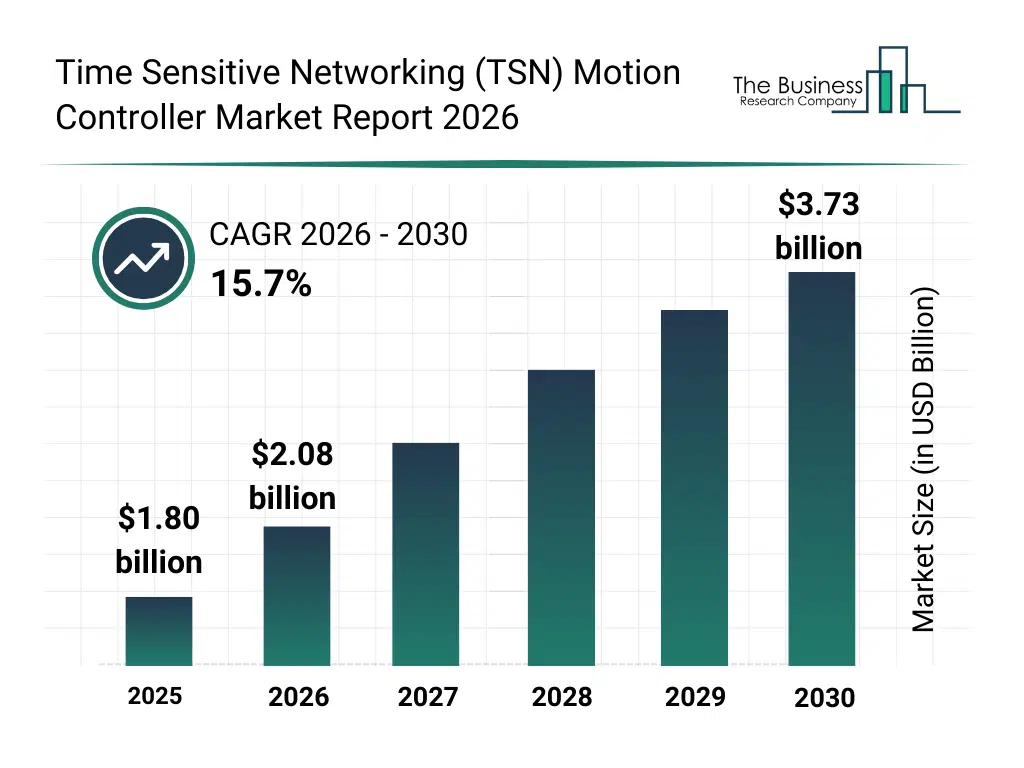
What Is The Time Sensitive Networking (TSN) Motion Controller Market Size and Share 2026?
The time sensitive networking (TSN) motion controller market size has grown rapidly in recent years. It will grow from $1.80 billion in 2025 to $2.08 billion in 2026 at a compound annual growth rate (CAGR) of 16.0%. The growth in the historic period can be attributed to increasing adoption of industrial ethernet in automation, growing demand for deterministic communication in manufacturing, rising integration of robotics in production lines, expansion of computer numerical control (CNC) and machine tool automation, and increasing need for synchronized multi axis motion control.What Is The Time Sensitive Networking (TSN) Motion Controller Market Growth Forecast?
The time sensitive networking (TSN) motion controller market size is expected to see rapid growth in the next few years. It will grow to $3.73 billion in 2030 at a compound annual growth rate (CAGR) of 15.7%. The growth in the forecast period can be attributed to growing shift toward time sensitive networking based industrial communication, increasing investment in smart factory infrastructure, rising adoption of distributed motion control architectures, expanding demand for real time robotics and autonomous systems, growing implementation of high speed packaging and printing machinery. Major trends in the forecast period include technological advancements in deterministic ethernet communication, innovation in synchronized motion and multi axis control, development of software defined motion control platforms, research and development in artificial intelligence driven motion optimization, advancements in time sensitive networking enabled robotics systems.
Global Time Sensitive Networking (TSN) Motion Controller Market Segmentation
1) By Component: Hardware, Software, Services 2) By Communication Protocol: Ethernet Or IP, PROFINET, EtherCAT, Sercos III, Other Communication Protocols 3) By Deployment Mode: On Premise, Cloud Based 4) By Application: Robotics Motion Control, Machine Tools And Computer Numerical Control Systems, Packaging And Printing Machinery, Material Handling And Conveyor Systems, Process Automation And Drives, Vision Guided Motion Systems 5) By End Use Industry: Automotive Manufacturing, Electronics And Semiconductor Manufacturing, Food And Beverages Processing, Pharmaceuticals And Biotechnology, Metals And Mining, Oil And Gas, Power Generation And Utilities, Aerospace And Defense, Logistics And Warehousing Subsegments: 1) By Hardware: Motion Controllers, Timing Synchronization Units, Industrial Ethernet Switches, Deterministic Communication Modules, Servo Drives 2) By Software: Motion Control Software, Network Configuration Software, Real Time Operating Systems, Synchronization Management Software, Diagnostics and Monitoring Software 3) By Services: System Integration Services, Customization And Programming Services, Maintenance And Support Services, Network Optimization Services, Training And Consulting ServicesWhat Are The Drivers Of The Time Sensitive Networking (TSN) Motion Controller Market?
The expansion of 5G networks is expected to propel the growth of the time sensitive networking (TSN) motion controller market going forward. 5G networks refers to the number of global 5G connections, infrastructure deployments, and network coverage worldwide. The rise in demand for 5G networks is due to growing needs for ultra?fast low?latency connectivity that can simultaneously support billions of connected devices advanced mobile apps and data?intensive services. 5G benefits TSN motion controllers by providing ultra-low-latency, high-reliability wireless connectivity, enabling precise real-time synchronization and control of industrial machines and automated processes. For instance, in February 2024, according to the Global System for Mobile Communications Association (GSMA), a UK-based mobile industry association, 5G connections are projected to account for 51% of mobile connections by 2029 and 56% by 2030. Therefore, the expansion of 5G networks is driving the growth of the time sensitive networking (TSN) motion controller industry. The growth in electric vehicles is expected to propel the growth of the time sensitive networking (TSN) motion controller market going forward. Electric vehicles are automobiles that use one or more electric motors powered by rechargeable batteries or other onboard electrical energy storage systems instead of internal combustion engines. Electric vehicles are rising due to growing government regulations and incentives promoting low-emission transportation, which encourage manufacturers and consumers to shift away from fossil fuel–based vehicles to reduce carbon emissions and meet climate targets. TSN motion controllers benefit EVs by ensuring precise, real-time coordination of electric drive systems, steering actuators, and other in-vehicle components, enhancing performance, safety, and energy efficiency. For instance, in May 2025, according to the International Energy Agency, a France-based government agency, global electric car sales exceeded 17 million units in 2024, reflecting growth of over 25%, with approximately 3.5 million more vehicles sold compared with the previous year. Therefore, the growth in electric vehicles is driving the growth of the time sensitive networking (TSN) motion controller industry. The growing adoption of autonomous vehicles is expected to propel the growth of the time sensitive networking (TSN) motion controller market going forward. Autonomous vehicles are self driving or driver assist vehicles that can navigate roads using sensors, AI, and connectivity rather than relying exclusively on human input. The adoption is rising as regulators and companies continue to grant permits for AV testing and deployment, enabling more real world AVs to be on the roads. TSN motion controllers benefit autonomous vehicles by enabling deterministic, synchronized control of steering, braking, and sensor-actuator systems, ensuring accurate and safe real-time vehicle maneuvering. For instance, in January 2025, according to the California Department of Motor Vehicles (DMV), a US-based government department, autonomous vehicles under testing permits logged 4,498,066 test miles on California’s public roads between December 2023 and November 2024. Therefore, the growing adoption of autonomous vehicles is driving the growth of the time sensitive networking (TSN) motion controller industry.Key Players In The Global Time Sensitive Networking (TSN) Motion Controller Market
Major companies operating in the time sensitive networking (tsn) motion controller market are Siemens AG, Panasonic Corporation, Schneider Electric SE, Mitsubishi Electric Corporation, NXP Semiconductors, Rockwell Automation, Microchip Technology Inc., Bosch Rexroth AG, Fuji Electric Co. Ltd., Omron Corporation, Marvell Technology Group, Yaskawa Electric Corporation, Belden Inc., Advantech Co. Ltd., Beckhoff Automation GmbH Co. Kg, SICK AG, National Instruments (NI), Lenze SE, Moxa Inc., Shenzhen Sinee Electric Co.Ltd., Sodick America Corporation
This chart is for illustrative purposes; the full report includes a detailed competitor analysis and comprehensive overview of the top 10 companies in the market.
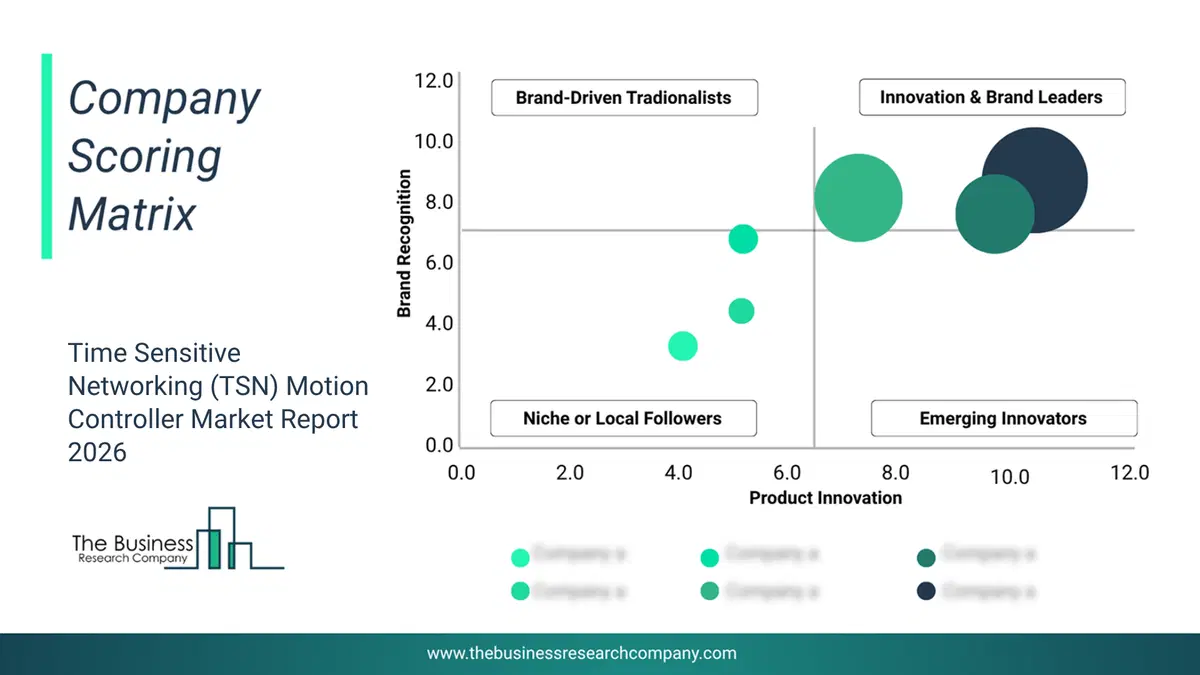
This chart maps companies by product innovation and brand strength, with bubble size indicating relative revenue, helping identify market leaders, challengers, and niche players. This is an illustrative chart; the full report provides a complete and accurate competitive analysis.
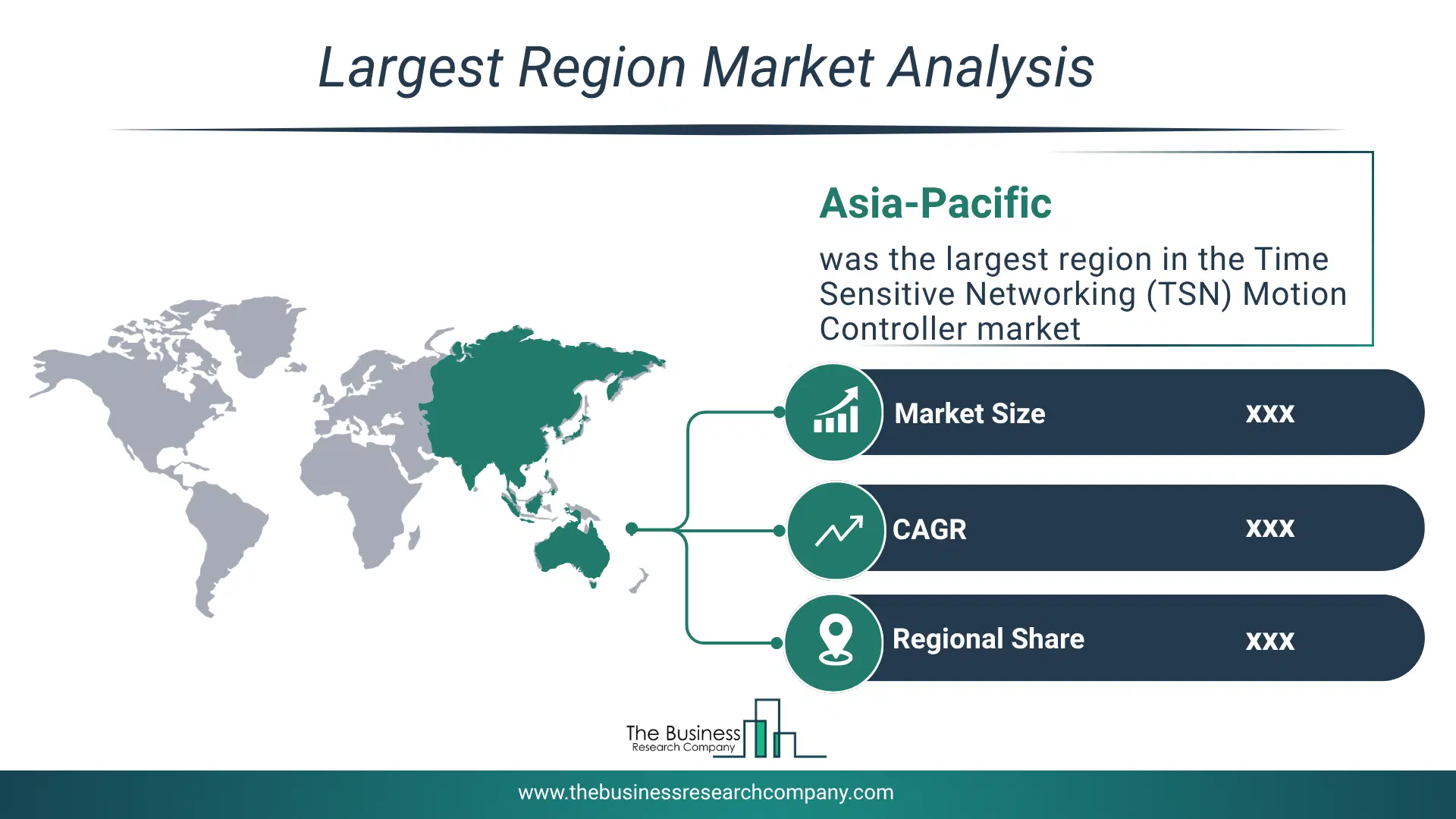
Regional Insights
Asia-Pacific was the largest region in the time sensitive networking (TSN) motion controller market in 2025. North America is expected to be the fastest-growing region in the forecast period. The regions covered in this market report are Asia-Pacific, South East Asia, Western Europe, Eastern Europe, North America, South America, Middle East, Africa. The countries covered in this market report are Australia, Brazil, China, France, Germany, India, Indonesia, Japan, Taiwan, Russia, South Korea, UK, USA, Canada, Italy, Spain.What Defines the Time Sensitive Networking (TSN) Motion Controller Market?
The time sensitive networking (TSN) motion controller market consists of revenues earned by entities by providing services such as system integration, real-time network configuration, controller programming and customization, performance tuning and optimization, and maintenance and technical support.The market value includes the value of related goods sold by the service provider or included within the service offering. The time sensitive networking (TSN) motion controller market also includes sales of industrial switches, motion controllers, real-time ethernet adapters, servo motors, industrial gateways, sensors, actuators, plc modules, and cabling kits. Values in this market are ‘factory gate’ values, that is, the value of goods sold by the manufacturers or creators of the goods, whether to other entities (including downstream manufacturers, wholesalers, distributors, and retailers) or directly to end customers. The value of goods in this market includes related services sold by the creators of the goods.How is Market Value Defined and Measured?
The market value is defined as the revenues that enterprises gain from the sale of goods and/or services within the specified market and geography through sales, grants, or donations in terms of the currency (in USD unless otherwise specified). The revenues for a specified geography are consumption values that are revenues generated by organizations in the specified geography within the market, irrespective of where they are produced. It does not include revenues from resales along the supply chain, either further along the supply chain or as part of other products.
This chart presents market attractiveness based on a quantitative evaluation of growth, competition, strategic alignment, and risk, offering a clear view of opportunity areas for decision-making. This chart is for illustrative purposes; the full report contains the complete analysis.

This chart highlights the Total Addressable Market (TAM) by estimating the maximum revenue opportunity using an assumption-driven approach, supporting strategic planning and opportunity sizing across markets. The chart is illustrative; the full report provides a more comprehensive analysis.
What Key Data and Analysis Are Included in the Time Sensitive Networking (TSN) Motion Controller Market Report 2026?
The time sensitive networking (tsn) motion controller market research report is one of a series of new reports from The Business Research Company that provides market statistics, including industry global market size, regional shares, competitors with the market share, detailed market segments, market trends and opportunities, and any further data you may need to thrive in the time sensitive networking (tsn) motion controller industry. The market research report delivers a complete perspective of everything you need, with an in-depth analysis of the current and future state of the industry.Time Sensitive Networking (TSN) Motion Controller Market Report Forecast Analysis
| Report Attribute | Details |
|---|---|
| Market Size Value In 2026 | $2.08 billion |
| Revenue Forecast In 2030 | $3.73 billion |
| Growth Rate | CAGR of 16.0% from 2026 to 2030 |
| Base Year For Estimation | 2025 |
| Actual Estimates/Historical Data | 2020-2025 |
| Forecast Period | 2026 - 2030 |
| Market Representation | Revenue in USD Billion and CAGR from 2026 to 2030 |
| Segments Covered | Component, Communication Protocol, Deployment Mode, Application, End Use Industry |
| Regional Scope | Asia-Pacific, Western Europe, Eastern Europe, North America, South America, Middle East, Africa |
| Country Scope | The countries covered in the report are Australia, Brazil, China, France, Germany, India, Indonesia, Japan, Taiwan, Russia, South Korea, UK, USA, Canada, Italy, Spain. |
| Key Companies Profiled | Siemens AG, Panasonic Corporation, Schneider Electric SE, Mitsubishi Electric Corporation, NXP Semiconductors, Rockwell Automation, Microchip Technology Inc., Bosch Rexroth AG, Fuji Electric Co. Ltd., Omron Corporation, Marvell Technology Group, Yaskawa Electric Corporation, Belden Inc., Advantech Co. Ltd., Beckhoff Automation GmbH Co. Kg, SICK AG, National Instruments (NI), Lenze SE, Moxa Inc., Shenzhen Sinee Electric Co.Ltd., Sodick America Corporation |
| Customization Scope | Request for Customization |
| Pricing And Purchase Options | Explore Purchase Options |