

Time-shifting Market Report 2026
Global Outlook – By Component (Hardware, Software, Services), By Deployment Type (On Premises Deployment, Cloud-Based Deployment), By Application (Entertainment And Media Consumption, Sports And Live Events, News Broadcasting, Educational Content Delivery), By End User (Residential Users, Commercial Users) – Market Size, Trends, Strategies, and Forecast to 2030
Time-shifting Market Overview
• Time-shifting market size has reached to $29.53 billion in 2025 • Expected to grow to $33.13 billion in 2030 at a compound annual growth rate (CAGR) of 12.4% • Growth Driver: Expansion Of OTT Platforms Fueling The Growth Of The Market Due To Rising Demand For Flexible On-Demand Content Consumption • North America was the largest region in 2025 and Asia-Pacific is the fastest growing region.What Is Covered Under Time-shifting Market?
Time-shifting is a digital media capability that allows users to record, pause, rewind, or replay live broadcast or streamed content so it can be consumed at a later time. It enables greater viewing flexibility by decoupling content consumption from its original broadcast schedule, leveraging digital storage, streaming, and playback technologies. It enhances user control over media consumption and improves overall viewing convenience and personalization. The main component of time-shifting includes hardware, software and services. Hardware refers to the physical devices and equipment, such as set-top boxes, digital video recorders, and storage systems, that enable the recording, storage, and playback of time-shifted media content. The deployment type includes on-premises deployment and cloud-based deployment, with applications across entertainment and media consumption, sports and live events, news broadcasting, and educational content delivery, and the key end users include residential users and commercial users.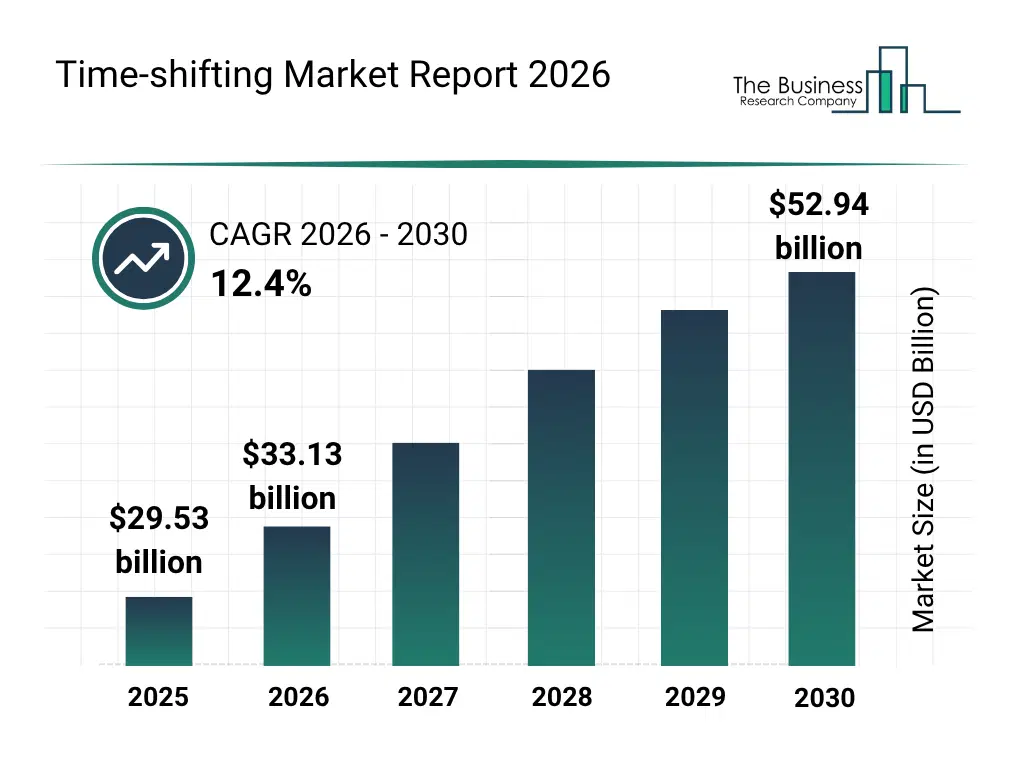
What Is The Time-shifting Market Size and Share 2026?
The time-shifting market size has grown rapidly in recent years. It will grow from $29.53 billion in 2025 to $33.13 billion in 2026 at a compound annual growth rate (CAGR) of 12.2%. The growth in the historic period can be attributed to rise of digital video recorders adoption, expansion of broadband internet penetration, growth of cable and satellite tv services, increasing demand for on demand viewing flexibility, development of early streaming platforms.What Is The Time-shifting Market Growth Forecast?
The time-shifting market size is expected to see rapid growth in the next few years. It will grow to $52.94 billion by 2030 at a compound annual growth rate (CAGR) of 12.4%. The growth in the forecast period can be attributed to rapid shift toward cloud based media storage systems, increasing consumption of personalized on demand content, expansion of 5g enabled streaming ecosystems, rising integration of AI in content discovery and playback, growing adoption of multi device entertainment ecosystems. Major trends in the forecast period include AI powered content recommendation in time shifting platforms, cloud based dvr and recording infrastructure expansion, multi device cross platform playback synchronization, edge based content storage and streaming optimization, personalized viewing experience through user behavior analytics.
Global Time-shifting Market Segmentation
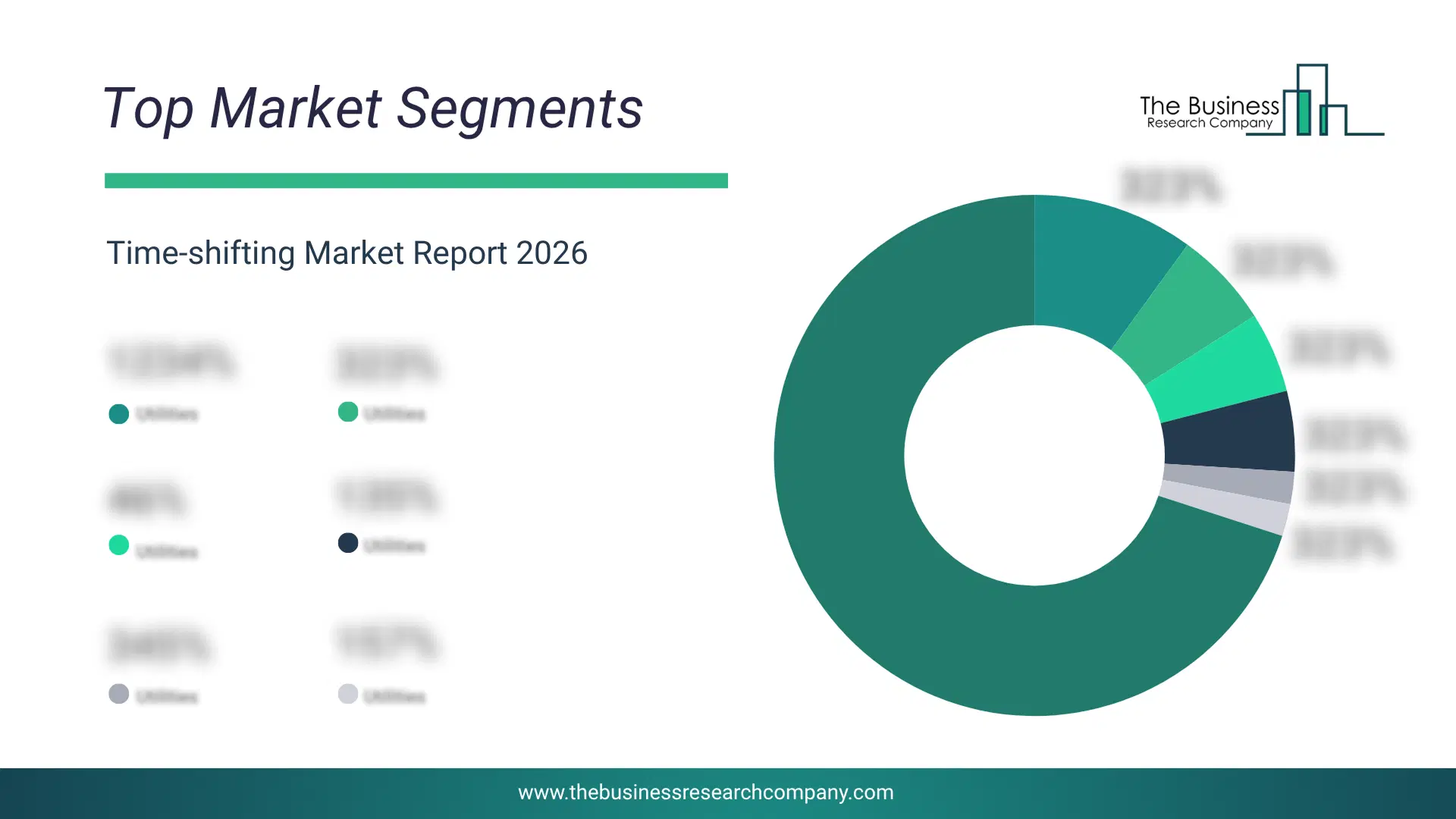
1) By Component: Hardware, Software, Services 2) By Deployment Type: On Premises Deployment, Cloud-Based Deployment 3) By Application: Entertainment And Media Consumption, Sports And Live Events, News Broadcasting, Educational Content Delivery 4) By End User: Residential Users, Commercial Users Subsegments: 1) By Hardware: Set Top Boxes, Digital Video Recorders, Storage Devices, Servers, Broadcasting Equipment, Network Equipment 2) By Software: Content Management Software, Video Playback Software, Streaming Software, User Interface Software, Scheduling And Recording Software, Analytics And Monitoring Software 3) By Services: Installation And Integration Services, Maintenance And Support Services, Managed Services, Consulting Services, Content Delivery Services, Training And Education ServicesWhat Are The Drivers Of The Time-shifting Market?
The expansion of over-the-top (OTT) platforms is expected to propel the growth of the time shifting market going forward. OTT platforms are digital streaming services that deliver video content over the internet, enabling users to watch programs on demand rather than following traditional broadcast schedules. The increasing popularity of OTT platforms is driven by rising consumer preference for flexible, on-demand entertainment, as it allows users to access content anytime and anywhere at their convenience, eliminating the constraints of fixed broadcast schedules and enhancing the overall viewing experience. Time-shifting enhances the flexibility and convenience of OTT platforms, aligning with evolving consumer demand for on-demand and personalized content consumption. For instance, in December 2025, according to Uswitch, a UK-based price comparison website, the average UK adult watches 4 hours and 31 minutes of content daily, with live TV accounting for 1 hour and 49 minutes in 2023. Additionally, as of 2024, Netflix remained the most-subscribed OTT service, with nearly three-fifths (58%) of UK households paying for a subscription. Therefore, the expansion of over-the-top (OTT) platforms is driving the growth of the time shifting market. The rising penetration of smart televisions (TVs) is expected to propel the growth of the time shifting market going forward. Smart TVs are television devices equipped with integrated internet connectivity and streaming capabilities, enabling users to access online video content and digital services directly. The increasing adoption of smart TVs is driven by the growing preference for on-demand entertainment, the expansion of streaming platforms, and improved internet accessibility. Time-shifting in smart TVs enables users to pause, rewind, and view content at their convenience rather than in real time. It enhances viewing flexibility and improves the user experience by supporting personalized and on-demand content consumption. For instance, in December 2024, according to the Australian Communications and Media Authority, an Australia-based regulatory body, smart TV ownership continued to increase, with 58% of users watching online video content at home in 2024, up from 52% in 2023. Smart TVs also accounted for the majority of television imports, with industry projections indicating continued growth through 2027. Therefore, the rising penetration of smart televisions (TVs) is driving the growth of the time shifting market. The increasing internet penetration is expected to propel the growth of the time-shifting market going forward. Internet penetration denotes the proportion of a population with access to the internet, enabling connectivity to digital platforms and services. The expansion of affordable smartphones, the development of broadband infrastructure, and the rollout of high-speed mobile networks are key factors driving global internet adoption. Time-shifting technologies rely on internet connectivity to enable users to watch content at their convenience rather than in real time. With robust internet access, consumers can pause, rewind, record, or stream content on demand, enhancing flexibility and personalized viewing experiences. For instance, in October 2023, according to the International Telecommunication Union (ITU), a Switzerland-based agency for information and communication technologies, approximately 67% of the global population, or 5.4 billion people, had internet access, representing a 4.7% increase since 2022. Therefore, the increasing internet penetration is driving the growth of the time-shifting industry.Key Players In The Global Time-shifting Market
Major companies operating in the time-shifting market are Swisscom AG; Telia Company AB; Rostelecom PJSC; Proximus Group; KPN N.V.; Fuji Media Holdings (FOD); Media Prima Berhad (Tonton); Vecima Networks Inc.; Broadpeak S.A.S; Synology Inc.; Japan TVer Corporation (TVer); VBox Communications Ltd.; Ateme S.A.; NextPVR; Tripleplay Services India Pvt Ltd; Plex Inc.; Jellyfin; MythTV; NXTDIGITAL Limited; Channels DVR; Tablo; Emby LLC; Elisa Oyj; PlayOn.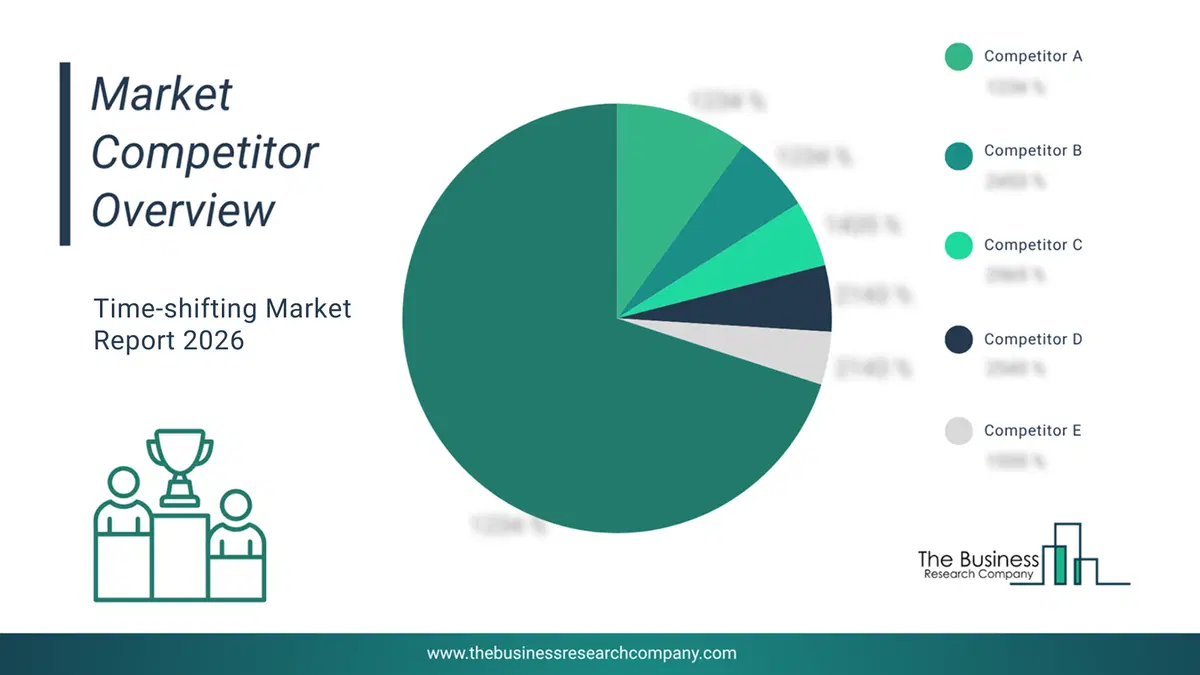
This chart is for illustrative purposes; the full report includes a detailed competitor analysis and comprehensive overview of the top 10 companies in the market.
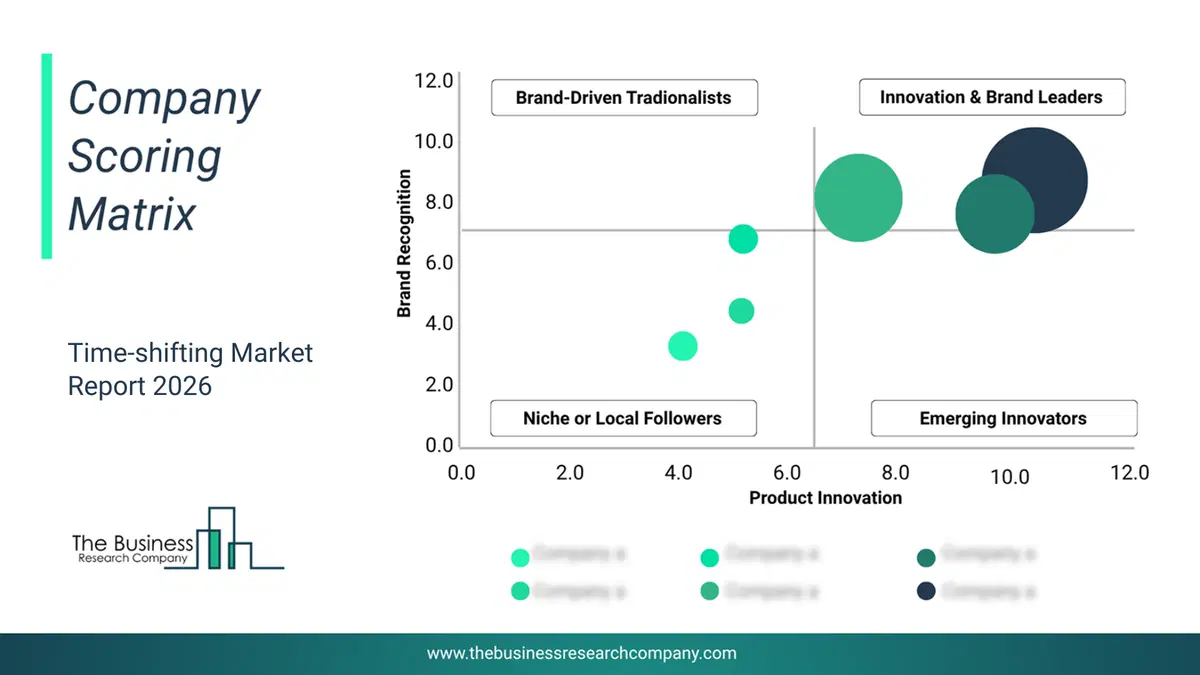
This chart maps companies by product innovation and brand strength, with bubble size indicating relative revenue, helping identify market leaders, challengers, and niche players. This is an illustrative chart; the full report provides a complete and accurate competitive analysis.
Regional Insights
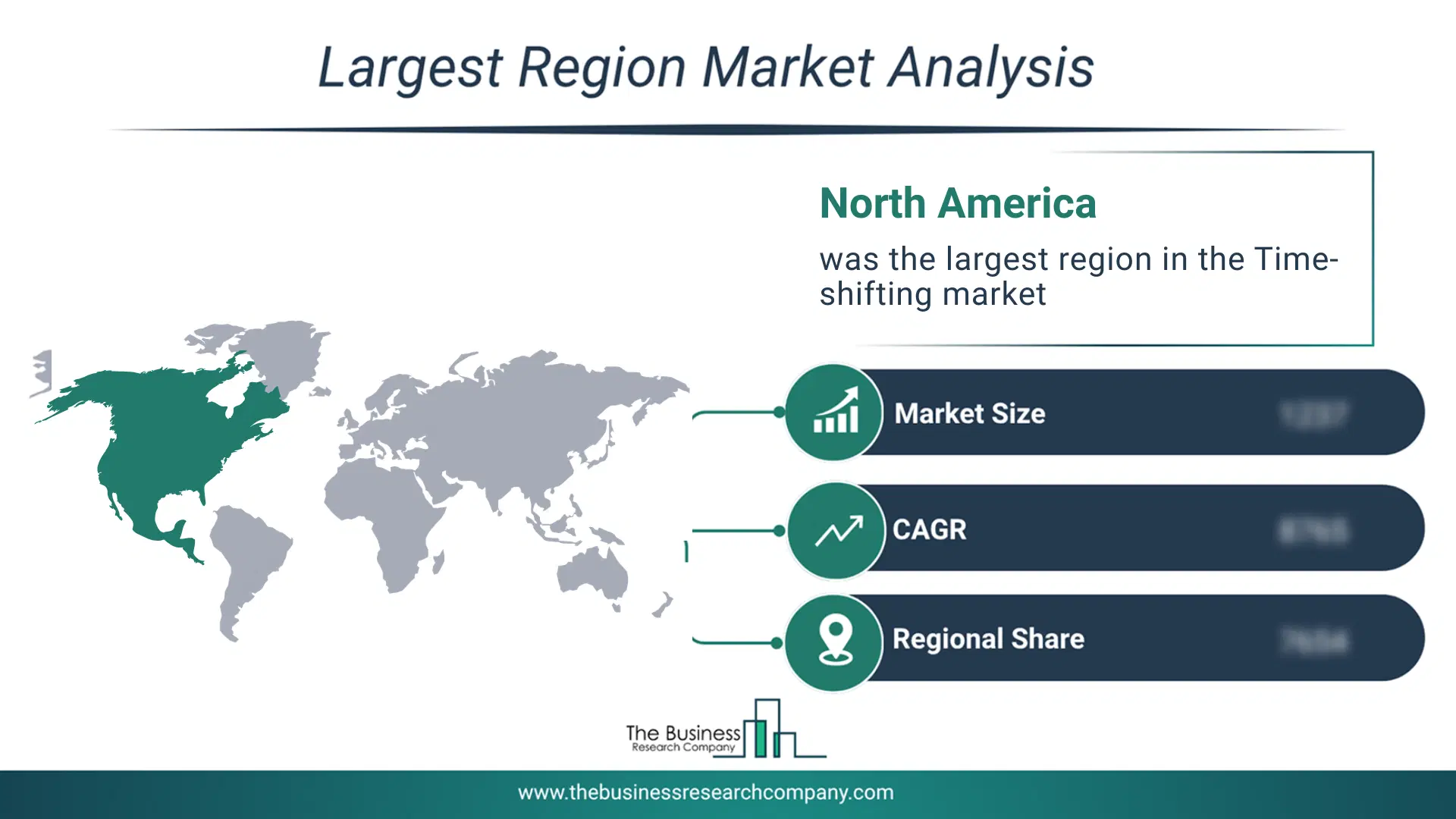
North America was the largest region in the time-shifting market in 2025. Asia-Pacific is expected to be the fastest-growing region in the forecast period. The regions covered in this market report are Asia-Pacific, South East Asia, Western Europe, Eastern Europe, North America, South America, Middle East, Africa. The countries covered in this market report are Australia, Brazil, China, France, Germany, India, Indonesia, Japan, Taiwan, Russia, South Korea, UK, USA, Canada, Italy, Spain.What Defines the Time-shifting Market?
The time-shifting market consists of revenues earned by entities by providing services such as digital video recording (DVR), network-based recording, cloud recording and storage, catch-up TV services, pause-and-restart live TV functionality, content buffering, and playback management solutions. The market value includes the value of related goods sold by the service provider or included within the service offering. The time-shifting market also includes sales of DVR set-top boxes, storage devices, smart TVs, and network infrastructure. Values in this market are ‘factory gate’ values, that is the value of goods sold by the manufacturers or creators of the goods, whether to other entities (including downstream manufacturers, wholesalers, distributors and retailers) or directly to end customers. The value of goods in this market includes related services sold by the creators of the goods.How is Market Value Defined and Measured?
The market value is defined as the revenues that enterprises gain from the sale of goods and/or services within the specified market and geography through sales, grants, or donations in terms of the currency (in USD unless otherwise specified). The revenues for a specified geography are consumption values that are revenues generated by organizations in the specified geography within the market, irrespective of where they are produced. It does not include revenues from resales along the supply chain, either further along the supply chain or as part of other products.
This chart presents market attractiveness based on a quantitative evaluation of growth, competition, strategic alignment, and risk, offering a clear view of opportunity areas for decision-making. This chart is for illustrative purposes; the full report contains the complete analysis.

This chart highlights the Total Addressable Market (TAM) by estimating the maximum revenue opportunity using an assumption-driven approach, supporting strategic planning and opportunity sizing across markets. The chart is illustrative; the full report provides a more comprehensive analysis.
What Key Data and Analysis Are Included in the Time-shifting Market Report 2026?
The time-shifting market research report is one of a series of new reports from The Business Research Company that provides market statistics, including industry global market size, regional shares, competitors with the market share, detailed market segments, market trends and opportunities, and any further data you may need to thrive in the time-shifting industry. The market research report delivers a complete perspective of everything you need, with an in-depth analysis of the current and future state of the industry.Time-shifting Market Report Forecast Analysis
| Report Attribute | Details |
|---|---|
| Market Size Value In 2026 | $33.13 billion |
| Revenue Forecast In 2030 | $52.94 billion |
| Growth Rate | CAGR of 12.4% from 2026 to 2030 |
| Base Year For Estimation | 2025 |
| Actual Estimates/Historical Data | 2020-2025 |
| Forecast Period | 2026 - 2030 |
| Market Representation | Revenue in USD Billion and CAGR from 2026 to 2030 |
| Segments Covered | Component, Deployment Type, Application, End User |
| Regional Scope | Asia-Pacific, Western Europe, Eastern Europe, North America, South America, Middle East, Africa |
| Key Companies Profiled | Swisscom AG; Telia Company AB; Rostelecom PJSC; Proximus Group; KPN N.V.; Fuji Media Holdings (FOD); Media Prima Berhad (Tonton); Vecima Networks Inc.; Broadpeak S.A.S; Synology Inc.; Japan TVer Corporation (TVer); VBox Communications Ltd.; Ateme S.A.; NextPVR; Tripleplay Services India Pvt Ltd; Plex Inc.; Jellyfin; MythTV; NXTDIGITAL Limited; Channels DVR; Tablo; Emby LLC; Elisa Oyj; PlayOn. |
| Customization Scope | Request for Customization |
| Pricing And Purchase Options | Explore Purchase Options |