
Timing Devices Market Report 2026
Global Outlook – By Type ( Oscillators, Atomic Clocks, Resonators, Clock Generators, Clock Buffers, Jitter Attenuators), By Material ( Crystal, Silicon, Ceramic), By Vertical ( Consumer Electronics, Enterprise Electronics, Banking, Financial Services And Insurance (BFSI), Telecommunications And Networking, Automotive, Industrial, Military And Aerospace, Medical And Healthcare) – Market Size, Trends, Strategies, and Forecast to 2030
Timing Devices Market Overview
• Timing Devices market size has reached to $7.82 billion in 2025 • Expected to grow to $11.86 billion in 2030 at a compound annual growth rate (CAGR) of 8.4% • Growth Driver: Rising Smartphone Usage Propel Timing Devices Market Growth • Market Trend: Expanding Product Portfolio With Advanced Integrated Clock Chip for AI Datacentres • Asia-Pacific was the largest region in 2025.What Is Covered Under Timing Devices Market?
Timing devices refer to devices that provide signals necessary for transmitting information accurately at appropriate intervals and speeds, along with continuous synchronization signals. They are crucial in various applications such as telecommunications, computing, and instrumentation, ensuring accurate timing for synchronization and coordination of processes. The main types of timing devices are oscillators, atomic clocks, resonators, clock generators, clock buffers, and jitter attenuators. An oscillator refers to any system demonstrating periodic motion around an equilibrium position. various materials used in these devices, such as crystal, silicon, and ceramic, and they are used in various verticals such as consumer electronics, enterprise electronics, banking, financial services and insurance (BFSI), telecommunications and networking, automotive, industrial, military, and aerospace, and medical and healthcare.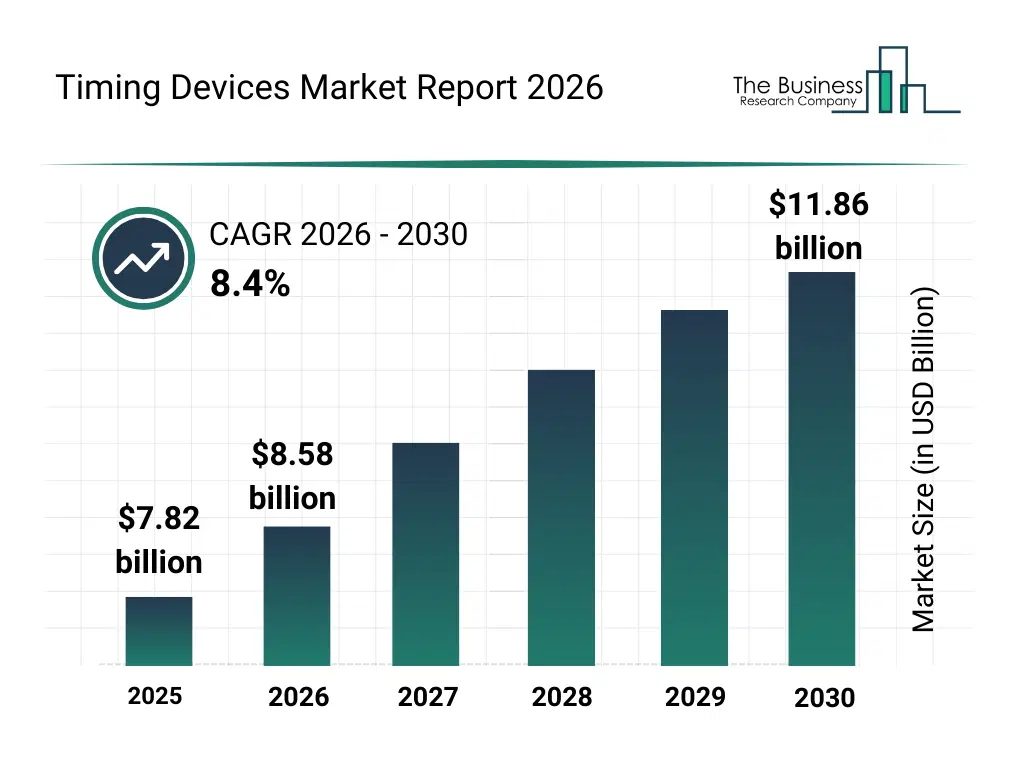
What Is The Timing Devices Market Size 2026 And Growth Rate?
The timing devices market size has grown strongly in recent years. It will grow from $7.82 billion in 2025 to $8.58 billion in 2026 at a compound annual growth rate (CAGR) of 9.7%. The growth in the historic period can be attributed to growth in telecommunications infrastructure, rising adoption of quartz based timing components, increasing use of timing devices in consumer electronics, advancements in computing and networking systems, expansion of industrial automation applications.What Is The Timing Devices Market Growth Forecast?
The timing devices market size is expected to see strong growth in the next few years. It will grow to $11.86 billion in 2030 at a compound annual growth rate (CAGR) of 8.4%. The growth in the forecast period can be attributed to growing demand for high precision timing in 5g networks, rising deployment of advanced timing in automotive electronics, increasing adoption of atomic and mems timing technologies, expansion of cloud and data center ecosystems, advancements in low jitter and high frequency timing devices. Major trends in the forecast period include growing adoption of high precision timing solutions for digital systems, increasing integration of iot enabled synchronization technologies, rising demand for ultra low jitter and high stability timing devices, advancements in automated manufacturing of timing components, growing use of intelligent timing solutions across connected applications.
Global Timing Devices Market Segmentation
1) By Type: Oscillators, Atomic Clocks, Resonators, Clock Generators, Clock Buffers, Jitter Attenuators 2) By Material: Crystal, Silicon, Ceramic 3) By Vertical: Consumer Electronics, Enterprise Electronics, Banking, Financial Services And Insurance (BFSI), Telecommunications And Networking, Automotive, Industrial, Military And Aerospace, Medical And Healthcare Subsegments: 1) By Oscillators: Quartz Oscillators, Voltage-Controlled Oscillators (VCO), Crystal Oscillators, MEMS Oscillators 2) By Atomic Clocks: Cesium Clocks, Hydrogen Masers, Rubidium Clocks 3) By Resonators: Quartz Resonators, MEMS Resonators 4) By Clock Generators: Digital Clock Generators, Phase-Locked Loop (PLL) Clock Generators 5) By Clock Buffers: Buffer Amplifiers, Buffer Circuits 6) By Jitter Attenuators: Analog Jitter Attenuators, Digital Jitter AttenuatorsWhat Is The Driver Of The Timing Devices Market?
The high adoption of smartphones is expected to propel the growth of the timing devices market going forward. A smartphone refers to a cellular device featuring operating systems, web browsing, and numerous applications. Smartphone usage is increasing due to advancements in technology, the proliferation of affordable smartphones, and the expansion of mobile networks. Timing devices in smartphones enable precise synchronization of various functions, including clock time, network communication, and sensor data sampling. For instance, in October 2025, according to the Demand Sage is a U.S.-based technology company, smartphone penetration in the United States reached 82.2% in 2023, up from 76.5% in 2022. Therefore, the high adoption of smartphones is driving the growth of the timing devices industry.Key Players In The Global Timing Devices Market
Major companies operating in the timing devices market are Texas Instruments Incorporated, Kyocera Corporation, STMicroelectronics N.V., Murata Manufacturing Co. Ltd, Infineon Technologies AG, NXP Semiconductors N.V., Analog Devices Inc., Renesas Electronics Corporation, Seiko Epson Corporation, ON Semiconductor Corporation, Microchip Technology Inc., Diodes Incorporated, Microsemi Corporation, CTS Corporation, TXC Corporation, Nihon Dempa Kogyo Co. Ltd., SiTime Corporation, Rakon Limited, Frequency Electronics Inc., Connor-Winfield Corporation , Oscilloquartz SA, AccuBeat Limited, Crystek Corporation, Greenray Industries Inc., IQD Frequency Products Ltd., Mercury United Electronics Inc.
This chart is for illustrative purposes; the full report includes a detailed competitor analysis and comprehensive overview of the top 10 companies in the market.
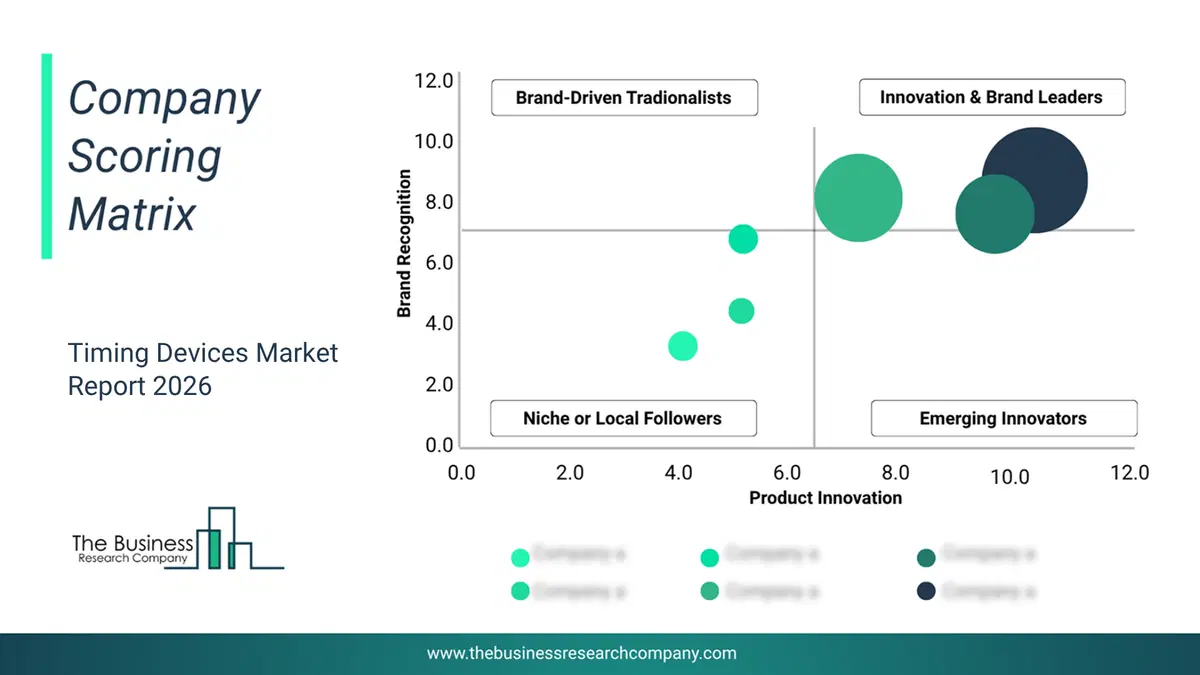
This chart maps companies by product innovation and brand strength, with bubble size indicating relative revenue, helping identify market leaders, challengers, and niche players. This is an illustrative chart; the full report provides a complete and accurate competitive analysis.
Global Timing Devices Market Trends and Insights
Major companies operating in the timing devices market are focusing on expanding their product portfolio by adding devices such as integrated clock chips to meet the evolving demands of telecommunications networks. An integrated clock chip is a specialized timing component designed to synchronize high-speed data processing across multiple servers, enhancing performance and reducing latency in AI-driven operations. For instance, in April 2024, SiTime Corporation, a US-based semiconductor company, launched its Chorus family of clock generators, designed specifically for AI datacenter applications. This innovative product is a MEMS-based clock-system-on-a-chip (ClkSoC) that delivers up to 10 times higher performance while occupying half the size compared to traditional standalone oscillators and clocks. The integrated design combines clock, oscillator, and resonator technologies, simplifying the clock architecture in systems and significantly reducing design time by up to six weeks.What Are Latest Mergers And Acquisitions In The Timing Devices Market?
In July 2023, Abracon LLC, a US-based supplier of electronic components, acquired NEL Frequency Controls Inc. for an undisclosed amount. With this acquisition, Abracon marks a significant milestone in expanding its product lineup focused on precise timing solutions. NEL Frequency Controls Inc. is a US-based manufacturer of timing devices that includes a product range such as modules and ultra-low-phase noise crystal oscillators.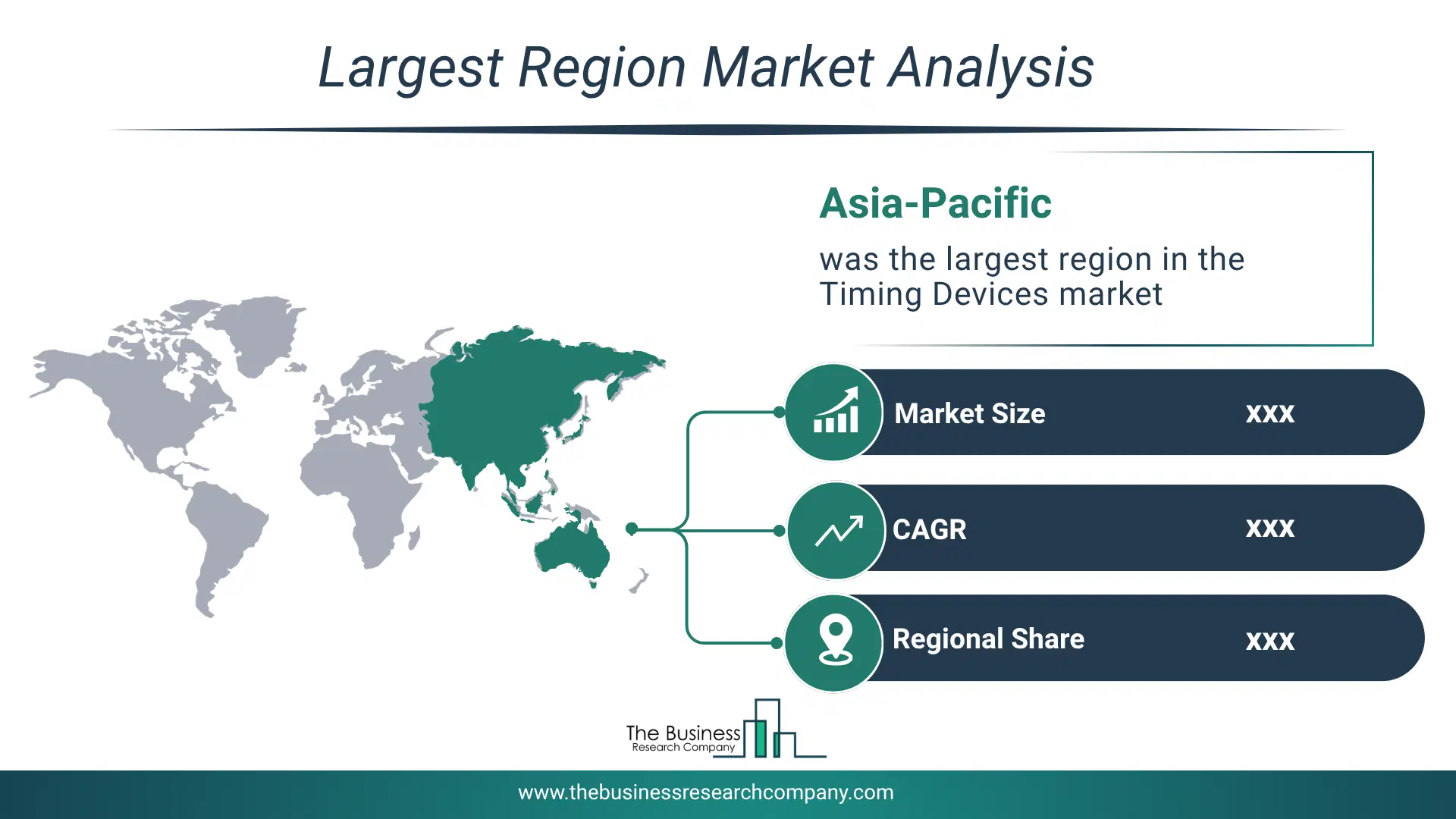
Regional Outlook
Asia-Pacific was the largest region in the timing devices market in 2025. The regions covered in this market report are Asia-Pacific, South East Asia, Western Europe, Eastern Europe, North America, South America, Middle East, Africa. The countries covered in this market report are Australia, Brazil, China, France, Germany, India, Indonesia, Japan, Taiwan, Russia, South Korea, UK, USA, Canada, Italy, Spain.What Defines the Timing Devices Market?
The timing devices market consists of sales of timers, real-time clocks, pulse generators, delay lines, and time-base generators. Values in this market are ‘factory gate’ values, that is the value of goods sold by the manufacturers or creators of the goods, whether to other entities (including downstream manufacturers, wholesalers, distributors, and retailers) or directly to end customers. The value of goods in this market includes related services sold by the creators of the goods.How is Market Value Defined and Measured?
The market value is defined as the revenues that enterprises gain from the sale of goods and/or services within the specified market and geography through sales, grants, or donations in terms of the currency (in USD unless otherwise specified). The revenues for a specified geography are consumption values that are revenues generated by organizations in the specified geography within the market, irrespective of where they are produced. It does not include revenues from resales along the supply chain, either further along the supply chain or as part of other products.
This chart presents market attractiveness based on a quantitative evaluation of growth, competition, strategic alignment, and risk, offering a clear view of opportunity areas for decision-making. This chart is for illustrative purposes; the full report contains the complete analysis.

This chart highlights the Total Addressable Market (TAM) by estimating the maximum revenue opportunity using an assumption-driven approach, supporting strategic planning and opportunity sizing across markets. The chart is illustrative; the full report provides a more comprehensive analysis.
What Key Data and Analysis Are Included in the Timing Devices Market Report 2026?
The timing devices market research report is one of a series of new reports from The Business Research Company that provides market statistics, including industry global market size, regional shares, competitors with the market share, detailed market segments, market trends and opportunities, and any further data you may need to thrive in the timing devices industry. The market research report delivers a complete perspective of everything you need, with an in-depth analysis of the current and future state of the industry.Timing Devices Market Report Forecast Analysis
| Report Attribute | Details |
|---|---|
| Market Size Value In 2026 | $8.58 billion |
| Revenue Forecast In 2030 | $11.86 billion |
| Growth Rate | CAGR of 8.4% from 2026 to 2030 |
| Base Year For Estimation | 2025 |
| Actual Estimates/Historical Data | 2020-2025 |
| Forecast Period | 2026 - 2030 |
| Market Representation | Revenue in USD Billion and CAGR from 2026 to 2030 |
| Segments Covered | Type, Material, Vertical |
| Regional Scope | Asia-Pacific, Western Europe, Eastern Europe, North America, South America, Middle East, Africa |
| Country Scope | The countries covered in the report are Australia, Brazil, China, France, Germany, India, Indonesia, Japan, Taiwan, Russia, South Korea, UK, USA, Canada, Italy, Spain. |
| Key Companies Profiled | Texas Instruments Incorporated, Kyocera Corporation, STMicroelectronics N.V., Murata Manufacturing Co. Ltd, Infineon Technologies AG, NXP Semiconductors N.V., Analog Devices Inc., Renesas Electronics Corporation, Seiko Epson Corporation, ON Semiconductor Corporation, Microchip Technology Inc., Diodes Incorporated, Microsemi Corporation, CTS Corporation, TXC Corporation, Nihon Dempa Kogyo Co. Ltd., SiTime Corporation, Rakon Limited, Frequency Electronics Inc., Connor-Winfield Corporation , Oscilloquartz SA, AccuBeat Limited, Crystek Corporation, Greenray Industries Inc., IQD Frequency Products Ltd., Mercury United Electronics Inc. |
| Customization Scope | Request for Customization |
| Pricing And Purchase Options | Explore Purchase Options |