

Tiny Homes Market Report 2026
Global Outlook – By Product Type (Mobile Tiny Homes, Stationary Tiny Homes), By Construction Type (On Site Built, Prefabricated), By Material (Composite, Concrete, Steel, Wood), By Distribution Channel (Direct Sales, Distributors), By Application (Household, Commercial, Industrial, Other Applications) – Market Size, Trends, Strategies, and Forecast to 2035
Tiny Homes Market Overview
• Tiny Homes market size has reached to $13.17 billion in 2025 • Expected to grow to $17.73 billion in 2030 at a compound annual growth rate (CAGR) of 6.1% • Growth Driver: Increase In Travel And Tourism Fueling The Growth Of The Market Due To Rising Demand For Affordable And Flexible Accommodations • Market Trend: Advancements In Modular Living For Travel Enthusiasts • North America was the largest region and fastest growing region.Market Gains By 2030 – Top Opportunities By Segment
Market Gain identifies the most promising market opportunities by highlighting the segments or products expected to generate the highest incremental revenue growth over the next five years.
What Is Covered Under Tiny Homes Market?
Tiny homes are small, fully functional living spaces that emphasize simplicity, efficiency, and affordability, often built with sustainable or modular construction techniques. Tiny homes utilize space-saving designs, multifunctional furniture, and sustainable materials to provide efficient and affordable living solutions within a compact footprint. The main product types of tiny homes include mobile tiny homes and stationary tiny homes. Mobile tiny homes are small, fully functional residences built on wheels or trailer bases. It offers both on-site built and prefabricated construction and uses various materials such as composite, concrete, steel, and wood. It is distributed through direct sales and distributors and is applied for household, commercial, industrial, and other uses.
What Is The Tiny Homes Market Size and Share 2026?
The tiny homes market size has grown strongly in recent years. It will grow from $13.17 billion in 2025 to $14 billion in 2026 at a compound annual growth rate (CAGR) of 6.4%. The growth in the historic period can be attributed to rising adoption of modular construction, increasing demand for compact housing solutions, growth in off-grid residential projects, rising focus on affordable housing, expansion of prefab tiny home kits.What Is The Tiny Homes Market Growth Forecast?
The tiny homes market size is expected to see strong growth in the next few years. It will grow to $17.73 billion in 2030 at a compound annual growth rate (CAGR) of 6.1%. The growth in the forecast period can be attributed to increasing integration of smart home automation, expansion of eco-friendly and energy-efficient tiny homes, rising use of AI-based design optimization, growth in transportable and mobile tiny home solutions, increasing application of lightweight and composite construction materials. Major trends in the forecast period include adoption of prefabricated tiny home modules, integration of smart home automation systems, deployment of energy-efficient construction materials, expansion of modular and transportable tiny homes, development of AI-driven design and space optimization tools.
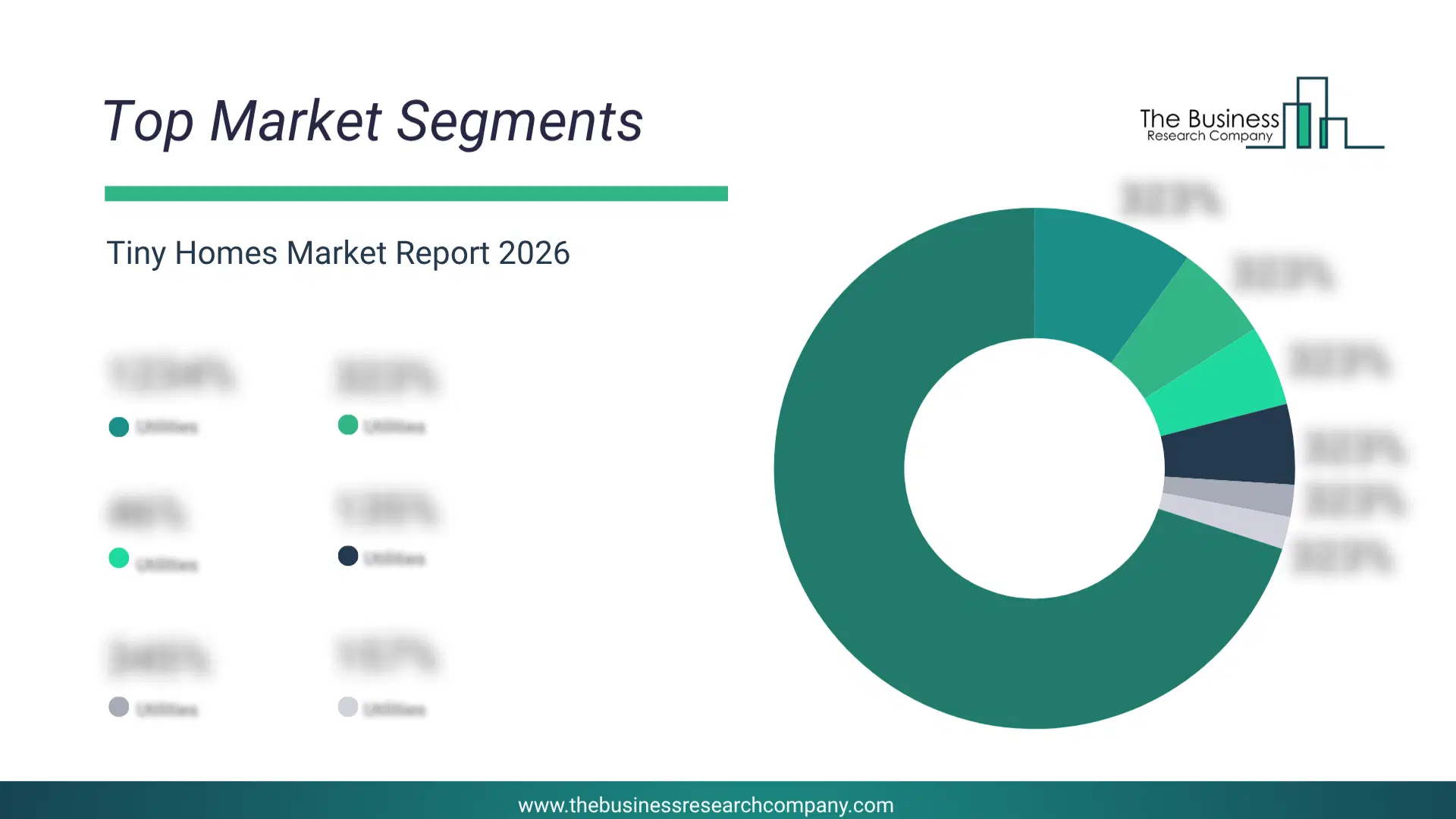
Global Tiny Homes Market Segmentation
1) By Product Type: Mobile Tiny Homes, Stationary Tiny Homes 2) By Construction Type: On Site Built, Prefabricated 3) By Material: Composite, Concrete, Steel, Wood 4) By Distribution Channel: Direct Sales, Distributors 5) By Application: Household, Commercial, Industrial, Other Applications Subsegments: 1) By Mobile Tiny Homes: Towable Tiny Homes, RV-Based Tiny Homes, Trailer-Mounted Tiny Homes, Foldable Or Expandable Tiny Homes 2) By Stationary Tiny Homes: Foundation-Built Tiny Homes, Container-Based Tiny Homes, Cabins Or Cottages, Modular Fixed Tiny Homes The top segments in the tiny homes market will be: • Household will reach $9503.7 Million by 2025. • Direct Sales will reach $8464.7 Million by 2025. • Prefabricated will reach $8442 Million by 2025. • Wood will reach $7793.8 Million by 2025. • Mobile Tiny Homes will reach $7728.2 Million by 2025.What Is The Driver Of The Tiny Homes Market?
The increasing travel and tourism is expected to propel the growth of the tiny homes market going forward. Travel and tourism refer to people journeying to places outside their usual environment for reasons such as leisure, business, or exploration, usually for a limited time. The growth in travel and tourism is driven by rising disposable incomes, which allow more individuals to afford vacations and visit diverse destinations both within their country and abroad. Tiny homes support travel and tourism by providing cost-effective and adaptable lodging choices, enabling tourists to stay near natural settings or distinctive locations without the expense of conventional accommodations. For instance, in May 2025, according to the UN Tourism (UNWTO), a Spain-based specialized agency, international tourist numbers exceeded 300 million during the first three months of 2025, showing a growth of around 14 million compared to the same timeframe in 2024, which equates to a 5% increase from the previous year. Therefore, the increasing travel and tourism is driving the growth of the tiny homes industry.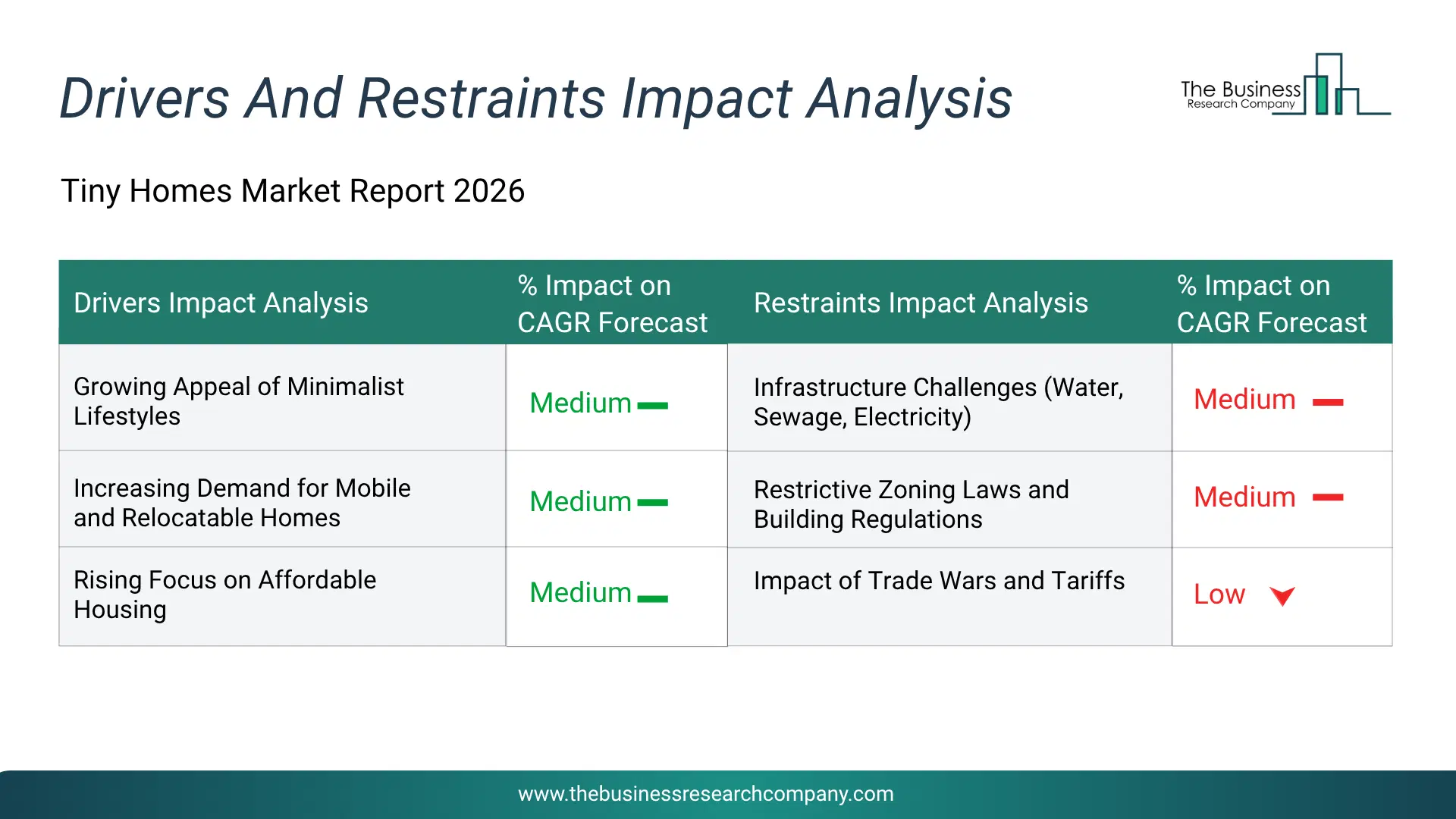
Infographic Chart Showing Key Market Drivers Analysis And Restraints For Tiny Homes Market
The chart presents an impact analysis of key drivers and restraints, quantifying their relative influence on the market's growth rate and helping assess the balance between growth enablers and limiting factors. This chart offers a high-level perspective; the full report contains more detailed insights.
How Will The Drivers Impact Growth In The Global Tiny Homes Market?
• Growing Appeal of Minimalist Lifestyles (Medium) – The growing appeal of minimalist lifestyles will become a key driver of growth in the tiny homes market by 2030. An increasing number of consumers are prioritizing simplicity, reduced consumption, and efficient use of space in their living arrangements. This shift is encouraging individuals to move away from large, high-maintenance homes toward smaller, more functional housing options. Tiny homes align well with minimalist values by offering compact designs, lower costs, and fewer material requirements. In addition, younger buyers and remote workers are increasingly seeking flexible and sustainable living solutions. Therefore, the growing appeal of minimalist lifestyles will drive the growth of the tiny homes market. As a result, the growing appeal of minimalist lifestyles is anticipated to contributing to a 1.5% annual growth in the market. • Increasing Demand for Mobile and Relocatable Homes (Medium) – The increasing demand for mobile and relocatable homes will emerge as a major factor driving the expansion of the tiny homes market by 2030. Consumers are increasingly valuing housing solutions that offer flexibility, portability, and the ability to relocate based on lifestyle or employment opportunities. Tiny homes on wheels and modular portable units allow homeowners to move their residences without the high costs associated with traditional property transactions. This mobility is particularly appealing to remote workers, travelers, and individuals seeking temporary or seasonal living arrangements. In addition, rising land prices and urban mobility trends are encouraging buyers to consider adaptable housing options. Therefore, the increasing demand for mobile and relocatable homes will drive the growth of the tiny homes market. Consequently, the increasing demand for mobile and relocatable homes is projected to contributing to a 1.3% annual growth in the market. • Rising Focus on Affordable Housing (Medium) – The rising focus on affordable housing will serve as a key growth catalyst for the tiny homes market by 2030. Increasing housing costs and limited access to traditional homeownership are encouraging governments, developers, and consumers to explore cost-effective housing alternatives. Tiny homes offer a practical solution due to their lower construction costs, reduced land requirements, and minimal maintenance expenses. In addition, these compact housing units can be developed quickly, making them suitable for addressing housing shortages in both urban and rural areas. Supportive policies, innovative financing options, and growing awareness of budget-friendly living are also contributing to their adoption. Therefore, the rising focus on affordable housing will drive the growth of the tiny homes market. Therefore, this rising focus on affordable housing is projected to supporting to a 1.0% annual growth in the market. • Increasing Urban Land Scarcity (Low) – The increasing urban land scarcity will become a significant driver contributing to the growth of the tiny homes market by 2030. Rapid urbanization and population growth are placing significant pressure on available land in major cities, making large residential developments more difficult and expensive. As a result, developers and consumers are exploring compact and space-efficient housing solutions. Tiny homes offer an effective alternative by maximizing the use of limited land while maintaining functional living spaces. In addition, urban planners are increasingly considering smaller housing units to optimize land utilization and support sustainable city development. Therefore, the increasing urban land scarcity will drive the growth of the tiny homes market. Consequently, the increasing urban land scarcity is projected to contributing to a 0.3% annual growth in the market.How Will The Restraints Impact Growth In The Global Tiny Homes Market?
• Infrastructure Challenges (Water, Sewage, Electricity) (Medium) – Infrastructure challenges (water, sewage, electricity) is expected to restrain market growth during the forecast period. It creates operational, financial, regulatory, or commercial challenges that can increase costs, delay projects, reduce investments, or discourage purchasing decisions depending on the market. These challenges can reduce product adoption, affect business confidence, and limit the ability of companies to expand efficiently across key regions. This can disrupt long-term growth strategies and reduce the ability of companies to capitalize on emerging market opportunities. • Restrictive Zoning Laws and Building Regulations (Medium) – During the forecast period, restrictive zoning laws and building regulations is likely to limit market expansion. It creates operational, financial, regulatory, or commercial challenges that can increase costs, delay projects, reduce investments, or discourage purchasing decisions depending on the market. These challenges can reduce product adoption, affect business confidence, and limit the ability of companies to expand efficiently across key regions. As a result, organizations may postpone purchasing decisions, limiting demand across both established and emerging markets. • Impact of Trade Wars and Tariffs (Medium) – The market is expected to face challenges due to impact of trade wars and tariffs over the forecast period. It creates operational, financial, regulatory, or commercial challenges that can increase costs, delay projects, reduce investments, or discourage purchasing decisions depending on the market. These challenges can reduce product adoption, affect business confidence, and limit the ability of companies to expand efficiently across key regions. This may reduce production efficiency, extend project timelines, and create challenges in meeting evolving customer requirements.Key Players In The Global Tiny Homes Market
Major companies operating in the tiny homes market are Tiny SMART House Inc., Boxabl, Tiny Home Builders LLC, The Skyline Corporation, Timbercaraft Tiny Homes, Tumbleweed Tiny House Company, Village Tiny Homes of Austin, Meka Inc., Alphaline Homes, Tiny Heirloom, Honomobo, Clever Homes LLC, Teeny Tiny Homes, Aussie Tiny Houses, Tiny Mountain Houses, Mustard Seed Tiny Homes LLC, New Frontier Design, Maverick Tiny Homes LLC, California Tiny House, Huslein Tiny House Co., Tiny House Basics LLC, GreenPod Development LLC, Pacifica Tiny Homes, Tru Form LLC, Rocky Mountain Tiny Houses Inc., Modern Tiny Living LLC.
This chart is for illustrative purposes; the full report includes a detailed competitor analysis and comprehensive overview of the top 10 companies in the market.
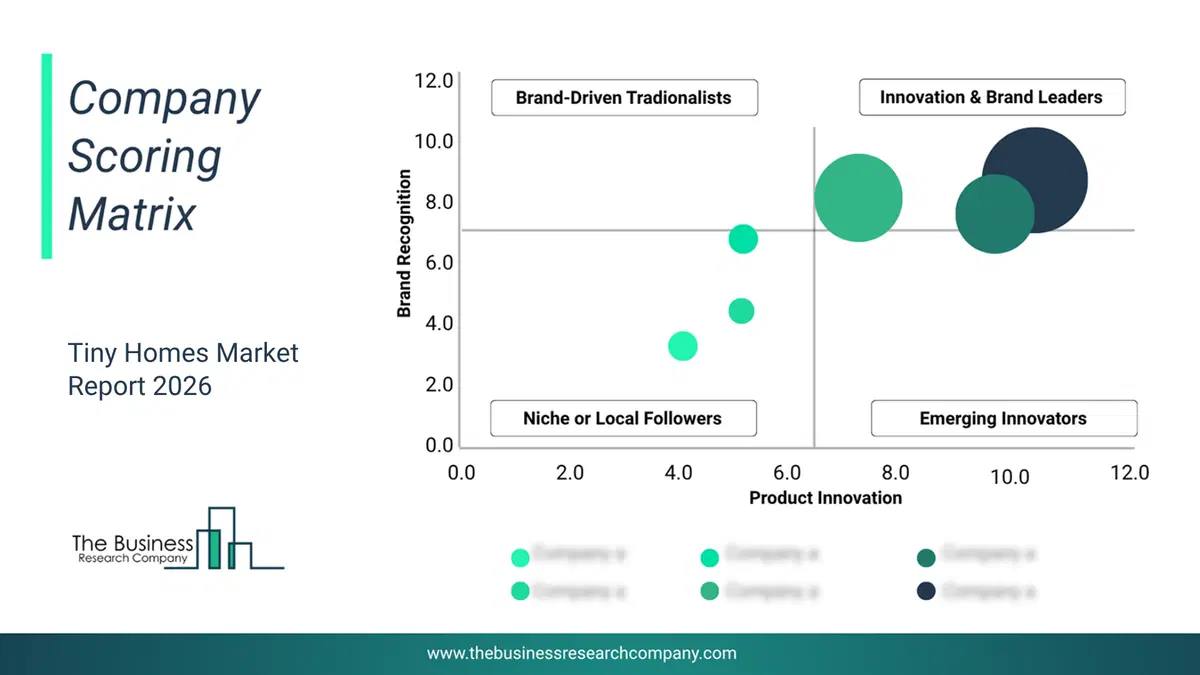
This chart maps companies by product innovation and brand strength, with bubble size indicating relative revenue, helping identify market leaders, challengers, and niche players. This is an illustrative chart; the full report provides a complete and accurate competitive analysis.
Global Tiny Homes Market Trends and Insights
Major companies operating in the tiny homes market are focusing on developing innovative products, such as prefabricated tiny homes, to offer flexibility for homeowners who value mobility and changing lifestyles. Prefabricated tiny homes are compact living units constructed in a factory setting and then delivered to a site for fast and easy installation. For instance, in July 2024, Continental AG, a Germany-based mobility solutions provider, launched ContiHome, a prefabricated tiny house. Located on Lake Belau in northern Germany between Kiel and Lübeck, the ContiHome is a compact, one-and-a-half-story tiny house covering 30 square meters. It stands out for its mobility, as it can be used with or without a trailer, making it adaptable for different locations. Aimed at enhancing comfort in vacation parks and campsites, it offers a higher standard of living compared to regular camping options. Key features include eco-friendly surface materials, a kitchen, a bathroom, and sleeping arrangements for up to four people.What Are Latest Mergers And Acquisitions In The Tiny Homes Market?
In May 2023, Zook Cabins, a US-based company specializing in the design and construction of modular log cabins, acquired the assets of Liberation Tiny Homes for an undisclosed amount. The acquisition paves the way for an expanded portfolio of distinctive and forward-looking small space solutions. The design capabilities and industry knowledge brought by the Liberation Tiny Homes team are set to enhance the development of innovative living concepts. Liberation Tiny Homes is a US-based company specializing in the construction of tiny homes.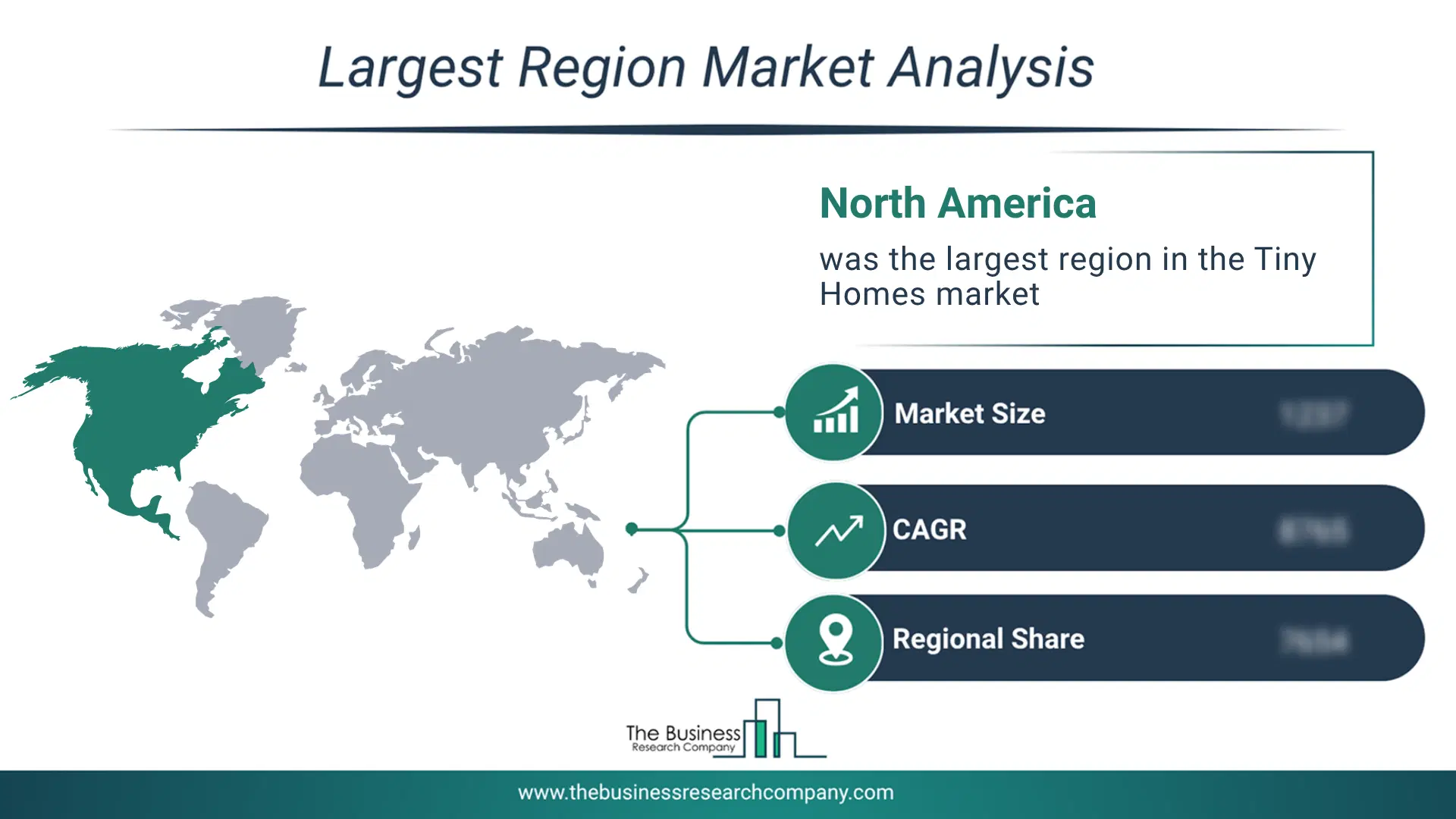
Regional Insights
North America was the largest region in the tiny homes market in 2025. Asia-Pacific is expected to be the fastest-growing region in the forecast period. The regions covered in this market report are Asia-Pacific, South East Asia, Western Europe, Eastern Europe, North America, South America, Middle East, Africa. The countries covered in this market report are Australia, Brazil, China, France, Germany, India, Indonesia, Japan, Taiwan, Russia, South Korea, UK, USA, Canada, Italy, Spain.What Defines the Tiny Homes Market?
The tiny homes market consists of sales of tiny homes on wheels, prefab tiny homes, tiny home shells, off-grid tiny homes, and DIY tiny home kits. Values in this market are ‘factory gate’ values, that is, the value of goods sold by the manufacturers or creators of the goods, whether to other entities (including downstream manufacturers, wholesalers, distributors, and retailers) or directly to end customers. The value of goods in this market includes related services sold by the creators of the goods.How is Market Value Defined and Measured?
The market value is defined as the revenues that enterprises gain from the sale of goods and/or services within the specified market and geography through sales, grants, or donations in terms of the currency (in USD unless otherwise specified). The revenues for a specified geography are consumption values that are revenues generated by organizations in the specified geography within the market, irrespective of where they are produced. It does not include revenues from resales along the supply chain, either further along the supply chain or as part of other products.
This chart presents market attractiveness based on a quantitative evaluation of growth, competition, strategic alignment, and risk, offering a clear view of opportunity areas for decision-making. This chart is for illustrative purposes; the full report contains the complete analysis.

This chart highlights the Total Addressable Market (TAM) by estimating the maximum revenue opportunity using an assumption-driven approach, supporting strategic planning and opportunity sizing across markets. The chart is illustrative; the full report provides a more comprehensive analysis.
What Key Data and Analysis Are Included in theTiny Homes Market Report 2026?
The tiny homes market research report is one of a series of new reports from The Business Research Company that provides market statistics, including industry global market size, regional shares, competitors with the market share, detailed market segments, market trends and opportunities, and any further data you may need to thrive in the tiny homes industry. The market research report delivers a complete perspective of everything you need, with an in-depth analysis of the current and future state of the industry.Tiny Homes Market Report Forecast Analysis
| Report Attribute | Details |
|---|---|
| Market Size Value In 2026 | $14 billion |
| Revenue Forecast In 2035 | $17.73 billion |
| Growth Rate | CAGR of 6.4% from 2026 to 2035 |
| Base Year For Estimation | 2025 |
| Actual Estimates/Historical Data | 2020-2025 |
| Forecast Period | 2026 - 2030 - 2035 |
| Market Representation | Revenue in USD Billion and CAGR from 2026 to 2035 |
| Segments Covered | Product Type, Construction Type, Material, Distribution Channel, Application |
| Regional Scope | Asia-Pacific, Western Europe, Eastern Europe, North America, South America, Middle East, Africa |
| Country Scope | The countries covered in the report are Australia, Brazil, China, France, Germany, India, ... |
| Key Companies Profiled | Tiny SMART House Inc., Boxabl, Tiny Home Builders LLC, The Skyline Corporation, Timbercaraft Tiny Homes, Tumbleweed Tiny House Company, Village Tiny Homes of Austin, Meka Inc., Alphaline Homes, Tiny Heirloom, Honomobo, Clever Homes LLC, Teeny Tiny Homes, Aussie Tiny Houses, Tiny Mountain Houses, Mustard Seed Tiny Homes LLC, New Frontier Design, Maverick Tiny Homes LLC, California Tiny House, Huslein Tiny House Co., Tiny House Basics LLC, GreenPod Development LLC, Pacifica Tiny Homes, Tru Form LLC, Rocky Mountain Tiny Houses Inc., Modern Tiny Living LLC. |
| Customization Scope | Request for Customization |
| Pricing And Purchase Options | Explore Purchase Options |