
Tissue Engineering For Wound Care Market Report 2026
Global Outlook – By Product Material (Scaffold, Tissue Grafts, Other Products), By Type Of Wound (Chronic Wounds, Acute Wounds), By Application (Skin Regeneration, Soft Tissue Repair), By End-User (Hospitals, Specialty Centers And Clinics, Ambulatory Surgical Centers) – Market Size, Trends, Strategies, and Forecast to 2030
Tissue Engineering For Wound Care Market Overview
• Tissue Engineering For Wound Care market size has reached to $6.93 billion in 2025 • Expected to grow to $13.61 billion in 2030 at a compound annual growth rate (CAGR) of 14.4% • Growth Driver: Rising Incidence Of Musculoskeletal Disorders Fueling The Growth Of The Market Due To Increasing Need For Regenerative Therapies • Market Trend: Advancements In Intraoperative 3D Printing Revolutionizing Personalized Wound Care • North America was the largest region in 2025.What Is Covered Under Tissue Engineering For Wound Care Market?
Tissue engineering for wound care is a specialized field that focuses on promoting the natural repair and regeneration of damaged tissue through the combination of biological components, such as cells and supportive materials. This approach aims to create an optimal environment that facilitates the body's healing processes by encouraging new tissue growth. The main tissue engineering for wound care product materials includes scaffolds, tissue grafts, and others. A scaffold is a three-dimensional structure that provides physical support to cells, enabling them to attach, proliferate, and differentiate to form new tissue. It is used for both chronic and acute wounds and is applied for skin regeneration, bone and cartilage regeneration, soft tissue repair, and organ regeneration. It is used by various end-users, including hospitals, specialty centers and clinics, and ambulatory surgical centers.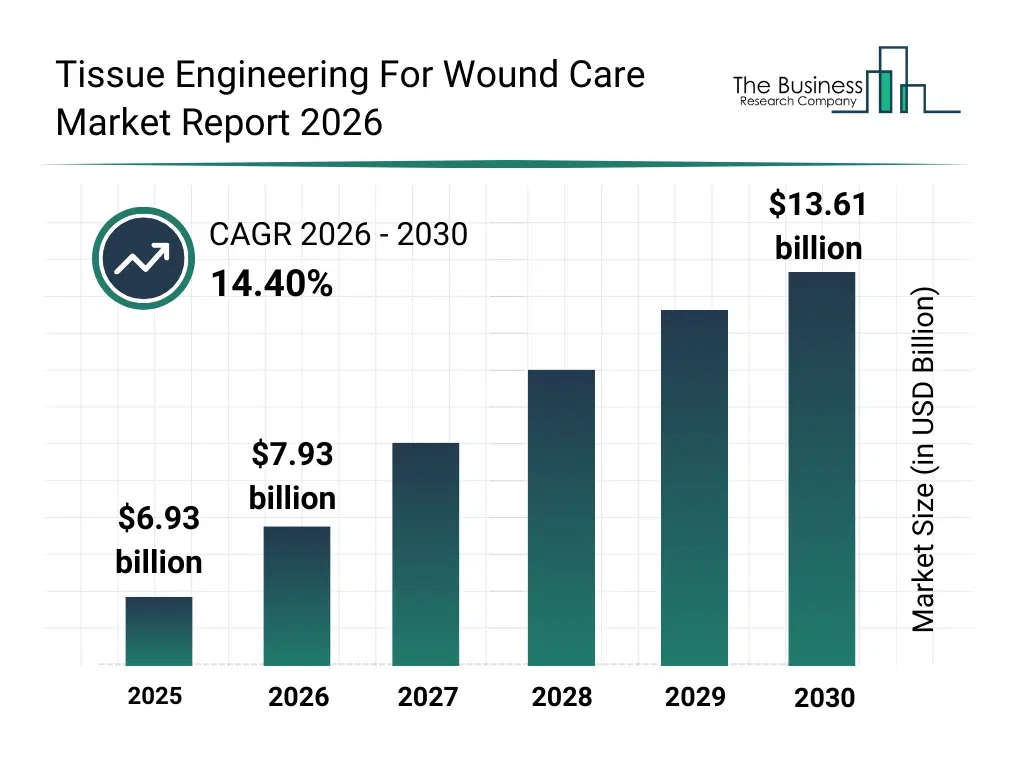
What Is The Tissue Engineering For Wound Care Market Size and Share 2026?
The tissue engineering for wound care market size has grown rapidly in recent years. It will grow from $6.93 billion in 2025 to $7.93 billion in 2026 at a compound annual growth rate (CAGR) of 14.5%. The growth in the historic period can be attributed to aging population, diabetes prevalence, burn injuries, hospital wound care programs, advances in biomaterials.What Is The Tissue Engineering For Wound Care Market Growth Forecast?
The tissue engineering for wound care market size is expected to see rapid growth in the next few years. It will grow to $13.61 billion in 2030 at a compound annual growth rate (CAGR) of 14.4%. The growth in the forecast period can be attributed to growth in chronic wound cases, regenerative medicine adoption, outpatient wound care expansion, innovation in biomaterials, rising healthcare expenditure. Major trends in the forecast period include rising use of bioengineered skin substitutes, growth of chronic wound management solutions, adoption of stem cell-based therapies, expansion of advanced wound care products, focus on faster tissue regeneration.
Global Tissue Engineering For Wound Care Market Segmentation
1) By Product Material: Scaffold, Tissue Grafts, Other Products 2) By Type Of Wound: Chronic Wounds, Acute Wounds 3) By Application: Skin Regeneration, Soft Tissue Repair 4) By End-User: Hospitals, Specialty Centers And Clinics, Ambulatory Surgical Centers Subsegments: 1) By Scaffold: Natural Scaffolds, Synthetic Scaffolds, Composite Scaffolds, Hydrogels, Nanofiber-Based Scaffolds 2) By Tissue Grafts: Autografts, Allografts, Xenografts, Bioengineered Skin Substitutes, Amniotic Tissue Grafts 3) By Other Products: Cell-Based Products, Growth Factors, Acellular Dermal Matrices, Collagen-Based Dressings, Stem Cell-Derived BiomaterialsWhat Is The Driver Of The Tissue Engineering For Wound Care Market?
The increasing prevalence of musculoskeletal disorders is anticipated to fuel the growth of the tissue engineering for wound care market in the coming years. Musculoskeletal disorders are conditions that affect the muscles, bones, joints, tendons, or ligaments, causing pain, stiffness, or limited movement. The rise in musculoskeletal disorders is driven by increasingly sedentary lifestyles, as extended periods of sitting and reduced physical movement contribute to muscle weakening and joint stress, leading to long-term issues. Tissue engineering for wound care is required for musculoskeletal disorders because it supports the regeneration of damaged tissues, helping restore function and structure in areas where natural healing is insufficient. For instance, in January 2024, according to the Office for Health Improvement and Disparities, a UK-based government public health agency, the prevalence of people aged 16 and over self-reporting a long-term musculoskeletal (MSK) condition reached 18.4% in 2023, rising from 17.6% in 2022. Therefore, the increasing prevalence of musculoskeletal disorders will boost the growth of the tissue engineering for wound care industry.Key Players In The Global Tissue Engineering For Wound Care Market
Major companies operating in the tissue engineering for wound care market are Smith & Nephew plc, ConvaTec Group Plc, MTF Biologics, MiMedx Group Inc., LifeNet Health Inc., Kerecis LLC, Aroa Biosurgery Ltd., Tissue Regenix Group PLC, BioStem Technologies Inc., Organogenesis Holdings Inc., Integra LifeSciences Holdings Corporation, Osiris Therapeutics (Smith & Nephew), Stryker Corporation, Medline Industries LP, Mölnlycke Health Care AB, 3M Health Care, Cardinal Health Inc., Derma Sciences Inc., Acell Inc., Wright Medical Group N.V., Anika Therapeutics Inc., Regen Lab SA, Skye Biologics Inc., Human Regenerative Technologies LLC, StimLabs LLC
This chart is for illustrative purposes; the full report includes a detailed competitor analysis and comprehensive overview of the top 10 companies in the market.
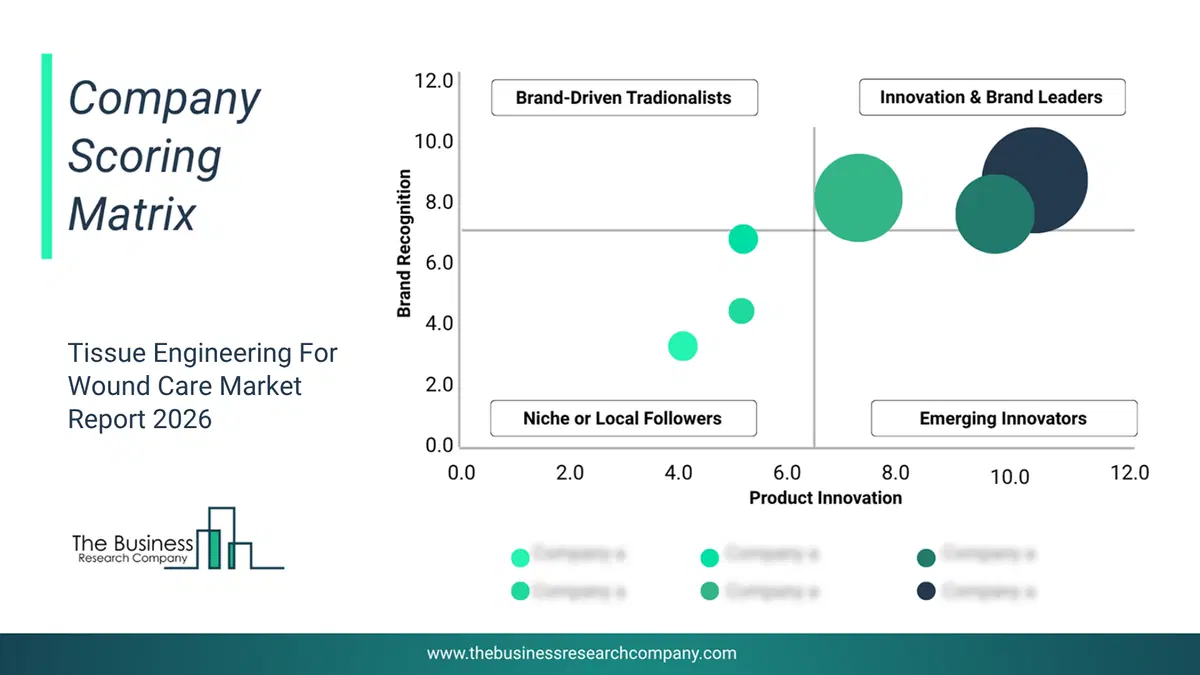
This chart maps companies by product innovation and brand strength, with bubble size indicating relative revenue, helping identify market leaders, challengers, and niche players. This is an illustrative chart; the full report provides a complete and accurate competitive analysis.
Global Tissue Engineering For Wound Care Market Trends and Insights
Major companies operating in the tissue engineering for wound care market are focusing on developing technologically advanced solutions, such as interoperative 3D printers, to enable the rapid prototyping of complex structures. Intraoperative 3D printers are advanced devices used during surgical procedures to create customized implants, models, or tools in real-time, enhancing precision and patient-specific treatment. For instance, in September 2024, Tides Medical, a US-based biotechnology company, launched APLICOR 3D, a personalized wound care interoperative 3D printer. It transforms wound care by utilizing the patient’s own tissue, artificial intelligence, and 3D printing technology to create personalized skin grafts directly at the treatment site. This one-time procedure meets the unique needs of each patient while simplifying supply chain logistics and inventory management and reducing physician workload. After determining the exact size, depth, and tissue volume needed by scanning the wound with a specialized tablet, the provider transmits the 3D file to the printer. After harvesting and processing fat into bio-ink, the 3D printer constructs the graft, enabling effective wound closure in under one hour.What Are Latest Mergers And Acquisitions In The Tissue Engineering For Wound Care Market?
In July 2023, Coloplast A/S, a Denmark-based healthcare technology company, acquired Kerecis Holding ApS for an undisclosed amount. With this acquisition, Coloplast aims to expand its advanced wound-care portfolio by integrating Kerecis’s fish-skin biologic technology and US commercial presence to accelerate growth in the biologics wound-care segment. Kerecis Holding ApS is a Denmark-based biotechnology company that specializes in providing intact fish-skin-based biologic wound-care solutions and related regenerative medicine products.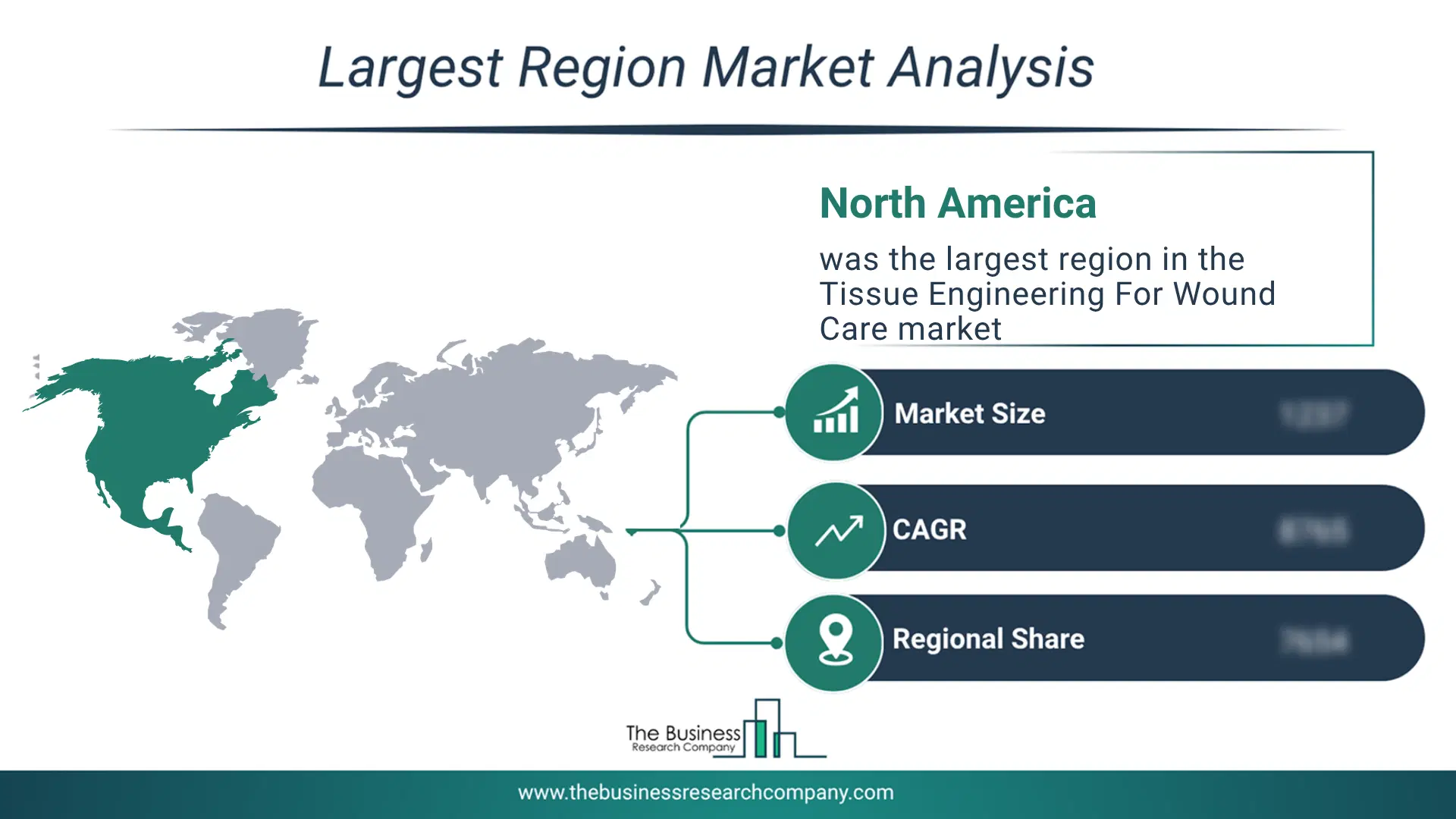
Regional Insights
North America was the largest region in the tissue engineering for wound care market in 2025. The regions covered in this market report are Asia-Pacific, South East Asia, Western Europe, Eastern Europe, North America, South America, Middle East, Africa. The countries covered in this market report are Australia, Brazil, China, France, Germany, India, Indonesia, Japan, Taiwan, Russia, South Korea, UK, USA, Canada, Italy, Spain.What Defines the Tissue Engineering For Wound Care Market?
The tissue engineering for wound care market consists of revenues earned by entities by providing services such as cell culture and expansion services, biomaterial research and development, and wound healing assessment and analysis. The market value includes the value of related goods sold by the service provider or included within the service offering. The tissue engineering for wound care market also includes sales of engineered skin substitutes, hydrogel dressings, bioactive wound dressings, and 3D bioprinted tissues. Values in this market are ‘factory gate’ values, that is the value of goods sold by the manufacturers or creators of the goods, whether to other entities (including downstream manufacturers, wholesalers, distributors and retailers) or directly to end customers. The value of goods in this market includes related services sold by the creators of the goods.How is Market Value Defined and Measured?
The market value is defined as the revenues that enterprises gain from the sale of goods and/or services within the specified market and geography through sales, grants, or donations in terms of the currency (in USD unless otherwise specified). The revenues for a specified geography are consumption values that are revenues generated by organizations in the specified geography within the market, irrespective of where they are produced. It does not include revenues from resales along the supply chain, either further along the supply chain or as part of other products.
This chart presents market attractiveness based on a quantitative evaluation of growth, competition, strategic alignment, and risk, offering a clear view of opportunity areas for decision-making. This chart is for illustrative purposes; the full report contains the complete analysis.

This chart highlights the Total Addressable Market (TAM) by estimating the maximum revenue opportunity using an assumption-driven approach, supporting strategic planning and opportunity sizing across markets. The chart is illustrative; the full report provides a more comprehensive analysis.
What Key Data and Analysis Are Included in the Tissue Engineering For Wound Care Market Report 2026?
The tissue engineering for wound care market research report is one of a series of new reports from The Business Research Company that provides market statistics, including industry global market size, regional shares, competitors with the market share, detailed market segments, market trends and opportunities, and any further data you may need to thrive in the tissue engineering for wound care industry. The market research report delivers a complete perspective of everything you need, with an in-depth analysis of the current and future state of the industry.Tissue Engineering For Wound Care Market Report Forecast Analysis
| Report Attribute | Details |
|---|---|
| Market Size Value In 2026 | $7.93 billion |
| Revenue Forecast In 2030 | $13.61 billion |
| Growth Rate | CAGR of 14.5% from 2026 to 2030 |
| Base Year For Estimation | 2025 |
| Actual Estimates/Historical Data | 2020-2025 |
| Forecast Period | 2026 - 2030 |
| Market Representation | Revenue in USD Billion and CAGR from 2026 to 2030 |
| Segments Covered | Product Material, Type Of Wound, Application, End-User |
| Regional Scope | Asia-Pacific, Western Europe, Eastern Europe, North America, South America, Middle East, Africa |
| Country Scope | The countries covered in the report are Australia, Brazil, China, France, Germany, India, Indonesia, Japan, Taiwan, Russia, South Korea, UK, USA, Canada, Italy, Spain. |
| Key Companies Profiled | Smith & Nephew plc, ConvaTec Group Plc, MTF Biologics, MiMedx Group Inc., LifeNet Health Inc., Kerecis LLC, Aroa Biosurgery Ltd., Tissue Regenix Group PLC, BioStem Technologies Inc., Organogenesis Holdings Inc., Integra LifeSciences Holdings Corporation, Osiris Therapeutics (Smith & Nephew), Stryker Corporation, Medline Industries LP, Mölnlycke Health Care AB, 3M Health Care, Cardinal Health Inc., Derma Sciences Inc., Acell Inc., Wright Medical Group N.V., Anika Therapeutics Inc., Regen Lab SA, Skye Biologics Inc., Human Regenerative Technologies LLC, StimLabs LLC |
| Customization Scope | Request for Customization |
| Pricing And Purchase Options | Explore Purchase Options |