
Tissue Fixation Devices Market Report 2026
Global Outlook – By Type (Sutures And Suture Anchors, Interference Screws, Plates And Pins, Buttons, Arrows, Darts, Other Types), By Application (Routine Histology, Immunohistochemistry, In Situ Hybridization, Electron Microscopy, Molecular Diagnostics), By End User (Hospitals, Diagnostic Laboratories, Research Institutes, Biomedical Companies, Forensic Laboratories) – Market Size, Trends, Strategies, and Forecast to 2035
Tissue Fixation Devices Market Overview
• Tissue Fixation Devices market size has reached to $16.58 billion in 2025 • Expected to grow to $21.68 billion in 2030 at a compound annual growth rate (CAGR) of 5.5% • Growth Driver: Impact Of Rising Chronic Diseases On The Tissue Fixation Devices Market • Market Trend: Advanced Bio-Integrative Fixation Materials Enhance Long-Term Healing • North America was the largest region in 2025.What Is Covered Under Tissue Fixation Devices Market?
Tissue fixation devices are medical instruments or implants used to stabilize, secure, or hold tissue in place during surgical procedures. These devices are designed to promote proper healing by maintaining the tissue in the correct position, preventing movement, and ensuring that the tissue heals as intended. They are commonly used in surgeries involving bones, muscles, tendons, and soft tissues. The main types of tissue fixation devices are sutures and suture anchors, interference screws, plates and pins, buttons, arrows, darts, and others. Sutures and suture anchors are medical devices used to secure tissues together during surgical procedures, promoting healing and stability. Tissue fixation devices are utilized in various applications, including routine histology, immunohistochemistry, in situ hybridization, electron microscopy, and molecular diagnostics. These devices serve various end users, such as hospitals, diagnostic laboratories, research institutes, biomedical companies, and forensic laboratories.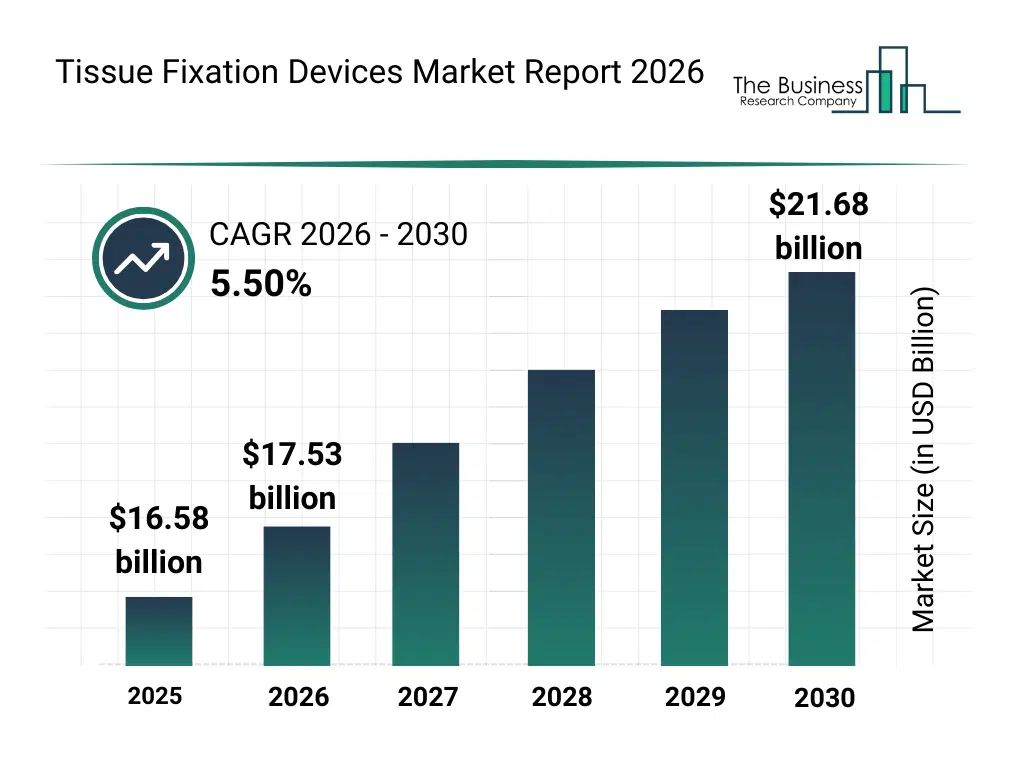
What Is The Tissue Fixation Devices Market Size and Share 2026?
The tissue fixation devices market size has grown strongly in recent years. It will grow from $16.58 billion in 2025 to $17.53 billion in 2026 at a compound annual growth rate (CAGR) of 5.8%. The growth in the historic period can be attributed to orthopedic surgery growth, trauma cases, sports injuries, implant technology advancements, hospital surgical capacity.What Is The Tissue Fixation Devices Market Growth Forecast?
The tissue fixation devices market size is expected to see strong growth in the next few years. It will grow to $21.68 billion in 2030 at a compound annual growth rate (CAGR) of 5.5%. The growth in the forecast period can be attributed to bioabsorbable adoption, minimally invasive procedures, sports medicine growth, reconstructive surgery demand, aging population. Major trends in the forecast period include rising demand for bioabsorbable fixation devices, growth in orthopedic and sports injuries, increased use in minimally invasive surgeries, innovation in fixation materials, expansion of trauma and reconstructive surgeries.
Global Tissue Fixation Devices Market Segmentation
1) By Type: Sutures And Suture Anchors, Interference Screws, Plates And Pins, Buttons, Arrows, Darts, Other Types 2) By Application: Routine Histology, Immunohistochemistry, In Situ Hybridization, Electron Microscopy, Molecular Diagnostics 3) By End User: Hospitals, Diagnostic Laboratories, Research Institutes, Biomedical Companies, Forensic Laboratories Subsegments: 1) By Sutures And Suture Anchors: Absorbable Sutures, Non-Absorbable Sutures, Metallic Suture Anchors, Bioabsorbable Suture Anchors 2) By Interference Screws: Bioabsorbable Interference Screws, Metallic Interference Screws 3) By Plates And Pins: Metallic Plates And Pins, Bioabsorbable Plates And Pins 4) By Buttons: Cortical Buttons, Toggle Buttons 5) By Arrows: Bioabsorbable Arrows, Metallic Arrows 6) By Darts: Bioabsorbable Darts, Metallic Darts 7) By Other Types: Staples, Spikes, WiresWhat Is The Driver Of The Tissue Fixation Devices Market?
The increasing prevalence of chronic diseases is expected to propel the growth of the tissue fixation devices market going forward. Chronic diseases are long-lasting health conditions that usually progress slowly over time, such as diabetes, heart disease, and arthritis, and often require ongoing medical attention and lifestyle management to control symptoms and prevent complications. Chronic diseases are increasing largely due to unhealthy lifestyles, including poor diet, physical inactivity, and smoking, which raise the risk of conditions such as diabetes, heart disease, and obesity. Tissue fixation devices aid in chronic disease management by providing reliable and durable solutions for repairing and stabilizing soft tissues and bones. They improve patient outcomes by reducing the risk of re-injury and supporting faster recovery, enhancing overall treatment effectiveness and long-term health management. For instance, in June 2024, according to the National Health Service, a UK-based government department, 3,615,330 individuals registered with a general practitioner (GP) were diagnosed with non-diabetic hyperglycemia or pre-diabetes (a condition with elevated blood sugar levels, not high enough to be classified as diabetes) in 2023, marking an 18% increase from 3,065,825 cases in 2022. Therefore, the increasing prevalence of chronic diseases is driving the growth of the tissue fixation devices industry.Key Players In The Global Tissue Fixation Devices Market
Major companies operating in the tissue fixation devices market are Medtronic plc, Stryker Corporation, Boston Scientific Corporation, B. Braun Group, Zimmer Biomet Holdings Inc., Smith & Nephew plc, Ethicon Inc., Cook Medical Incorporated, Arthrex Inc., Integra LifeSciences Holdings Corporation, In2Bones Global Inc., Conmed Corporation, Wright Medical Group N.V., Orthofix Medical Inc., LimaCorporate S.p.A., Exactech Inc., RTI Surgical Holdings Inc., Medartis AG, Aap Implantate AG, Promedics Orthopaedic Ltd.Global Tissue Fixation Devices Market Trends and Insights
Major companies operating in the tissue fixation devices market are focusing on developing advanced solutions such as bio-integrative fixation materials to improve long-term healing and reduce implant-related complications. Bio-integrative fixation materials are designed to gradually integrate with bone and tissue, supporting natural regeneration while avoiding the permanence and possible adverse reactions of metal implants. For instance, in June 2025, OSSIO, a US–based orthopedic device company, launched the OSSIOFiber 2.5 mm Suture Anchor featuring a novel, metal-free mineral fiber matrix. This anchor provides enhanced fixation strength with 55% greater pull-out resistance compared to market-leading bio-composite anchors, supports familiar surgical workflows using standard instrumentation, and integrates into bone over time without leaving a lasting footprint. It uses a slotted drill guide and drilled insertion path that surgeons already know, offering both unloaded and pre-loaded configurations to meet individual procedural preferences. The fully bio-integrative design is intended to support applications across extremities including foot, ankle, knee, shoulder, hand, wrist and elbow, combining strong mechanical performance with a biocompatible, resorbable profile.What Are Latest Mergers And Acquisitions In The Tissue Fixation Devices Market?
In July 2024, Stryker Corporation, a US-based medical technology company, acquired Artelon Inc. for an undisclosed amount. The acquisition aims to integrate innovative soft tissue fixation technologies into its offerings, thereby enhancing Stryker's competitive edge and expanding its product range in the foot, ankle, and sports medicine segments. Artelon Inc. is a US-based manufacturer of soft tissue fixation products for foot and ankle and sports medicine procedures.Regional Outlook
North America was the largest region in the tissue fixation devices market in 2025. The regions covered in this market report are Asia-Pacific, South East Asia, Western Europe, Eastern Europe, North America, South America, Middle East, Africa. The countries covered in this market report are Australia, Brazil, China, France, Germany, India, Indonesia, Japan, Taiwan, Russia, South Korea, UK, USA, Canada, Italy, SpainWhat Defines the Tissue Fixation Devices Market?
The tissue fixation devices market consists of sales of bone grafts and substitutes, endoscopic clips, tissue adhesives, and staples. Values in this market are ‘factory gate’ values, that is the value of goods sold by the manufacturers or creators of the goods, whether to other entities (including downstream manufacturers, wholesalers, distributors and retailers) or directly to end customers. The value of goods in this market includes related services sold by the creators of the goods.How is Market Value Defined and Measured?
The market value is defined as the revenues that enterprises gain from the sale of goods and/or services within the specified market and geography through sales, grants, or donations in terms of the currency (in USD unless otherwise specified). The revenues for a specified geography are consumption values that are revenues generated by organizations in the specified geography within the market, irrespective of where they are produced. It does not include revenues from resales along the supply chain, either further along the supply chain or as part of other products.Tissue Fixation Devices Market Report Forecast Analysis
| Report Attribute | Details |
|---|---|
| Market Size Value In 2026 | $17.53 billion |
| Revenue Forecast In 2035 | $21.68 billion |
| Growth Rate | CAGR of 5.8% from 2026 to 2035 |
| Base Year For Estimation | 2025 |
| Actual Estimates/Historical Data | 2020-2025 |
| Forecast Period | 2026 - 2030 - 2035 |
| Market Representation | Revenue in USD Billion and CAGR from 2026 to 2035 |
| Segments Covered | Type, Application, End User |
| Regional Scope | Asia-Pacific, Western Europe, Eastern Europe, North America, South America, Middle East, Africa |
| Country Scope | The countries covered in the report are Australia, Brazil, China, France, Germany, India, ... |
| Key Companies Profiled | Medtronic plc, Stryker Corporation, Boston Scientific Corporation, B. Braun Group, Zimmer Biomet Holdings Inc., Smith & Nephew plc, Ethicon Inc., Cook Medical Incorporated, Arthrex Inc., Integra LifeSciences Holdings Corporation, In2Bones Global Inc., Conmed Corporation, Wright Medical Group N.V., Orthofix Medical Inc., LimaCorporate S.p.A., Exactech Inc., RTI Surgical Holdings Inc., Medartis AG, Aap Implantate AG, Promedics Orthopaedic Ltd. |
| Customization Scope | Request for Customization |
| Pricing And Purchase Options | Explore Purchase Options |