

Token-Aware Load Balancing for Large Language Models (LLMs) Market Report 2026
Global Outlook – By Component (Software, Hardware, Services), By Deployment Mode (On-Premises, Cloud), By Application (Model Training, Inference, Data Processing, Real-Time Analytics, Other Applications), By End-User (Banking, Financial Services, And Insurance (BFSI), Healthcare, Information Technology (IT) And Telecommunications, Retail And E-commerce, Media And Entertainment, Manufacturing, Other End-Users) – Market Size, Trends, Strategies, and Forecast to 2030
Token-Aware Load Balancing for Large Language Models (LLMs) Market Overview
• Token-Aware Load Balancing for Large Language Models (LLMs) market size has reached to $1.67 billion in 2025 • Expected to grow to $4.85 billion in 2030 at a compound annual growth rate (CAGR) of 23.9% • Growth Driver: Expansion Of Cloud Deployment Models Fueling The Growth Of The Market Due To Rising Enterprise-Scale AI Adoption And The Need For Efficient Token And Resource Optimization • Market Trend: Integration Of Token-Aware Scheduling Into Large Language Model Inference Engines Shaping Token-Aware Load Balancing For Large Language Models (LLMs) • North America was the largest region in 2025 and Asia-Pacific is the fastest growing region.What Is Covered Under Token-Aware Load Balancing for Large Language Models (LLMs) Market?
The token-aware load balancing for large language models (LLMs) refers to a specialized technique for distributing inference requests across multiple large language models (LLMs) serving instances by taking into account the number of tokens in each request, rather than treating all requests as equal. large language models (LLMs) workloads vary greatly in cost and latency depending on input length and output generation size longer prompts or expected responses consume more compute resources so a token-aware balancer routes requests to ensure optimal utilization, reduced latency and balanced compute load across. The main components of token-aware load balancing for large language models include software, hardware, and services. Software refers to platforms that distribute computational workloads across servers efficiently by being aware of token-level processing requirements, optimizing performance and reducing latency for large language model operations. These solutions are deployed through on-premises and cloud models depending on organizational infrastructure and scalability needs. The various applications involved are model training, inference, data processing, real-time analytics, and other applications. The end users of token-aware load balancing solutions for large language models include banking, financial services, and insurance companies, healthcare providers, information technology and telecommunications companies, retail and e-commerce organizations, media and entertainment companies, manufacturing enterprises, and others.
What Is The Token-Aware Load Balancing for Large Language Models (LLMs) Market Size and Share 2026?
The token-aware load balancing for large language models (llms) market size has grown exponentially in recent years. It will grow from $1.67 billion in 2025 to $2.06 billion in 2026 at a compound annual growth rate (CAGR) of 23.6%. The growth in the historic period can be attributed to growth in llm deployment, rise in AI inference workloads, expansion of cloud AI platforms, demand for low latency AI responses, increase in multi model serving.What Is The Token-Aware Load Balancing for Large Language Models (LLMs) Market Growth Forecast?
The token-aware load balancing for large language models (llms) market size is expected to see exponential growth in the next few years. It will grow to $4.85 billion in 2030 at a compound annual growth rate (CAGR) of 23.9%. The growth in the forecast period can be attributed to expansion of enterprise llm use, growth in real time AI apps, rising need for cost optimized inference, increase in distributed AI serving, adoption of multi cluster AI routing. Major trends in the forecast period include token based request routing engines, llm inference traffic shaping, dynamic token cost scheduling, autoscaling for llm workloads, real time token usage analytics.
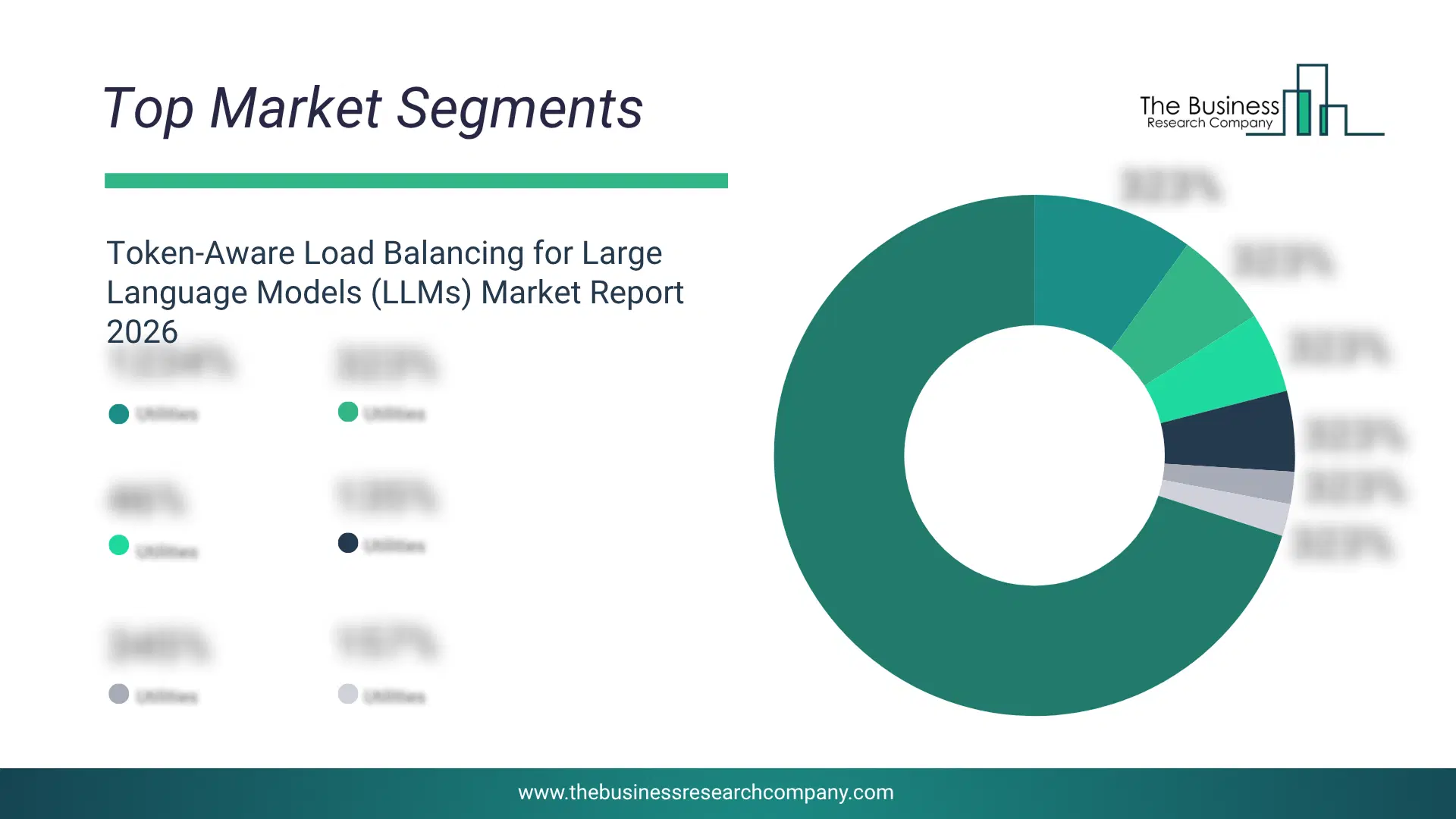
Global Token-Aware Load Balancing for Large Language Models (LLMs) Market Segmentation
1) By Component: Software; Hardware; Services 2) By Deployment Mode: On-Premises; Cloud 3) By Application: Model Training; Inference; Data Processing; Real-Time Analytics; Other Applications 4) By End-User: Banking, Financial Services, And Insurance (BFSI); Healthcare; Information Technology (IT) And Telecommunications; Retail And E-commerce; Media And Entertainment; Manufacturing; Other End-Users Subsegments: 1) By Software: Load Balancing Software; Traffic Management Software; Performance Monitoring Software; Token Routing Software; Analytics And Reporting Software 2) By Hardware: High Performance Servers; Network Switches; Storage Systems; Accelerator Cards; Edge Computing Devices 3) By Services: Consulting Services; Implementation And Integration Services; Monitoring And Optimization Services; Maintenance And Support Services; Training And Advisory ServicesWhat Is The Driver Of The Token-Aware Load Balancing for Large Language Models (LLMs) Market?
The rising adoption of cloud deployment is expected to propel the growth of the token-aware load balancing for large language models (LLMs) market going forward. Cloud deployment refer to the use of cloud infrastructure and platforms to host, manage, and scale artificial intelligence workloads, allowing enterprises to access elastic computing resources, integrate AI services efficiently, and reduce upfront infrastructure costs. The expansion of cloud deployment models is driven by the growing enterprise demand for AI, as organizations move beyond early experimentation toward large-scale, production-level deployments that require optimized Tokenization and resource management for large language models. Token-aware load balancing in cloud-deployed LLMs optimizes resource utilization by distributing requests based on token length and computational demand, reducing latency and preventing system overload. It ensures efficient scaling and consistent performance by dynamically aligning workloads with available processing capacity. For instance, in June 2024, according to AAG, public cloud platform-as-a-service (PaaS) revenue reached $111 billion, and the cloud market is projected to grow to $376.36 billion by 2029, with an estimated 200 zettabytes (2 billion terabytes) expected to be stored in the cloud by 2025. Therefore, the rising adoption of cloud deployment is driving the growth of the token-aware load balancing for large language models (LLMs) industry.Key Players In The Global Token-Aware Load Balancing for Large Language Models (LLMs) Market
Major companies operating in the token-aware load balancing for large language models (llms) market are International Business Machines Corporation, NVIDIA Corporation, SAP SE, AkamAI Technologies Inc., Snowflake Inc., Databricks Inc., Datadog Inc., Dynatrace LLC, Cloudflare Inc., Elastic N.V., Fastly Inc., Kong Inc., Redis Ltd., Vercel Inc., Cohere Inc., Together AI Inc., Mistral AI SAS, Solo.io Inc., Fireworks AI Inc., HAProxy Technologies LLC, Fly.io Inc., and Envoy Proxy.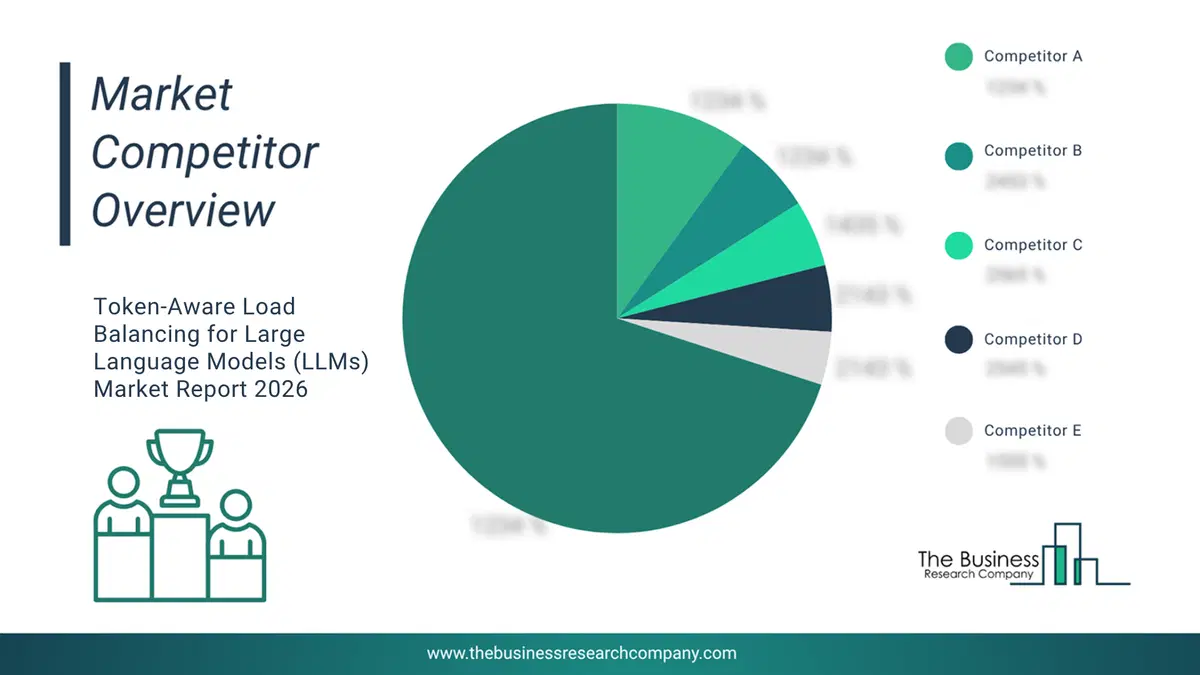
This chart is for illustrative purposes; the full report includes a detailed competitor analysis and comprehensive overview of the top 10 companies in the market.
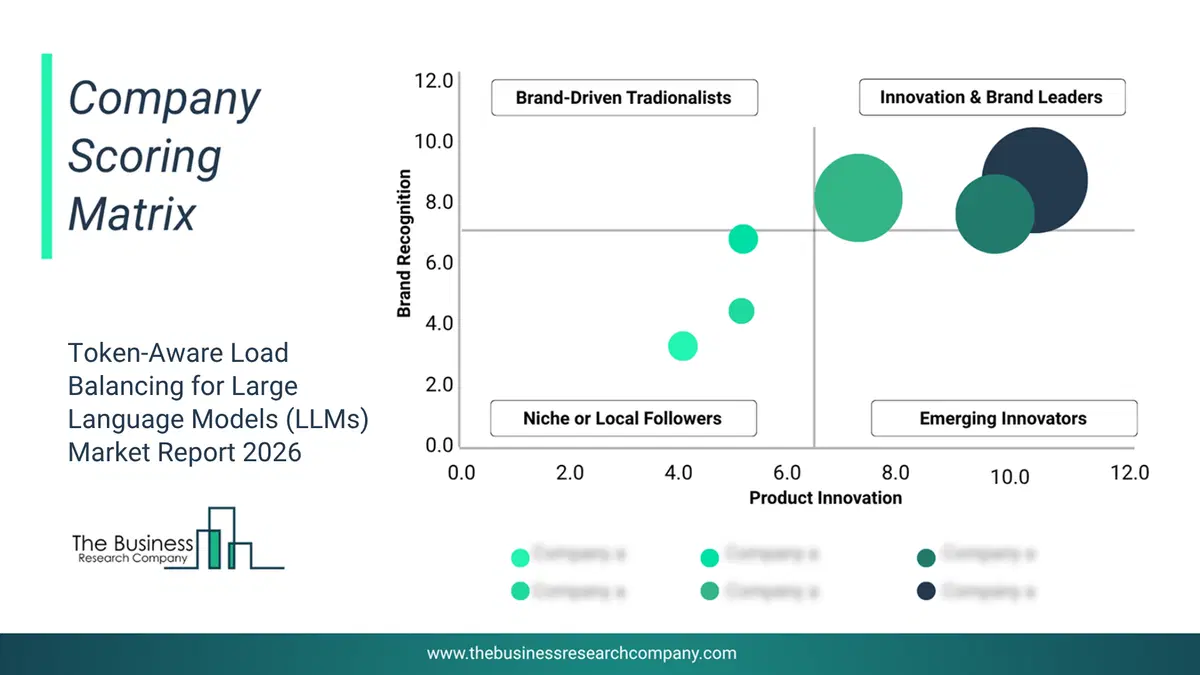
This chart maps companies by product innovation and brand strength, with bubble size indicating relative revenue, helping identify market leaders, challengers, and niche players. This is an illustrative chart; the full report provides a complete and accurate competitive analysis.
Global Token-Aware Load Balancing for Large Language Models (LLMs) Market Trends and Insights
Major companies operating in the token-aware load balancing for large language models (LLMs) market are focusing on integrating token-aware scheduling into large language model inference engines, such as zero overhead batch schedulers, which enable overlapping central processing unit (CPU)-side request scheduling with graphics processing unit (GPU) computation. A zero-overhead batch scheduler refers to a scheduling mechanism that manages inference batches in parallel with ongoing GPU computations, ensuring that the GPU is always fully utilized and never idle due to CPU-side batching delays. For instance, in December 2024, the Laboratory for Machine Systems (LMSYS), a US-based research organization specializing in large language model inference systems, introduced a cache-aware load balancer. A cache-aware load balancer provides intelligent request routing by directing LLM inference requests to workers with the highest likelihood of prefix key-value (KV) cache reuse, thereby reducing redundant token computation. It improves throughput and lowers response latency by maximizing cache hit rates during real-time inference. By avoiding naive round-robin routing, it ensures better utilization of computational resources across distributed workers. This approach scales efficiently across multi-node environments while maintaining token locality.What Are Latest Mergers And Acquisitions In The Token-Aware Load Balancing for Large Language Models (LLMs) Market?
In October 2025, F5, Inc., a US-based technology company specializing in application delivery networking and cloud services, partnered with NVIDIA Corporation to integrate F5’s BIG-IP platform into NVIDIA’s Cloud Partner (NCP) reference architecture for large-scale artificial intelligence inference. Through this partnership, F5 and NVIDIA aim to strengthen AI infrastructure and software capabilities by combining F5’s expertise in LLM-aware routing, token-metrics-aware traffic management, and secure application delivery to optimize GPU utilization and reduce latency for large-scale AI workloads. NVIDIA Corporation is a US-based technology company specializing in graphics processing units (GPUs) and artificial intelligence infrastructure.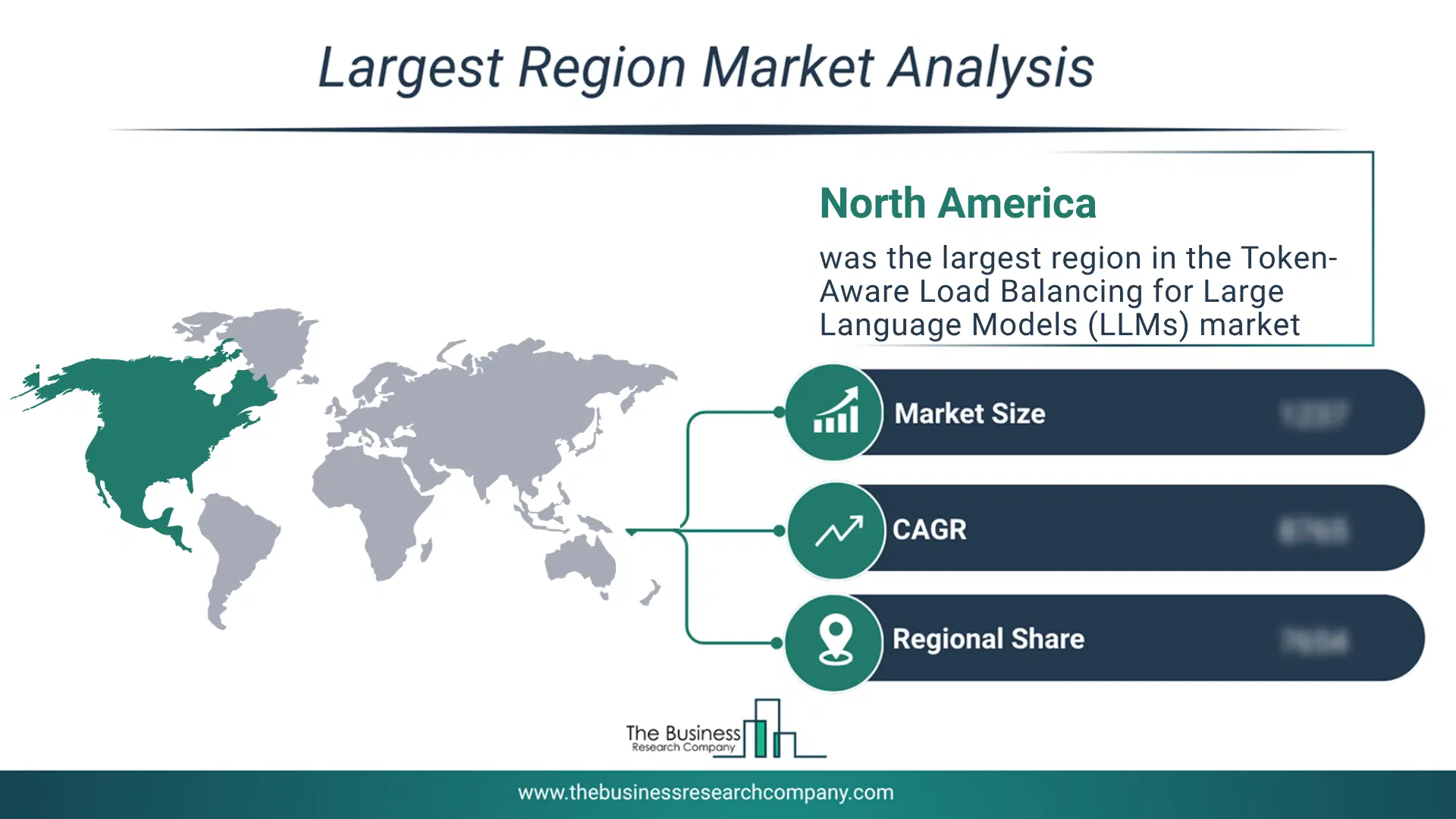
Regional Insights
North America was the largest region in the token-aware load balancing for large language models (LLMs) market in 2025. Asia-Pacific is expected to be the fastest-growing region in the forecast period. The regions covered in this market report are Asia-Pacific, South East Asia, Western Europe, Eastern Europe, North America, South America, Middle East, Africa. The countries covered in this market report are Australia, Brazil, China, France, Germany, India, Indonesia, Japan, Taiwan, Russia, South Korea, UK, USA, Canada, Italy, Spain.What Defines the Token-Aware Load Balancing for Large Language Models (LLMs) Market?
The token-aware load balancing for large language models (LLMs) market consists of revenues earned by entities by providing services such as token usage monitoring, autoscaling management and reliability and failover management and usage analytics. The market value includes the value of related goods sold by the service provider or included within the service offering. Only goods and services traded between entities or sold to end consumers are included.How is Market Value Defined and Measured?
The market value is defined as the revenues that enterprises gain from the sale of goods and/or services within the specified market and geography through sales, grants, or donations in terms of the currency (in USD unless otherwise specified). The revenues for a specified geography are consumption values that are revenues generated by organizations in the specified geography within the market, irrespective of where they are produced. It does not include revenues from resales along the supply chain, either further along the supply chain or as part of other products.
This chart presents market attractiveness based on a quantitative evaluation of growth, competition, strategic alignment, and risk, offering a clear view of opportunity areas for decision-making. This chart is for illustrative purposes; the full report contains the complete analysis.

This chart highlights the Total Addressable Market (TAM) by estimating the maximum revenue opportunity using an assumption-driven approach, supporting strategic planning and opportunity sizing across markets. The chart is illustrative; the full report provides a more comprehensive analysis.
What Key Data and Analysis Are Included in the Token-Aware Load Balancing for Large Language Models (LLMs) Market Report 2026?
The token-aware load balancing for large language models (llms) market research report is one of a series of new reports from The Business Research Company that provides market statistics, including industry global market size, regional shares, competitors with the market share, detailed market segments, market trends and opportunities, and any further data you may need to thrive in the token-aware load balancing for large language models (llms) industry. The market research report delivers a complete perspective of everything you need, with an in-depth analysis of the current and future state of the industry.Token-Aware Load Balancing for Large Language Models (LLMs) Market Report Forecast Analysis
| Report Attribute | Details |
|---|---|
| Market Size Value In 2026 | $2.06 billion |
| Revenue Forecast In 2030 | $4.85 billion |
| Growth Rate | CAGR of 23.9% from 2026 to 2030 |
| Base Year For Estimation | 2025 |
| Actual Estimates/Historical Data | 2020-2025 |
| Forecast Period | 2026 - 2030 |
| Market Representation | Revenue in USD Billion and CAGR from 2026 to 2030 |
| Segments Covered | Component, Deployment Mode, Application, End-User |
| Regional Scope | Asia-Pacific, Western Europe, Eastern Europe, North America, South America, Middle East, Africa |
| Country Scope | The Countries Covered In This Market Report Are Australia, Brazil, China, France, Germany, India, Indonesia, Japan, Taiwan, Russia, South Korea, Uk, Usa, Canada, Italy, Spain. |
| Key Companies Profiled | International Business Machines Corporation, NVIDIA Corporation, SAP SE, AkamAI Technologies Inc., Snowflake Inc., Databricks Inc., Datadog Inc., Dynatrace LLC, Cloudflare Inc., Elastic N.V., Fastly Inc., Kong Inc., Redis Ltd., Vercel Inc., Cohere Inc., Together AI Inc., Mistral AI SAS, Solo.io Inc., Fireworks AI Inc., HAProxy Technologies LLC, Fly.io Inc., and Envoy Proxy. |
| Customization Scope | Request for Customization |
| Pricing And Purchase Options | Explore Purchase Options |