
Tokenization Optimization for LLMs Market Report 2026
Global Outlook – By Solution Type (Software Tools, Hardware Accelerators, Services), By Deployment Mode (On-Premises, Cloud), By Application (Natural Language Processing, Text Analytics, Speech Recognition, Machine Translation, Other Applications), By End-User (Banking, Financial Services, And Insurance (BFSI), Healthcare, Information Technology (IT) And Telecommunications, Retail And E-Commerce, Media And Entertainment, Other End-Users) – Market Size, Trends, Strategies, and Forecast to 2030
Tokenization Optimization for LLMs Market Overview
• Tokenization Optimization for LLMs market size has reached to $1.59 billion in 2025 • Expected to grow to $4.72 billion in 2030 at a compound annual growth rate (CAGR) of 24.4% • Growth Driver: Expansion Of Cloud-Based AI Deployment Models Fueling The Growth Of The Market Due To Rising Enterprise-Scale AI Adoption And The Need For Efficient Token And Resource Optimization • Market Trend: Technological Advancements Enhancing Inference Speed, Reducing Latency, And Improving Model Efficiency • North America was the largest region in 2025 and Asia-Pacific is the fastest growing region.What Is Covered Under Tokenization Optimization for LLMs Market?
Tokenization optimization for large language models (LLMs) refers to techniques and methods used to improve how text is broken into tokens so that large language models can process information more efficiently and accurately. It focuses on reducing token count, improving representation of words and symbols, and enhancing model performance while lowering computational costs. This optimization helps language models handle complex inputs better and deliver faster, more reliable outputs. The main solution types of tokenization optimization for large language models include software tools, hardware accelerators, and services. Software tools refer to platforms that enhance the efficiency and accuracy of tokenization processes in large language models. These solutions are deployed through on-premises and cloud models depending on organizational infrastructure and scalability requirements. The various applications involved are natural language processing, text analytics, speech recognition, machine translation, and other applications and they are used by several end users such as banking, financial services, and insurance companies, healthcare providers, information technology and telecommunications companies, retail and e-commerce organizations, media and entertainment companies, and others.
What Is The Tokenization Optimization for LLMs Market Size and Share 2026?
The tokenization optimization for llms market size has grown exponentially in recent years. It will grow from $1.59 billion in 2025 to $1.97 billion in 2026 at a compound annual growth rate (CAGR) of 24.1%. The growth in the historic period can be attributed to growth in llm training, rise in nlp applications, expansion of large text datasets, need for faster model processing, increase in AI model costs.What Is The Tokenization Optimization for LLMs Market Growth Forecast?
The tokenization optimization for llms market size is expected to see exponential growth in the next few years. It will grow to $4.72 billion in 2030 at a compound annual growth rate (CAGR) of 24.4%. The growth in the forecast period can be attributed to demand for cost efficient llm inference, growth in domain specific llms, expansion of multilingual AI systems, rising focus on compute efficiency, adoption of tokenizer optimization tools. Major trends in the forecast period include custom domain specific tokenizers, token compression techniques, multilingual token vocabulary tuning, adaptive tokenization algorithms, low token count encoding methods.
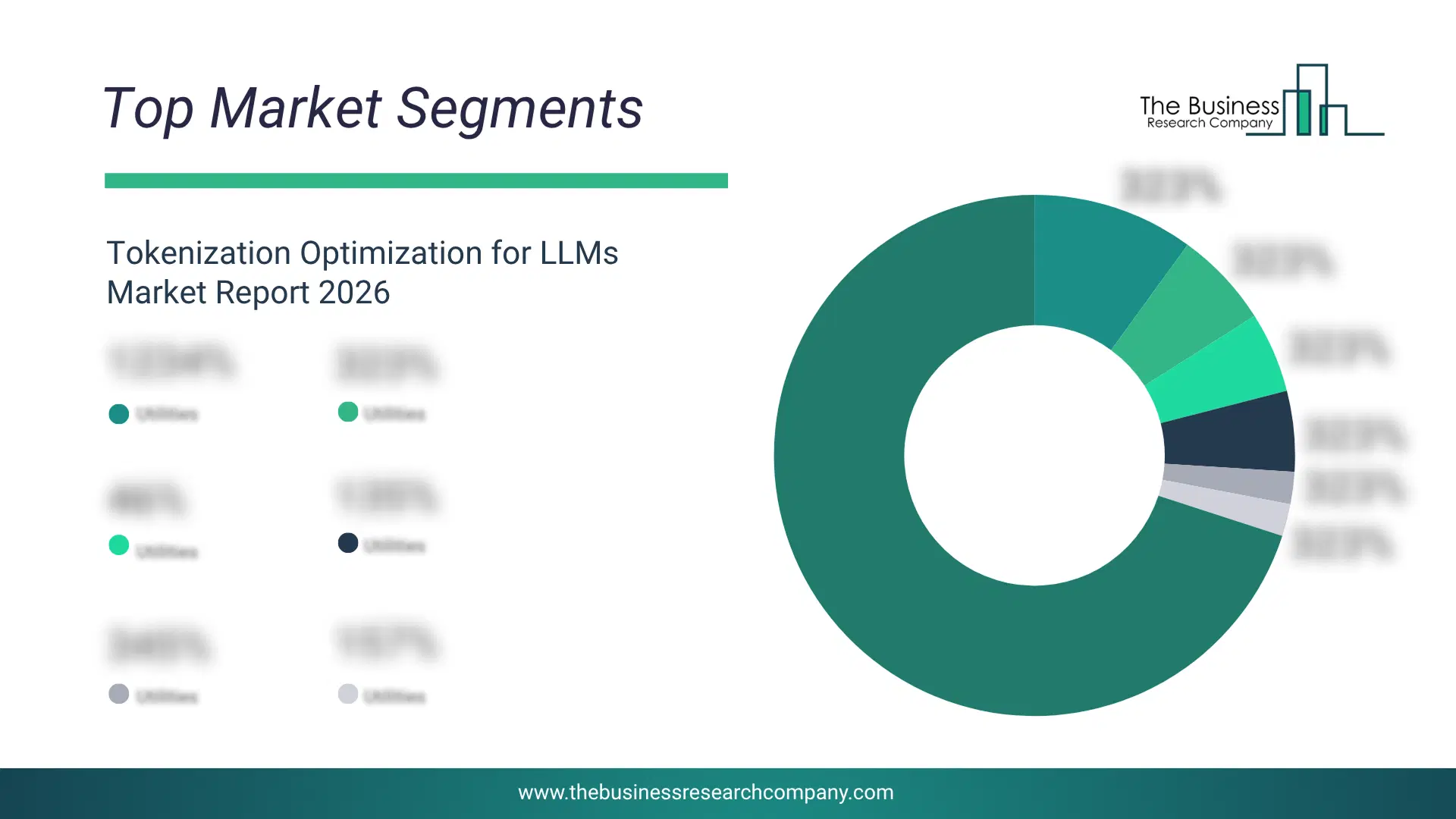
Global Tokenization Optimization for LLMs Market Segmentation
1) By Solution Type: Software Tools; Hardware Accelerators; Services 2) By Deployment Mode: On-Premises; Cloud 3) By Application: Natural Language Processing; Text Analytics; Speech Recognition; Machine Translation; Other Applications 4) By End-User: Banking, Financial Services, And Insurance (BFSI); Healthcare; Information Technology (IT) And Telecommunications; Retail And E-Commerce; Media And Entertainment; Other End-Users Subsegments: 1) By Software Tools: Tokenization Algorithm Optimization; Vocabulary Management Software; Text Preprocessing And Normalization Tools; Token Compression Software; Language Specific Tokenization Tools 2) By Hardware Accelerators: Artificial Intelligence Processing Chips; High Performance Computing Processors; Edge Computing Acceleration Devices; Memory Optimized Processing Units 3) By Services: Consulting And Strategy Services; Custom Tokenization Development Services; System Integration Services; Performance Optimization And Tuning Services; Support And Maintenance ServicesWhat Is The Driver Of The Tokenization Optimization for LLMs Market?
The expansion of cloud-based AI deployment models is expected to propel the growth of the tokenization optimization for LLM market going forward. Cloud-based AI deployment models refer to the use of cloud infrastructure and platforms to host, manage, and scale artificial intelligence workloads, allowing enterprises to access elastic computing resources, integrate AI services efficiently, and reduce upfront infrastructure costs. The expansion of cloud-based AI deployment models is driven by the growing enterprise demand for AI, as organizations move beyond early experimentation toward large-scale, production-level deployments that require optimized tokenization and resource management for large language models. Tokenization optimization for LLM supports cloud-based AI deployment by reducing input sequence length and improving token efficiency, which lowers compute usage, memory consumption, and inference latency across shared cloud infrastructure. For instance, in June 2024, according to AAG, public cloud platform-as-a-service (PaaS) revenue reached $111 billion, and the cloud market is projected to grow to $376.36 billion by 2029, with an estimated 200 zettabytes (2 billion terabytes) expected to be stored in the cloud by 2025. Therefore, the expansion of cloud-based AI deployment models is driving the growth of the tokenization optimization for LLM industry.Key Players In The Global Tokenization Optimization for LLMs Market
Major companies operating in the tokenization optimization for llms market are Amazon Web Services Inc., Google LLC, Microsoft Corporation, Meta Platforms Inc., Intel Corporation, Qualcomm Incorporated, Galileo Technologies Inc., Cohere Inc., SambaNova Systems Inc., Cerebras Systems Inc., Together AI Inc., AI21 Labs Ltd., Hugging Face Inc., Predibase Inc., Weaviate B.V., PromptLayer Inc., Baseten Inc., Mistral AI SAS, Stability AI Ltd., Modular AI Inc., Fireworks AI Inc., Deci AI Ltd., Aleph Alpha GmbH, and OpenAI L.L.C.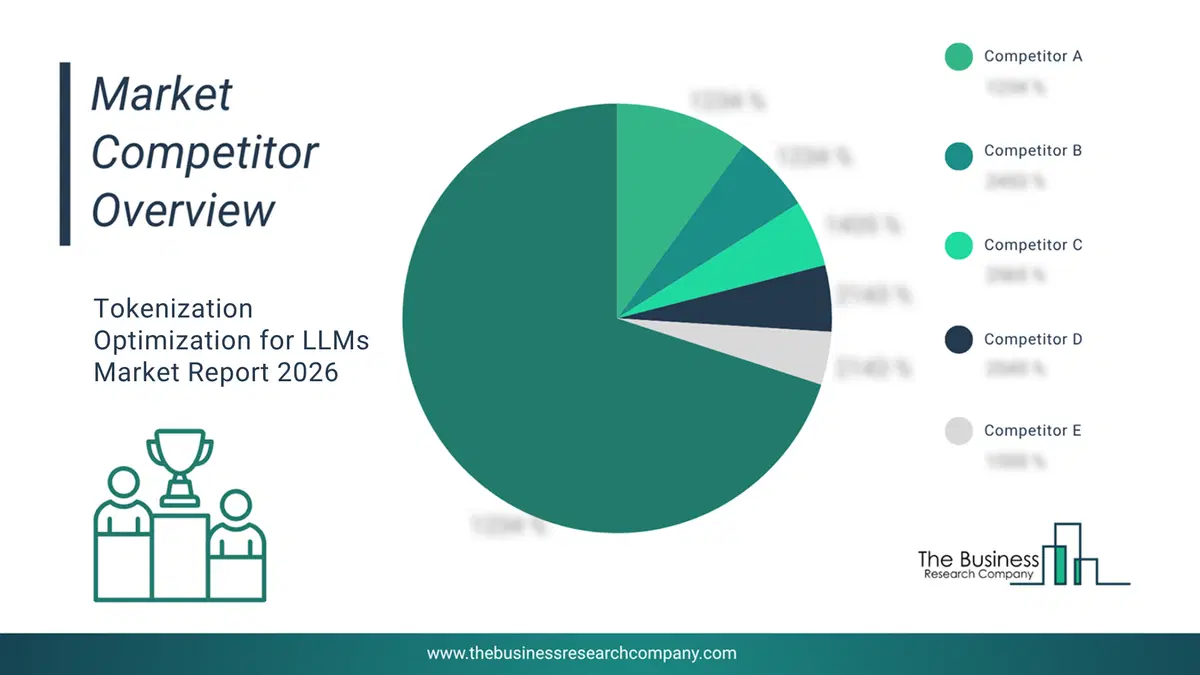
This chart is for illustrative purposes; the full report includes a detailed competitor analysis and comprehensive overview of the top 10 companies in the market.
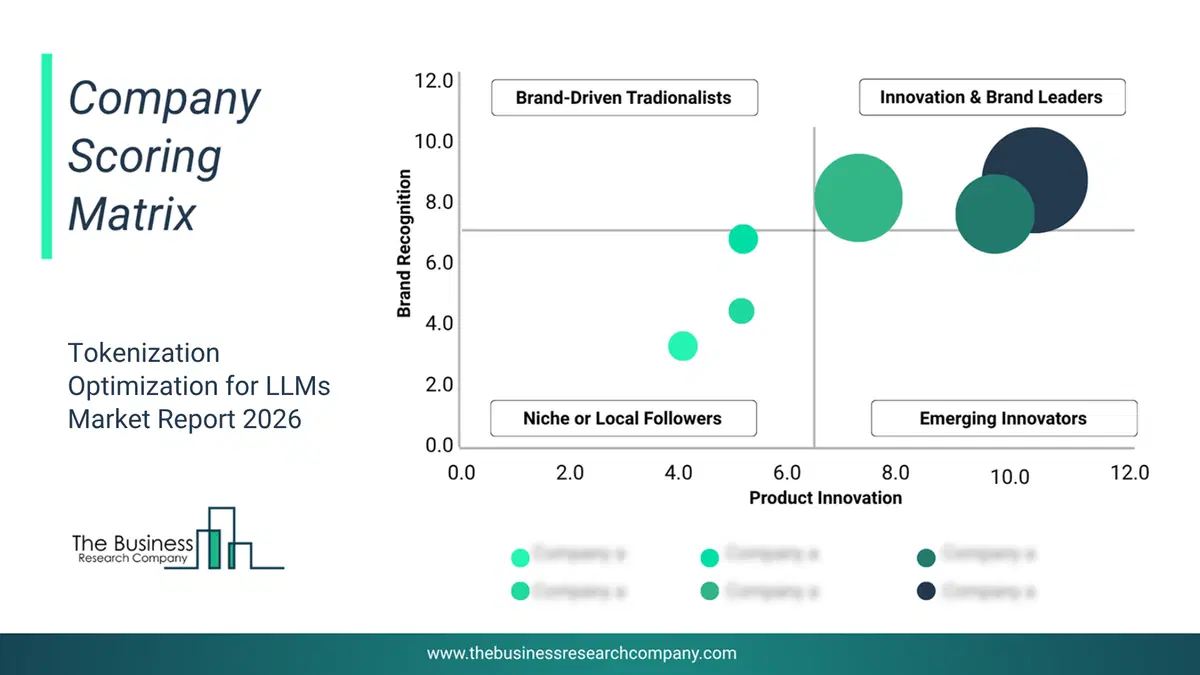
This chart maps companies by product innovation and brand strength, with bubble size indicating relative revenue, helping identify market leaders, challengers, and niche players. This is an illustrative chart; the full report provides a complete and accurate competitive analysis.
Global Tokenization Optimization for LLMs Market Trends and Insights
Major companies operating in the tokenization optimization for large language models (LLMs) market are focusing on technological advancements to improve inference speed, reduce latency, and enhance overall model efficiency during deployment. Tokenization optimization refers to the process of improving how text is segmented into tokens so that LLMs can process inputs faster and more accurately, which is critical for real-time and large-scale AI applications. For instance, in March 2025, Hugging Face, Inc., a US-based open-source machine learning and data science platform, introduced FlashTokenizer to enhance tokenization speed and efficiency for large language model training and inference. FlashTokenizer delivers ultra-low latency tokenization by leveraging highly optimized C++ and GPU-accelerated kernels, significantly reducing preprocessing overhead during LLM inference. It is designed for seamless integration with modern LLM pipelines, enabling higher throughput, lower memory usage, and faster end-to-end response times at scale.What Are Latest Mergers And Acquisitions In The Tokenization Optimization for LLMs Market?
In January 2025, Aleph Alpha GmbH, a Germany-based AI technology solutions provider, partnered with AMD and Schwarz Digits KG to enhance high-performance computing and sovereign cloud capabilities for next-generation AI solutions. Following this collaboration, Aleph Alpha launched a pioneering tokenizer-free (T-Free) LLM architecture designed to improve efficiency and effectiveness for fine-tuning and customizing AI across diverse languages, alphabets, and specialized industries. This innovation addresses the limitations of conventional tokenized LLMs and unlocks new possibilities for sovereign AI solutions for governments and enterprises. AMD is a US-based semiconductor and high-performance computing company, and Schwarz Digits KG is a cloud solutions provider supporting secure and scalable AI deployments.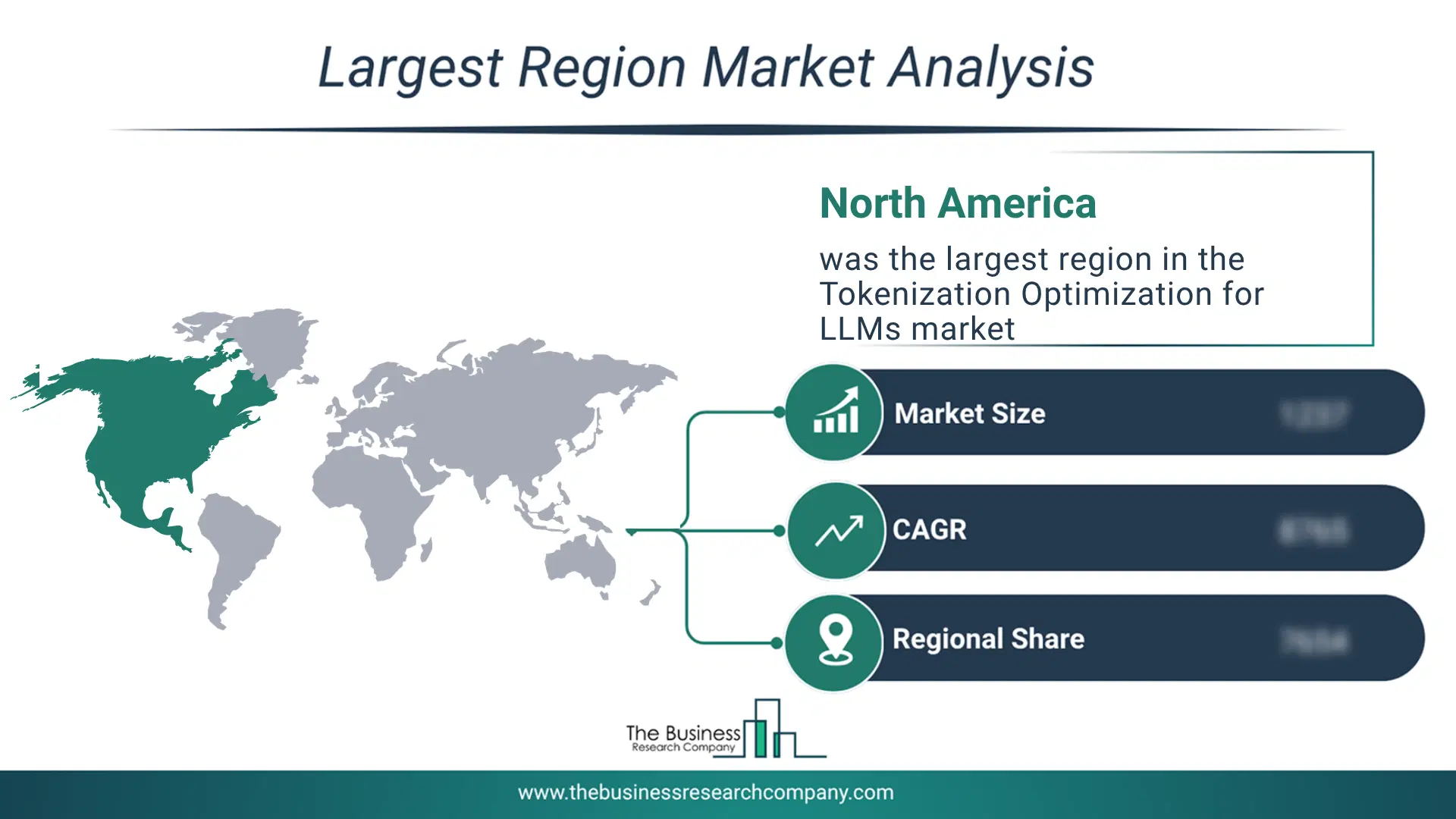
Regional Insights
North America was the largest region in the tokenization optimization for LLMs market in 2025. Asia-Pacific is expected to be the fastest-growing region in the forecast period. The regions covered in this market report are Asia-Pacific, South East Asia, Western Europe, Eastern Europe, North America, South America, Middle East, Africa. The countries covered in this market report are Australia, Brazil, China, France, Germany, India, Indonesia, Japan, Taiwan, Russia, South Korea, UK, USA, Canada, Italy, Spain.What Defines the Tokenization Optimization for LLMs Market?
The tokenization optimization for large language models (LLMs) market consists of revenues earned by entities by providing services such as custom tokenizer design, vocabulary optimization, token efficiency analysis, multilingual and domain-specific tokenization tuning, and consulting for performance and cost optimization. The market value includes the value of related goods sold by the service provider or included within the service offering. The tokenization optimization for large language models (LLMs) market also includes sales of pre-built and domain-specific token vocabularies, tokenization libraries and frameworks, software development kits, and performance optimization tools. Values in this market are ‘factory gate’ values, that is the value of goods sold by the manufacturers or creators of the goods, whether to other entities (including downstream manufacturers, wholesalers, distributors and retailers) or directly to end customers. The value of goods in this market includes related services sold by the creators of the goods.How is Market Value Defined and Measured?
The market value is defined as the revenues that enterprises gain from the sale of goods and/or services within the specified market and geography through sales, grants, or donations in terms of the currency (in USD unless otherwise specified). The revenues for a specified geography are consumption values that are revenues generated by organizations in the specified geography within the market, irrespective of where they are produced. It does not include revenues from resales along the supply chain, either further along the supply chain or as part of other products.
This chart presents market attractiveness based on a quantitative evaluation of growth, competition, strategic alignment, and risk, offering a clear view of opportunity areas for decision-making. This chart is for illustrative purposes; the full report contains the complete analysis.

This chart highlights the Total Addressable Market (TAM) by estimating the maximum revenue opportunity using an assumption-driven approach, supporting strategic planning and opportunity sizing across markets. The chart is illustrative; the full report provides a more comprehensive analysis.
What Key Data and Analysis Are Included in the Tokenization Optimization for LLMs Market Report 2026?
The tokenization optimization for llms market research report is one of a series of new reports from The Business Research Company that provides market statistics, including industry global market size, regional shares, competitors with the market share, detailed market segments, market trends and opportunities, and any further data you may need to thrive in the tokenization optimization for llms industry. The market research report delivers a complete perspective of everything you need, with an in-depth analysis of the current and future state of the industry.Tokenization Optimization for LLMs Market Report Forecast Analysis
| Report Attribute | Details |
|---|---|
| Market Size Value In 2026 | $1.97 billion |
| Revenue Forecast In 2030 | $4.72 billion |
| Growth Rate | CAGR of 24.4% from 2026 to 2030 |
| Base Year For Estimation | 2025 |
| Actual Estimates/Historical Data | 2020-2025 |
| Forecast Period | 2026 - 2030 |
| Market Representation | Revenue in USD Billion and CAGR from 2026 to 2030 |
| Segments Covered | Solution Type, Deployment Mode, Application, End-User |
| Regional Scope | Asia-Pacific, Western Europe, Eastern Europe, North America, South America, Middle East, Africa |
| Country Scope | The Countries Covered In This Market Report Are Australia, Brazil, China, France, Germany, India, Indonesia, Japan, Taiwan, Russia, South Korea, Uk, Usa, Canada, Italy, Spain. |
| Key Companies Profiled | Amazon Web Services Inc., Google LLC, Microsoft Corporation, Meta Platforms Inc., Intel Corporation, Qualcomm Incorporated, Galileo Technologies Inc., Cohere Inc., SambaNova Systems Inc., Cerebras Systems Inc., Together AI Inc., AI21 Labs Ltd., Hugging Face Inc., Predibase Inc., Weaviate B.V., PromptLayer Inc., Baseten Inc., Mistral AI SAS, Stability AI Ltd., Modular AI Inc., Fireworks AI Inc., Deci AI Ltd., Aleph Alpha GmbH, and OpenAI L.L.C. |
| Customization Scope | Request for Customization |
| Pricing And Purchase Options | Explore Purchase Options |