
Traction Battery Market 2025
By Product Type (Lead-Acid Based, Li-Ion Based, Nickel Based, Other Types), By Capacity (Less Than 100 Ah, 100 – 200 Ah, 200 – 300 Ah, 300 – 400 Ah, 400 Ah And above), By Application (Electrical Vehicle (EV), Hybrid Electric Vehicles (HEV), Industrial, Forklift, Mechanical Handling Equipment, Other Applications), And By Region, Opportunities And Strategies – Global Forecast To 2035
Traction Battery Market Definition
A traction battery is a rechargeable energy storage system specifically designed to supply power to electric motors in vehicles such as electric cars, forklifts, trams, trains, and industrial machinery. The primary purpose of a traction battery is to provide reliable, sustained power for vehicle propulsion while enabling efficient energy storage and regeneration (such as during braking). The traction battery market consists of sales, by entities (organizations, sole traders, or partnerships), of traction batteries are primarily used by manufacturers and operators of electric and hybrid vehicles, including passenger cars, commercial electric vehicle (EV) and hybrid electric vehicle (HEV), as well as in forklifts, mechanical handling equipment and other electric-powered machinery. They are utilized wherever a dependable, high‑density energy source is needed to deliver torque over sustained periods, enabling motion rather than just enabling electronics.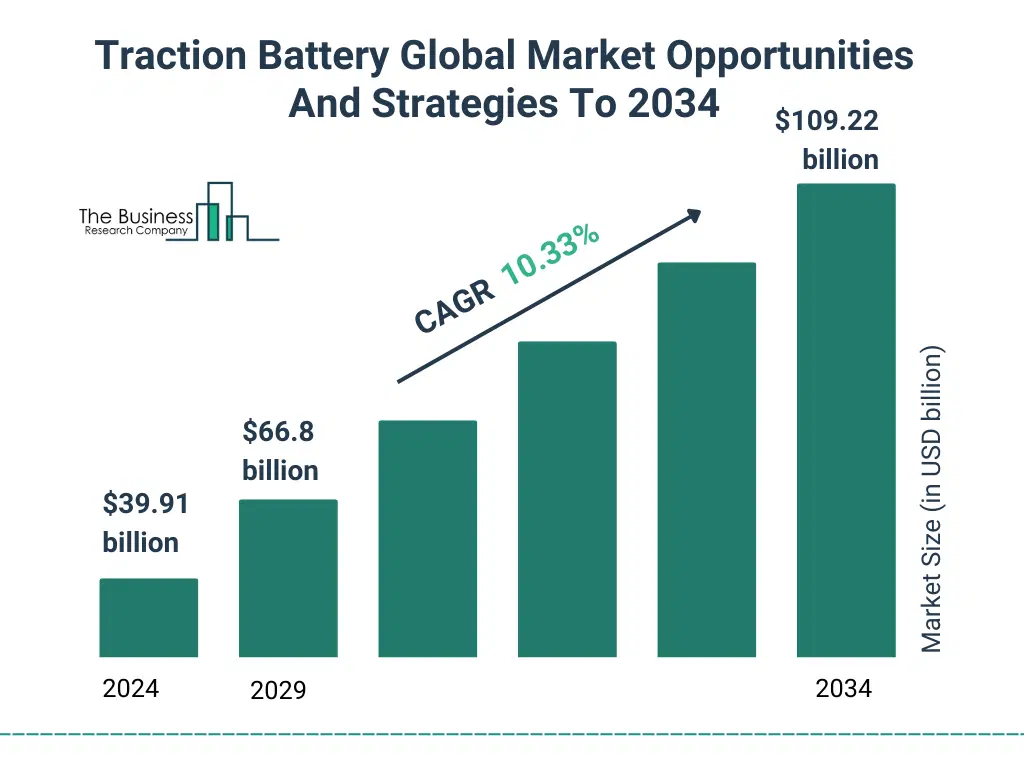
Traction Battery Market Size
The global traction battery market reached a value of nearly $39,912.45 million in 2024, having grown at a compound annual growth rate (CAGR) of 9.23% since 2019. The market is expected to grow from $39,912.45 million in 2024 to $66,797.14 million in 2029 at a rate of 10.85%. The market is then expected to grow at a CAGR of 10.33% from 2029 and reach $109,223.41 million in 2034. Growth in the historic period resulted from rising demand for electric vehicles, increasing investments by governments and growing regulatory push for zero-emission vehicles. Factors that negatively affected growth in the historic period were regulatory hurdles and infrastructure limitations. Going forward, increasing demand for sustainable transportation, expansion of electric commercial vehicles and logistics fleets, rising environmental regulations and emission requirements and expansion of fast-charging and battery swapping infrastructure will drive growth. Factors that could hinder the growth of the traction battery market in the future include competition from alternative powertrains, unresolved environmental impacts and impact of trade war and tariff.Traction Battery Market Drivers
The key drivers of the traction battery market include: Increasing Demand For Sustainable Transportation During the forecast period, the increasing demand for sustainable transportation will propel the growth of the traction battery market. Electric vehicles require reliable, high-performance batteries that support long driving ranges, fast charging and reduced emissions, all of which are effectively addressed by traction batteries. These batteries provide the core energy storage system for EVs, making them essential in the global shift toward low-carbon mobility Moreover, the scalability of traction battery technology supports applications across passenger cars, commercial fleets and public transportation, strengthening its role in sustainable mobility solutions. The increasing demand for sustainable transportation during the forecast period in 2024 is 1.60%.Traction Battery Market Restraints
The key restraints on the traction battery market include: Competition From Alternative Powertrains Competition from alternative powertrains is restricting the growth of the traction battery market during the forecast period. Consumers and fleet operators are increasingly attracted to hybrid-electric and plug-in hybrid vehicles, which offer the benefits of electrified mobility, such as improved fuel efficiency and lower emissions, without the range anxiety or charging infrastructure dependency that pure battery-electric vehicles face. This growing preference creates a constraint for traction battery demand, as these alternative powertrains continue capturing significant market share. Consequently, competition from alternative powertrains is restricting the expansion of the traction battery market. Growth affected by competition from alternative powertrains during the forecast period in 2025 is -2.03%.Traction Battery Market Trends
Major trends shaping the traction battery market include: Development Of Battery-Electric Rail Solutions Key companies in the traction battery market are focusing on the development of battery-electric rail solutions. Introducing advanced traction battery systems designed to power next-generation trains, these innovations aim to enhance performance, reduce maintenance needs, and support the shift toward sustainable transportation. For example, in January 2025, ABB (Asea Brown Boveri), a Switzerland-based electrification and automation company, collaborated with Škoda Auto, a Czech Republic-based wholly-owned subsidiary of the German automotive conglomerate Volkswagen Group, to equip Czech railways with new battery-electric multiple units (BEMUs). ABB is supplying its innovative Traction Battery Pro Series, which is compact, lightweight, and engineered to optimize vehicle performance while minimizing downtime. These batteries will power Škoda’s new fleet of BEMUs, accelerating the adoption of greener rail transport. Advancing Electric Traction Battery Industrialization Major companies in the traction battery market are advancing electric traction battery industrialization projects. Introducing large-scale manufacturing and infrastructure-scale expansion, these efforts aim to amplify production capacity and support the transition to sustainable energy systems. For example, on June 2025, Contemporary Amperex Technology Co. Limited (CATL) and SAIC Motor Corporation Limited launched the second phase of their advanced traction battery industrialization project in Liyang, Jiangsu Province. The project, backed by an investment of approximately RMB 12 billion and covering around 70 hectares, is expected to complete construction in 2024, further enhancing the production base jointly built by both parties. This milestone comes on the heels of CATL’s RMB 40 billion investment spanning 267 hectares in the region. The inauguration also celebrated the production of the 100,000th traction battery pack at the United Auto Battery System Co., Ltd. facility—marking a significant stride toward carbon neutrality and scaled-up EV infrastructure.Opportunities And Recommendations In The Traction Battery Market
Opportunities – The top opportunities in the traction battery market segmented by product type will arise in the Li-ion based segment, which will gain $21,019.37 million of global annual sales by 2029. The top opportunities in the traction battery market segmented by capacity will arise in the 400 Ah And above segment, which will gain $6,949.08 million of global annual sales by 2029. The top opportunities in the traction battery market segmented by application will arise in the electrical vehicle (EV) segment, which will gain $19,291.43 million of global annual sales by 2029. The traction battery market size will gain the most in the USA at $4,018.02 million. Recommendations- To take advantage of the opportunities, The Business Research Company recommends the traction battery companies to focus on expanding battery-electric rail solutions, focus on scaling industrial production capacity for traction batteries, focus on advancing ultra-fast charging battery development, focus on developing advanced hybrid battery solutions, focus on enhancing lead-acid auxiliary battery performance, focus on developing high-energy-density batteries for commercial EVs, focus on expanding the Li-Ion based traction battery segment, focus on expanding in the 400 Ah and above traction battery segment, expand in emerging markets, continue to focus on developed markets, focus on strengthening distribution and market access channels, focus on competitive and value-based pricing strategies, focus on strengthening market awareness through targeted promotion, focus on leveraging digital platforms for demand generation and focus on expanding in the electric vehicle traction battery segment.
Traction Battery Market Segmentation
The traction battery market is segmented by product type, by capacity and by application.By Product Type –
The traction battery market is segmented by product type into:
- a) Lead-Acid Based
- b) Li-Ion Based
- c) Nickel Based
- d) Other Types
By Capacity –
The traction battery market is segmented by capacity into:
- a) Less Than 100 Ah
- b) 100 – 200 Ah
- c) 200 – 300 Ah
- d) 300 – 400 Ah
- e) 400 Ah And above
By Banking Mode –
The traction battery market is segmented by banking mode into:
- a) Electrical Vehicle (EV)
- b) Hybrid Electric Vehicles (HEV)
- c) Industrial
- d) Forklift
- e) Mechanical Handling Equipment
- f) Other Applications
By Geography - The traction battery market is segmented by geography into:
- • China
- • India
- • Japan
- • Australia
- • Indonesia
- • South Korea
- • USA
- • Canada
- • Brazil
- • France
- • Germany
- • UK
- • Italy
- • Spain
- • Russia
-
o Asia Pacific
o Africa