
Traction Inverter Market Report 2026
Global Outlook – By Propulsion (Battery Electric Vehicle (BEV), Hybrid Electric Vehicles (HEV), Plug-In Hybrid Electric Vehicles (PHEV), Other Propulsion), By Technology (Insulated-Gate Bipolar Transistor (IGBT), Metal-Oxide Semiconductor Field-Effect Transistor (MOSFET), Other Technologies), By Vehicle (Passenger Cars, Commercial Vehicles) – Market Size, Trends, Strategies, and Forecast to 2030
Traction Inverter Market Overview
• Traction Inverter market size has reached to $20.3 billion in 2025 • Expected to grow to $41.49 billion in 2030 at a compound annual growth rate (CAGR) of 15.4% • Growth Driver: Surging Electric Vehicle Popularity Fuels Robust Growth In The Traction Inverter Market • Market Trend: Advancements In Silicon Carbide Technology For Electric Vehicle Traction Inverters • North America was the largest region in 2025 and Asia-Pacific is the fastest growing region.What Is Covered Under Traction Inverter Market?
A traction inverter is an electronic device used in electric vehicles (EVs) and hybrid vehicles to control the electric motor's speed and torque. It converts the vehicle's DC power (from the battery) into AC power, which is required to drive the electric motor. This critical component plays a key role in the performance, efficiency, and control of the vehicle's propulsion system. The main propulsion types of traction inverters are battery electric vehicles (BEV), hybrid electric vehicles(HEV), plug-in hybrid electric vehicles(PHEV), and others. A battery electric vehicle (BEV) is a type of electric vehicle that exclusively uses chemical energy stored in rechargeable battery packs for propulsion. The various technologies include insulated-gate bipolar transistor(IGBT), metal-oxide-semiconductor field-effect transistor(MOSFET), and others. These are used in various vehicles such as passenger cars, and commercial vehicles.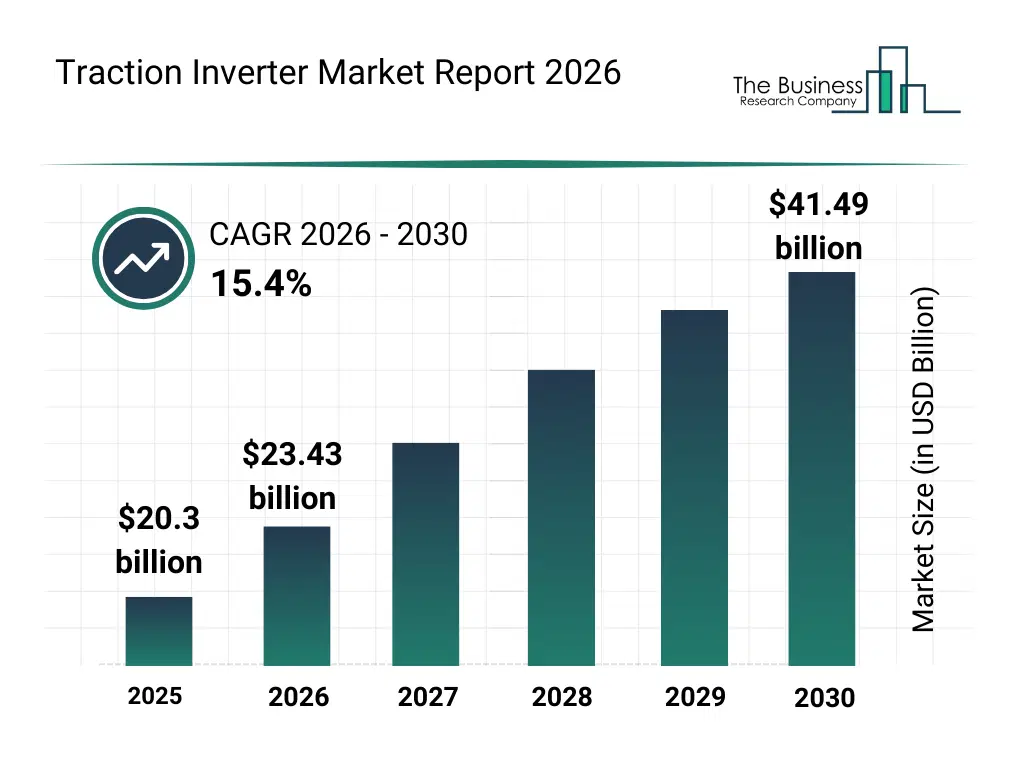
What Is The Traction Inverter Market Size and Share 2026?
The traction inverter market size has grown rapidly in recent years. It will grow from $20.3 billion in 2025 to $23.43 billion in 2026 at a compound annual growth rate (CAGR) of 15.4%. The growth in the historic period can be attributed to growth of electric vehicle production, advancements in power semiconductor technologies, rising adoption of hybrid drivetrains, increasing investments in automotive electrification, improvements in inverter efficiency.What Is The Traction Inverter Market Growth Forecast?
The traction inverter market size is expected to see rapid growth in the next few years. It will grow to $41.49 billion in 2030 at a compound annual growth rate (CAGR) of 15.4%. The growth in the forecast period can be attributed to increasing penetration of battery electric vehicles, rising demand for silicon carbide inverters, expansion of charging infrastructure ecosystems, growing focus on vehicle range optimization, increasing investments in next-generation power electronics. Major trends in the forecast period include increasing adoption of high-efficiency power electronics, rising use of igbt and mosfet technologies, growing demand for compact and lightweight inverters, expansion of ev and hybrid vehicle production, enhanced focus on thermal management solutions.
Global Traction Inverter Market Segmentation
1) By Propulsion: Battery Electric Vehicle (BEV), Hybrid Electric Vehicles (HEV), Plug-In Hybrid Electric Vehicles (PHEV), Other Propulsion 2) By Technology: Insulated-Gate Bipolar Transistor (IGBT), Metal-Oxide Semiconductor Field-Effect Transistor (MOSFET), Other Technologies 3) By Vehicle: Passenger Cars, Commercial Vehicles Subsegments: 1) By Battery Electric Vehicle (BEV): Fully Electric Vehicles, E-Bikes And E-Scooters 2) By Hybrid Electric Vehicles (HEV): Full Hybrid Vehicles, Mild Hybrid Vehicles 3) By Plug-In Hybrid Electric Vehicles (PHEV): PHEVs With Extended Range, Standard PHEVs 4) By Other Propulsion: Fuel Cell Electric Vehicles (FCEV), Range-Extended Electric Vehicles (REEV)What Is The Driver Of The Traction Inverter Market?
The rising popularity of electric vehicles is expected to propel the growth of the traction inverter market. An electric vehicle (EV) is a vehicle that relies on an electric motor for propulsion, using energy stored in rechargeable batteries. The traction inverter is used in electric vehicles to convert direct current (DC) from batteries into alternating current (AC), thus controlling the speed and torque of the electric motor, which is essential for the vehicle's performance and efficiency. For instance, in April 2024, according to the International Energy Agency (IEA), a France-based intergovernmental organization, in 2023 global electric car sales reached nearly 14 million units, and EVs accounted for about 18% of all new cars sold, up from 14% in 2022. Therefore, the rising popularity of electric vehicles is driving the growth of the traction inverter industry.Key Players In The Global Traction Inverter Market
Major companies operating in the traction inverter market report include Robert Bosch GmbH, Hitachi Ltd., Continental AG, Mitsubishi Electric Corporation, ABB Ltd., Toshiba Corporation, Lear Corporation, Texas Instruments Incorporated, Parker Hannifin Corporation, STMicroelectronics N.V., BorgWarner Inc., Infineon Technologies AG, Renesas Electronics Corporation, Dana Incorporated, ON Semiconductor, Fuji Electric Co. Ltd., Voith GmbH & Co. KGaA, Yaskawa Electric Corporation, Curtiss Aeroplane and Motor Company, Delphi Technologies PLC
This chart is for illustrative purposes; the full report includes a detailed competitor analysis and comprehensive overview of the top 10 companies in the market.
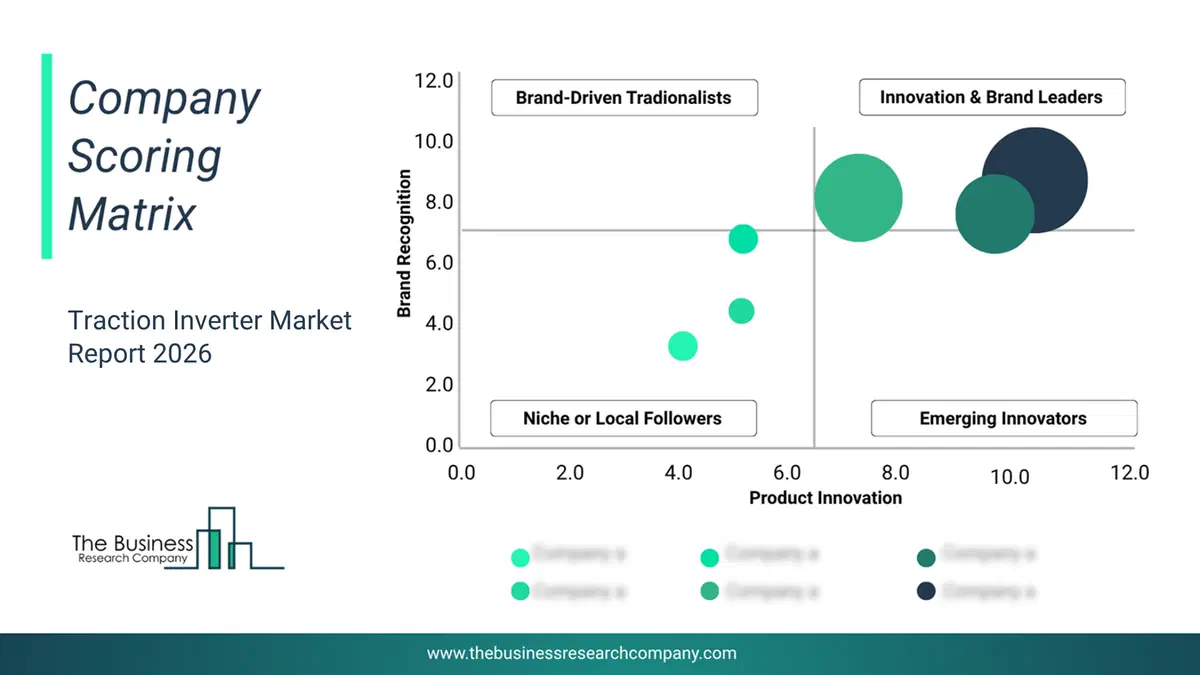
This chart maps companies by product innovation and brand strength, with bubble size indicating relative revenue, helping identify market leaders, challengers, and niche players. This is an illustrative chart; the full report provides a complete and accurate competitive analysis.
Global Traction Inverter Market Trends and Insights
Major companies operating in the traction inverter market are focused on developing new technologies, such as next-gen silicon carbide tech for EV traction inverters to enable higher switching frequencies and reduce conduction losses. Next-generation silicon carbide (SiC) technology for electric vehicle (EV) traction inverters refers to the utilization of silicon carbide semiconductor materials to enhance the performance, efficiency, and durability of traction inverters used in electric and hybrid vehicles. For instance, in October 2024, STMicroelectronics NV, a Switzerland-based semiconductor manufacturing corporation, launched its fourth-generation STPOWER silicon carbide (SiC) MOSFET technology, specifically designed for electric vehicle (EV) traction inverters. This new generation boasts significantly lower on-resistance, faster switching speeds, and enhanced robustness, making it ideal for both 400V and 800V applications. With availability in 750V and 1200V classes, the technology aims to improve power efficiency and density, benefiting not only the automotive sector but also high-power industrial applications like solar inverters and energy storage systems.What Are Latest Mergers And Acquisitions In The Traction Inverter Market?
In March 2023, Infineon Technologies, a Germany-based semiconductor company, acquired GaN Systems for $830 million. This acquisition aims to enhance its portfolio in gallium nitride power conversion solutions, addressing the growing demand for efficient and high-performance power systems across industries such as renewable energy, electric vehicles, and consumer electronics. GaN Systems is a Canada-based company involved in the development and application of traction inverters that utilize their advanced GaN technology.
Regional Outlook
North America was the largest region in the traction inverter market in 2025. Asia-Pacific is expected to be the fastest-growing region in the forecast period. The regions covered in this market report include Asia-Pacific, South East Asia, Western Europe, Eastern Europe, North America, South America, Middle East, Africa. The countries covered in this market report include Australia, Brazil, China, France, Germany, India, Indonesia, Japan, Taiwan, Russia, South Korea, UK, USA, Canada, Italy, SpainWhat Defines the Traction Inverter Market?
The traction inverter market consists of sales of inverter units, power modules, control software, cooling systems, and sensors. Values in this market are ‘factory gate’ values, that is, the value of goods sold by the manufacturers or creators of the goods, whether to other entities (including downstream manufacturers, wholesalers, distributors, and retailers) or directly to end customers. The value of goods in this market includes related services sold by the creators of the goods.How is Market Value Defined and Measured?
The market value is defined as the revenues that enterprises gain from the sale of goods and/or services within the specified market and geography through sales, grants, or donations in terms of the currency (in USD unless otherwise specified). The revenues for a specified geography are consumption values that are revenues generated by organizations in the specified geography within the market, irrespective of where they are produced. It does not include revenues from resales along the supply chain, either further along the supply chain or as part of other products.
This chart presents market attractiveness based on a quantitative evaluation of growth, competition, strategic alignment, and risk, offering a clear view of opportunity areas for decision-making. This chart is for illustrative purposes; the full report contains the complete analysis.

This chart highlights the Total Addressable Market (TAM) by estimating the maximum revenue opportunity using an assumption-driven approach, supporting strategic planning and opportunity sizing across markets. The chart is illustrative; the full report provides a more comprehensive analysis.
What Key Data and Analysis Are Included in the Traction Inverter Market Report 2026?
The traction inverter market research report is one of a series of new reports from The Business Research Company that provides market statistics, including industry global market size, regional shares, competitors with the market share, detailed market segments, market trends and opportunities, and any further data you may need to thrive in the traction inverter industry. The market research report delivers a complete perspective of everything you need, with an in-depth analysis of the current and future state of the industry.Traction Inverter Market Report Forecast Analysis
| Report Attribute | Details |
|---|---|
| Market Size Value In 2026 | $23.43 billion |
| Revenue Forecast In 2030 | $41.49 billion |
| Growth Rate | CAGR of 15.4% from 2026 to 2030 |
| Base Year For Estimation | 2025 |
| Actual Estimates/Historical Data | 2020-2025 |
| Forecast Period | 2026 - 2030 - 2030 |
| Market Representation | Revenue in USD Billion and CAGR from 2026 to 2030 |
| Segments Covered | Propulsion, Technology, Vehicle |
| Regional Scope | Asia-Pacific, Western Europe, Eastern Europe, North America, South America, Middle East, Africa |
| Country Scope | The countries covered in the report are Australia, Brazil, China, France, Germany, India, Indonesia, Japan, Taiwan, Russia, South Korea, UK, USA, Canada, Italy, Spain. |
| Key Companies Profiled | Robert Bosch GmbH, Hitachi Ltd., Continental AG, Mitsubishi Electric Corporation, ABB Ltd., Toshiba Corporation, Lear Corporation, Texas Instruments Incorporated, Parker Hannifin Corporation, STMicroelectronics N.V., BorgWarner Inc., Infineon Technologies AG, Renesas Electronics Corporation, Dana Incorporated, ON Semiconductor, Fuji Electric Co. Ltd., Voith GmbH & Co. KGaA, Yaskawa Electric Corporation, Curtiss Aeroplane and Motor Company, Delphi Technologies PLC |
| Customization Scope | Request for Customization |
| Pricing And Purchase Options | Explore Purchase Options |