
Traffic Jam Assist Market Report 2026
Global Outlook – By Component (Automotive Cameras, Ultrasonic Sensors, RADAR (Radio Detection And Ranging), LiDAR (Light Detection And Ranging), ECUs (Electronic Control Unit)), By Automation (Level 2, Level 3), By Method (Lane Tracking System, Vehicle Detection And Collision Avoidance System, Auto Steering And Speed Control System, Other Methods), By Vehicle Type (Passenger Cars, Commercial Vehicles) – Market Size, Trends, Strategies, and Forecast to 2030
Traffic Jam Assist Market Overview
• Traffic Jam Assist market size has reached to $3.21 billion in 2025 • Expected to grow to $4.95 billion in 2030 at a compound annual growth rate (CAGR) of 8.8% • Growth Driver: Smart City Initiatives Propel Traffic Jam Assistance Market • Market Trend: Advancements In Sensor Technology Driving Traffic Jam Assistance Innovations • Asia-Pacific was the largest region in 2025.What Is Covered Under Traffic Jam Assist Market?
Traffic jam assist (TJA) is an advanced driver assistance system designed to alleviate congestion by providing semi-autonomous driving capabilities in slow-moving or stationary traffic conditions. These systems utilize sensors, cameras, and algorithms to control acceleration, braking, and steering, helping drivers navigate traffic more safely and efficiently. The main components of traffic jam assist are automotive cameras, ultrasonic sensors, RADAR (radio detection and ranging), LiDAR (light detection and ranging), and ECUs (electronic control unit). Automotive cameras refer to cameras specifically designed and integrated into vehicles for various purposes, such as providing a view of the surroundings, enabling driver assistance features, and supporting advanced driver-assistance systems (ADAS) and autonomous driving technologies. Level 2 and level 3 automation can be achieved by lane tracking system, vehicle detection and collision avoidance system, auto steering and speed control system, and other methods in passenger cars and commercial vehicles.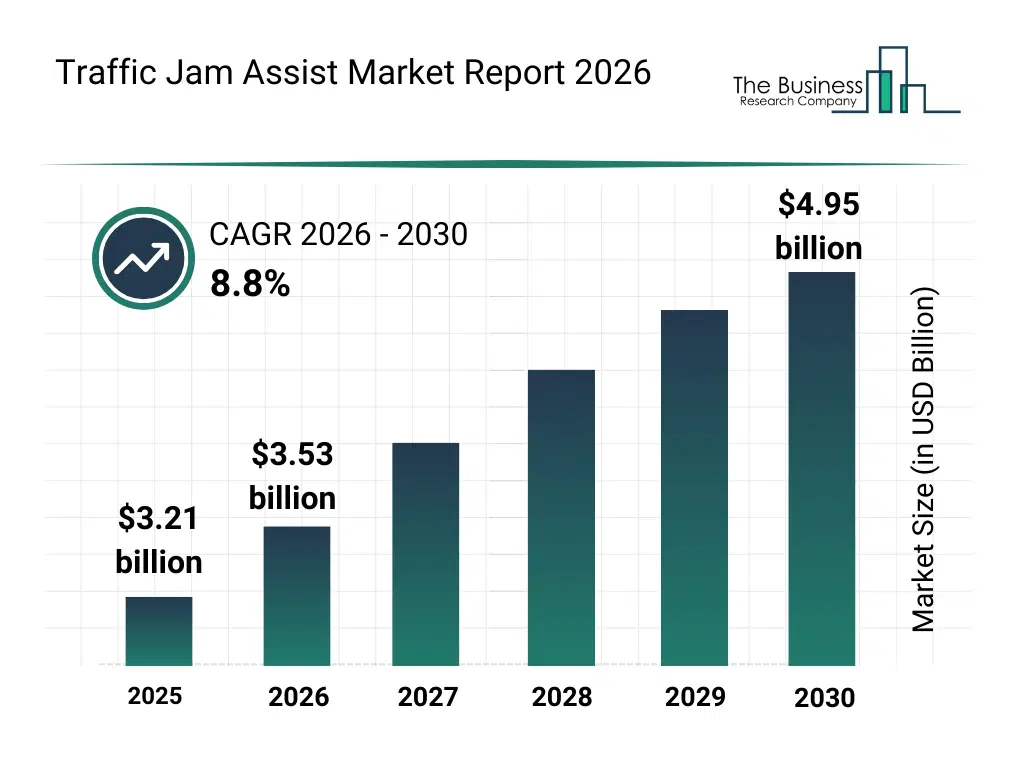
What Is The Traffic Jam Assist Market Size and Share 2026?
The traffic jam assist market size has grown rapidly in recent years. It will grow from $3.21 billion in 2025 to $3.53 billion in 2026 at a compound annual growth rate (CAGR) of 10.1%. The growth in the historic period can be attributed to rising traffic congestion in urban areas, increasing adoption of advanced driver assistance systems, improvements in camera and radar technologies, growth in premium vehicle penetration, regulatory support for vehicle safety systems.What Is The Traffic Jam Assist Market Growth Forecast?
The traffic jam assist market size is expected to see strong growth in the next few years. It will grow to $4.95 billion in 2030 at a compound annual growth rate (CAGR) of 8.8%. The growth in the forecast period can be attributed to increasing transition toward autonomous driving, rising investments in ai-driven vehicle software, expansion of connected vehicle infrastructure, growing demand for enhanced in-car safety features, increasing adoption of adas in mid-range vehicles. Major trends in the forecast period include increasing integration of semi-autonomous driving functions, rising adoption of sensor fusion technologies, growing deployment of level 2 and level 3 adas features, expansion of steering and speed automation capabilities, enhanced focus on driver comfort in congested traffic.
Global Traffic Jam Assist Market Segmentation
1) By Component: Automotive Cameras, Ultrasonic Sensors, RADAR (Radio Detection And Ranging), LiDAR (Light Detection And Ranging), ECUs (Electronic Control Unit) 2) By Automation: Level 2, Level 3 3) By Method: Lane Tracking System, Vehicle Detection And Collision Avoidance System, Auto Steering And Speed Control System, Other Methods 4) By Vehicle Type: Passenger Cars, Commercial Vehicles Subsegments: 1) By Automotive Cameras: Front Cameras, Rear Cameras, Surround View Cameras 2) By Ultrasonic Sensors: Parking Sensors, Proximity Sensors 3) By RADAR (Radio Detection and Ranging): Long-Range RADAR, Short-Range RADAR 4) By LiDAR (Light Detection and Ranging): Solid-State LiDAR, Mechanical LiDAR 5) By ECUs (Electronic Control Unit): Powertrain Control Units, Body Control Modules, Driver Assistance ECUsWhat Is The Driver Of The Traffic Jam Assist Market?
The emergence of smart city initiatives is expected to propel the growth of the traffic jam assist market going forward. Smart cities utilize information and communication technologies (ICT) to enhance operational efficiency, share information with the public, and improve government services and citizen welfare. Smart city initiatives are rising due to improving infrastructure, enhancing public services, and creating a better quality of life for residents by utilizing information and communication technologies (ICT) to optimize city functions and drive economic growth. The traffic jam contributes to the advancement of smart city initiatives by addressing traffic congestion challenges, improving traffic flow, reducing driver fatigue, and enhancing road safety by utilizing advanced technologies like automated steering, braking, and acceleration capabilities. For instance, in October 2025, according to the European Commission, a Belgium-based executive branch of the European Union, the EU Cities Mission supports 112 cities (100 EU + 12 associated countries), aims to make 100 cities climate-neutral and smart by 2030, has awarded the EU Mission Label to 103 cities since April 2023, and provides approximately €120 million per year in Horizon Europe funding to drive smart-city transformation. Therefore, the emergence of smart city initiatives is driving the growth of the traffic jam assistance market.Key Players In The Global Traffic Jam Assist Market
Major companies operating in the traffic jam assist market report include Volkswagen AG, Toyota Motor Corporation, Ford Motor Company, General Motors Company, Bayerische Motoren Werke AG, Honda Motor Co. Ltd., Hyundai Motor Company, Robert Bosch GmbH, Tesla Inc., Denso Corporation, ZF Friedrichshafen AG, Continental AG, NVIDIA Corporation, Aptiv PLC, Jaguar Land Rover Automotive PLC, Nissan Motor Co. Ltd., Delphi Technologies PLC, Subaru Corporation, Mobileye Global Inc., Mitsubishi Motors Corporation, Kia Corporation, Waymo LLC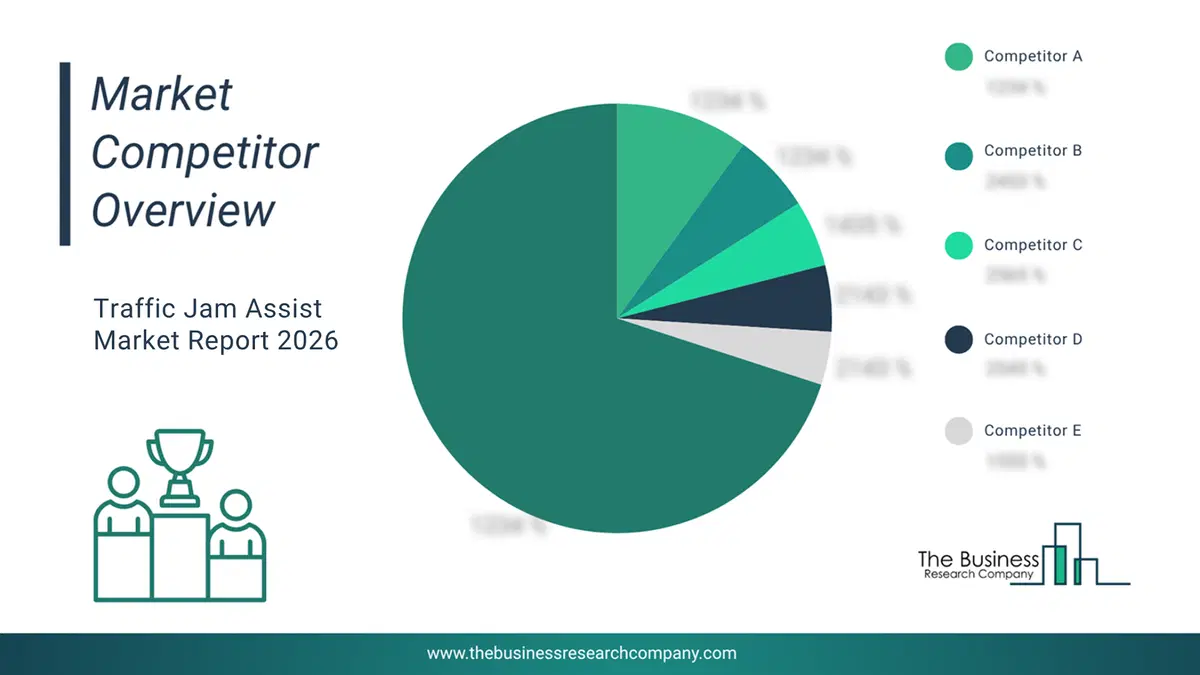
This chart is for illustrative purposes; the full report includes a detailed competitor analysis and comprehensive overview of the top 10 companies in the market.
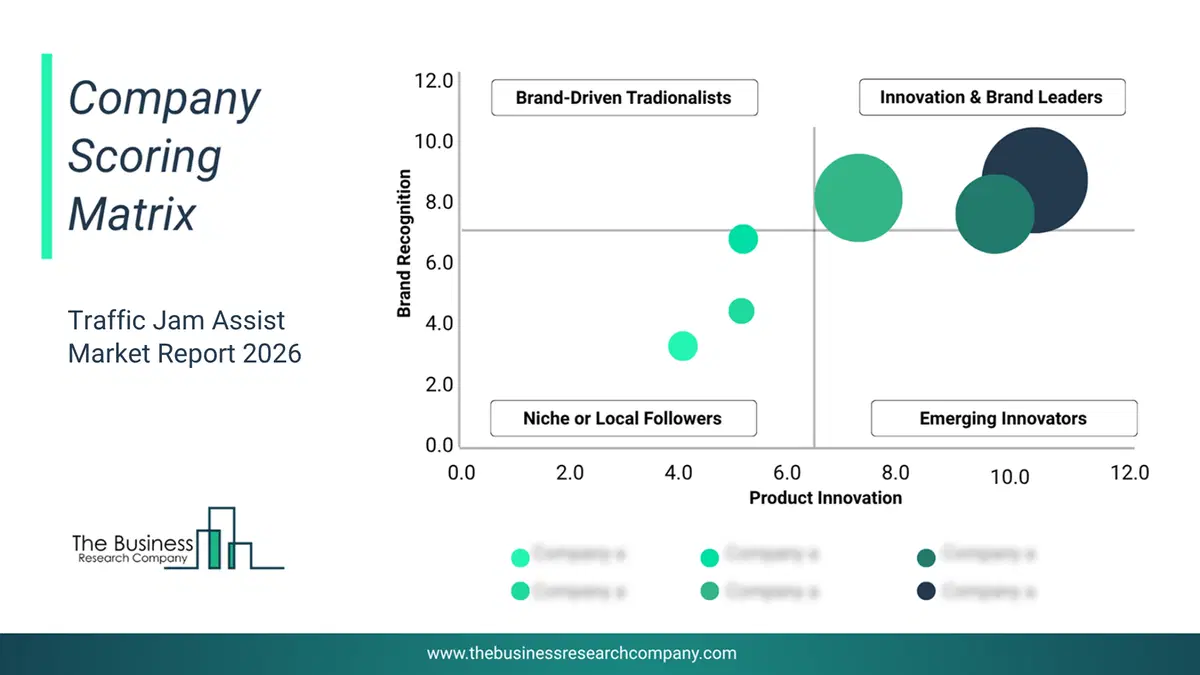
This chart maps companies by product innovation and brand strength, with bubble size indicating relative revenue, helping identify market leaders, challengers, and niche players. This is an illustrative chart; the full report provides a complete and accurate competitive analysis.
Global Traffic Jam Assist Market Trends and Insights
Major companies operating in the traffic jam assist market are developing innovative technologies, such as Staria Hybrid, to enhance the driving experience in heavy traffic conditions. Staria Hybrid is a smart traffic jam assist that utilizes features such as adaptive cruise control and lane departure warning to provide a safer and more convenient driving experience, making driving better, particularly in traffic situations. For example, in February 2024, Hyundai Motor Company, a South Korea-based automotive manufacturer, launched the Staria Hybrid with a new feature called 'Traffic Jam Assist.' This technology enhances driving safety and convenience, especially in congested traffic conditions, by automatically adjusting speed, maintaining a safe distance from the vehicle ahead, and keeping the vehicle in its lane.What Are Latest Mergers And Acquisitions In The Traffic Jam Assist Market?
In July 2023, LeddarTech, a US-based company that specializes in providing high-performance, cost-effective sensor fusion and perception solutions, partnered with Hailo AI. This partnership offers a comprehensive traffic jam assist solution that leverages cutting-edge technology to enhance the driving experience in heavy traffic conditions. Hailo AI is an Israel-based company specializing in providing comprehensive traffic jam assistance solutions.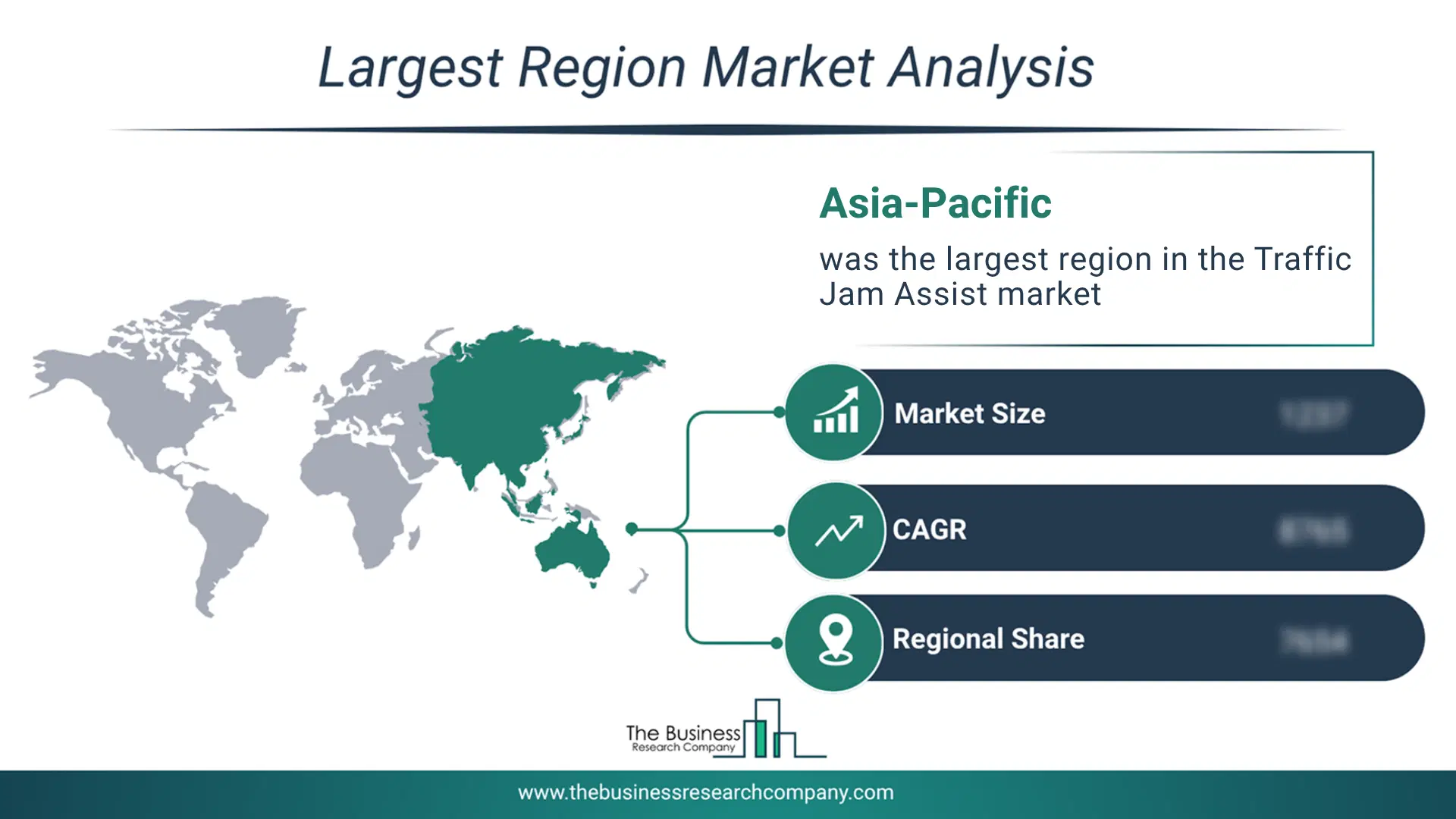
Regional Outlook
Asia-Pacific was the largest region in the traffic jam assist market in 2025. The regions covered in this market report include Asia-Pacific, South East Asia, Western Europe, Eastern Europe, North America, South America, Middle East, Africa. The countries covered in this market report include Australia, Brazil, China, France, Germany, India, Indonesia, Japan, Taiwan, Russia, South Korea, UK, USA, Canada, Italy, SpainWhat Defines the Traffic Jam Assist Market?
The traffic jam assist market consists of revenues earned by entities by providing services such as installation, maintenance, and support for traffic jam assist systems. The market value includes the value of related goods sold by the service provider or included within the service offering. The traffic jam assist (TJA) market also includes sales of cameras, radar sensors, ultrasonic sensors and GPS receiver. Values in this market are 'factory gate' values, that is the value of goods sold by the manufacturers or creators of the goods, whether to other entities (including downstream manufacturers, wholesalers, distributors and retailers) or directly to end customers. The value of goods in this market includes related services sold by the creators of the goods.How is Market Value Defined and Measured?
The market value is defined as the revenues that enterprises gain from the sale of goods and/or services within the specified market and geography through sales, grants, or donations in terms of the currency (in USD unless otherwise specified). The revenues for a specified geography are consumption values that are revenues generated by organizations in the specified geography within the market, irrespective of where they are produced. It does not include revenues from resales along the supply chain, either further along the supply chain or as part of other products.
This chart presents market attractiveness based on a quantitative evaluation of growth, competition, strategic alignment, and risk, offering a clear view of opportunity areas for decision-making. This chart is for illustrative purposes; the full report contains the complete analysis.

This chart highlights the Total Addressable Market (TAM) by estimating the maximum revenue opportunity using an assumption-driven approach, supporting strategic planning and opportunity sizing across markets. The chart is illustrative; the full report provides a more comprehensive analysis.
What Key Data and Analysis Are Included in the Traffic Jam Assist Market Report 2026?
The traffic jam assist market research report is one of a series of new reports from The Business Research Company that provides market statistics, including industry global market size, regional shares, competitors with the market share, detailed market segments, market trends and opportunities, and any further data you may need to thrive in the traffic jam assist industry. The market research report delivers a complete perspective of everything you need, with an in-depth analysis of the current and future state of the industry.Traffic Jam Assist Market Report Forecast Analysis
| Report Attribute | Details |
|---|---|
| Market Size Value In 2026 | $3.53 billion |
| Revenue Forecast In 2030 | $4.95 billion |
| Growth Rate | CAGR of 10.1% from 2026 to 2030 |
| Base Year For Estimation | 2025 |
| Actual Estimates/Historical Data | 2020-2025 |
| Forecast Period | 2026 - 2030 - 2030 |
| Market Representation | Revenue in USD Billion and CAGR from 2026 to 2030 |
| Segments Covered | Component, Automation, Method, Vehicle Type |
| Regional Scope | Asia-Pacific, Western Europe, Eastern Europe, North America, South America, Middle East, Africa |
| Country Scope | The countries covered in the report are Australia, Brazil, China, France, Germany, India, Indonesia, Japan, Taiwan, Russia, South Korea, UK, USA, Canada, Italy, Spain. |
| Key Companies Profiled | Volkswagen AG, Toyota Motor Corporation, Ford Motor Company, General Motors Company, Bayerische Motoren Werke AG, Honda Motor Co. Ltd., Hyundai Motor Company, Robert Bosch GmbH, Tesla Inc., Denso Corporation, ZF Friedrichshafen AG, Continental AG, NVIDIA Corporation, Aptiv PLC, Jaguar Land Rover Automotive PLC, Nissan Motor Co. Ltd., Delphi Technologies PLC, Subaru Corporation, Mobileye Global Inc., Mitsubishi Motors Corporation, Kia Corporation, Waymo LLC |
| Customization Scope | Request for Customization |
| Pricing And Purchase Options | Explore Purchase Options |