
Trailer Electronic Braking System (EBS) Telematics Market Report 2026
Global Outlook – By Component (Hardware, Software, Services), By Trailer Type (Dry Van Trailers, Refrigerated Trailers, Flatbed Trailers, Tank Trailers, Curtain-Sider Trailers, Container Chassis, Specialized And Heavy-Duty Trailers), By Technology (Electronic Braking System-Based Telematics, Global Positioning System And Connectivity Telematics, Sensor-Based Telematics), By Application (Fleet Management, Asset Tracking, Safety and Security, Predictive Maintenance, Other Applications), By End User (Logistics And Transportation Companies, Fleet Operators, Original Equipment Manufacturer Trailer Manufacturers, Rental And Leasing Companies, Cold Chain Providers, Oil And Gas Transportation Firms) – Market Size, Trends, Strategies, and Forecast to 2030
Trailer Electronic Braking System (EBS) Telematics Market Overview
• Trailer Electronic Braking System (EBS) Telematics market size has reached to $1.39 billion in 2025 • Expected to grow to $2.52 billion in 2030 at a compound annual growth rate (CAGR) of 12.6% • Growth Driver: Rising Emphasis On Road Safety Fueling The Growth Of The Market Due To Stricter Safety Measures And Accident Reduction Efforts • Market Trend: Integrated Data Platforms Enable Real-Time Monitoring Of Trailer Braking And Operational Systems • North America was the largest region in 2025 and Asia-Pacific is the fastest growing region.What Is Covered Under Trailer Electronic Braking System (EBS) Telematics Market?
Trailer electronic braking system (EBS) telematics is a system that integrates electronic braking technology with telematics to monitor and control trailer braking performance in real time. It collects and transmits data on braking status, vehicle dynamics, and system health to improve operational safety and efficiency. The technology enables predictive maintenance, reduces braking-related risks, and optimizes overall fleet management. The main components of trailer EBS telematics include hardware, software, and services. Hardware consists of electronic braking system modules, sensors, and connectivity devices installed on trailers to monitor and control braking performance, vehicle status, and safety parameters in real time. Multiple trailer types are dry van trailers, refrigerated trailers, flatbed trailers, tank trailers, curtain-sider trailers, container chassis, and specialized and heavy-duty trailers. The different technologies are electronic braking system-based telematics, global positioning system and connectivity telematics, and sensor-based telematics. The various applications are fleet management, asset tracking, safety and security, and predictive maintenance, and they are used by several end-users such as logistics and transportation companies, fleet operators, original equipment manufacturer trailer manufacturers, rental and leasing companies, cold chain providers, oil and gas transportation firms, and others.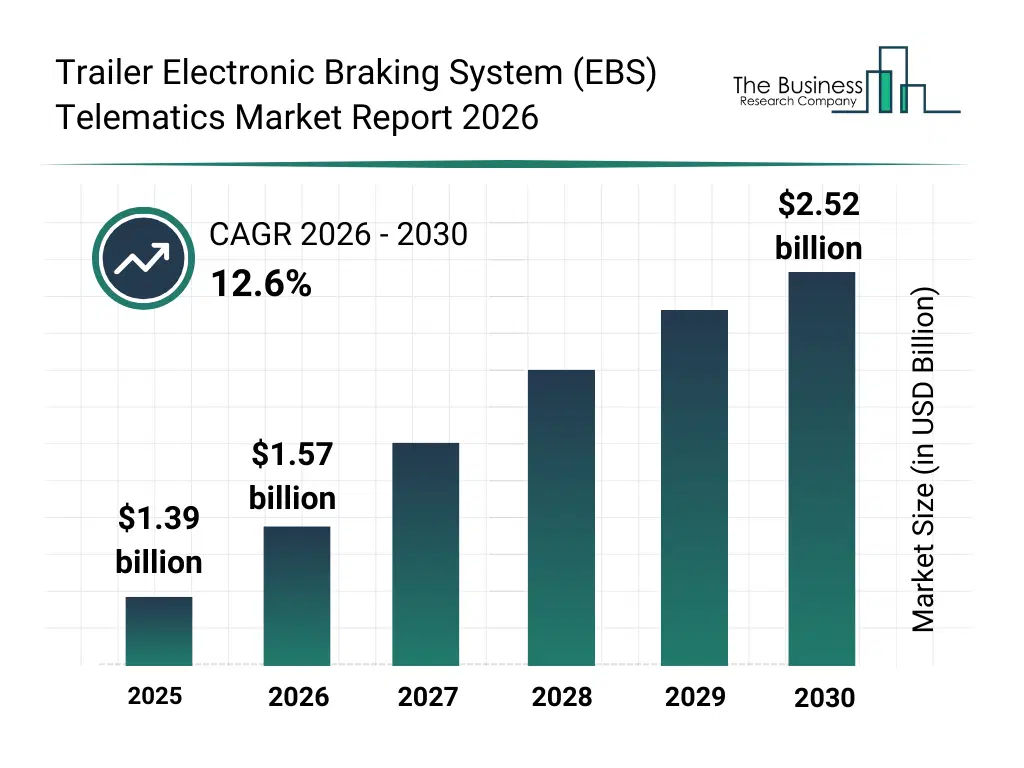
What Is The Trailer Electronic Braking System (EBS) Telematics Market Size and Share 2026?
The trailer ebs telematics market size has grown rapidly in recent years. It will grow from $1.39 billion in 2025 to $1.57 billion in 2026 at a compound annual growth rate (CAGR) of 12.8%. The growth in the historic period can be attributed to increasing safety compliance requirements, growing fleet digitization adoption, rising demand for real-time trailer monitoring, expanding use of electronic braking systems, and increasing focus on cargo security.What Is The Trailer Electronic Braking System (EBS) Telematics Market Growth Forecast?
The trailer ebs telematics market size is expected to see rapid growth in the next few years. It will grow to $2.52 billion in 2030 at a compound annual growth rate (CAGR) of 12.6%. The growth in the forecast period can be attributed to increasing regulatory push for connected braking data, growing integration of telematics into oem trailer builds, rising adoption of predictive maintenance systems, expanding cold-chain and sensitive cargo movement,and increasing dependence on data-driven fleet optimization. Major trends in the forecast period include advancements in sensor fusion technologies, innovations in cloud-based fleet analytics, developments in real-time braking performance algorithms, research and development in ai-driven predictive diagnostics,and advancements in connectivity modules (4g/5g).
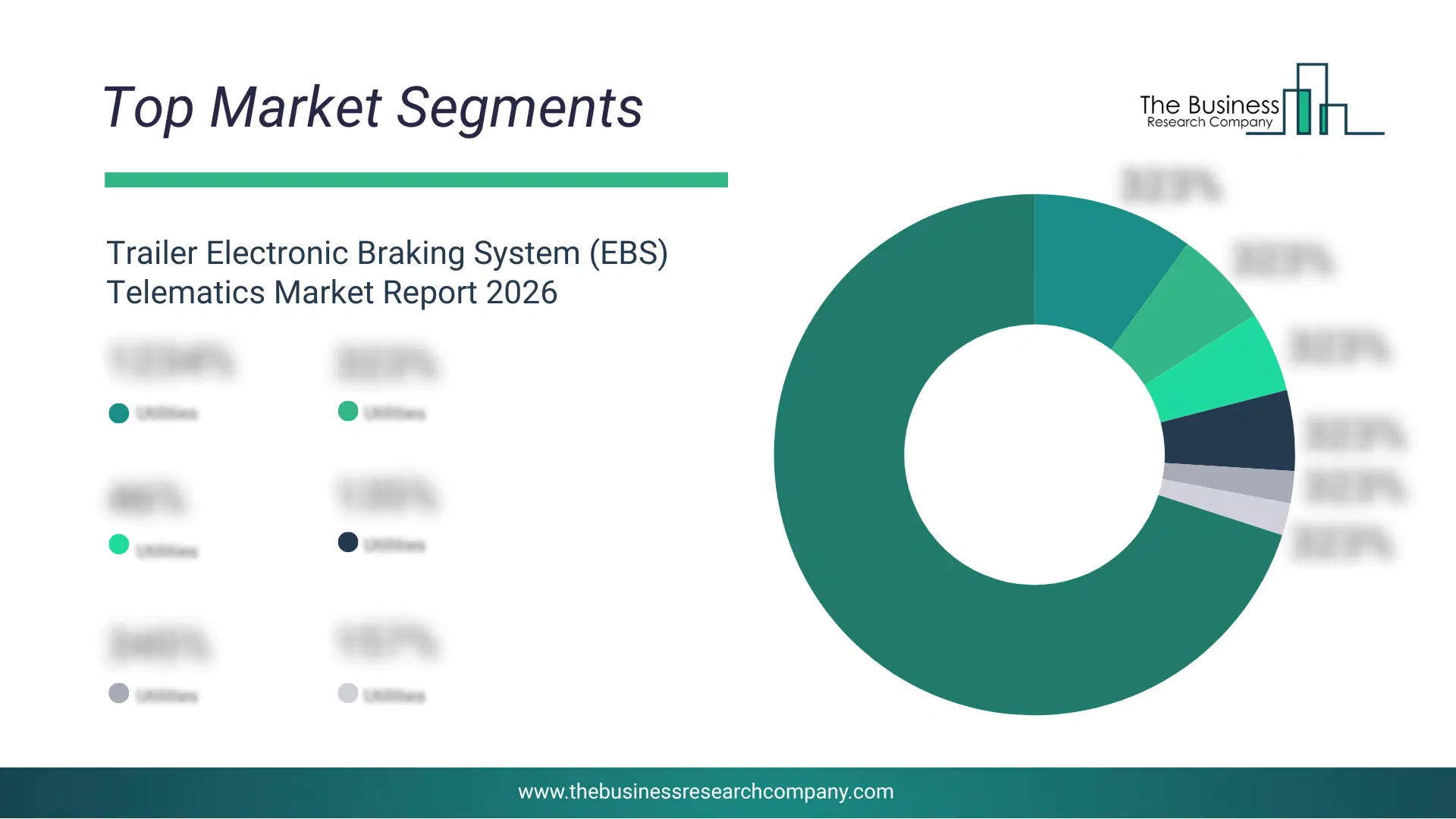
Global Trailer Electronic Braking System (EBS) Telematics Market Segmentation
1) By Component: Hardware, Software, Services 2) By Trailer Type: Dry Van Trailers, Refrigerated Trailers, Flatbed Trailers, Tank Trailers, Curtain-Sider Trailers, Container Chassis, Specialized And Heavy-Duty Trailers 3) By Technology: Electronic Braking System-Based Telematics, Global Positioning System And Connectivity Telematics, Sensor-Based Telematics 4) By Application: Fleet Management, Asset Tracking, Safety and Security, Predictive Maintenance, Other Applications 5) By End User: Logistics And Transportation Companies, Fleet Operators, Original Equipment Manufacturer Trailer Manufacturers, Rental And Leasing Companies, Cold Chain Providers, Oil And Gas Transportation Firms Subsegments: 1) By Hardware: Telematics Control Units, Electronic Braking System Sensors, Electronic Control Modules, Connectivity Modules, Global Positioning System Modules, Power Management Units, Wiring Harnesses, Onboard Diagnostic Interfaces 2) By Software: Fleet Management Software, Predictive Maintenance Software, Cloud Analytics Platforms, Real-Time Monitoring Software, Diagnostics Software, Safety And Compliance Software 3) By Services: Installation Services, Integration Services, Maintenance And Repair Services, Data Subscription Services, Remote Monitoring Services, Technical Support ServicesWhat Are The Drivers Of The Trailer Electronic Braking System (EBS) Telematics Market?
The rising emphasis on road safety is expected to propel the growth of the trailer electronic braking system (EBS) telematics market going forward. Emphasis on road safety refers to the measures, policies, and technologies aimed at reducing road accidents, injuries, and fatalities, particularly involving vehicles and trailers. The rise in emphasis on road safety is due to increasing awareness of the high number of annual road traffic deaths, leading governments and organizations to implement stricter safety measures and promote advanced safety technologies. Trailer electronic braking system (EBS) telematics supports road safety management by enabling real-time monitoring of braking performance, improving stability control, and ensuring timely fault detection. It enhances braking efficiency, reduces accident risks, and supports safer fleet operations. For instance, in 2023, according to the World Health Organization, a Switzerland-based intergovernmental organization, the number of road-traffic deaths decreased by 5%, reaching approximately 1.19 million, compared to 2022. Therefore, the rising emphasis on road safety is driving the growth of the trailer electronic braking system (EBS) telematics industry. The rising adoption of automated driver assistance systems is expected to propel the growth of the trailer electronic braking system (EBS) telematics market going forward. Automated driver assistance systems refer to in?vehicle technologies such as adaptive cruise control, lane?keeping assist, automatic emergency braking, and blind?spot detection that improve vehicle control and safety. The adoption of automated driver assistance systems (ADAS) is increasing due to the rising need for enhanced vehicle safety, regulatory compliance, and operational efficiency. Trailer electronic braking system (EBS) telematics supports automated driver assistance systems by providing real-time braking data, enhancing stability control, and enabling precise, automated braking responses. It improves safety, reduces stopping distance, and strengthens overall vehicle-trailer coordination. For instance, in September?2025, according to JATO Dynamics Ltd, a UK-based commercial company, ADAS penetration in India’s passenger?vehicle wholesale market reached 8.3%, up from 6.2% in the first half of 2024, a 33% increase year-over-year. Therefore, the increasing adoption of automated driver assistance systems is driving the growth of the trailer electronic braking system (EBS) telematics industry.Key Players In The Global Trailer Electronic Braking System (EBS) Telematics Market
Major companies operating in the trailer electronic braking system (ebs) telematics market are ZF Friedrichshafen AG, Knorr-Bremse AG, Schmitz Cargobull AG, SAF-Holland SE, Samsara Inc., Wielton S.A., Haldex AB, ORBCOMM Inc., TCOMM Telematics, Microlise Group plc, Clarience Technologies LLC, Spireon Inc., Geotab Inc., PowerFleet Inc., Quake Global Inc., Phillips Connect Technologies LLC, Tırsan Treyler A.Ş., AddSecure Group, Carrier Transicold, AirIQ Inc., Fleetly Technologies Ltd., TIP Group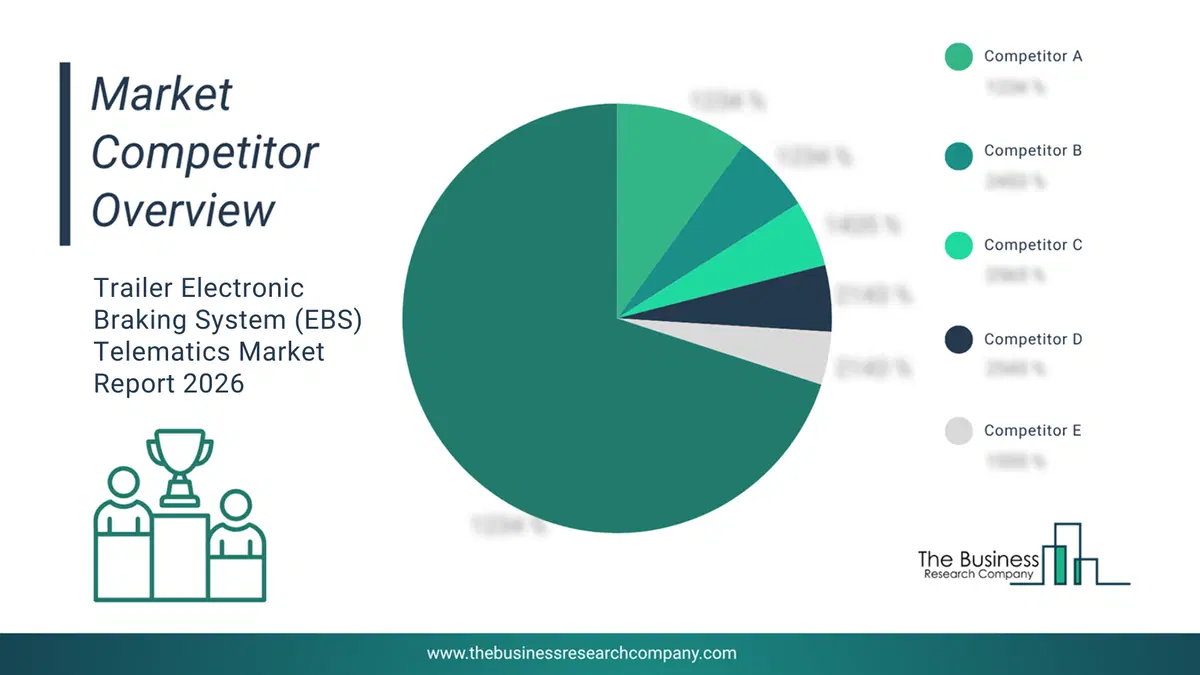
This chart is for illustrative purposes; the full report includes a detailed competitor analysis and comprehensive overview of the top 10 companies in the market.
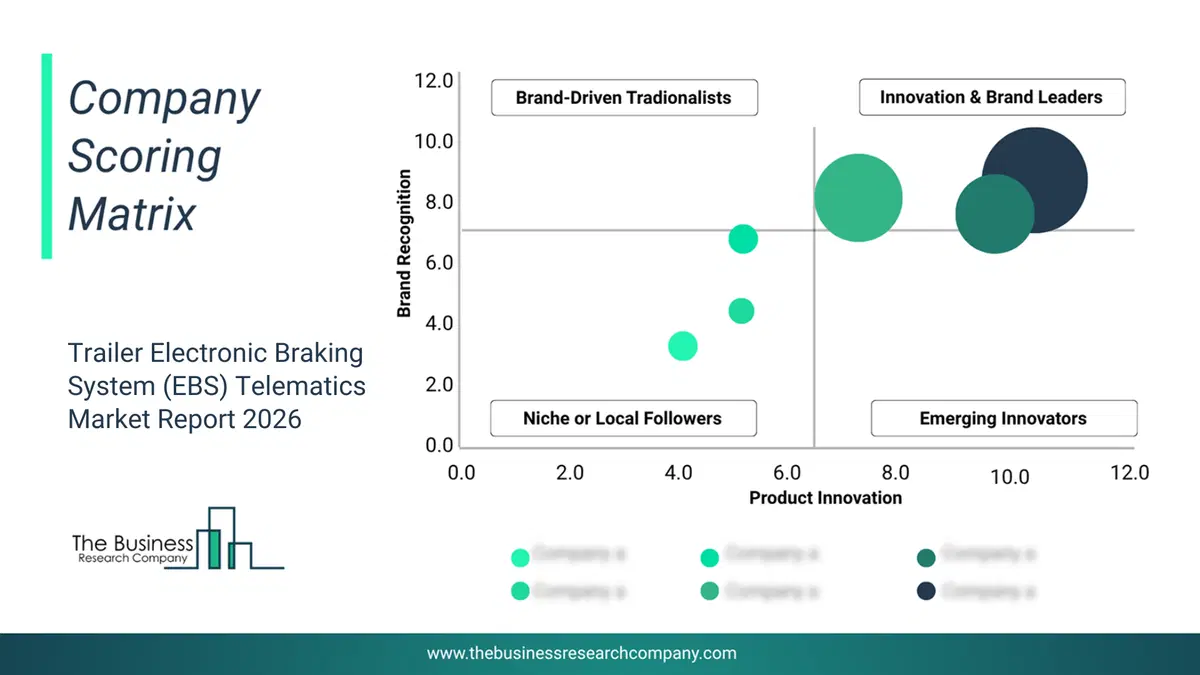
This chart maps companies by product innovation and brand strength, with bubble size indicating relative revenue, helping identify market leaders, challengers, and niche players. This is an illustrative chart; the full report provides a complete and accurate competitive analysis.
Global Trailer Electronic Braking System (EBS) Telematics Market Trends and Insights
Major companies operating in the trailer electronic braking system (EBS) telematics market are focusing on developing advanced products, such as integrated data platforms, to boost efficiency, enhance safety, and reduce operational costs. Integrated data platforms refer to comprehensive telematics systems that connect critical trailer components, such as electronic braking systems (EBS), to a cloud platform, enabling real-time monitoring and data-driven insights. For instance, in July 2024, ZF Commercial Vehicles Solutions (CVS), a Germany-based automotive supplier, launched a new trailer telematics solution that combines its next-generation trailer electronic braking systems (iEBS), OptiTire tyre pressure monitoring system (TPMS), and operating data recorder (ODR), all connected via ZF’s SCALAR EVO Pulse connectivity device to the SCALAR cloud platform. These features provide real-time trailer operational data, enable remote monitoring of braking and tyre pressure, support compliance with UN ECE regulation R141 and GDPR, and allow fleet operators to schedule predictive maintenance efficiently.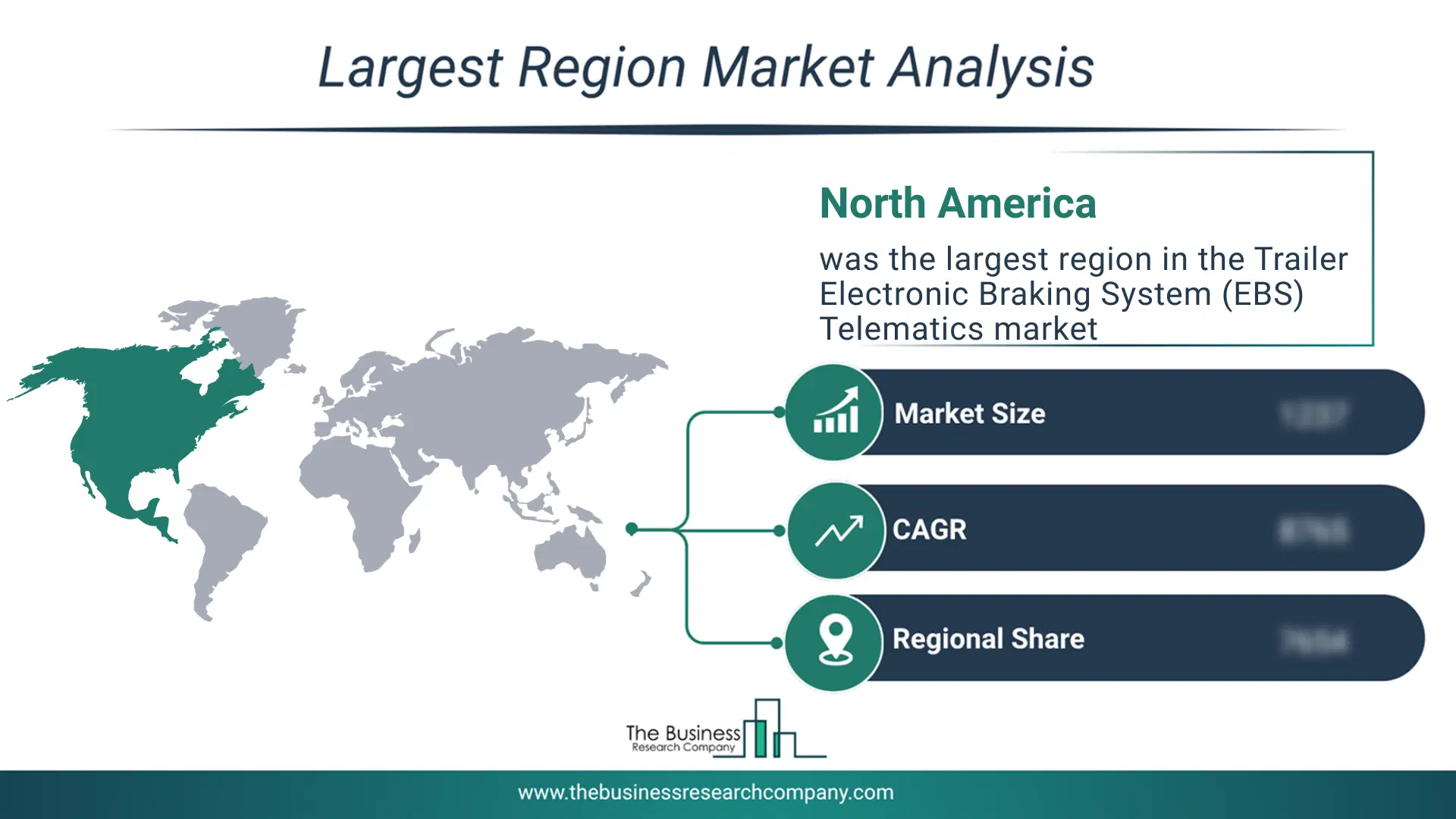
Regional Insights
North America was the largest region in the trailer ebs telematics market in 2025. Asia-Pacific is expected to be the fastest-growing region in the forecast period. The regions covered in this market report are Asia-Pacific, South East Asia, Western Europe, Eastern Europe, North America, South America, Middle East, Africa. The countries covered in this market report are Australia, Brazil, China, France, Germany, India, Indonesia, Japan, Taiwan, Russia, South Korea, UK, USA, Canada, Italy, Spain.What Defines the Trailer Electronic Braking System (EBS) Telematics Market?
The trailer electronic braking system (EBS) telematics market consists of revenues earned by entities by providing services such as fleet management support, software updates, system integration, training, and consulting. The market value includes the value of related goods sold by the service provider or included within the service offering. The trailer ebs telematics market includes sales of wiring harnesses, display units, brake actuators, diagnostic tools, and connectors. Values in this market are ‘factory gate’ values, that is, the value of goods sold by the manufacturers or creators of the goods, whether to other entities (including downstream manufacturers, wholesalers, distributors, and retailers) or directly to end customers. The value of goods in this market includes related services sold by the creators of the goods.How is Market Value Defined and Measured?
The market value is defined as the revenues that enterprises gain from the sale of goods and/or services within the specified market and geography through sales, grants, or donations in terms of the currency (in USD unless otherwise specified). The revenues for a specified geography are consumption values that are revenues generated by organizations in the specified geography within the market, irrespective of where they are produced. It does not include revenues from resales along the supply chain, either further along the supply chain or as part of other products.
This chart presents market attractiveness based on a quantitative evaluation of growth, competition, strategic alignment, and risk, offering a clear view of opportunity areas for decision-making. This chart is for illustrative purposes; the full report contains the complete analysis.

This chart highlights the Total Addressable Market (TAM) by estimating the maximum revenue opportunity using an assumption-driven approach, supporting strategic planning and opportunity sizing across markets. The chart is illustrative; the full report provides a more comprehensive analysis.
What Key Data and Analysis Are Included in the Trailer Electronic Braking System (EBS) Telematics Market Report 2026?
The trailer electronic braking system (ebs) telematics market research report is one of a series of new reports from The Business Research Company that provides market statistics, including industry global market size, regional shares, competitors with the market share, detailed market segments, market trends and opportunities, and any further data you may need to thrive in the trailer electronic braking system (ebs) telematics industry. The market research report delivers a complete perspective of everything you need, with an in-depth analysis of the current and future state of the industry.Trailer Electronic Braking System (EBS) Telematics Market Report Forecast Analysis
| Report Attribute | Details |
|---|---|
| Market Size Value In 2026 | $1.57 billion |
| Revenue Forecast In 2030 | $2.52 billion |
| Growth Rate | CAGR of 12.8% from 2026 to 2030 |
| Base Year For Estimation | 2025 |
| Actual Estimates/Historical Data | 2020-2025 |
| Forecast Period | 2026 - 2030 - 2030 |
| Market Representation | Revenue in USD Billion and CAGR from 2026 to 2030 |
| Segments Covered | Component, Trailer Type, Technology, Application, End User |
| Regional Scope | Asia-Pacific, Western Europe, Eastern Europe, North America, South America, Middle East, Africa |
| Country Scope | The countries covered in the report are Australia, Brazil, China, France, Germany, India, Indonesia, Japan, Taiwan, Russia, South Korea, UK, USA, Canada, Italy, Spain. |
| Key Companies Profiled | ZF Friedrichshafen AG, Knorr-Bremse AG, Schmitz Cargobull AG, SAF-Holland SE, Samsara Inc., Wielton S.A., Haldex AB, ORBCOMM Inc., TCOMM Telematics, Microlise Group plc, Clarience Technologies LLC, Spireon Inc., Geotab Inc., PowerFleet Inc., Quake Global Inc., Phillips Connect Technologies LLC, Tırsan Treyler A.Ş., AddSecure Group, Carrier Transicold, AirIQ Inc., Fleetly Technologies Ltd., TIP Group |
| Customization Scope | Request for Customization |
| Pricing And Purchase Options | Explore Purchase Options |