
Trailer Market Report 2026
Global Outlook – By Type (Dry Vans, Refrigerated Trailers, Tank Trailers, Flatbed Trailers, Lowboy Trailers, Other Trailers ), By Axle Type (Single Axle, Tandem Axle, Three Or More Than Three Axle), By End-Use (Paper And Paper Products, Pharma Drugs, Textile Products, Food And Groceries, Agriculture And Farm Products, Chemicals, Petroleum And Petroleum Products, Motor Vehicle And Motor Vehicle Parts, Metal And Minerals, Commercial Machinery, Other Products ) – Market Size, Trends, Strategies, and Forecast to 2030
Trailer Market Overview
• Trailer market size has reached to $64.61 billion in 2025 • Expected to grow to $96.9 billion in 2030 at a compound annual growth rate (CAGR) of 8.6% • Growth Driver: E-Commerce Expansion Ignites Trailer Market Growth Bridging The Last-Mile Delivery Gap • Market Trend: Innovative Trailers For The Future • Asia-Pacific was the largest region in 2025 and North America is the fastest growing region.What Is Covered Under Trailer Market?
A trailer is a wheeled container that is pulled by a car or other vehicle and is designed to convey objects that are large or heavy. The trailer is frequently utilized for the transportation of commodities and goods. The main types in the trailer market are dry vans, refrigerated trailers, tank trailers, flatbed trailers, lowboy trailers, and other trailers. A dry van is referred to as a van that is a semi-trailer that is used to protect shipments from the outside elements. The various types of axles are single axles, tandem axles, three-axles or more. The trailers are used in paper and paper products, pharma drugs, textile products, food and groceries, agriculture and farm products, chemicals, petroleum and petroleum products, motor vehicles and motor vehicle parts, metal and minerals, commercial machinery, other products.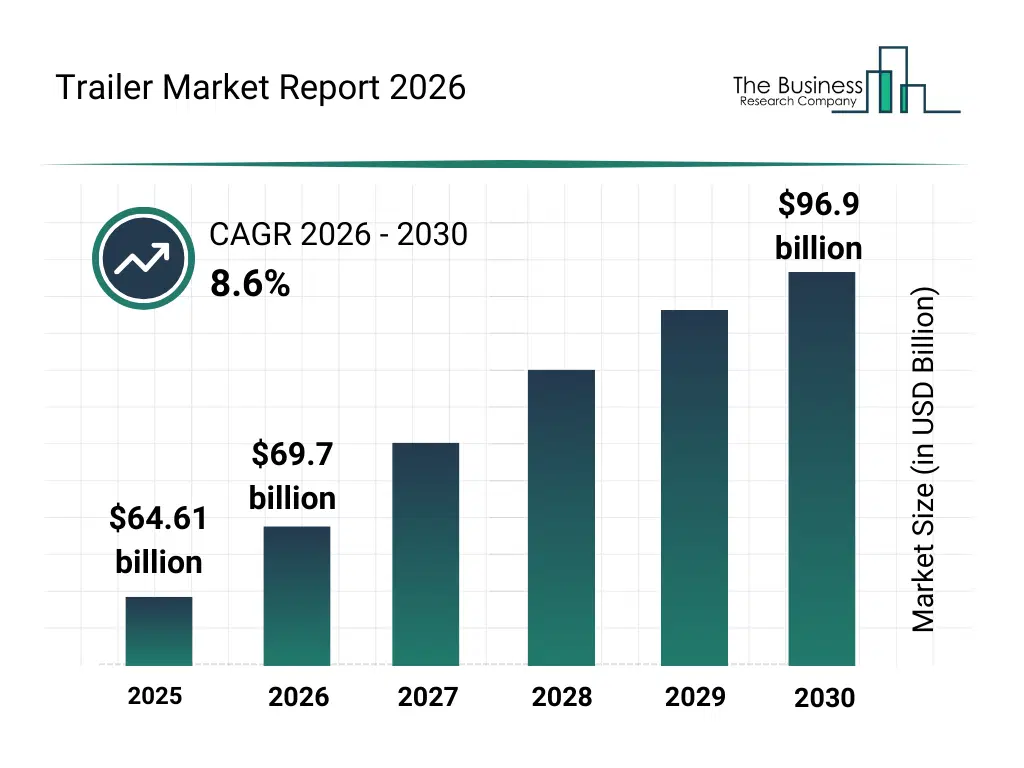
What Is The Trailer Market Size and Share 2026?
The trailer market size has grown strongly in recent years. It will grow from $64.61 billion in 2025 to $69.7 billion in 2026 at a compound annual growth rate (CAGR) of 7.9%. The growth in the historic period can be attributed to growth of freight transportation volumes, expansion of logistics and distribution networks, rising demand for long-haul transportation, increased use of trailers in agricultural and industrial sectors, availability of standardized trailer designs.What Is The Trailer Market Growth Forecast?
The trailer market size is expected to see strong growth in the next few years. It will grow to $96.9 billion in 2030 at a compound annual growth rate (CAGR) of 8.6%. The growth in the forecast period can be attributed to increasing e-commerce driven freight movement, rising adoption of smart trailers, expansion of cold chain logistics, growing demand for fuel-efficient transport solutions, increasing investments in fleet modernization. Major trends in the forecast period include increasing adoption of lightweight trailer designs, rising demand for refrigerated transportation solutions, growing integration of telematics and tracking systems, expansion of multi-axle high-capacity trailers, enhanced focus on fuel efficiency.
Global Trailer Market Segmentation
1) By Type: Dry Vans, Refrigerated Trailers, Tank Trailers, Flatbed Trailers, Lowboy Trailers, Other Trailers 2) By Axle Type: Single Axle, Tandem Axle, Three Or More Than Three Axle 3) By End-Use: Paper And Paper Products, Pharma Drugs, Textile Products, Food And Groceries, Agriculture And Farm Products, Chemicals, Petroleum And Petroleum Products, Motor Vehicle And Motor Vehicle Parts, Metal And Minerals, Commercial Machinery, Other Products Subsegments: 1) By Dry Vans: Standard Dry Vans, High Cube Dry Vans 2) By Refrigerated Trailers: Single Temperature Refrigerated Trailers, Multi-Temperature Refrigerated Trailers 3) By Tank Trailers: Liquid Tank Trailers, Gas Tank Trailers, Specialized Tank Trailers 4) By Flatbed Trailers: Standard Flatbeds, Extendable Flatbeds, Drop Deck Flatbeds 5) By Lowboy Trailers: Fixed Gooseneck Lowboys, Removable Gooseneck Lowboys 6) By Other Trailers: Curtain Side Trailers, Car Carriers, Horse TrailersWhat Is The Driver Of The Trailer Market?
The growing e-commerce sector is expected to propel the growth of the trailer market in the coming years. E-commerce (electronic commerce) comprises the purchase and sale of products and services, as well as the transfer of payments or data, through an electronic network, most notably the Internet. Trailers are used in e-commerce to transport merchandise from warehouses to customers. This involves the transportation of products and commodities such as apparel, electronics, and home furnishings. For instance, in August 2023, according to the U.S. Census Bureau, a US-based primary organization in the United States Federal Statistics System responsible for producing data on the country's population and economy, retail e-commerce sales in the 2nd quarter of 2023 reached $269.5 billion, up 7.7% (1.4%) compared to the 2nd quarter of 2022. Therefore, the growing e-commerce sector is driving the trailer industry.Key Players In The Global Trailer Market
Major companies operating in the trailer market report include China International Marine Containers (Group) Ltd., Bernard Krone Holding SE & Co. KG, Wabash National Corporation, Schmitz Cargobull AG, EnTrans International LLC, Mac Trailer Manufacturing Inc., Heil Trailer International Co., Landoll Corporation, Trail King Industries Inc., Pitts Trailers, Doepker Industries Limited, Humbaur GmbH, Fontaine Trailer Company, East Manufacturing Company, Travis Body & Trailer Inc., Towmaster Trailers, Utility Trailer Manufacturing Company, Felling Trailers, Ledwell, Krone Trailer, Kögel Trailer GmbH & Co. KG, Dennison Trailers Ltd., MANAC INC., Böckmann Fahrzeugwerke GmbH, Ifor Williams Trailers Ltd.
This chart is for illustrative purposes; the full report includes a detailed competitor analysis and comprehensive overview of the top 10 companies in the market.
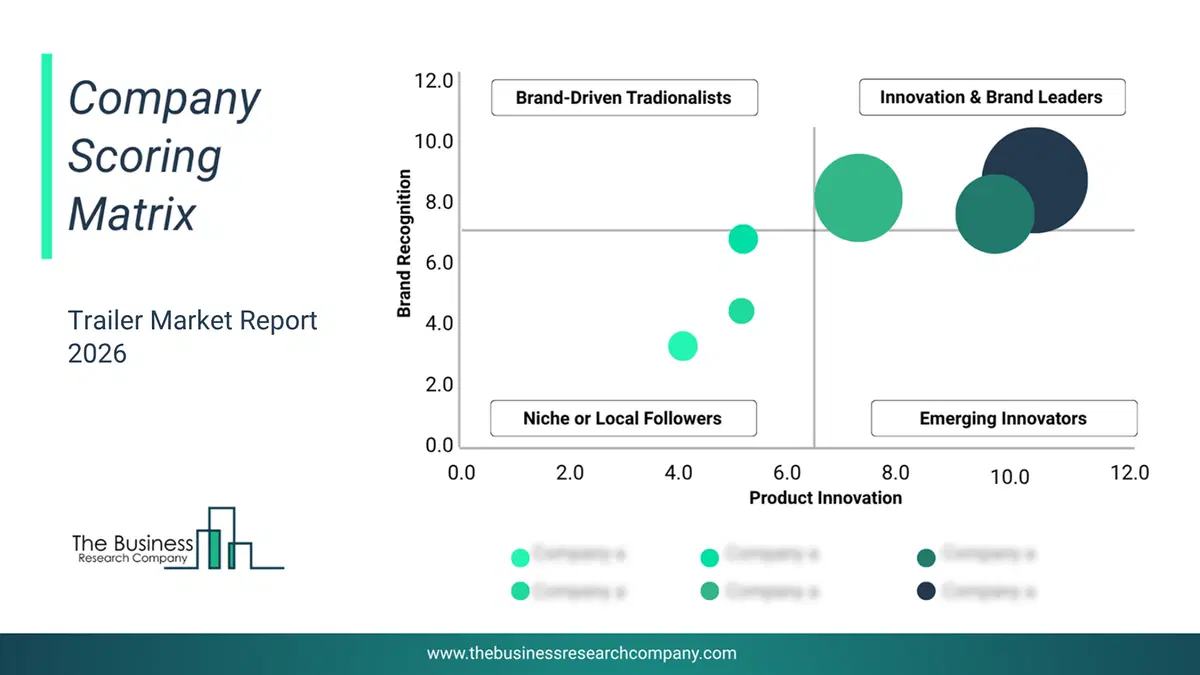
This chart maps companies by product innovation and brand strength, with bubble size indicating relative revenue, helping identify market leaders, challengers, and niche players. This is an illustrative chart; the full report provides a complete and accurate competitive analysis.
Global Trailer Market Trends and Insights
Major companies operating in the trailer market are focusing on innovative products such as the Lightship L1 to better meet the needs of their existing consumers. The Lightship L1 is a self-propelled, entirely electrically powered travel trailer intended to be more aerodynamic and effective than typical travel trailers. This implies that the L1 is not going to hinder the tow vehicle's range or efficiency, regardless of whether it is an electric vehicle. For instance, in March 2023, Lightship Energy, Inc., a US-based manufacturer of electric-age, streamlined, battery-powered trailers, launched Lightship L1. The Lightship L1 has a hyper-efficient construction that is threefold more aerodynamic compared to a standard travel trailer for increased efficiency and range. It has an electric drivetrain with up to 80 kWh of inbuilt battery storage, enabling the trailer to drive itself while the tow vehicle suffers near-zero range or productivity loss. It also has a collection of all-electric equipment, associated features, and modern comforts for a smooth camping experience, as well as an uncompromised battery system capable of supplying a week's worth of off-grid electricity without recharging.What Are Latest Mergers And Acquisitions In The Trailer Market?
In September 2025, Liberty Trailers, a US-based provider of commercial-grade utility, equipment, car hauler, tilt, and dump trailers, acquired Summit Trailer Manufacturing Inc. for an undisclosed amount. With this acquisition, Liberty Trailers aims to expand its national footprint, enhance manufacturing capacity, and strengthen its dealer network by combining complementary regional strengths while maintaining both brands’ independent identities. Summit Trailer Manufacturing Inc. is a US-based manufacturing company that specializes in providing high-quality utility, car hauler, equipment, tilt, and dump trailers serving professional and consumer markets across the Pacific Northwest.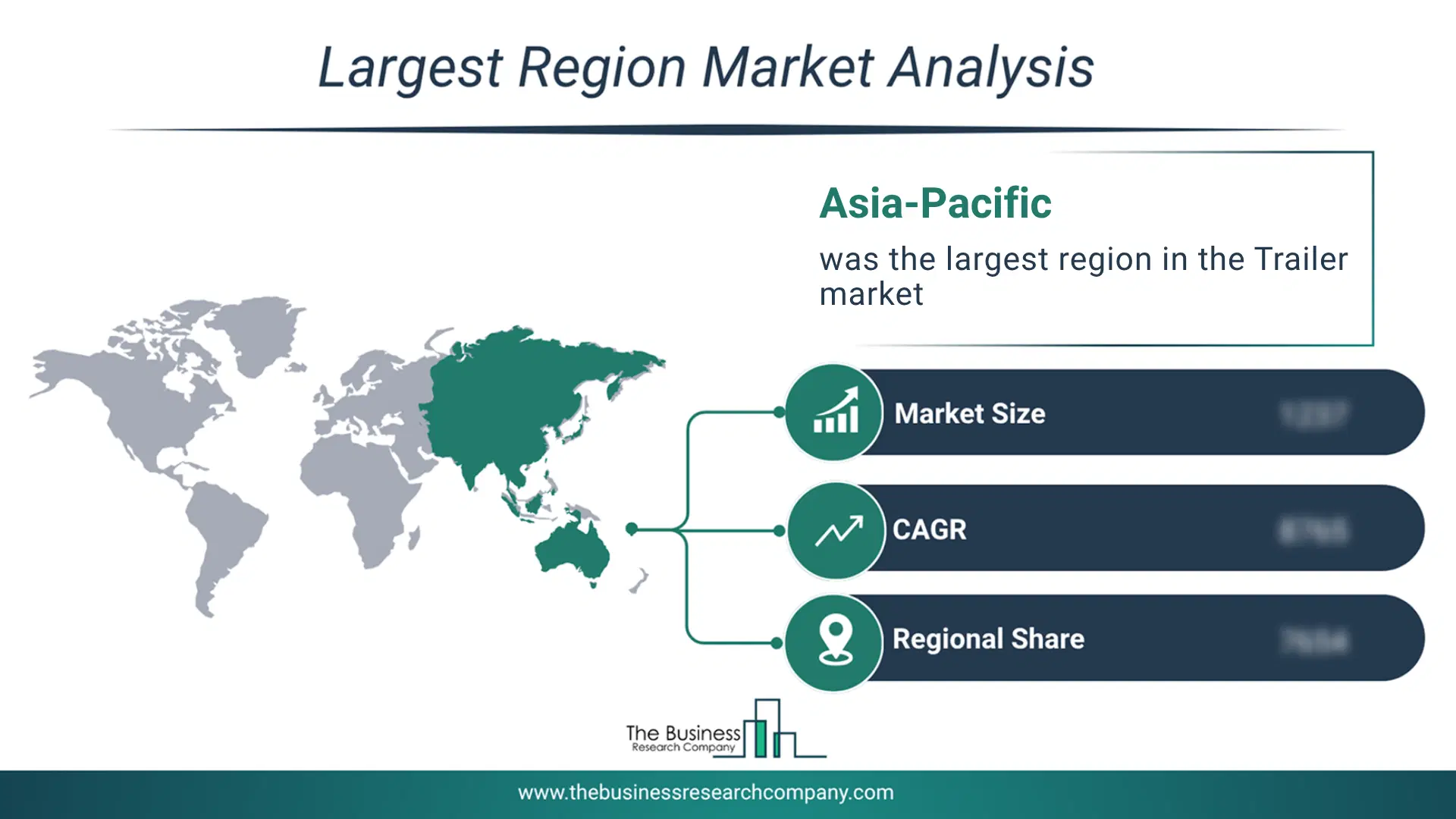
Regional Outlook
Asia-Pacific was the largest region in the trailer market of the trailers market in 2025. North America was the second-largest region of the trailer market. The regions covered in this market report include Asia-Pacific, South East Asia, Western Europe, Eastern Europe, North America, South America, Middle East, Africa. The countries covered in this market report include China, India, Japan, Australia, Indonesia, South Korea, Bangladesh, Thailand, Vietnam, Malaysia, Singapore, Philippines, Hong Kong, Taiwan, New Zealand, UK, Germany, France, Italy, Spain, Austria, Belgium, Denmark, Finland, Ireland, Netherlands, Norway, Portugal, Sweden, Switzerland, Russia, Czech Republic, Poland, Romania, Ukraine, USA, Canada, Mexico, Brazil, Chile, Argentina, Colombia, Peru, Saudi Arabia, Israel, Iran, Turkey, UAE, Egypt, Nigeria, South Africa.What Defines the Trailer Market?
The trailer market consists of sales of drop-deck/step-deck trailers, double drop/lowboy trailers, removable gooseneck trailers (RGN), extendable flatbed stretch trailers, and side-kit trailers. Values in this market are ‘factory gate’ values, that is the value of goods sold by the manufacturers or creators of the goods, whether to other entities (including downstream manufacturers, wholesalers, distributors and retailers) or directly to end customers. The value of goods in this market includes related services sold by the creators of the goods.How is Market Value Defined and Measured?
The market value is defined as the revenues that enterprises gain from the sale of goods and/or services within the specified market and geography through sales, grants, or donations in terms of the currency (in USD unless otherwise specified). The revenues for a specified geography are consumption values that are revenues generated by organizations in the specified geography within the market, irrespective of where they are produced. It does not include revenues from resales along the supply chain, either further along the supply chain or as part of other products.
This chart presents market attractiveness based on a quantitative evaluation of growth, competition, strategic alignment, and risk, offering a clear view of opportunity areas for decision-making. This chart is for illustrative purposes; the full report contains the complete analysis.

This chart highlights the Total Addressable Market (TAM) by estimating the maximum revenue opportunity using an assumption-driven approach, supporting strategic planning and opportunity sizing across markets. The chart is illustrative; the full report provides a more comprehensive analysis.
What Key Data and Analysis Are Included in the Trailer Market Report 2026?
The trailer market research report is one of a series of new reports from The Business Research Company that provides market statistics, including industry global market size, regional shares, competitors with the market share, detailed market segments, market trends and opportunities, and any further data you may need to thrive in the trailer industry. The market research report delivers a complete perspective of everything you need, with an in-depth analysis of the current and future state of the industry.Trailer Market Report Forecast Analysis
| Report Attribute | Details |
|---|---|
| Market Size Value In 2026 | $69.7 billion |
| Revenue Forecast In 2030 | $96.9 billion |
| Growth Rate | CAGR of 7.9% from 2026 to 2030 |
| Base Year For Estimation | 2025 |
| Actual Estimates/Historical Data | 2020-2025 |
| Forecast Period | 2026 - 2030 - 2030 |
| Market Representation | Revenue in USD Billion and CAGR from 2026 to 2030 |
| Segments Covered | Type, Axle Type, End-Use |
| Regional Scope | Asia-Pacific, Western Europe, Eastern Europe, North America, South America, Middle East, Africa |
| Country Scope | The countries covered in the report are Australia, Brazil, China, France, Germany, India, Indonesia, Japan, Taiwan, Russia, South Korea, UK, USA, Canada, Italy, Spain. |
| Key Companies Profiled | China International Marine Containers (Group) Ltd., Bernard Krone Holding SE & Co. KG, Wabash National Corporation, Schmitz Cargobull AG, EnTrans International LLC, Mac Trailer Manufacturing Inc., Heil Trailer International Co., Landoll Corporation, Trail King Industries Inc., Pitts Trailers, Doepker Industries Limited, Humbaur GmbH, Fontaine Trailer Company, East Manufacturing Company, Travis Body & Trailer Inc., Towmaster Trailers, Utility Trailer Manufacturing Company, Felling Trailers, Ledwell, Krone Trailer, Kögel Trailer GmbH & Co. KG, Dennison Trailers Ltd., MANAC INC., Böckmann Fahrzeugwerke GmbH, Ifor Williams Trailers Ltd. |
| Customization Scope | Request for Customization |
| Pricing And Purchase Options | Explore Purchase Options |