
Train Collision Avoidance System Market Report 2026
Global Outlook – By System Type (Positive Train Control (PTC), Automatic Train Control (ATC), Train Collision Avoidance System (TCAS), Automatic Train Protection (ATP), Computer-Based Train Control (CBTC)), By Technology (Radar-Based Systems, Sensor-Based Systems, Camera-Based Systems), By Propulsion Type (Electric, Diesel-Electric, Diesel-Hydraulic, Steam, Other Propulsion Types), By Application (High-Speed Rail, Metro Rail, Regional Rail, Intercity Rail, Freight Rail) – Market Size, Trends, Strategies, and Forecast to 2030
Train Collision Avoidance System Market Overview
• Train Collision Avoidance System market size has reached to $6.59 billion in 2025 • Expected to grow to $13.32 billion in 2030 at a compound annual growth rate (CAGR) of 15.1% • Growth Driver: Rising Demand for High-Speed Rail Networks Fuels Growth in Train Collision Avoidance Systems • Market Trend: AI-Enhanced Safety Investments Surge • Asia-Pacific was the largest region in 2025.What Is Covered Under Train Collision Avoidance System Market?
A train collision avoidance system (TCAS) is a safety mechanism designed to prevent collisions between trains by automatically monitoring their positions and speeds. It uses onboard sensors to detect potential risks and issue warnings or take corrective action, such as automatically slowing down or stopping the train if needed. TCAS helps enhance rail safety by minimizing human error and preventing accidents on rail networks. The main types of systems in the train collision avoidance system are positive train control (PTC), automatic train control (ATC), train collision avoidance system (TCAS), automatic train protection (ATP), and computer-based train control (CBTC). Positive train control (PTC) is a safety system designed to prevent train accidents caused by human error. The various technologies include radar-based systems, sensor-based systems, and camera-based systems, and several types of propulsion including electric, diesel-electric, diesel-hydraulic, steam, and others. The different applications encompass high-speed rail, metro rail, regional rail, intercity rail, and freight rail.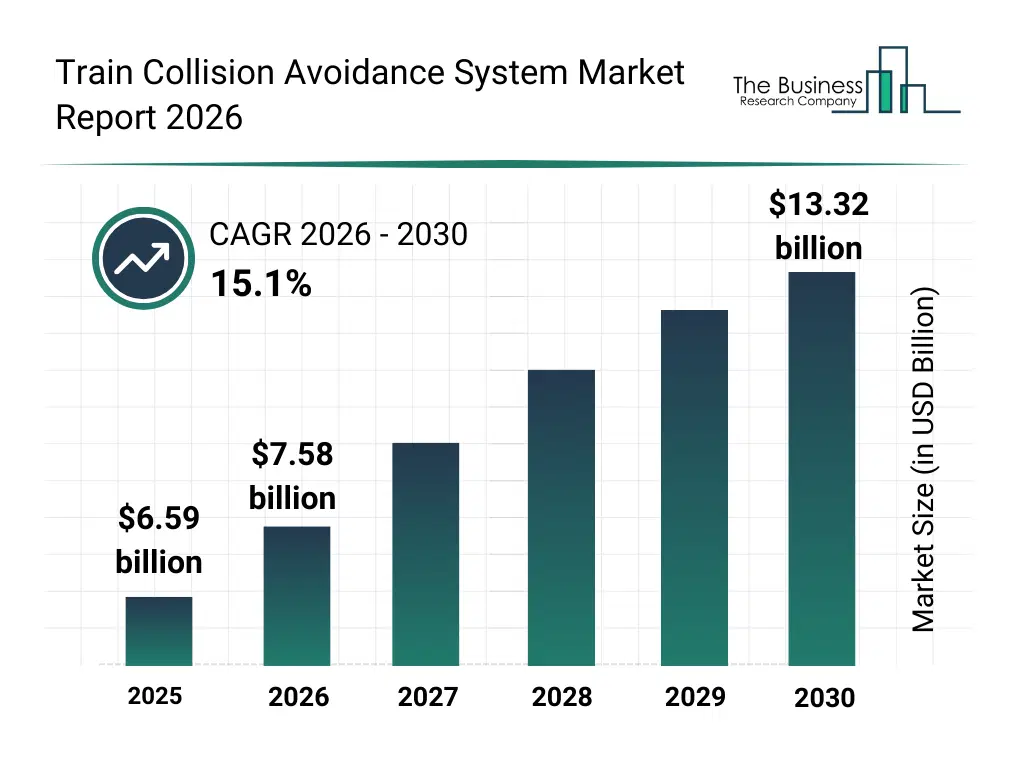
What Is The Train Collision Avoidance System Market Size and Share 2026?
The train collision avoidance system market size has grown rapidly in recent years. It will grow from $6.59 billion in 2025 to $7.58 billion in 2026 at a compound annual growth rate (CAGR) of 15.0%. The growth in the historic period can be attributed to increasing rail traffic density, rising safety regulations for rail operations, expansion of metro and high-speed rail networks, adoption of digital signaling systems, investments in rail safety infrastructure.What Is The Train Collision Avoidance System Market Growth Forecast?
The train collision avoidance system market size is expected to see rapid growth in the next few years. It will grow to $13.32 billion in 2030 at a compound annual growth rate (CAGR) of 15.1%. The growth in the forecast period can be attributed to increasing demand for fully automated rail operations, rising investments in smart rail safety technologies, expansion of ai-based traffic management, growing adoption of real-time monitoring platforms, increasing focus on zero-accident rail systems. Major trends in the forecast period include increasing deployment of automated train safety systems, rising adoption of cbtc and ptc technologies, growing use of sensor-based collision detection, expansion of real-time rail monitoring solutions, enhanced focus on rail network safety.
Global Train Collision Avoidance System Market Segmentation
1) By System Type: Positive Train Control (PTC), Automatic Train Control (ATC), Train Collision Avoidance System (TCAS), Automatic Train Protection (ATP), Computer-Based Train Control (CBTC) 2) By Technology: Radar-Based Systems, Sensor-Based Systems, Camera-Based Systems 3) By Propulsion Type: Electric, Diesel-Electric, Diesel-Hydraulic, Steam, Other Propulsion Types 4) By Application: High-Speed Rail, Metro Rail, Regional Rail, Intercity Rail, Freight Rail Subsegments: 1) By Positive Train Control (PTC): Interoperable PTC Systems, Non-Interoperable PTC Systems, Integrated PTC Systems 2) By Automatic Train Control (ATC): Continuous ATC Systems, Intermittent ATC Systems, Digital ATC Systems 3) By Train Collision Avoidance System (TCAS): TCAS II, TCAS III, Enhanced TCAS Solutions 4) By Automatic Train Protection (ATP): Line-Side ATP Systems, On-Board ATP Systems, Hybrid ATP Systems 5) By Computer-Based Train Control (CBTC): Fixed Block CBTC, Moving Block CBTC, Communication-Based CBTCWhat Is The Driver Of The Train Collision Avoidance System Market?
The rising demand for high-speed rail networks is expected to propel the growth of the train collision avoidance system market going forward. High-speed rail networks refer to rail systems designed for trains operating at speeds exceeding 250 km/h (155 mph), offering fast, efficient, and environmentally friendly transportation between major cities over long distances. High-speed rail networks are attributed to innovations in rail technology, growing demand for rapid transit, and the pursuit of environmentally sustainable transport solutions through government infrastructure investments. A train collision avoidance system helps high-speed rail networks by preventing collisions through real-time monitoring of train positions and automatically triggering braking systems to maintain safe distances between trains. For instance, in January 2024, the State Council Information Office (SICO), a China-based government administration, reported that by the end of 2023, the total length of China's high-speed rail network reached 45,000 km, with a target to expand to 70,000 km by the end of 2035. Therefore, the rising demand for high-speed rail networks drives the train collision avoidance system industry.Key Players In The Global Train Collision Avoidance System Market
Major companies operating in the train collision avoidance system market report include Siemens AG, Hitachi Ltd., Wabtec Corporation, CRRC Corporation Limited, Alstom SA, Thales Group, Mitsubishi Electric Corporation, CAF Signalling, Indra Sistemas S.A., Kernex Microsystems India Ltd., AŽD Praha s.r.o., Knorr-Bremse AG, MERMEC S.p.A., Medha Servo Drives Pvt. Ltd., HollySys Automation Technologies Ltd., Hitachi Rail STS, Bombardier Transportation (Alstom), Rail Vision Ltd., HBL Power Systems Ltd., Quester Tangent Corporation, Kawasaki Heavy Industries, ABB Ltd., Huawei Technologies Co. Ltd., Argenia Railway Technologies, Robert Bosch GmbH
This chart is for illustrative purposes; the full report includes a detailed competitor analysis and comprehensive overview of the top 10 companies in the market.
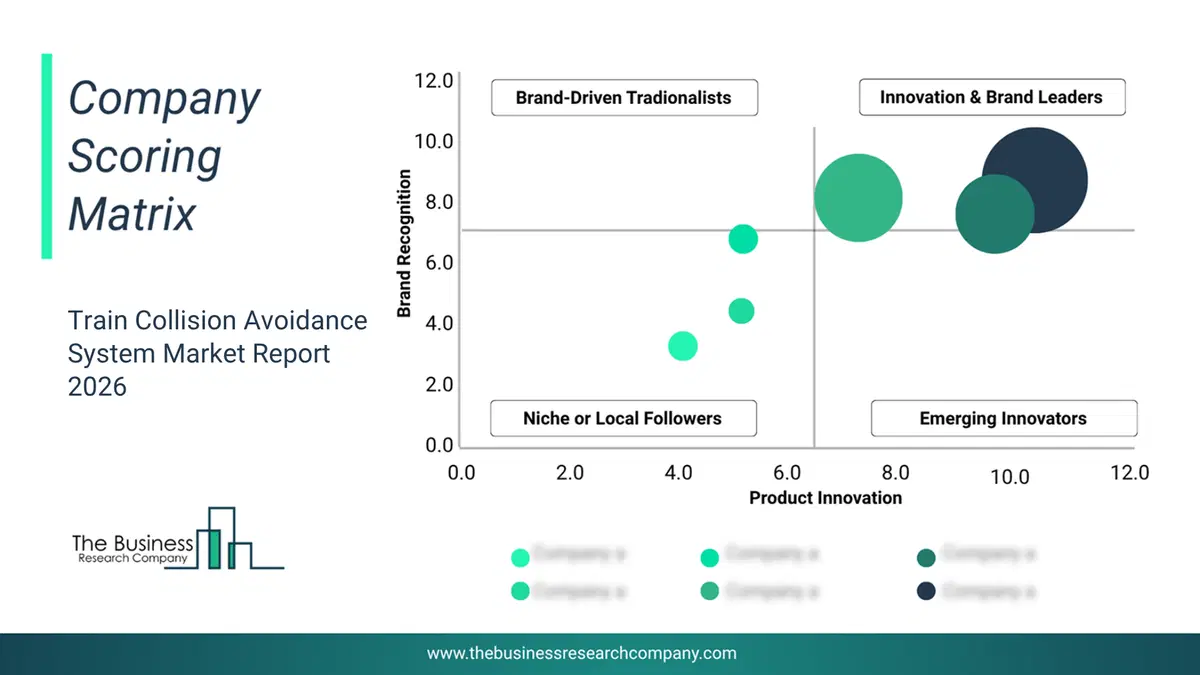
This chart maps companies by product innovation and brand strength, with bubble size indicating relative revenue, helping identify market leaders, challengers, and niche players. This is an illustrative chart; the full report provides a complete and accurate competitive analysis.
Global Train Collision Avoidance System Market Trends and Insights
Major companies operating in the train collision avoidance system market focus on strategic investments to enhance safety technologies, improve system efficiency, and comply with stringent regulatory standards. Strategic investments are directed toward innovations in sensor technologies, real-time data communication, and advanced braking systems. For instance, in July 2024, the Ministry of Railways, an India-based railway service, allocated $132.5 million to implement the Kavach automatic train protection (ATP) system for the 2024-25 fiscal year. Kavach enhances operational safety by automatically applying brakes if a train exceeds speed limits or the loco pilot fails to respond to danger signals, especially under adverse conditions like fog. Kavach has been installed across 1,465 route kilometers and 144 locomotives, predominantly on the South-Central Railway. The key infrastructure, including optical fiber cables and telecom towers, has been deployed over 4,275 kilometers, with installations at 285 stations.What Are Latest Mergers And Acquisitions In The Train Collision Avoidance System Market?
In August 2024, CG Power and Industrial Solutions Limited, an India-based electronics manufacturing company, acquired a 55% stake in G G Tronics India Private Ltd. for $0.038 Billion (Rs 319 crore). This acquisition strengthens CG Power's product offerings in railway safety by integrating G G Tronics' expertise in collision avoidance systems, enabling CG to pursue advanced safety projects such as KAVACH and enhancing its market position. G G Tronics India Private Ltd. is an India-based railroad equipment manufacturing company specializing in designing and manufacturing electronic safety embedded systems such as train collision avoidance systems for the railway sector.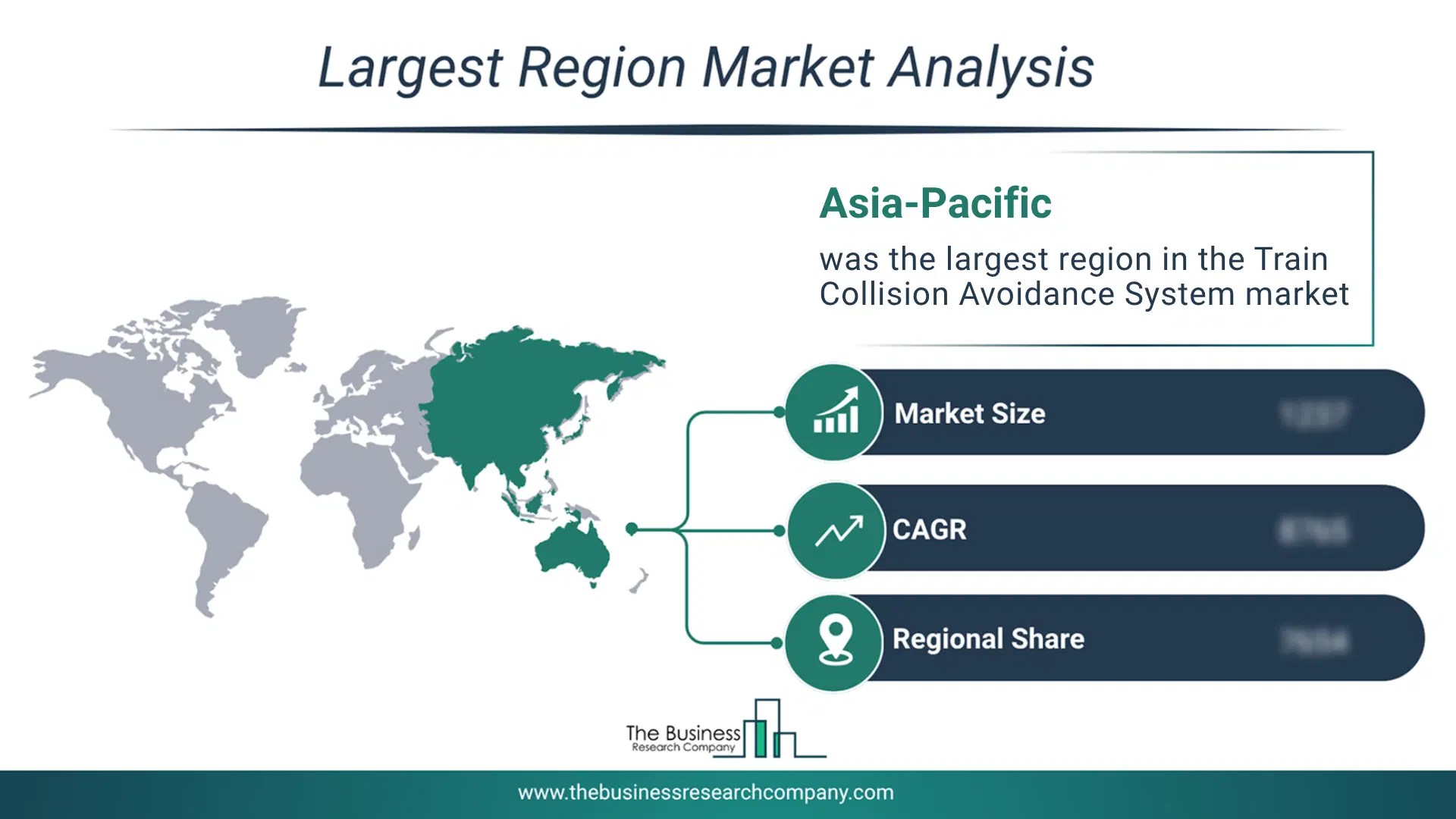
Regional Outlook
Asia-Pacific was the largest region in the train collision avoidance system market in 2025. The regions covered in this market report include Asia-Pacific, South East Asia, Western Europe, Eastern Europe, North America, South America, Middle East, Africa. The countries covered in this market report include Australia, Brazil, China, France, Germany, India, Indonesia, Japan, Taiwan, Russia, South Korea, UK, USA, Canada, Italy, SpainWhat Defines the Train Collision Avoidance System Market?
The train collision avoidance system market consists of revenues earned by entities by providing services such as real-time tracking, communication between trains and control centers, automated braking, and collision warnings to enhance rail safety. The market value includes the value of related goods sold by the service provider or included within the service offering. The train collision avoidance system market also includes sales of GPS devices, onboard computers, sensors, communication modules, automated braking systems, and signaling equipment. Values in this market are ‘factory gate’ values, that is the value of goods sold by the manufacturers or creators of the goods, whether to other entities (including downstream manufacturers, wholesalers, distributors, and retailers) or directly to end customers. The value of goods in this market includes related services sold by the creators of the goods.How is Market Value Defined and Measured?
The market value is defined as the revenues that enterprises gain from the sale of goods and/or services within the specified market and geography through sales, grants, or donations in terms of the currency (in USD unless otherwise specified). The revenues for a specified geography are consumption values that are revenues generated by organizations in the specified geography within the market, irrespective of where they are produced. It does not include revenues from resales along the supply chain, either further along the supply chain or as part of other products.
This chart presents market attractiveness based on a quantitative evaluation of growth, competition, strategic alignment, and risk, offering a clear view of opportunity areas for decision-making. This chart is for illustrative purposes; the full report contains the complete analysis.

This chart highlights the Total Addressable Market (TAM) by estimating the maximum revenue opportunity using an assumption-driven approach, supporting strategic planning and opportunity sizing across markets. The chart is illustrative; the full report provides a more comprehensive analysis.
What Key Data and Analysis Are Included in the Train Collision Avoidance System Market Report 2026?
The train collision avoidance system market research report is one of a series of new reports from The Business Research Company that provides market statistics, including industry global market size, regional shares, competitors with the market share, detailed market segments, market trends and opportunities, and any further data you may need to thrive in the train collision avoidance system industry. The market research report delivers a complete perspective of everything you need, with an in-depth analysis of the current and future state of the industry.Train Collision Avoidance System Market Report Forecast Analysis
| Report Attribute | Details |
|---|---|
| Market Size Value In 2026 | $7.58 billion |
| Revenue Forecast In 2030 | $13.32 billion |
| Growth Rate | CAGR of 15.0% from 2026 to 2030 |
| Base Year For Estimation | 2025 |
| Actual Estimates/Historical Data | 2020-2025 |
| Forecast Period | 2026 - 2030 - 2030 |
| Market Representation | Revenue in USD Billion and CAGR from 2026 to 2030 |
| Segments Covered | System Type, Technology, Propulsion Type, Application |
| Regional Scope | Asia-Pacific, Western Europe, Eastern Europe, North America, South America, Middle East, Africa |
| Country Scope | The countries covered in the report are Australia, Brazil, China, France, Germany, India, Indonesia, Japan, Taiwan, Russia, South Korea, UK, USA, Canada, Italy, Spain. |
| Key Companies Profiled | Siemens AG, Hitachi Ltd., Wabtec Corporation, CRRC Corporation Limited, Alstom SA, Thales Group, Mitsubishi Electric Corporation, CAF Signalling, Indra Sistemas S.A., Kernex Microsystems India Ltd., AŽD Praha s.r.o., Knorr-Bremse AG, MERMEC S.p.A., Medha Servo Drives Pvt. Ltd., HollySys Automation Technologies Ltd., Hitachi Rail STS, Bombardier Transportation (Alstom), Rail Vision Ltd., HBL Power Systems Ltd., Quester Tangent Corporation, Kawasaki Heavy Industries, ABB Ltd., Huawei Technologies Co. Ltd., Argenia Railway Technologies, Robert Bosch GmbH |
| Customization Scope | Request for Customization |
| Pricing And Purchase Options | Explore Purchase Options |