
Transmission Towers Market Report 2026
Global Outlook – By Type (Self-Supporting Towers, Guyed Towers, Monopole Towers ), By Material (Aluminum, Concrete, Galvanized Steel, Wood, Other Materials), By Voltage (132 Kilovolts To 220 Kilovolts, > 220 Kilovolts To 660 Kilovolts, > 660 Kilovolt ), By Application (Transmission Of Electric Power, Telecommunication, Broadcasting, Railway Electrification ), By End-User (Government, Railway, Telecommunication, Defense, Power And Energy, Other End-Users) – Market Size, Trends, Strategies, and Forecast to 2030
Transmission Towers Market Overview
• Transmission Towers market size has reached to $20.71 billion in 2025 • Expected to grow to $28.01 billion in 2030 at a compound annual growth rate (CAGR) of 6.2% • Growth Driver: Surge In Electricity Demand Fueling The Growth Of The Market Due To Urbanization And Increasing Energy Consumption • Market Trend: Innovative Space Optimization Towers Revolutionize Urban Transmission Infrastructure • North America was the largest region and fastest growing region.Market Gains By 2030 – Top Opportunities By Segment
Market Gain identifies the most promising market opportunities by highlighting the segments or products expected to generate the highest incremental revenue growth over the next five years.
What Is Covered Under Transmission Towers Market?
Transmission towers refer to tall, sturdy structures designed to support overhead power lines that transmit electricity over long distances. They are used for safely carrying high-voltage electrical cables across various terrains, ensuring reliable delivery of power from generation plants to substations and distribution networks. The main types of transmission towers are self-supporting towers, guyed towers, and monopole towers. Self-supporting towers are independent, free-standing structures that do not rely on external supports such as wires or anchors. These towers are constructed using various materials, including aluminum, concrete, galvanized steel, wood, and others, and they are operated through different voltage levels, including 132–220 kilovolts, above 220–660 kilovolts, and over 660 kilovolts. The various applications involved are electric power transmission, telecommunications, broadcasting, and railway electrification and are used by several end users such as government, railways, telecommunications, defense, power and energy, and others.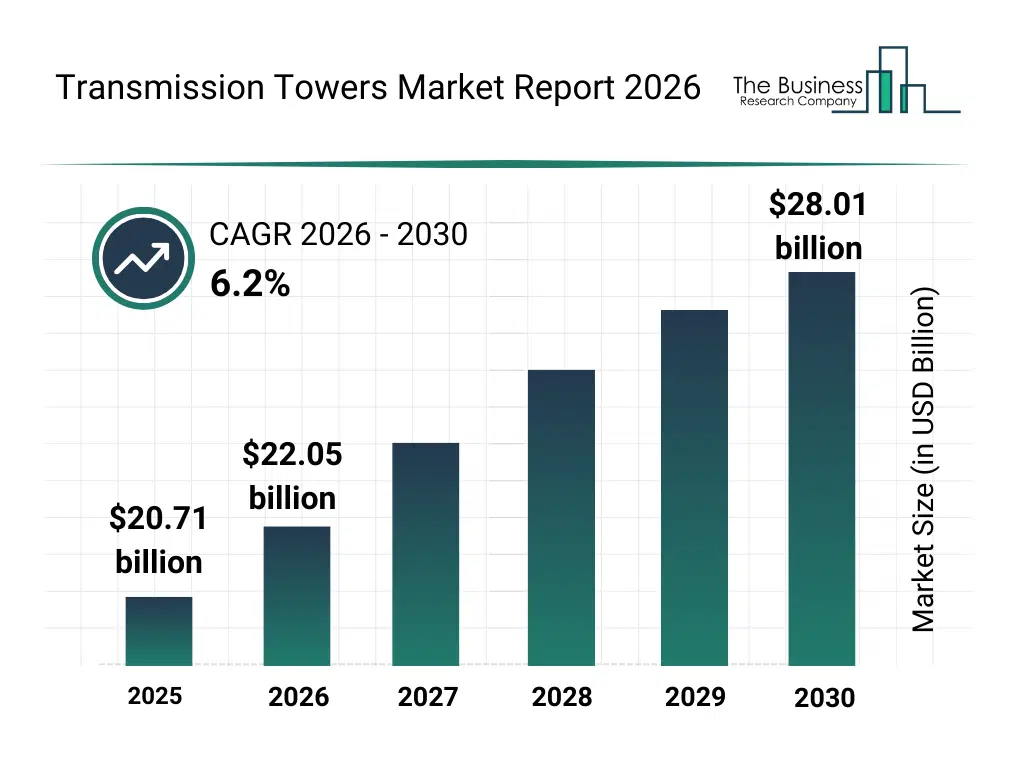
What Is The Transmission Towers Market Size and Share 2026?
The transmission towers market size has grown strongly in recent years. It will grow from $20.71 billion in 2025 to $22.05 billion in 2026 at a compound annual growth rate (CAGR) of 6.5%. The growth in the historic period can be attributed to increasing electrification projects, steady expansion of national grids, long-term use of steel-based tower materials, reliance on imported metals, early adoption of lattice tower designs.What Is The Transmission Towers Market Growth Forecast?
The transmission towers market size is expected to see strong growth in the next few years. It will grow to $28.01 billion in 2030 at a compound annual growth rate (CAGR) of 6.2%. The growth in the forecast period can be attributed to rising grid modernization programs, expansion of renewable energy transmission lines, increased deployment of high-voltage corridors, growing investment in corrosion-resistant tower materials, accelerated infrastructure upgrades. Major trends in the forecast period include growing deployment of grid modernization tools, rising demand for durable tower structures, expansion of high-voltage power networks, increased adoption of automated inspection technologies, growth in structural performance monitoring.
Global Transmission Towers Market Segmentation
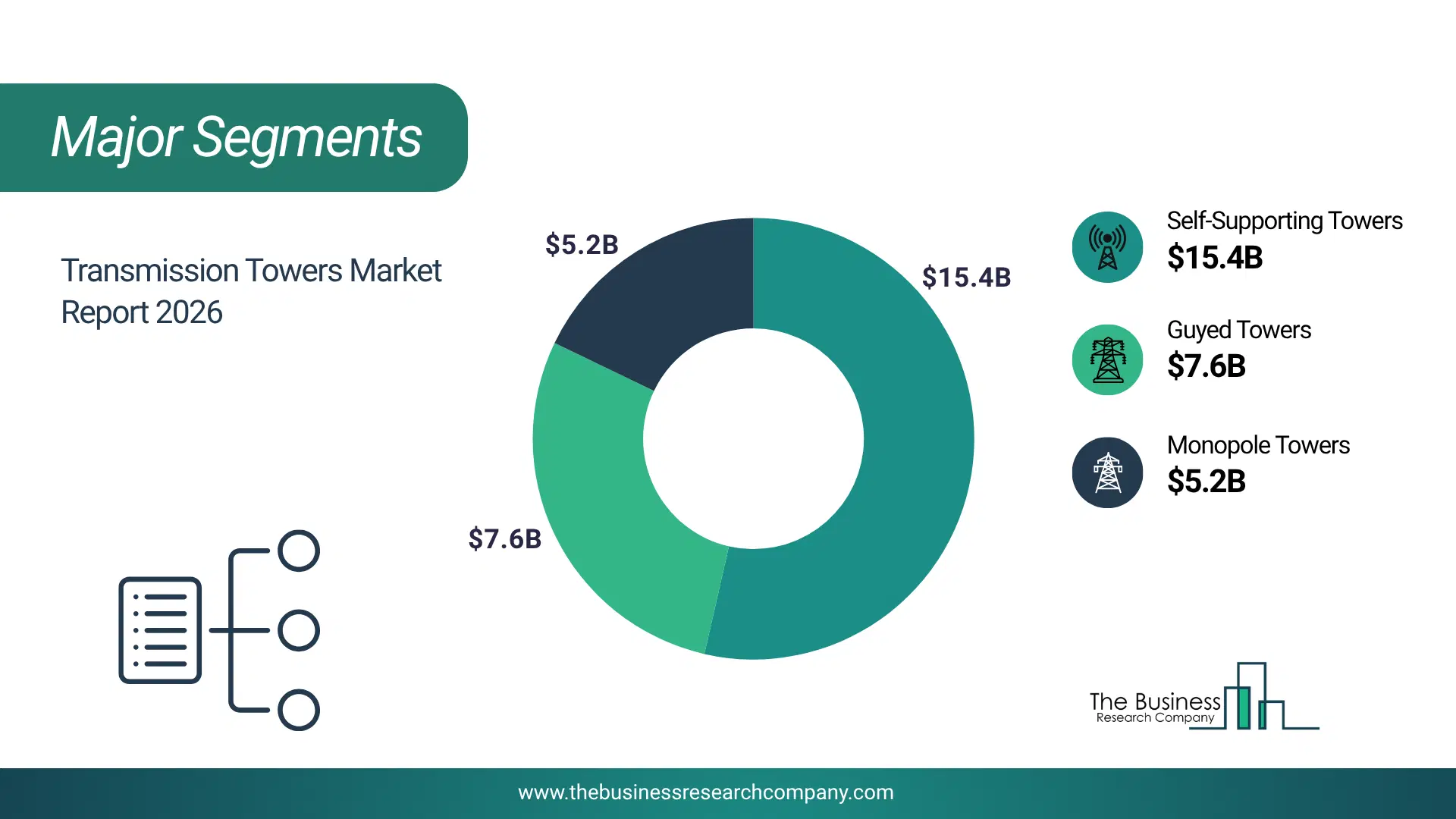
1) By Type: Self-Supporting Towers, Guyed Towers, Monopole Towers 2) By Material: Aluminum, Concrete, Galvanized Steel, Wood, Other Materials 3) By Voltage: 132 Kilovolts To 220 Kilovolts, > 220 Kilovolts To 660 Kilovolts, > 660 Kilovolt 4) By Application: Transmission Of Electric Power, Telecommunication, Broadcasting, Railway Electrification 5) By End-User: Government, Railway, Telecommunication, Defense, Power And Energy, Other End-Users Subsegments: 1) By Self-Supporting Towers: Lattice Towers, Tubular Steel Towers, Space Frame Towers 2) By Guyed Towers: Single-Circuit Guyed Towers, Double-Circuit Guyed Towers, Multiple-Circuit Guyed Towers 3) By Monopole Towers: Steel Monopoles, Concrete Monopoles, Hybrid Monopoles The top segments in the transmission towers market will be: • Self-Supporting Towers will reach $15.3 billion by 2030. • Guyed Towers will reach $7.52 billion by 2030. • Monopole Towers will reach $5.19 billion by 2030.What Is The Driver Of The Transmission Towers Market?
The increasing demand for electricity is expected to propel the growth of the transmission towers market going forward. Electricity refers to the flow of electric charge, typically through conductors, which can be harnessed to produce light, heat, and power. The rise in electricity demand is due to an increase in urbanization, which leads to more residential and commercial energy consumption. Transmission towers play a crucial role in meeting electricity demand by efficiently carrying high-voltage power over long distances from generation plants to distribution networks. For instance, in July 2024, according to the International Energy Agency (IEA), a France-based intergovernmental organization, global electricity demand increased by approximately 4% in 2024, compared to a 2.5% growth rate in 2023. Therefore, the increasing demand for electricity is driving the growth of the transmission towers industry.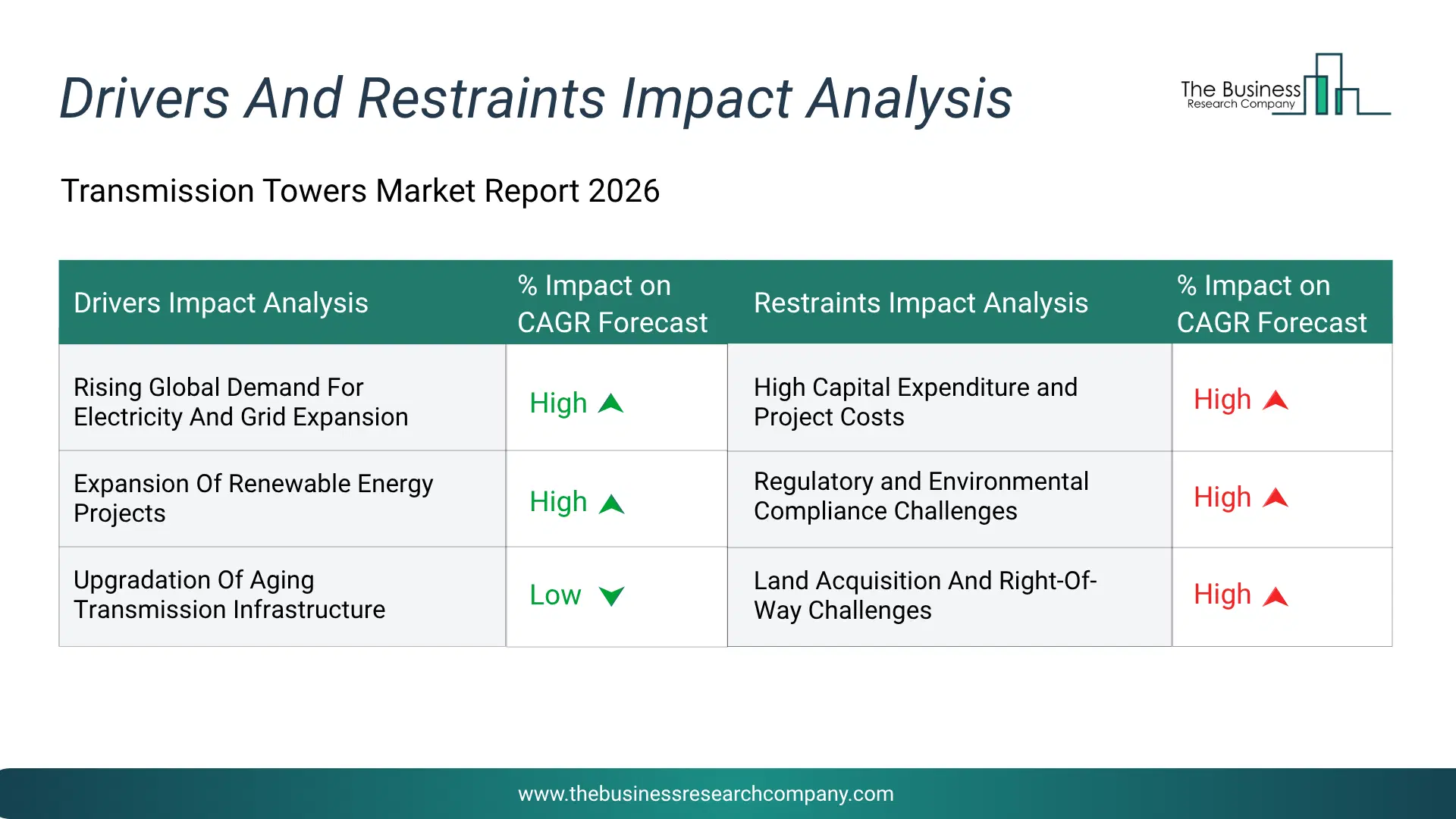
Infographic Chart Showing Key Market Drivers Analysis And Restraints For Transmission Towers Market
The chart presents an impact analysis of key drivers and restraints, quantifying their relative influence on the market's growth rate and helping assess the balance between growth enablers and limiting factors. This chart offers a high-level perspective; the full report contains more detailed insights.
How Will The Drivers Impact Growth In The Global Transmission Towers Market?
• Rising Global Demand For Electricity And Grid Expansion (High) – During the forecast period, the rising global demand for electricity and grid expansion is expected to become a key growth driver for the transmission towers market by 2030. Increasing electricity consumption driven by urbanization, industrialization, and population growth is fueling demand for new transmission infrastructure. Transmission towers form the backbone of power grids, enabling efficient long -distance electricity transmission from power plants to substations and end -users. Governments and private utilities are investing heavily in grid expansion projects to improve energy access, enhance reliability, and reduce transmission losses. The continuous need to strengthen and modernize power infrastructure worldwide is a key driver for the transmission towers market, as robust grids are critical for sustaining economic growth and supporting renewable energy integration. • Expansion Of Renewable Energy Projects (High) – During the forecast period, the expansion of renewable energy projects is expected to emerge as a major factor driving the expansion of the transmission towers market by 2030. The global shift toward renewable energy sources such as wind, solar, and hydroelectric power requires extensive transmission infrastructure to transport electricity from often remote generation sites to urban consumption centers. Transmission towers are essential for connecting large-scale solar parks, wind farms, and hydropower plants to existing grids. The increasing focus on clean energy generation and carbon reduction targets by governments and private players is driving investment in high-capacity transmission networks, which in turn boosts demand for transmission towers and associated components. • Upgradation Of Aging Transmission Infrastructure (Low) – During the forecast period, the upgradation of aging transmission infrastructure is expected to act as a key growth catalyst for the transmission towers market by 2030. Many countries, particularly in north america, europe, and asia, are modernizing aging electricity transmission systems to enhance reliability, reduce maintenance costs, and prevent outages. Old towers, lines, and components require replacement or reinforcement to meet current safety and performance standards. The need for durable, high-capacity, and technologically advanced transmission towers encourages investment in new designs, materials, and construction methods. This continuous infrastructure upgradation acts as a strong growth driver for the transmission towers market, ensuring grid stability and energy efficiency.How Will The Restraints Impact Growth In The Global Transmission Towers Market?
• High Capital Expenditure and Project Costs (High) – During the forecast period, the the construction and installation of transmission towers involve substantial capital investment, including land acquisition, materials, labor, and engineering services. High project costs, particularly for long-distance or high-voltage lines, can be a barrier for utilities or new market entrants. Additionally, financing challenges in emerging economies may slow project execution. These high capital expenditure requirements act as a restraint on market growth, limiting the pace at which new towers can be deployed, particularly in cost-sensitive regions. • Regulatory and Environmental Compliance Challenges (High) – During the forecast period, the transmission tower construction requires compliance with multiple regulatory frameworks, including environmental clearances, land acquisition approvals, and safety standards. Lengthy approval processes and strict regulations, especially in ecologically sensitive regions, can cause project delays and increase costs. These compliance requirements act as a significant restraint on the market, particularly in regions where bureaucratic hurdles are high or environmental concerns are prioritized. • Land Acquisition And Right-Of-Way Challenges (High) – During the forecast period, the the construction of transmission towers often requires securing land access and rights-of-way across multiple jurisdictions and private properties. Negotiations, legal disputes, and stakeholder opposition can significantly delay project execution. These challenges increase development costs and create project uncertainties. As a result, network expansion plans may be postponed or scaled back.Key Players In The Global Transmission Towers Market
Major companies operating in the transmission towers market are Valmont Industries Inc., Sabre Industries Inc., KEC International Limited, Kalpataru Power Transmission Limited, Tata Projects Limited, Canam Group Inc., Sterlite Power Transmission Limited, Al-Babtain Power and Telecommunications Company, Karamtara Engineering Private Limited, Skipper Limited, Associated Power Structures Limited, SAE Towers Holdings LLC, Kocaer Çelik Sanayi ve Ticaret A.S., Utkarsh India Limited, Jyoti Structures Limited, Zamil Steel Holding Company, Shandong Dingchang Tower Co. Ltd., Jiangsu Huadan Steel Tower Manufacturing Co. Ltd., Groovefab International Private Limited, Qingdao BST Steel Structure Co. Ltd.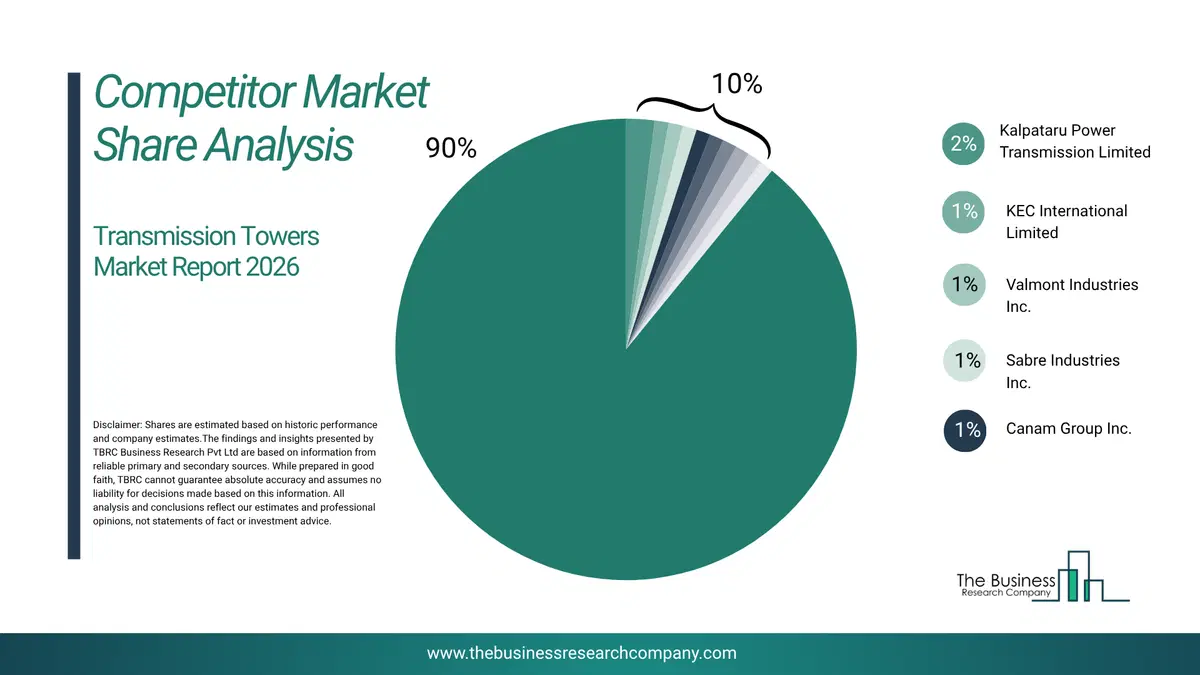
This chart is for illustrative purposes; the full report includes a detailed competitor analysis and comprehensive overview of the top 10 companies in the market.
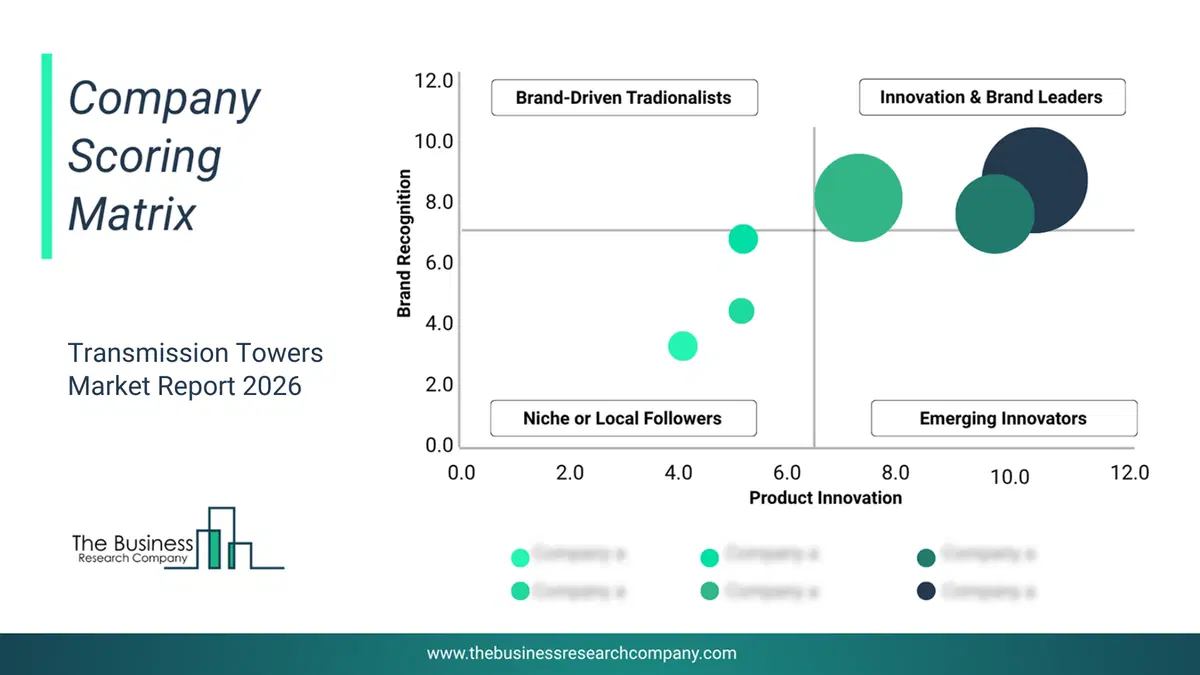
This chart maps companies by product innovation and brand strength, with bubble size indicating relative revenue, helping identify market leaders, challengers, and niche players. This is an illustrative chart; the full report provides a complete and accurate competitive analysis.
Global Transmission Towers Market Trends and Insights
Major companies operating in the transmission towers market are focusing on developing advanced innovations, such as space optimization towers, to enhance structural efficiency, reduce land use, and improve grid reliability. Space optimization towers are transmission towers designed to minimize the land area they occupy while maximizing their capacity to support electrical conductors, improving the efficient use of space in crowded or urban environments. For instance, in July 2023, Tata Power Company Limited, an India-based electric power distribution company, introduced a tower-within-tower design to upgrade its 110 kV transmission network in Mumbai. This design features narrow-based towers erected within the footprint of existing towers, allowing faster construction with reduced land acquisition costs, enhanced safety, and minimal power outages, especially suited for densely populated metropolitan areas.What Are Latest Mergers And Acquisitions In The Transmission Towers Market?
In August 2023, Adani Energy Solutions Limited, an India-based electric power distribution company, acquired the KPS1 transmission project from Megha Engineering and Infrastructures Limited (MEIL) for an undisclosed amount. With this acquisition, Adani aims to strengthen its foothold in India’s power transmission sector, enhance grid reliability, and support the integration of large-scale renewable energy projects, including the development of a 20-gigawatt hybrid renewable energy park in Khavda, Gujarat. Megha Engineering and Infrastructures Limited is an India-based company that produces transmission towers and landline and wireless telecom equipment.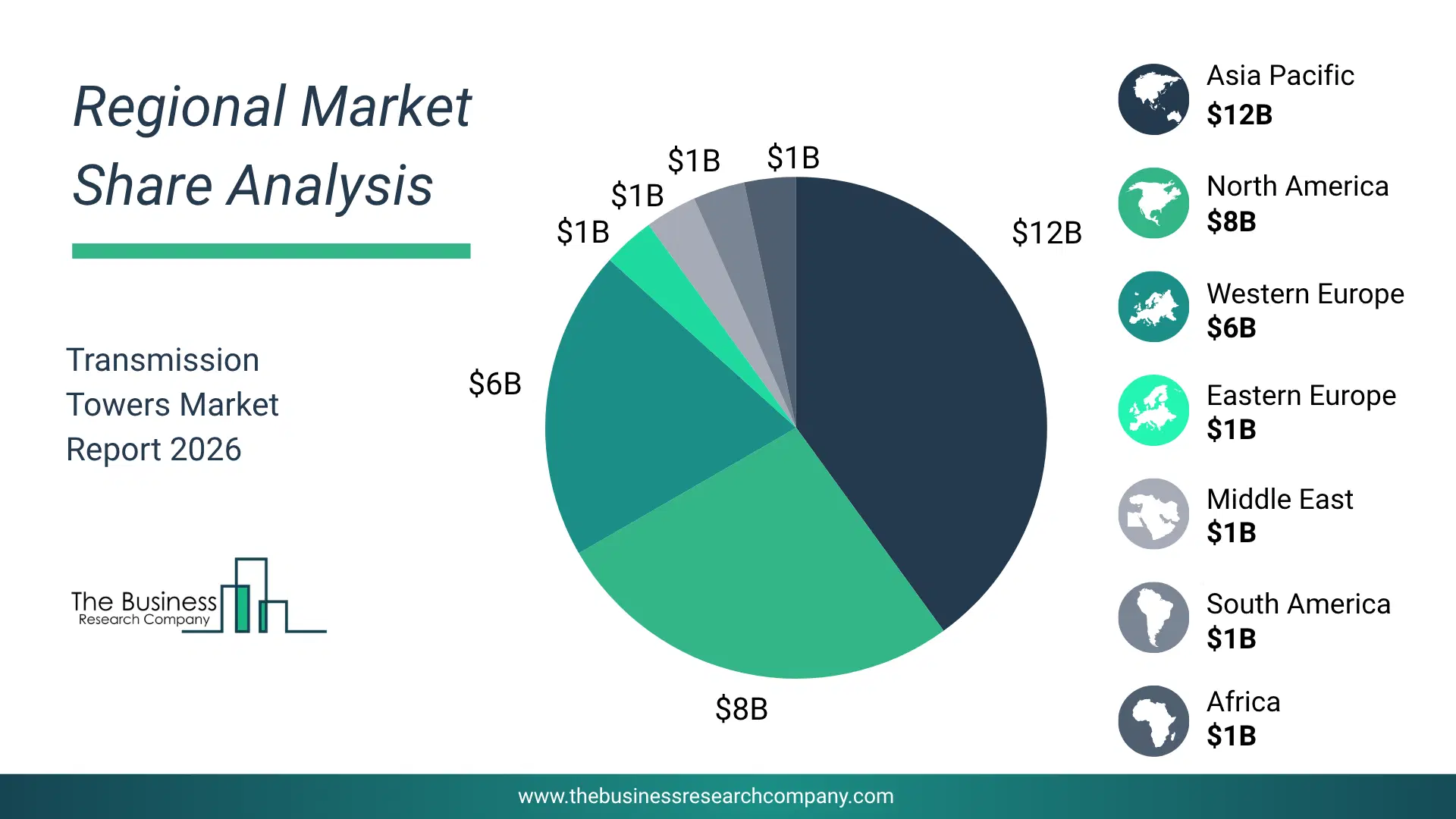
Regional Insights
North America was the largest region in the transmission towers market in 2025. Asia-Pacific is expected to be the fastest-growing region in the forecast period. The regions covered in this market report are Asia-Pacific, South East Asia, Western Europe, Eastern Europe, North America, South America, Middle East, Africa. The countries covered in this market report are Australia, Brazil, China, France, Germany, India, Indonesia, Japan, Taiwan, Russia, South Korea, UK, USA, Canada, Italy, Spain.What Defines the Transmission Towers Market?
The transmission towers market consists of sales of cross arms, insulators, tower extensions, anchor bolts, foundation hardware, anti-climbing devices, lightning protection systems, vibration dampers, and corrosion protection coatings. Values in this market are ‘factory gate’ values, that is, the value of goods sold by the manufacturers or creators of the goods, whether to other entities (including downstream manufacturers, wholesalers, distributors, and retailers) or directly to end customers. The value of goods in this market includes related services sold by the creators of the goods.How is Market Value Defined and Measured?
The market value is defined as the revenues that enterprises gain from the sale of goods and/or services within the specified market and geography through sales, grants, or donations in terms of the currency (in USD unless otherwise specified). The revenues for a specified geography are consumption values that are revenues generated by organizations in the specified geography within the market, irrespective of where they are produced. It does not include revenues from resales along the supply chain, either further along the supply chain or as part of other products.
This chart presents market attractiveness based on a quantitative evaluation of growth, competition, strategic alignment, and risk, offering a clear view of opportunity areas for decision-making. This chart is for illustrative purposes; the full report contains the complete analysis.

This chart highlights the Total Addressable Market (TAM) by estimating the maximum revenue opportunity using an assumption-driven approach, supporting strategic planning and opportunity sizing across markets. The chart is illustrative; the full report provides a more comprehensive analysis.
What Key Data and Analysis Are Included in theTransmission Towers Market Report 2026?
The transmission towers market research report is one of a series of new reports from The Business Research Company that provides market statistics, including industry global market size, regional shares, competitors with the market share, detailed market segments, market trends and opportunities, and any further data you may need to thrive in the transmission towers industry. The market research report delivers a complete perspective of everything you need, with an in-depth analysis of the current and future state of the industry.Transmission Towers Market Report Forecast Analysis
| Report Attribute | Details |
|---|---|
| Market Size Value In 2026 | $22.05 billion |
| Revenue Forecast In 2030 | $28.01 billion |
| Growth Rate | CAGR of 6.2% from 2026 to 2030 |
| Base Year For Estimation | 2025 |
| Actual Estimates/Historical Data | 2020-2025 |
| Forecast Period | 2026 - 2030 |
| Market Representation | Revenue in USD Billion and CAGR from 2026 to 2030 |
| Segments Covered | Type, Material, Voltage, Application, End-User |
| Regional Scope | Asia-Pacific, Western Europe, Eastern Europe, North America, South America, Middle East, Africa |
| Country Scope | The countries covered in the report are Australia, Brazil, China, France, Germany, India, ... |
| Key Companies Profiled | Valmont Industries Inc., Sabre Industries Inc., KEC International Limited, Kalpataru Power Transmission Limited, Tata Projects Limited, Canam Group Inc., Sterlite Power Transmission Limited, Al-Babtain Power and Telecommunications Company, Karamtara Engineering Private Limited, Skipper Limited, Associated Power Structures Limited, SAE Towers Holdings LLC, Kocaer Çelik Sanayi ve Ticaret A.S., Utkarsh India Limited, Jyoti Structures Limited, Zamil Steel Holding Company, Shandong Dingchang Tower Co. Ltd., Jiangsu Huadan Steel Tower Manufacturing Co. Ltd., Groovefab International Private Limited, Qingdao BST Steel Structure Co. Ltd. |
| Customization Scope | Request for Customization |
| Pricing And Purchase Options | Explore Purchase Options |