
Transmucosal Drug Delivery Devices Market Report 2026
Global Outlook – By Type (Buccal Drug Delivery Devices, Sublingual Drug Delivery Devices, Nasal Drug Delivery Devices, Rectal Drug Delivery Devices, Vaginal Drug Delivery Devices), By Drug Type (Buccal Tablets, Oral Sprays, Sublingual Films And Wafers, Gels, Medicated Confectionery, Other Drug Types), By Indication (Pain Management, Addiction Treatment, Hormonal Therapies, Others Indications), By End User (Academic And Research Institutes, Pharmaceutical And Biotechnology Companies, Diagnostic Laboratories, Hospitals) – Market Size, Trends, Strategies, and Forecast to 2035
Transmucosal Drug Delivery Devices Market Overview
• Transmucosal Drug Delivery Devices market size has reached to $54.63 billion in 2025 • Expected to grow to $81.52 billion in 2030 at a compound annual growth rate (CAGR) of 8.1% • Growth Driver: Growth In Chronic Diseases Propels Transmucosal Drug Delivery Devices Market • Market Trend: Innovative Technologies Transforming Transmucosal Drug Delivery Devices • North America was the largest region in 2025.What Is Covered Under Transmucosal Drug Delivery Devices Market?
Transmucosal drug delivery devices are medical devices designed to deliver drugs through the mucous membranes, such as those in the mouth, nose, or rectum, for rapid absorption into the bloodstream. These devices are used to administer medications that are poorly absorbed by the gastrointestinal tract or that require quick onset of action, such as pain relief or hormone therapy. Their purpose is to bypass the digestive system, providing a more direct and efficient route for drug delivery. The main types of transmucosal drug delivery devices are passive transmucosal drug delivery and active transmucosal drug delivery devices. Passive transmucosal drug delivery refers to the process where drugs are absorbed through mucous membranes without the use of external energy or active transport mechanisms. The types of drugs available include buccal tablets, oral sprays, sublingual films, wafers, gels, medicated confectionery, and others, used for indications such as pain management, addiction treatment, and hormonal therapies. End users encompass academic and research institutes, pharmaceutical and biotechnology companies, diagnostics laboratories, and hospitals.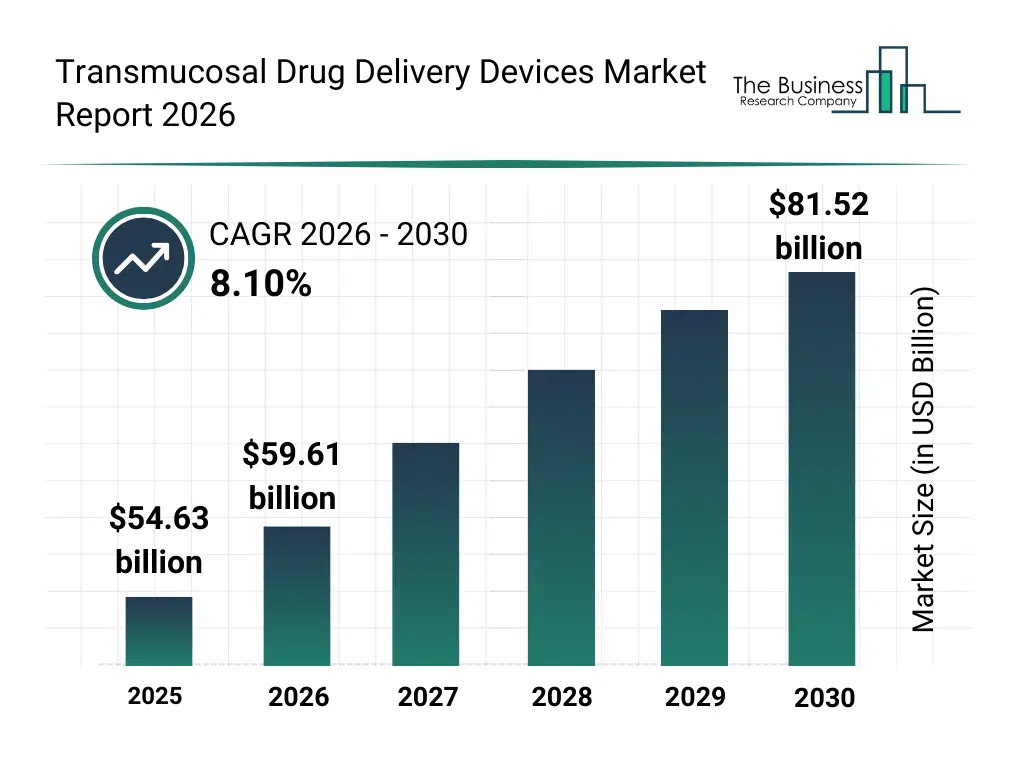
What Is The Transmucosal Drug Delivery Devices Market Size and Share 2026?
The transmucosal drug delivery devices market size has grown strongly in recent years. It will grow from $54.63 billion in 2025 to $59.61 billion in 2026 at a compound annual growth rate (CAGR) of 9.1%. The growth in the historic period can be attributed to expansion of non-invasive drug delivery approaches, rising demand for pain management therapies, increased use of hormone replacement treatments, growth in pharmaceutical formulation innovation, wider acceptance of transmucosal therapies.What Is The Transmucosal Drug Delivery Devices Market Growth Forecast?
The transmucosal drug delivery devices market size is expected to see strong growth in the next few years. It will grow to $81.52 billion in 2030 at a compound annual growth rate (CAGR) of 8.1%. The growth in the forecast period can be attributed to increasing development of personalized medicine solutions, rising investments in advanced drug delivery platforms, growing demand for at-home drug administration devices, expansion of biologics and peptide-based drugs, increased regulatory approvals for novel delivery systems. Major trends in the forecast period include increasing adoption of buccal and sublingual delivery formats, growing demand for rapid onset drug administration, expansion of microneedle and active delivery technologies, rising focus on patient-friendly drug delivery devices, enhanced emphasis on dose accuracy and bioavailability.
Global Transmucosal Drug Delivery Devices Market Segmentation
1) By Type: Buccal Drug Delivery Devices, Sublingual Drug Delivery Devices, Nasal Drug Delivery Devices, Rectal Drug Delivery Devices, Vaginal Drug Delivery Devices 2) By Drug Type: Buccal Tablets, Oral Sprays, Sublingual Films And Wafers, Gels, Medicated Confectionery, Other Drug Types 3) By Indication: Pain Management, Addiction Treatment, Hormonal Therapies, Others Indications 4) By End User: Academic And Research Institutes, Pharmaceutical And Biotechnology Companies, Diagnostic Laboratories, Hospitals Subsegments: 1) By Buccal Drug Delivery Devices: Mucoadhesive Buccal Tablets, Buccal Patches, Buccal Films 2) By Sublingual Drug Delivery Devices: Sublingual Tablets, Sublingual Films, Sublingual Sprays 3) By Nasal Drug Delivery Devices: Metered Dose Nasal Sprays, Nasal Powder Devices, Nasal Gel Applicators 4) By Rectal Drug Delivery Devices: Rectal Suppositories, Rectal Gels 5) By Vaginal Drug Delivery Devices: Vaginal Rings, Vaginal Tablets, Vaginal GelsWhat Is The Driver Of The Transmucosal Drug Delivery Devices Market?
The growing prevalence of chronic diseases is expected to propel the growth of the transmucosal drug delivery devices market going forward. A chronic disease refers to a long-lasting condition that typically progresses slowly and persists over time, often requiring ongoing medical management to control symptoms and prevent complications. Chronic diseases are rising as a result of, lifestyle factors, aging populations, environmental factors, healthcare system challenges, and urbanization. Transmucosal drug delivery devices are used in chronic diseases to provide controlled and efficient delivery of medications, ensuring sustained therapeutic levels for managing symptoms and improving patient adherence. For instance, in June 2024, according to the National Health Service, a UK-based government department, 3,615,330 individuals registered with a general practitioner (GP) were diagnosed with non-diabetic hyperglycemia or pre-diabetes (a condition with elevated blood sugar levels, not high enough to be classified as diabetes) in 2023, marking an 18% increase from 3,065,825 cases in 2022. Therefore, growing prevalence of chronic diseases is driving the transmucosal drug delivery devices industry.Key Players In The Global Transmucosal Drug Delivery Devices Market
Major companies operating in the transmucosal drug delivery devices market are Johnson & Johnson, Bayer AG, Sanofi SA, Bristol-Myers Squibb Company, Abbott Laboratories, Novartis AG, Viatris Inc., Teva Pharmaceutical Industries Ltd., Catalent Inc., AptarGroup, Glenmark Pharmaceuticals Limited, Stevanato Group S.p.A, Noven Pharmaceuticals, Antares Pharma Inc., Satsuma Pharmaceuticals Inc., AdvaCare Pharma LLP, Lifevision Healthcare Private Limited, SAVA Healthcare Limited, Kaizen Pharmaceuticals Pvt. Ltd., Maya Biotech Pvt. LtdGlobal Transmucosal Drug Delivery Devices Market Trends and Insights
Major companies operating in transmucosal drug delivery devices are developing innovative smart platform, such as proprietary transdermal patch delivery platforms that enhance drug absorption and improve patient compliance and convenience. Proprietary transdermal patch delivery platforms refer to specialized technologies owned by companies for administering medications through the skin, ensuring controlled release, and enhanced therapeutic outcomes. For instance, in January 2024, Starton Therapeutics Inc, a US-based biotechnology company, launched STARSILON, a novel proprietary transdermal patch delivery platform, for a longer duration to achieve therapeutic delivery of difficult-to-formulate APIs. It expands transdermal drug delivery options for challenging active pharmaceutical ingredients (APIs), enhancing therapeutic efficacy with sustained delivery rates.What Are Latest Mergers And Acquisitions In The Transmucosal Drug Delivery Devices Market?
In April 2023, Difgen Pharmaceuticals, an India-based pharmaceutical company, acquired Aveva Drug Delivery Services for an undisclosed amount. With this acquisition, Difgen Pharmaceuticals aims to enhance its drug delivery capabilities and integrate advanced technologies into its pharmaceutical offerings. Aveva Drug Delivery Services is a US-based company that manufacturers transdermal delivery systems (TDS) and oral dissolvable films (ODF).Regional Outlook
North America was the largest region in the transmucosal drug delivery devices market in 2025. The regions covered in this market report are Asia-Pacific, South East Asia, Western Europe, Eastern Europe, North America, South America, Middle East, Africa. The countries covered in this market report are Australia, Brazil, China, France, Germany, India, Indonesia, Japan, Taiwan, Russia, South Korea, UK, USA, Canada, Italy, SpainWhat Defines the Transmucosal Drug Delivery Devices Market?
The transmucosal drug delivery devices market consists of sales of sublingual sprays, nasal drops, rectal suppositories, and sublingual tablets. Values in this market are ‘factory gate’ values, that is the value of goods sold by the manufacturers or creators of the goods, whether to other entities (including downstream manufacturers, wholesalers, distributors and retailers) or directly to end customers. The value of goods in this market includes related services sold by the creators of the goods.How is Market Value Defined and Measured?
The market value is defined as the revenues that enterprises gain from the sale of goods and/or services within the specified market and geography through sales, grants, or donations in terms of the currency (in USD unless otherwise specified). The revenues for a specified geography are consumption values that are revenues generated by organizations in the specified geography within the market, irrespective of where they are produced. It does not include revenues from resales along the supply chain, either further along the supply chain or as part of other products.Transmucosal Drug Delivery Devices Market Report Forecast Analysis
| Report Attribute | Details |
|---|---|
| Market Size Value In 2026 | $59.61 billion |
| Revenue Forecast In 2035 | $81.52 billion |
| Growth Rate | CAGR of 9.1% from 2026 to 2035 |
| Base Year For Estimation | 2025 |
| Actual Estimates/Historical Data | 2020-2025 |
| Forecast Period | 2026 - 2030 - 2035 |
| Market Representation | Revenue in USD Billion and CAGR from 2026 to 2035 |
| Segments Covered | Type, Drug Type, Indication, End User |
| Regional Scope | Asia-Pacific, Western Europe, Eastern Europe, North America, South America, Middle East, Africa |
| Country Scope | The countries covered in the report are Australia, Brazil, China, France, Germany, India, ... |
| Key Companies Profiled | Johnson & Johnson, Bayer AG, Sanofi SA, Bristol-Myers Squibb Company, Abbott Laboratories, Novartis AG, Viatris Inc., Teva Pharmaceutical Industries Ltd., Catalent Inc., AptarGroup, Glenmark Pharmaceuticals Limited, Stevanato Group S.p.A, Noven Pharmaceuticals, Antares Pharma Inc., Satsuma Pharmaceuticals Inc., AdvaCare Pharma LLP, Lifevision Healthcare Private Limited, SAVA Healthcare Limited, Kaizen Pharmaceuticals Pvt. Ltd., Maya Biotech Pvt. Ltd |
| Customization Scope | Request for Customization |
| Pricing And Purchase Options | Explore Purchase Options |