
Transportation Infrastructure Construction Market Report 2026
Global Outlook – By Infrastructure Type (Roads, Highways, And Bridges, Railways And Metros, Sea Ports, Airports), By Construction Type (New Construction, Repair And Maintenance), By Application (Urban, Rural) – Market Size, Trends, Strategies, and Forecast to 2030
Transportation Infrastructure Construction Market Overview
• Transportation Infrastructure Construction market size has reached to $3654.96 billion in 2025 • Expected to grow to $4665.78 billion in 2030 at a compound annual growth rate (CAGR) of 5% • Growth Driver: Tourism Industry Growth Fuels Demand For Transportation Infrastructure Construction • Market Trend: Strategic Partnerships In Transportation Infrastructure Construction Driving Innovation And Collaboration • Asia Pacific was the largest region and fastest growing region.Market Gains By 2030 – Top Opportunities By Segment
Market Gain identifies the most promising market opportunities by highlighting the segments or products expected to generate the highest incremental revenue growth over the next five years.
What Is Covered Under Transportation Infrastructure Construction Market?
Transportation infrastructure construction refers to the process of planning, designing, and building physical structures and systems that support the movement of people, goods, and vehicles. It aims to create efficient, safe, and reliable transportation networks that facilitate economic development, enhance mobility, and connect communities locally, nationally, and globally. The main infrastructure types of transportation infrastructure are roads highways and bridges, railways and metros, sea ports and airports. Roads, highways, and bridges collectively form the infrastructure that facilitates land-based transportation networks. The construction type involved are new construction, repair and maintenance which are used in urban and rural applications.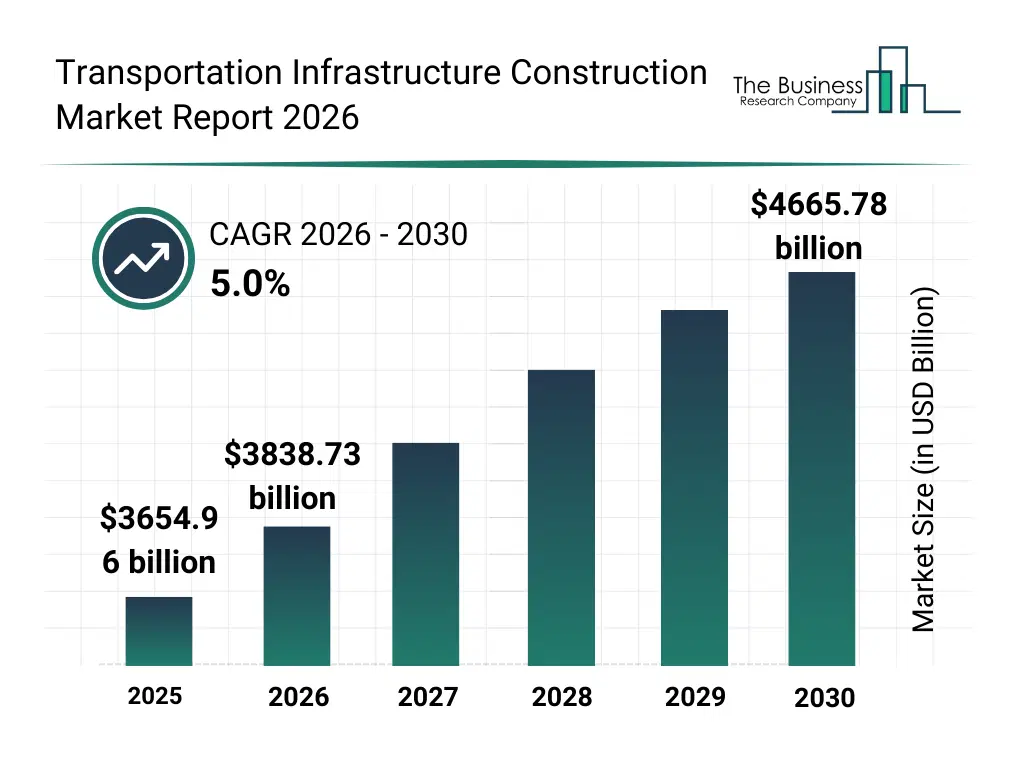
What Is The Transportation Infrastructure Construction Market Size and Share 2026?
The transportation infrastructure construction market size has grown strongly in recent years. It will grow from $3654.96 billion in 2025 to $3838.73 billion in 2026 at a compound annual growth rate (CAGR) of 5.0%. The growth in the historic period can be attributed to increase in government-led infrastructure programs, historical expansion of urban transport networks, early adoption of large-scale construction machinery, steady growth in freight and logistics demand, rising civil engineering investments.What Is The Transportation Infrastructure Construction Market Growth Forecast?
The transportation infrastructure construction market size is expected to see steady growth in the next few years. It will grow to $4665.78 billion in 2030 at a compound annual growth rate (CAGR) of 5.0%. The growth in the forecast period can be attributed to rising demand for sustainable and smart transportation systems, increased adoption of automation in construction, expansion of public transit networks, higher focus on climate-resilient infrastructure, growing use of digital twins in project planning. Major trends in the forecast period include expansion of smart transportation infrastructure, rising adoption of automated construction equipment, increased focus on sustainable road and rail projects, growth in real-time infrastructure monitoring, adoption of digital project planning and management tools.
Global Transportation Infrastructure Construction Market Segmentation
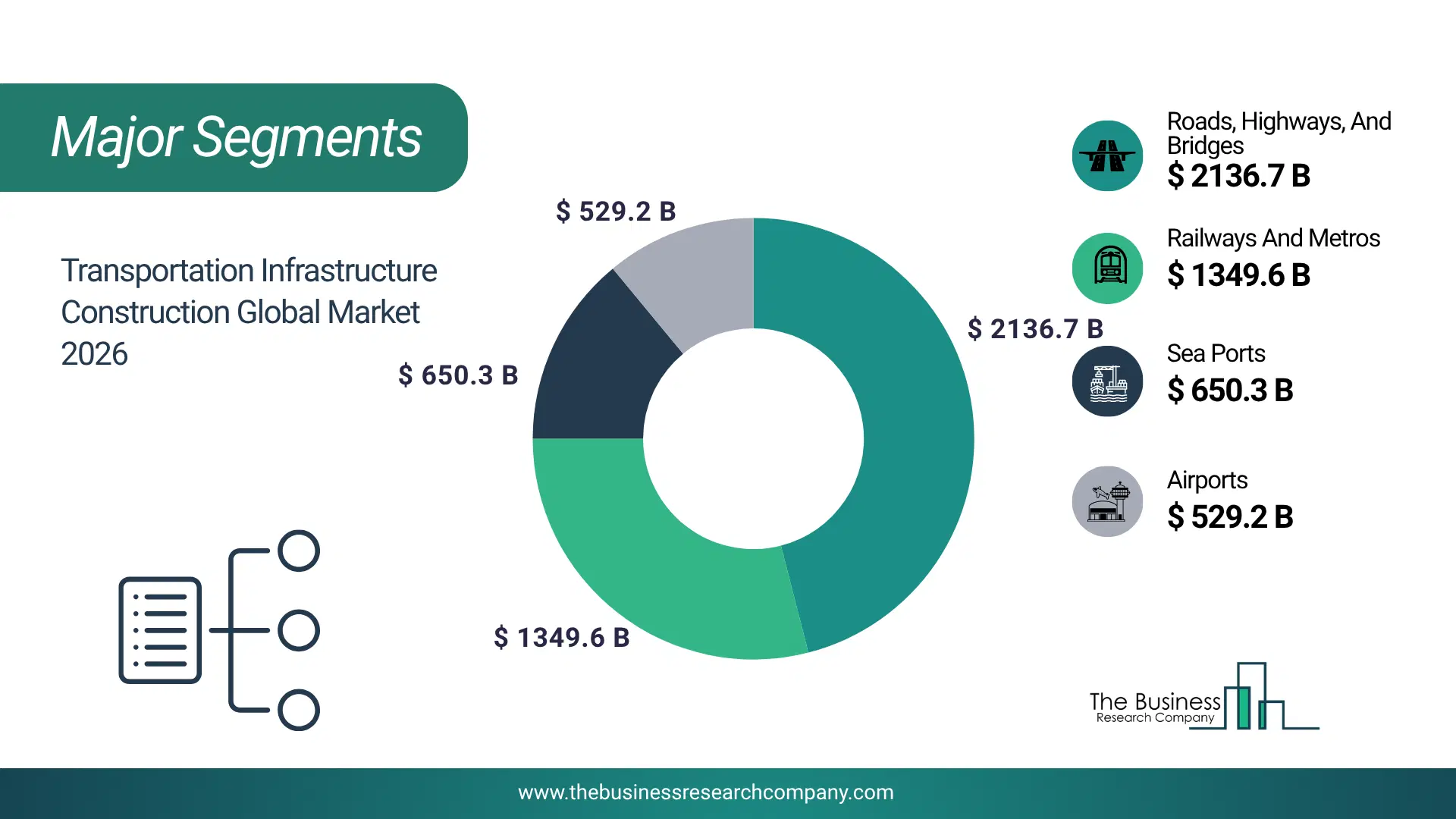
1) By Infrastructure Type: Roads, Highways, And Bridges, Railways And Metros, Sea Ports, Airports 2) By Construction Type: New Construction, Repair And Maintenance 3) By Application: Urban, Rural Subsegments: 1) By Roads, Highways, And Bridges: Urban Roads, Rural Roads, Expressways, Overpasses, Underpasses, Pedestrian Bridges, Suspension Bridges 2) By Railways And Metros: Urban Railways, High-Speed Railways, Metro Stations And Tracks, Light Rail Systems 3) By Sea Ports: Container Terminals, Cargo Ports, Passenger Ports, Dry Ports, Port Expansion And Modernization 4) By Airports: Runways, Terminals, Taxiways, Cargo and Logistics Facilities, Airport Infrastructure Expansion The top segments in the transportation infrastructure construction market will be: • Roads, Highways, And Bridges will reach $2136.68 billion by 2030. • Railways And Metros will reach $1349.65 billion by 2030. • Sea Ports will reach $650.25 billion by 2030. • Airports will reach $529.2 billion by 2030.What Is The Driver Of The Transportation Infrastructure Construction Market?
The growing tourism industry is expected to propel the growth of the transportation infrastructure construction market going forward. The tourism industry encompasses the activities, services, and infrastructure facilitating travel and leisure experiences for individuals visiting destinations outside their usual environment. The tourism industry is growing due to increased disposable income, more accessible access to travel, and a desire for cultural exploration and leisure experiences. Tourism destinations often require well-developed road networks to provide access to attractions, accommodations, and amenities. Governments and transportation authorities invest in constructing and improving roads and highways to support tourism activities, enhance connectivity between destinations, and promote economic development in tourist areas. For instance, in August 2025, according to the World Tourism Forum Institute (WTFI), a UK-based think tank and non-governmental organization, Australia recorded 8.4 million international arrivals in the 12 months ending May 2025, reflecting a 5.6% year-on-year growth. Therefore, the growing tourism industry is expected to drive the growth of the transportation infrastructure construction industry.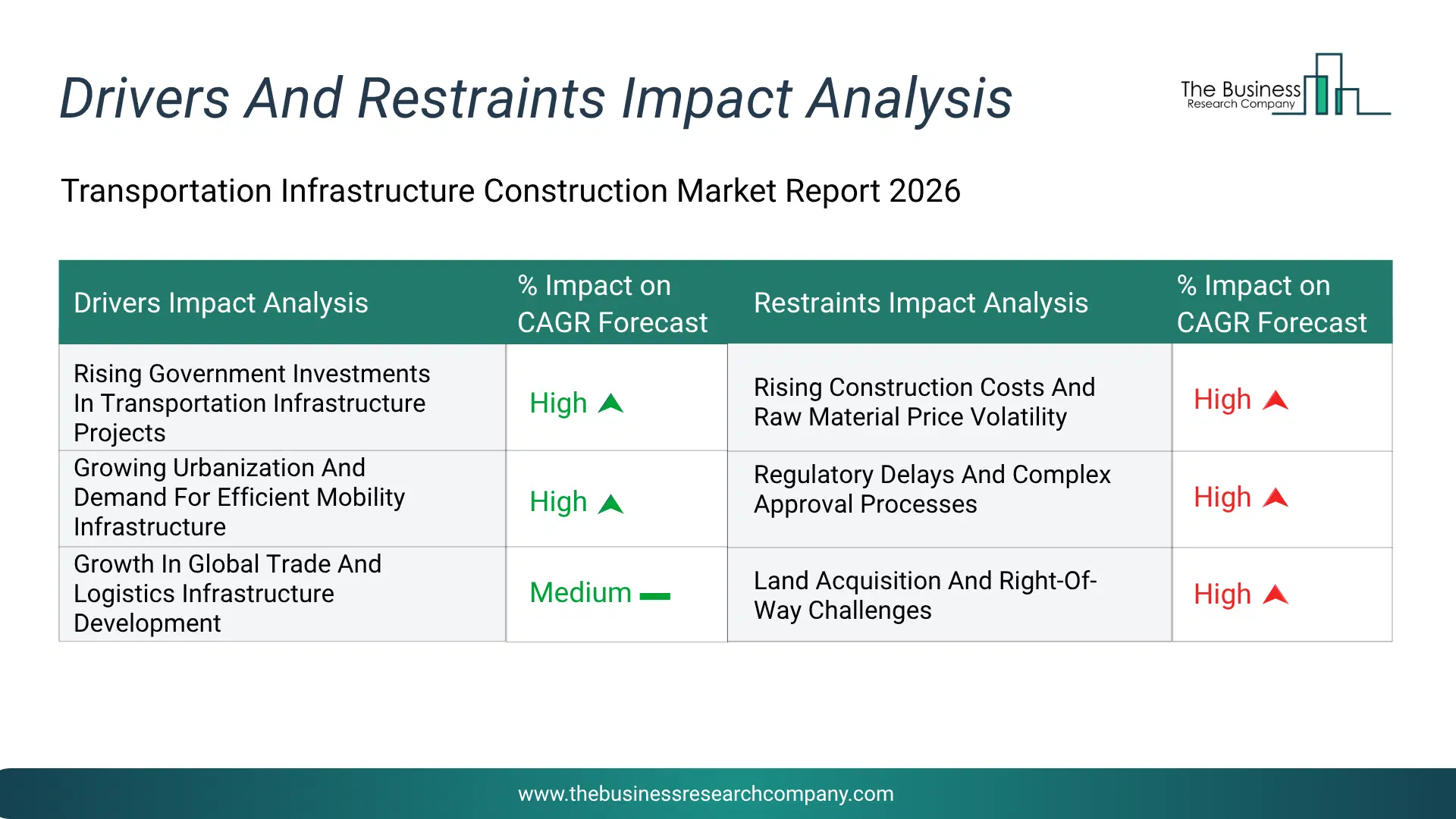
Infographic Chart Showing Key Market Drivers Analysis And Restraints For Transportation Infrastructure Construction Market
The chart presents an impact analysis of key drivers and restraints, quantifying their relative influence on the market's growth rate and helping assess the balance between growth enablers and limiting factors. This chart offers a high-level perspective; the full report contains more detailed insights.
How Will The Drivers Impact Growth In The Global Transportation Infrastructure Construction Market?
• Rising Government Investments In Transportation Infrastructure Projects (High) – During the forecast period, the rising government investments in transportation infrastructure projects is expected to become a key growth driver for the transportation infrastructure construction market by 2030. The increasing government investments in transportation infrastructure development act as a primary driver for the transportation infrastructure construction market. Governments worldwide are allocating significant budgets toward the development of highways, railways, bridges, airports, and seaports to support economic growth and improve connectivity. Large -scale infrastructure programs such as national highway expansions, urban metro projects, and logistics corridors are accelerating construction activities. These investments strengthen trade networks and enhance regional mobility, driving consistent market growth. • Growing Urbanization And Demand For Efficient Mobility Infrastructure (High) – During the forecast period, the growing urbanization and demand for efficient mobility infrastructure is expected to emerge as a major factor driving the expansion of the transportation infrastructure construction market by 2030. Rapid urbanization and population growth significantly drive the transportation infrastructure construction market. Expanding urban populations require efficient transportation systems to manage increasing traffic volumes and commuter demand. Cities are investing in modern road networks, metro rail systems, airports, and public transit infrastructure to support sustainable urban mobility. As urban centers expand and smart city initiatives grow globally, the demand for advanced transportation infrastructure continues to increase. • Growth In Global Trade And Logistics Infrastructure Development (Medium) – During the forecast period, the growth in global trade and logistics infrastructure development is expected to act as a key growth catalyst for the transportation infrastructure construction market by 2030. Expansion of global trade and logistics networks further accelerates market growth. Increasing international trade requires improved ports, rail freight corridors, highways, and airport cargo facilities to support efficient movement of goods. Governments and private investors are developing multimodal transportation hubs and logistics parks to strengthen supply chain efficiency. These developments contribute significantly to the growth of large-scale infrastructure construction projects worldwide.How Will The Restraints Impact Growth In The Global Transportation Infrastructure Construction Market?
• Rising Construction Costs And Raw Material Price Volatility (High) – During the forecast period, the rising construction costs and volatility in raw material prices are expected to act as a major restraint for the transportation infrastructure construction market during the forecast period. Fluctuating prices of key materials such as steel, cement, asphalt, and aggregates significantly increase overall project costs and financial risks for contractors and governments. Supply chain disruptions and energy price fluctuations further contribute to construction cost inflation. These challenges may delay infrastructure projects, increase budget overruns, and limit investment in new large-scale transportation developments. • Regulatory Delays And Complex Approval Processes (High) – During the forecast period, the regulatory delays and complex approval processes are a major restraint for the transportation infrastructure construction market, as large-scale projects must obtain multiple permits, environmental clearances, land-use approvals, and government authorizations before construction can begin. These lengthy procedures often extend project timelines, increase administrative costs, and create uncertainty for contractors and investors. In addition, differing regulations across national, state, and local authorities can further complicate project execution and coordination. As a result, delayed project completion and cost overruns can hinder infrastructure development and limit overall market growth. • Land Acquisition And Right-Of-Way Challenges (High) – During the forecast period, the large transportation infrastructure projects often face difficulties related to land acquisition, property disputes, and resettlement requirements. Negotiations with stakeholders can significantly delay project initiation and execution timelines. Legal disputes and compensation issues further increase project uncertainty and costs. These challenges can hinder timely infrastructure development and investment returns.Key Players In The Global Transportation Infrastructure Construction Market
Major companies operating in the transportation infrastructure construction market are China Communications Construction Company, Vinci SA, CK Hutchison Holdings, CRH plc, Hochtief AG, Bechtel Corporation, Colas Group, Fluor Corporation, Bouygues Construction SA, Larsen & Toubro Limited, AECOM, Kiewit Corporation, Balfour Beatty plc, Laing O'Rourke, Jacobs Engineering Group Inc., TATA Projects, KEC International Limited, Hindustan Construction Company Limited, Globalvia Inversiones S.A., Megha Engineering & Infrastructures Limited, ACS Group of Companies LLC, Beijing Urban Construction Group, Eagle Infra India Ltd, IRB Infrastructure Developers Ltd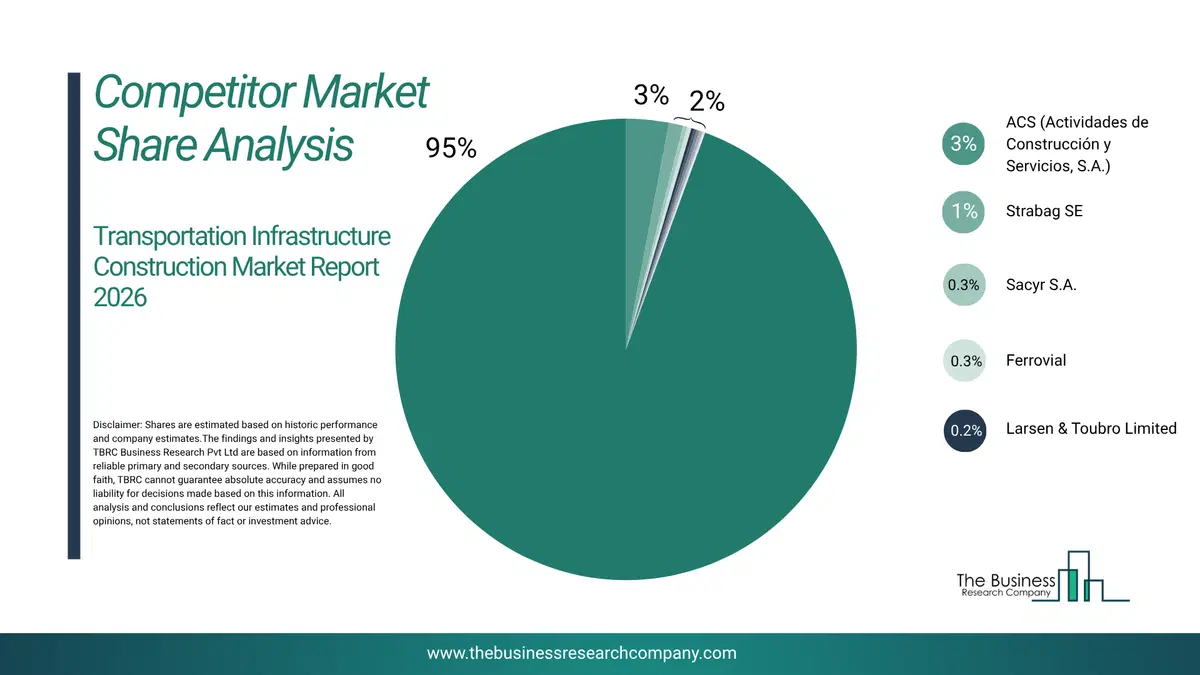
This chart is for illustrative purposes; the full report includes a detailed competitor analysis and comprehensive overview of the top 10 companies in the market.
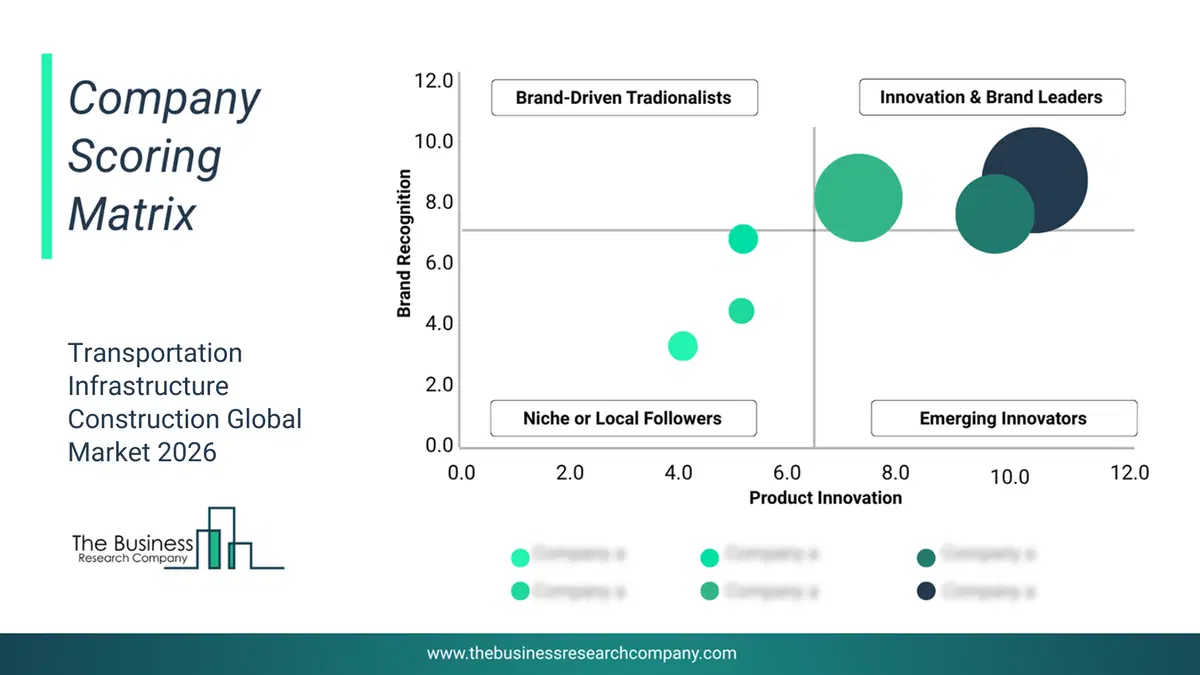
This chart maps companies by product innovation and brand strength, with bubble size indicating relative revenue, helping identify market leaders, challengers, and niche players. This is an illustrative chart; the full report provides a complete and accurate competitive analysis.
Global Transportation Infrastructure Construction Market Trends and Insights
Major companies operating in the transportation infrastructure construction market are adopting strategic partnerships to enhance project execution and foster innovation. Strategic partnerships refer to a process in which companies leverage each other's strengths and resources to achieve mutual benefits and success. For instance, in September 2023, Ferrovial, a Finland-based company specializing in construction and maintenance services for electrical technical services, partnered with Georgia Institute of Technology, a Georgia-based research university and institute of technology. With this partnership, Ferrovial aims to develop advanced innovation in transport infrastructure. The partnership will allow for joint research activities, provide new educational and development opportunities for students, and enable Ferrovial to create a more sustainable future for mobility.What Are Latest Mergers And Acquisitions In The Transportation Infrastructure Construction Market?
In June 2023, Accenture, a US-based professional services company, acquired Anser Advisory for an undisclosed amount. With this acquisition, Accenture aimed to enhance its ability to help companies and state and local public sector organizations complete large, long-term infrastructure projects more predictably and efficiently. Anser Advisory is a US-based advisory and management company specializing in infrastructure projects, providing services that span advisory, compliance, and management, with expertise in reducing risks and cost overruns in large-scale critical infrastructure projects.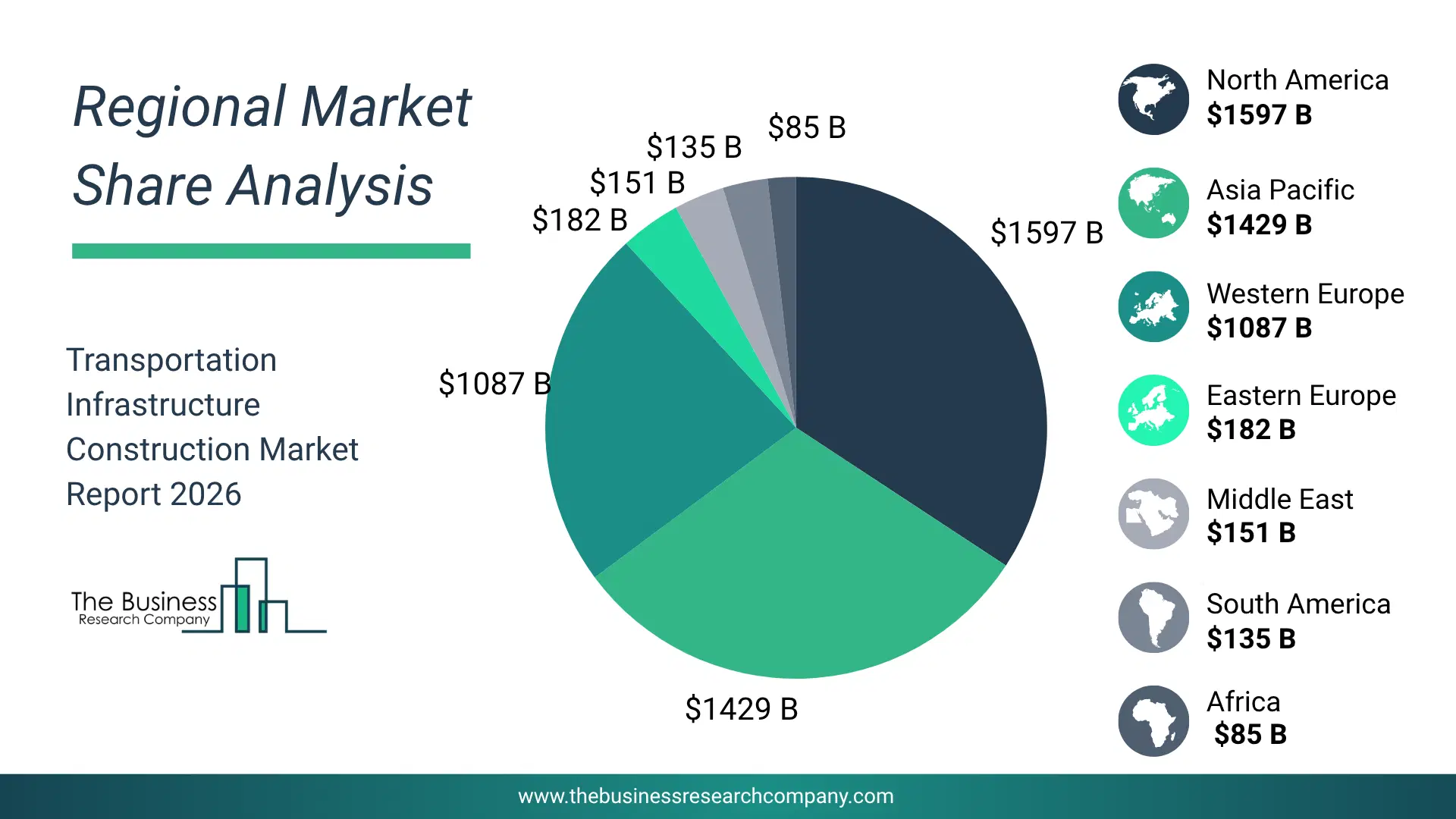
Regional Insights
Asia Pacific was the largest region in the transportation infrastructure construction market in 2025. North America is expected to be the fastest-growing region in the forecast period. The regions covered in this market report are Asia-Pacific, South East Asia, Western Europe, Eastern Europe, North America, South America, Middle East, Africa. The countries covered in this market report are Australia, Brazil, China, France, Germany, India, Indonesia, Japan, Taiwan, Russia, South Korea, UK, USA, Canada, Italy, Spain.What Defines the Transportation Infrastructure Construction Market?
The transportation infrastructure construction market consist of revenues earned by providing services such as planning, design, road and bridge building, railway construction, airport expansion, and port development. The market value includes the value of related goods sold by the service provider or included within the service offering. The transportation infrastructure construction market also includes of sales of motor graders, road rollers, asphalt mixing plants, forklift trucks, and excavators. Values in this market are ‘factory gate’ values, that is the value of goods sold by the manufacturers or creators of the goods, whether to other entities (including downstream manufacturers, wholesalers, distributors, and retailers) or directly to end customers. The value of goods in this market includes related services sold by the creators of the goods.How is Market Value Defined and Measured?
The market value is defined as the revenues that enterprises gain from the sale of goods and/or services within the specified market and geography through sales, grants, or donations in terms of the currency (in USD unless otherwise specified). The revenues for a specified geography are consumption values that are revenues generated by organizations in the specified geography within the market, irrespective of where they are produced. It does not include revenues from resales along the supply chain, either further along the supply chain or as part of other products.
This chart presents market attractiveness based on a quantitative evaluation of growth, competition, strategic alignment, and risk, offering a clear view of opportunity areas for decision-making. This chart is for illustrative purposes; the full report contains the complete analysis.

This chart highlights the Total Addressable Market (TAM) by estimating the maximum revenue opportunity using an assumption-driven approach, supporting strategic planning and opportunity sizing across markets. The chart is illustrative; the full report provides a more comprehensive analysis.
What Key Data and Analysis Are Included in theTransportation Infrastructure Construction Market Report 2026?
The transportation infrastructure construction market research report is one of a series of new reports from The Business Research Company that provides market statistics, including industry global market size, regional shares, competitors with the market share, detailed market segments, market trends and opportunities, and any further data you may need to thrive in the transportation infrastructure construction industry. The market research report delivers a complete perspective of everything you need, with an in-depth analysis of the current and future state of the industry.Transportation Infrastructure Construction Market Report Forecast Analysis
| Report Attribute | Details |
|---|---|
| Market Size Value In 2026 | $3838.73 billion |
| Revenue Forecast In 2030 | $4665.78 billion |
| Growth Rate | CAGR of 5.0% from 2026 to 2030 |
| Base Year For Estimation | 2025 |
| Actual Estimates/Historical Data | 2020-2025 |
| Forecast Period | 2026 - 2030 |
| Market Representation | Revenue in USD Billion and CAGR from 2026 to 2030 |
| Segments Covered | Infrastructure Type, Construction Type, Application |
| Regional Scope | Asia-Pacific, Western Europe, Eastern Europe, North America, South America, Middle East, Africa |
| Country Scope | The countries covered in the report are Australia, Brazil, China, France, Germany, India, Indonesia, Japan, Taiwan, Russia, South Korea, UK, USA, Canada, Italy, Spain. |
| Key Companies Profiled | China Communications Construction Company, Vinci SA, CK Hutchison Holdings, CRH plc, Hochtief AG, Bechtel Corporation, Colas Group, Fluor Corporation, Bouygues Construction SA, Larsen & Toubro Limited, AECOM, Kiewit Corporation, Balfour Beatty plc, Laing O'Rourke, Jacobs Engineering Group Inc., TATA Projects, KEC International Limited, Hindustan Construction Company Limited, Globalvia Inversiones S.A., Megha Engineering & Infrastructures Limited, ACS Group of Companies LLC, Beijing Urban Construction Group, Eagle Infra India Ltd, IRB Infrastructure Developers Ltd |
| Customization Scope | Request for Customization |
| Pricing And Purchase Options | Explore Purchase Options |