

Trapped Ion Devices Market Report 2026
Global Outlook – By Product Type (Ion Traps, Quantum Computers, Mass Spectrometers, Laser Cooling Systems), By Technology (Laser Based Technology, Microwave Technology, Optical Technology, Hybrid Technology), By Ion Type (Single Ion, Ensemble Ion, Neutral Atoms, Molecules And Clusters), By Application (Scientific Research, Medical Applications, Aerospace Engineering, Industrial Applications), By End User (Aerospace And Defense, Healthcare And Pharmaceuticals, Academia And Research Institutions, Manufacturing And Industrial Companies) – Market Size, Trends, Strategies, and Forecast to 2030
Trapped Ion Devices Market Overview
• Trapped Ion Devices market size has reached to $1.17 billion in 2025 • Expected to grow to $1.96 billion in 2030 at a compound annual growth rate (CAGR) of 10.7% • Growth Driver: The Increasing Investments In Quantum Computing Research And Development Driving The Growth Of The Market Due To Growing Demand For Solving Complex Problems • Market Trend: AI And Data-Driven Transformer Monitoring Solutions Enable Smarter Grid Management • North America was the largest region in 2025 and Asia-Pacific is the fastest growing region.What Is Covered Under Trapped Ion Devices Market?
Trapped ion devices are quantum technology systems that use electrically confined charged atoms (ions) suspended in electromagnetic fields to perform quantum computing, precision sensing, or frequency measurement with extremely high accuracy. These devices manipulate the quantum states of trapped ions using lasers or microwave fields, enabling reliable quantum operations for applications in computing, metrology, secure communications, and advanced scientific research. The main product types of trapped ion devices include ion traps, quantum computers, mass spectrometers, and laser cooling systems. Ion traps refer to devices that confine and control charged particles using electromagnetic fields for applications such as quantum information processing, spectroscopy, and precision measurement. These devices use laser based technology, microwave technology, optical technology, and hybrid technology and support single ions, ensemble ions, neutral atoms, and molecules and clusters. The various applications involved are scientific research, medical applications, aerospace engineering, and industrial applications, and they are used by several end users such as aerospace and defense, healthcare and pharmaceuticals, academia and research institutions, and manufacturing and industrial companies.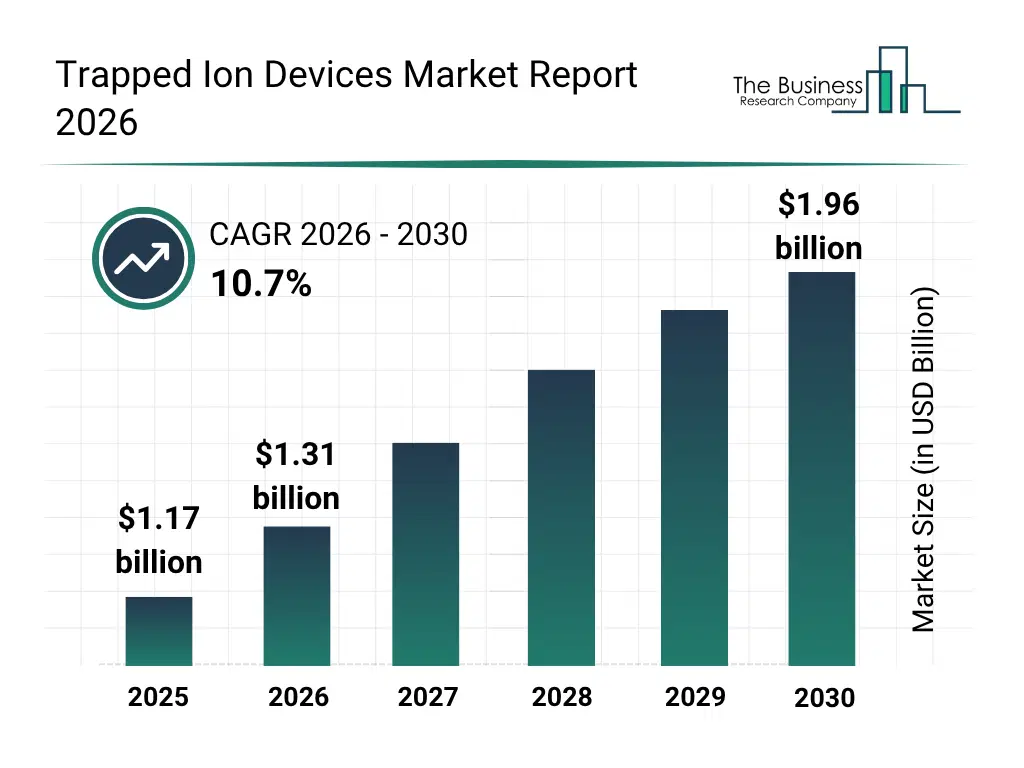
What Is The Trapped Ion Devices Market Size and Share 2026?
The trapped ion devices market size has grown rapidly in recent years. It will grow from $1.17 billion in 2025 to $1.31 billion in 2026 at a compound annual growth rate (CAGR) of 11.2%. The growth in the historic period can be attributed to increasing investment in quantum computing research, growing development of trapped ion quantum processors, rising demand for high-precision quantum measurement, increasing government funding for quantum technology, growing adoption of quantum computing research platforms.What Is The Trapped Ion Devices Market Growth Forecast?
The trapped ion devices market size is expected to see rapid growth in the next few years. It will grow to $1.96 billion in 2030 at a compound annual growth rate (CAGR) of 10.7%. The growth in the forecast period can be attributed to rising demand for fault-tolerant quantum computing, increasing development of scalable ion trap architectures, growing adoption of quantum computing as a service, rising demand for quantum-enhanced cryptography, increasing investment in commercial quantum computing infrastructure. Major trends in the forecast period include increasing development of scalable trapped ion quantum processing units, growing adoption of laser-based ion manipulation techniques, rising development of advanced ion trap architectures, increasing integration of high-precision qubit measurement systems, growing demand for improved quantum error correction capabilities.
Global Trapped Ion Devices Market Segmentation
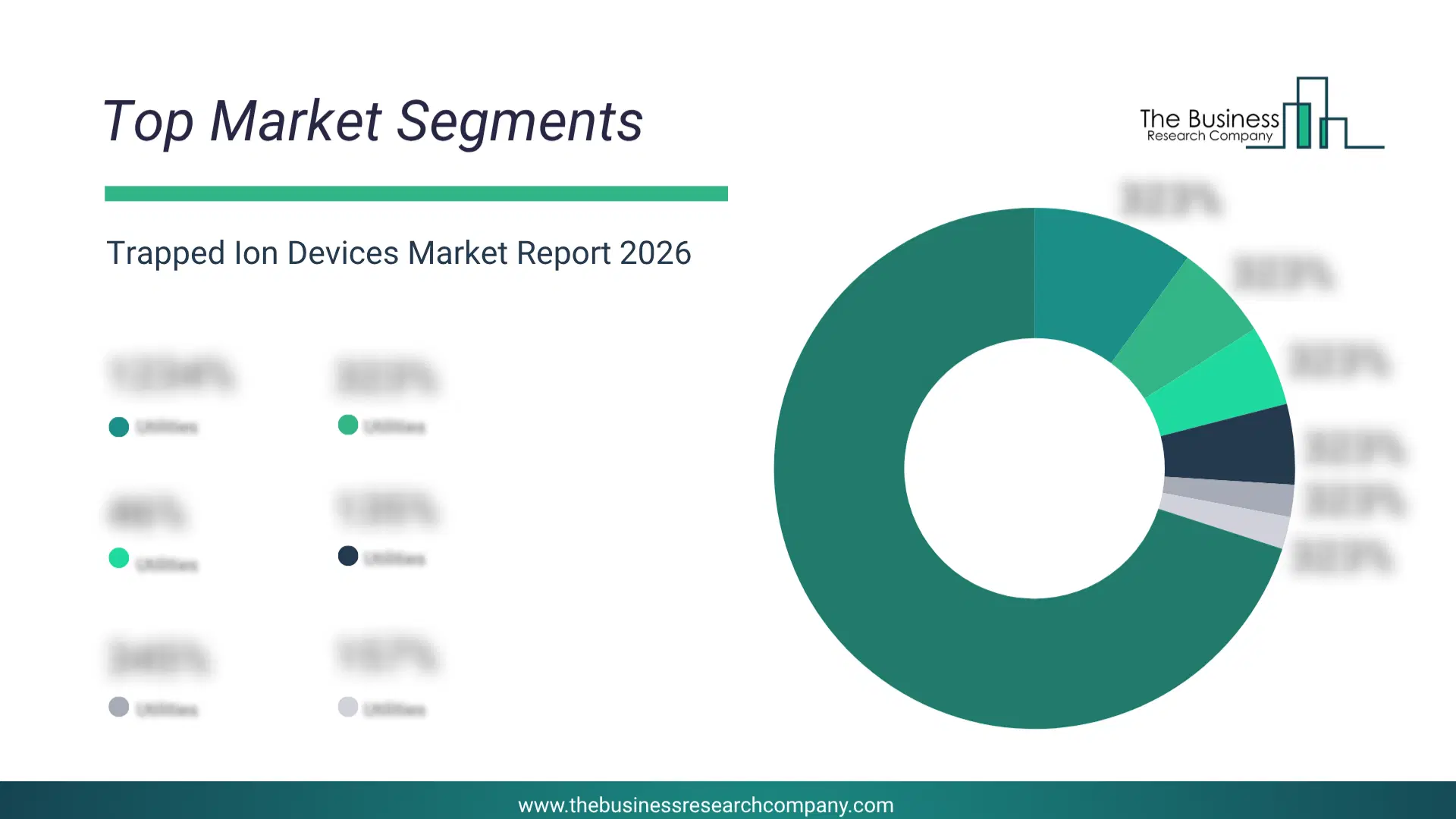
1) By Product Type: Ion Traps, Quantum Computers, Mass Spectrometers, Laser Cooling Systems 2) By Technology: Laser Based Technology, Microwave Technology, Optical Technology, Hybrid Technology 3) By Ion Type: Single Ion, Ensemble Ion, Neutral Atoms, Molecules And Clusters 4) By Application: Scientific Research, Medical Applications, Aerospace Engineering, Industrial Applications 5) By End User: Aerospace And Defense, Healthcare And Pharmaceuticals, Academia And Research Institutions, Manufacturing And Industrial Companies Subsegments: 1) By Ion Traps: Linear Ion Traps, Quadrupole Ion Traps, Penning Ion Traps, Surface Electrode Ion Traps 2) By Quantum Computers: Universal Quantum Computers, Gate Based Quantum Computers, Programmable Quantum Computers, Networked Quantum Computers 3) By Mass Spectrometers: Ion Trap Mass Spectrometers, Quadrupole Mass Spectrometers, Time Of Flight Mass Spectrometers, Orbitrap Mass Spectrometers 4) By Laser Cooling Systems: Doppler Cooling Systems, Sideband Cooling Systems, Raman Cooling Systems, Polarization Gradient Cooling SystemsWhat Is The Driver Of The Trapped Ion Devices Market?
The increasing investments in quantum computing research and development are expected to propel the growth of the trapped ion devices market going forward. Quantum computing research and development refers to the systematic study, experimentation, and innovation aimed at advancing the capabilities of quantum computers. The rise in quantum computing research and development is due to the growing demand for solving complex problems beyond the capability of classical computers, such as simulating molecular interactions, optimizing large-scale systems, and enhancing cryptography. Increasing investments in quantum computing research and development accelerate advancements in trapped ion devices by driving innovation in qubit stability, error correction, and scalability, thereby enhancing performance and expanding their adoption across commercial and scientific applications. For instance, in October 2025, according to the Private Equity Council (USPEC), a US-based professional body, venture funding in quantum computing reached more than $1.25 billion in the first quarter of 2025, marking a 128% increase compared to the first quarter of 2024. Therefore, the increasing investments in quantum computing research are driving the growth of the trapped ion devices industry.Key Players In The Global Trapped Ion Devices Market
Major companies operating in the trapped ion devices market are Thermo Fisher Scientific Inc, Infineon Technologies AG, Agilent Technologies Inc, Coherent Corp, Waters Corporation, Bruker Corporation, Hamamatsu Photonics KK, Thorlabs Inc, Quantinuum Ltd, IonQ Inc, Menlo Systems GmbH, HUBNER Photonics GmbH, Oxford Ionics Ltd, Universal Quantum Ltd, Alpine Quantum Technologies GmbH, eleQtron GmbH, Vescent Photonics Inc, Qubitcore Inc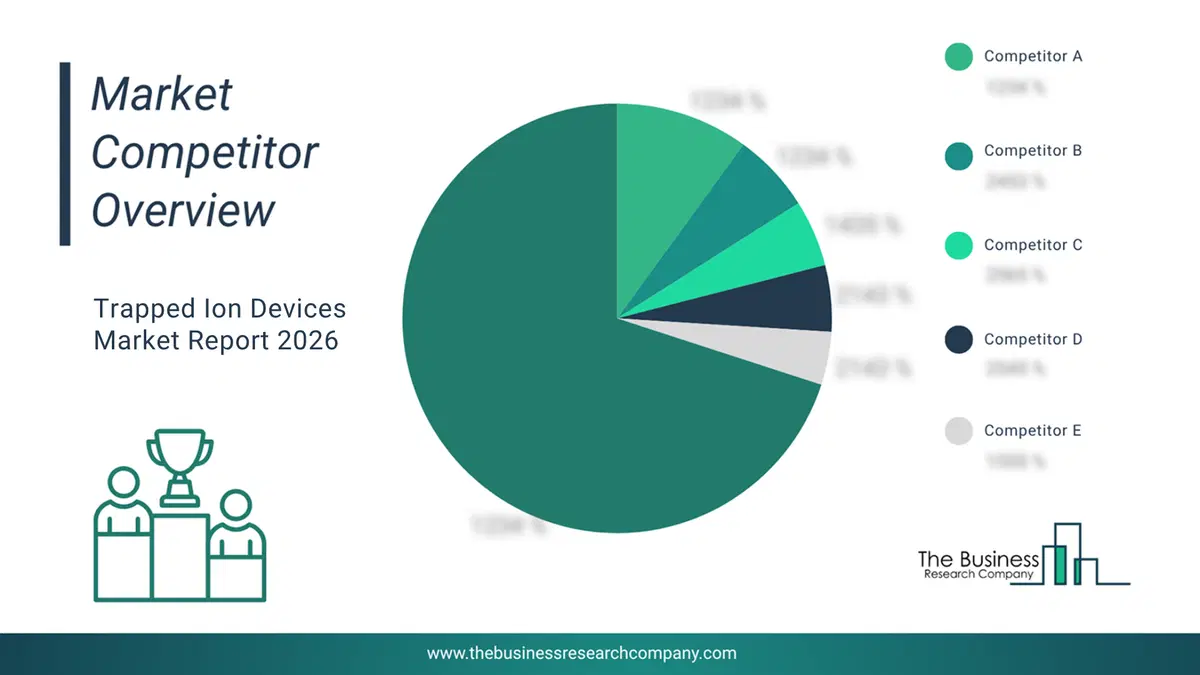
This chart is for illustrative purposes; the full report includes a detailed competitor analysis and comprehensive overview of the top 10 companies in the market.
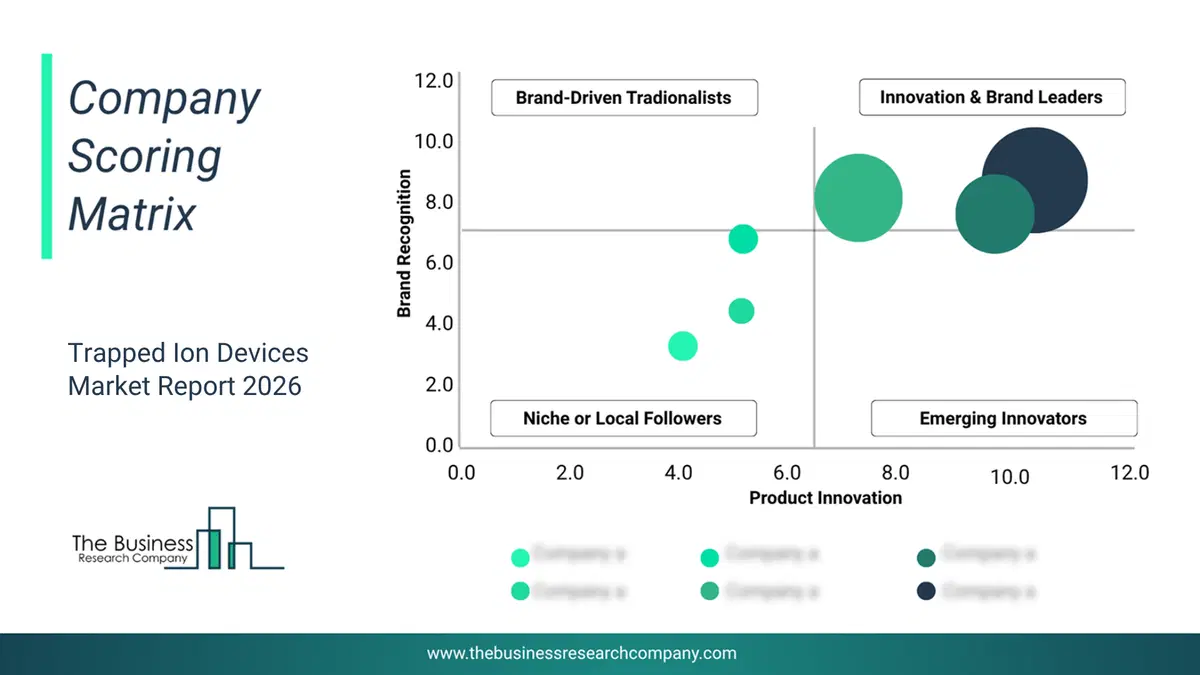
This chart maps companies by product innovation and brand strength, with bubble size indicating relative revenue, helping identify market leaders, challengers, and niche players. This is an illustrative chart; the full report provides a complete and accurate competitive analysis.
Global Trapped Ion Devices Market Trends and Insights
Major companies operating in the trapped ion devices market are focusing on developing innovative solutions, such as high-fidelity trapped-ion quantum computers, to enhance computational accuracy, scalability, and performance for complex quantum applications. High-fidelity trapped-ion quantum computers are advanced quantum computing systems that use electromagnetically trapped ions as qubits to perform quantum operations with exceptionally low error rates, providing greater computational precision and stability than many conventional quantum computing architectures. For instance, in June 2024, Quantinuum Ltd., a UK-based quantum computing company, launched H2-1, the industry's first quantum computer featuring 56 trapped-ion qubits. The system achieved a 100-fold improvement in the Random Circuit Sampling benchmark compared to previous industry records, demonstrating exceptional hardware fidelity and computational capability. Additionally, H2-1 offers significantly lower estimated power consumption than classical supercomputers while supporting advanced quantum research across industries including finance, logistics, transportation, and chemistry.What Are Latest Mergers And Acquisitions In The Trapped Ion Devices Market?
In September 2025, IonQ Inc., a US-based quantum computing and platform company, acquired Oxford Ionics Limited for $1.075 billion. With this acquisition, IonQ aims to accelerate its quantum computing roadmap by integrating Oxford Ionics' semiconductor-based trapped-ion technology, strengthening its high-fidelity quantum capabilities, expanding its global R&D presence, and advancing the development of scalable fault-tolerant quantum computers. Oxford Ionics Limited is a UK-based provider of trapped-ion quantum computing systems, ion-trap semiconductor chip technology, quantum hardware, high-fidelity quantum processors, and quantum computing research and development solutions.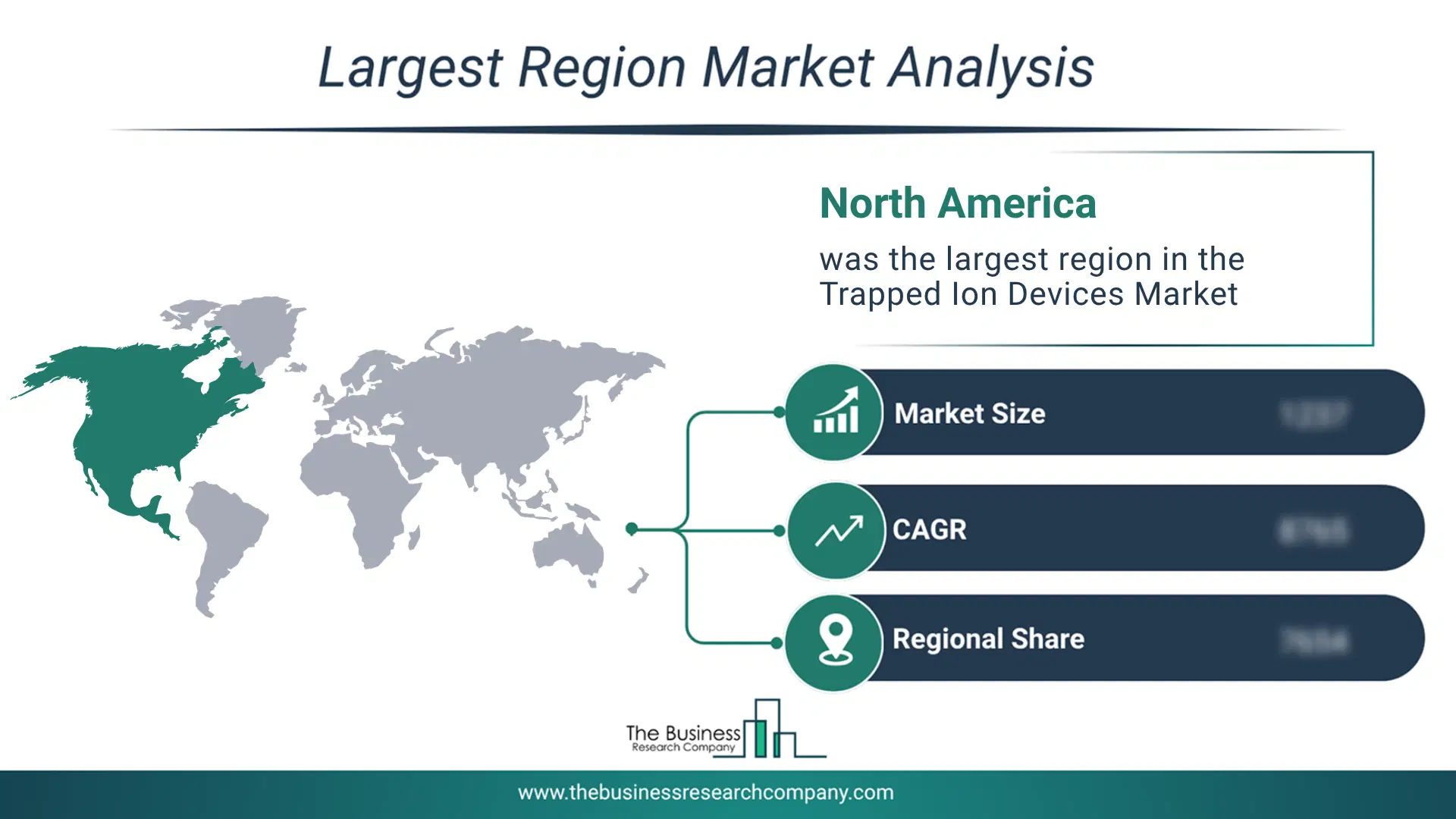
Regional Outlook
North America was the largest region in the trapped ion devices market in 2025. Asia-Pacific is expected to be the fastest-growing region in the forecast period. The regions covered in this market report are Asia-Pacific, South East Asia, Western Europe, Eastern Europe, North America, South America, Middle East, Africa. The countries covered in this market report are Australia, Brazil, China, France, Germany, India, Indonesia, Japan, Taiwan, Russia, South Korea, UK, USA, Canada, Italy, Spain.What Defines the Trapped Ion Devices Market?
The trapped ion devices market consists of sales of quantum control electronics, ultra-high vacuum systems, cryogenic cooling platforms, and microwave and radio frequency control modules. Values in this market are ‘factory gate’ values, that is, the value of goods sold by the manufacturers or creators of the goods, whether to other entities (including downstream manufacturers, wholesalers, distributors, and retailers) or directly to end customers. The value of goods in this market includes related services sold by the creators of the goods.How is Market Value Defined and Measured?
The market value is defined as the revenues that enterprises gain from the sale of goods and/or services within the specified market and geography through sales, grants, or donations in terms of the currency (in USD unless otherwise specified). The revenues for a specified geography are consumption values that are revenues generated by organizations in the specified geography within the market, irrespective of where they are produced. It does not include revenues from resales along the supply chain, either further along the supply chain or as part of other products.
This chart presents market attractiveness based on a quantitative evaluation of growth, competition, strategic alignment, and risk, offering a clear view of opportunity areas for decision-making. This chart is for illustrative purposes; the full report contains the complete analysis.

This chart highlights the Total Addressable Market (TAM) by estimating the maximum revenue opportunity using an assumption-driven approach, supporting strategic planning and opportunity sizing across markets. The chart is illustrative; the full report provides a more comprehensive analysis.
What Key Data and Analysis Are Included in the Trapped Ion Devices Market Report 2026?
The trapped ion devices market research report is one of a series of new reports from The Business Research Company that provides market statistics, including industry global market size, regional shares, competitors with the market share, detailed market segments, market trends and opportunities, and any further data you may need to thrive in the trapped ion devices industry. The market research report delivers a complete perspective of everything you need, with an in-depth analysis of the current and future state of the industry.Trapped Ion Devices Market Report Forecast Analysis
| Report Attribute | Details |
|---|---|
| Market Size Value In 2026 | $1.31 billion |
| Revenue Forecast In 2030 | $1.96 billion |
| Growth Rate | CAGR of 10.7% from 2026 to 2030 |
| Base Year For Estimation | 2025 |
| Actual Estimates/Historical Data | 2020-2025 |
| Forecast Period | 2026 - 2030 |
| Market Representation | Revenue in USD Billion and CAGR from 2026 to 2030 |
| Segments Covered | Product Type, Technology, Ion Type, Application, End User |
| Regional Scope | Asia-Pacific, Western Europe, Eastern Europe, North America, South America, Middle East, Africa |
| Country Scope | The countries covered in the report are Australia, Brazil, China, France, Germany, India, Indonesia, Japan, Taiwan, Russia, South Korea, UK, USA, Canada, Italy, Spain. |
| Key Companies Profiled | Thermo Fisher Scientific Inc, Infineon Technologies AG, Agilent Technologies Inc, Coherent Corp, Waters Corporation, Bruker Corporation, Hamamatsu Photonics KK, Thorlabs Inc, Quantinuum Ltd, IonQ Inc, Menlo Systems GmbH, HUBNER Photonics GmbH, Oxford Ionics Ltd, Universal Quantum Ltd, Alpine Quantum Technologies GmbH, eleQtron GmbH, Vescent Photonics Inc, Qubitcore Inc |
| Customization Scope | Request for Customization |
| Pricing And Purchase Options | Explore Purchase Options |