

Traumatic Brain Injury Biomarkers Market Report 2026
Global Outlook – By Type (Protein Biomarkers, Genetic Biomarkers, Metabolomic Biomarkers), By Sample Type (Blood-based, Cerebrospinal Fluid (CSF)-Based, Urine-Based), By Application (Diagnosis, Prognosis, Monitoring Treatment Response), By End Use (Hospitals And Clinics, Diagnostic Laboratories, Research Institutes) – Market Size, Trends, Strategies, and Forecast to 2035
Traumatic Brain Injury Biomarkers Market Overview
• Traumatic Brain Injury Biomarkers market size has reached to $1.38 billion in 2025 • Expected to grow to $3.68 billion in 2030 at a compound annual growth rate (CAGR) of 21.6% • Growth Driver: Increasing Number Of Road Traffic Accidents Fueling The Growth Of The Market Due To Rising Need For Rapid Head Injury Diagnosis • Market Trend: Lab-Based Blood Tests Enhance Concussion-global-market-report" target="_blank">Concussion Diagnosis Accuracy • North America was the largest region in 2025 and Asia-Pacific is the fastest growing region.What Is Covered Under Traumatic Brain Injury Biomarkers Market?
Traumatic brain injury biomarkers are measurable biological indicators such as proteins, enzymes, or genetic material found in blood, cerebrospinal fluid, or brain tissue that signal the presence and severity of brain injury. These biomarkers help detect, diagnose, and monitor traumatic brain injury, offering insights into the extent of damage and guiding treatment decisions. The main types of traumatic brain injury biomarkers are protein biomarkers, genetic biomarkers, and metabolomic biomarkers. Protein biomarkers refer to specific proteins released into the blood or cerebrospinal fluid as a result of brain tissue damage, which can be measured to assess the presence, severity, and progression of the injury. These biomarkers can be collected from various sample types, including blood, cerebrospinal fluid (CSF), and urine, and are used in a wide range of applications such as diagnosis, prognosis, and monitoring treatment response, serving end users such as hospitals and clinics, diagnostic laboratories, and research institutes.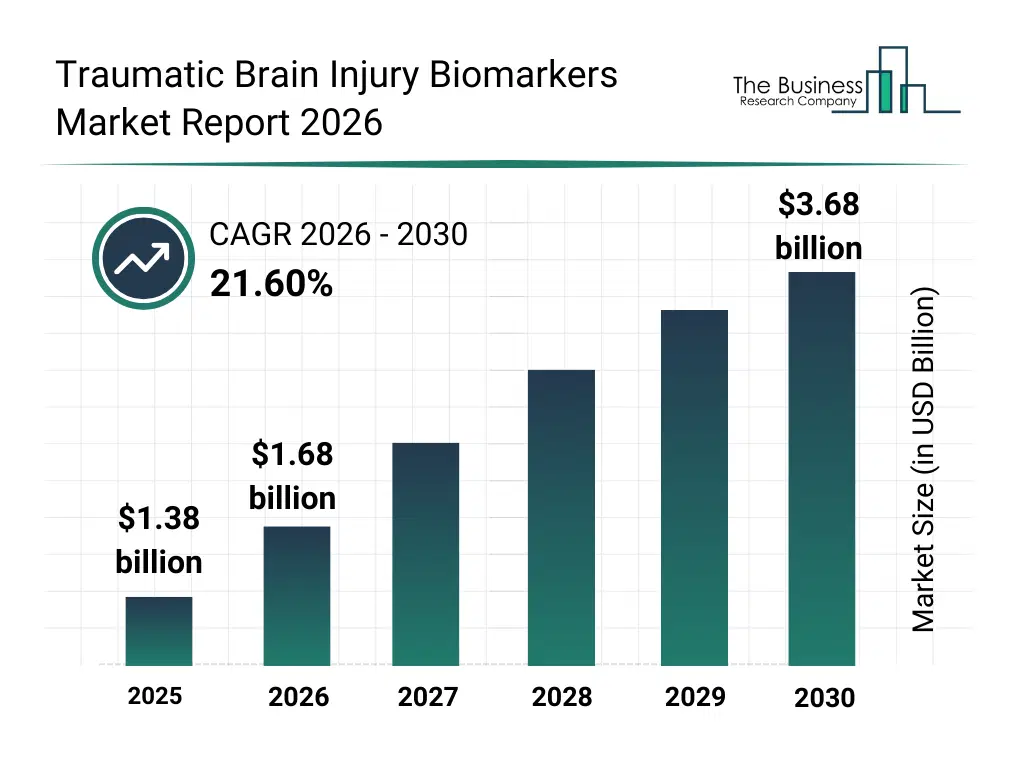
What Is The Traumatic Brain Injury Biomarkers Market Size and Share 2026?
The traumatic brain injury biomarkers market size has grown exponentially in recent years. It will grow from $1.38 billion in 2025 to $1.68 billion in 2026 at a compound annual growth rate (CAGR) of 21.9%. The growth in the historic period can be attributed to limited availability of standardized tbi biomarkers, reliance on conventional imaging techniques, growing awareness of traumatic brain injury impacts, increasing hospital-based diagnostic facilities, early research on protein and genetic biomarkers.What Is The Traumatic Brain Injury Biomarkers Market Growth Forecast?
The traumatic brain injury biomarkers market size is expected to see exponential growth in the next few years. It will grow to $3.68 billion in 2030 at a compound annual growth rate (CAGR) of 21.6%. The growth in the forecast period can be attributed to advancement in high-sensitivity protein and genetic assays, integration of metabolomic biomarkers in tbi assessment, growth of personalized monitoring and prognosis tools, expansion of hospital and diagnostic lab adoption, rising investment in tbi biomarker research and clinical trials. Major trends in the forecast period include increased adoption of blood-based and csf-based biomarker testing, rising focus on early diagnosis and prognosis of traumatic brain injury, development of multiplex protein and genetic biomarker panels, expansion of monitoring tools for treatment response, integration of research-based biomarkers into clinical practice.
Global Traumatic Brain Injury Biomarkers Market Segmentation
1) By Type: Protein Biomarkers, Genetic Biomarkers, Metabolomic Biomarkers 2) By Sample Type: Blood-based, Cerebrospinal Fluid (CSF)-Based, Urine-Based 3) By Application: Diagnosis, Prognosis, Monitoring Treatment Response 4) By End Use: Hospitals And Clinics, Diagnostic Laboratories, Research Institutes Subsegments: 1) By Protein Biomarkers: Glial Fibrillary Acidic Protein (GFAP), Ubiquitin C-Terminal Hydrolase L1 (UCH-L1), S100 Calcium Binding Protein B (S100B), Neuron-Specific Enolase (NSE) 2) By Genetic Biomarkers: Apolipoprotein E (APOE) Genotyping, Brain-Derived Neurotrophic Factor (BDNF) Polymorphism, Interleukin-6 (IL-6) Gene Variants, Tumor Necrosis Factor-Alpha (TNF-α) Polymorphism 3) By Metabolomic Biomarkers: Lactate, Creatine, Choline, N-Acetylaspartate (NAA)What Are The Drivers Of The Traumatic Brain Injury Biomarkers Market?
The increasing number of road traffic accidents is expected to propel the growth of the traumatic brain injury biomarkers market going forward. Road traffic accidents refer to unplanned, unexpected events that cause injury, harm, or damage, often requiring immediate medical attention. The number of road traffic accidents is rising due to a rapid increase in private vehicle usage due to urbanization and motorization. Traumatic brain injury biomarkers aid in road traffic accident care by enabling rapid and accurate assessment of head injuries. They support early diagnosis by detecting specific proteins in the blood, helping clinicians make timely treatment decisions and improving patient outcomes in emergency situations. For instance, in October 2025, according to a report published by the National Highway Traffic Safety Administration (NHTSA), a US-based national safety organisation, reported that the United States recorded 6,138,359 police-reported motor-vehicle crashes, resulting in 40,901 deaths and 2,442,581 injuries, highlighting a significant trauma burden. Therefore, the increasing number of road traffic accidents is driving the growth of the traumatic brain injury biomarkers industry. The rising adoption of personalized medicine is expected to propel the growth of the traumatic brain injury biomarkers market going forward. Personalized medicine is a medical approach that involves tailoring treatments to individual patients based on their genetic, environmental, and lifestyle factors to optimize outcomes and improve care. The demand for personalized medicine is increasing due to advancements in genomic technologies, which enable the precise identification of genetic variations and tailored treatments for individuals. Traumatic brain injury biomarkers support personalized medicine by identifying specific biological indicators linked to brain injuries. They enable tailored treatment plans based on individual responses, improving recovery outcomes and optimizing clinical decision making for each patient. For instance, in February 2024, according to the Personalized Medicine Coalition (PMC), a US based nonprofit organization, the U.S. Food and Drug Administration (FDA) approved 26 new personalized medicines in 2023, a significant increase from the 12 approved in 2022. Therefore, the rising adoption of personalized medicine is driving the growth of the traumatic brain injury biomarkers industry.Key Players In The Global Traumatic Brain Injury Biomarkers Market
Major companies operating in the traumatic brain injury biomarkers market are F. Hoffmann-La Roche Ltd, Thermo Fisher Scientific Inc., Abbott Laboratories, Siemens Healthineers AG, BioMérieux S.A., DiaSorin S.p.A., Abcam Limited, Fujirebio Inc., Meso Scale Diagnostics (MSD), Olink Holding AB, Quanterix Corporation, OriGene Technologies Inc., BioDirection Inc., BrainBox Solutions Inc., NeuroTrauma Sciences LLC, Banyan Biomarkers Inc.Global Traumatic Brain Injury Biomarkers Market Trends and Insights
Major companies operating in the traumatic brain injury biomarker market are focusing on developing innovative solutions, such as a laboratory-based blood test, to improve the accuracy and speed of concussion evaluation and diagnosis. A laboratory-based blood test is a diagnostic tool that measures specific biomarkers in the blood to assess the presence and severity of brain injuries, enabling earlier and more objective clinical decisions. For instance, in June 2025, Abbott Laboratories, a US-based healthcare company, launched the Alinity i and Architect i1000SR lab tests. These tests measure two key biomarkers, glial fibrillary acidic protein (GFAP) and ubiquitin carboxy-terminal hydrolase (UCH)-L1, to help clinicians evaluate suspected concussions within 12 hours of injury. These also deliver lab results in just 18 minutes, support faster triage decisions in emergency settings, and reduce reliance on unnecessary CT scans. This innovation provides physicians with a reliable method for identifying patients with potential traumatic brain injuries. It also represents a significant advancement in expanding access to faster, evidence-based care in emergency departments.Regional Insights
North America was the largest region in the traumatic brain injury biomarkers market in 2025. Asia-Pacific is expected to be the fastest-growing region in the forecast period. The regions covered in this market report are Asia-Pacific, South East Asia, Western Europe, Eastern Europe, North America, South America, Middle East, Africa. The countries covered in this market report are Australia, Brazil, China, France, Germany, India, Indonesia, Japan, Taiwan, Russia, South Korea, UK, USA, Canada, Italy, Spain.What Defines the Traumatic Brain Injury Biomarkers Market?
The traumatic brain injury biomarkers market consists of revenues earned by entities by providing services such as biomarker validation studies, clinical trial support, neurological data analysis, biomarker-based screening programs, and regulatory consulting. The market value includes the value of related goods sold by the service provider or included within the service offering. The traumatic brain injury biomarkers market also includes sales of biomarker assay kits, lab-on-a-chip devices, neuroimaging-linked biomarkers, biosensor-integrated test systems, and multiplex diagnostic platforms. Values in this market are ‘factory gate’ values, that is the value of goods sold by the manufacturers or creators of the goods, whether to other entities (including downstream manufacturers, wholesalers, distributors and retailers) or directly to end customers. The value of goods in this market includes related services sold by the creators of the goods.How is Market Value Defined and Measured?
The market value is defined as the revenues that enterprises gain from the sale of goods and/or services within the specified market and geography through sales, grants, or donations in terms of the currency (in USD unless otherwise specified). The revenues for a specified geography are consumption values that are revenues generated by organizations in the specified geography within the market, irrespective of where they are produced. It does not include revenues from resales along the supply chain, either further along the supply chain or as part of other products.What Key Data and Analysis Are Included in the Traumatic Brain Injury Biomarkers Market Report 2026?
The traumatic brain injury biomarkers market research report is one of a series of new reports from The Business Research Company that provides market statistics, including industry global market size, regional shares, competitors with the market share, detailed market segments, market trends and opportunities, and any further data you may need to thrive in the traumatic brain injury biomarkers industry. The market research report delivers a complete perspective of everything you need, with an in-depth analysis of the current and future state of the industry.Traumatic Brain Injury Biomarkers Market Report Forecast Analysis
| Report Attribute | Details |
|---|---|
| Market Size Value In 2026 | $1.68 billion |
| Revenue Forecast In 2035 | $3.68 billion |
| Growth Rate | CAGR of 21.9% from 2026 to 2035 |
| Base Year For Estimation | 2025 |
| Actual Estimates/Historical Data | 2020-2025 |
| Forecast Period | 2026 - 2030 - 2035 |
| Market Representation | Revenue in USD Billion and CAGR from 2026 to 2035 |
| Segments Covered | Type, Sample Type, Application, End Use |
| Regional Scope | Asia-Pacific, Western Europe, Eastern Europe, North America, South America, Middle East, Africa |
| Country Scope | The countries covered in the report are Australia, Brazil, China, France, Germany, India, ... |
| Key Companies Profiled | F. Hoffmann-La Roche Ltd, Thermo Fisher Scientific Inc., Abbott Laboratories, Siemens Healthineers AG, BioMérieux S.A., DiaSorin S.p.A., Abcam Limited, Fujirebio Inc., Meso Scale Diagnostics (MSD), Olink Holding AB, Quanterix Corporation, OriGene Technologies Inc., BioDirection Inc., BrainBox Solutions Inc., NeuroTrauma Sciences LLC, Banyan Biomarkers Inc. |
| Customization Scope | Request for Customization |
| Pricing And Purchase Options | Explore Purchase Options |