
Turbo Inlet Heat Shield Market Report 2026
Global Outlook – By Product Type (Aluminium Heat Shields, Stainless Steel Heat Shields, Composite Heat Shields, Other Product Types ), By Vehicle Type (Passenger Cars, Light Commercial Vehicles, Heavy Commercial Vehicles, Other Vehicle Types ), By Sales Channel (Online, Offline ), By Application (Original Equipment Manufacturer, Aftermarket ), By End-User (Automotive, Motorsport, Industrial, Other End Users ) – Market Size, Trends, Strategies, and Forecast to 2035
Turbo Inlet Heat Shield Market Overview
• Turbo Inlet Heat Shield market size has reached to $1.28 billion in 2025 • Expected to grow to $1.77 billion in 2030 at a compound annual growth rate (CAGR) of 6.8% • Growth Driver: The Increasing Demand For Passenger Cars Drives The Growth Of The Market Due To Rising Disposable Incomes And Expanding Vehicle Sales • Market Trend: • Asia-Pacific was the largest region and fastest growing region.What Is Covered Under Turbo Inlet Heat Shield Market?
Turbo inlet heat shield is an automotive component designed to protect the turbocharger’s air intake system from excessive engine bay heat. It helps to reduce heat soak, ensuring cooler and denser air enters the turbo for improved combustion efficiency and performance. It is commonly used in performance and turbocharged vehicles to enhance engine output, reliability, and overall efficiency. The main product types of turbo inlet heat shields include aluminum heat shields, stainless steel heat shields, composite heat shields, and other product types. Aluminum heat shields refer to components that protect the turbo inlet from excessive heat, improving performance and durability. The different types are designed for passenger cars, light commercial vehicles, heavy commercial vehicles, and other vehicles and are distributed through online and offline channels. The key applications of original equipment manufacturer (OEM) and aftermarket, while the end-use includes automotive, motorsport, industrial, and other end users.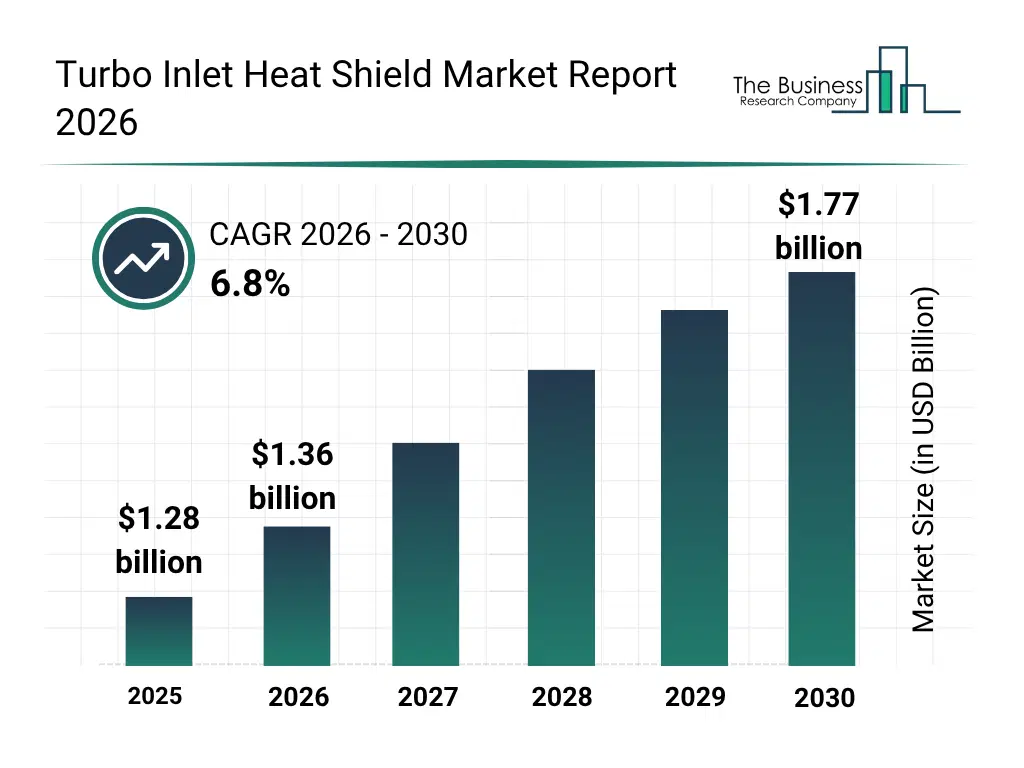
What Is The Turbo Inlet Heat Shield Market Size and Share 2026?
The turbo inlet heat shield market size has grown strongly in recent years. It will grow from $1.28 billion in 2025 to $1.36 billion in 2026 at a compound annual growth rate (CAGR) of 6.6%. The growth in the historic period can be attributed to increasing popularity of turbocharged engines, rising demand for performance vehicles, adoption of heat shields in passenger cars and LCVs, growth of aftermarket automotive parts industry, increasing focus on engine efficiency and reliability.What Is The Turbo Inlet Heat Shield Market Growth Forecast?
The turbo inlet heat shield market size is expected to see strong growth in the next few years. It will grow to $1.77 billion by 2030 at a compound annual growth rate (CAGR) of 6.8%. The growth in the forecast period can be attributed to growing adoption of electric and hybrid vehicles with heat management needs, rising demand for advanced composite and multi-material heat shields, expansion of motorsport and high-performance vehicle segments, increasing use of lightweight and corrosion-resistant materials, rising focus on thermal management and fuel efficiency. Major trends in the forecast period include increasing adoption of aluminium and stainless steel turbo heat shields, rising demand for composite and ceramic fiber heat shields, growing focus on aftermarket performance upgrades, expansion of multi-layer and insulated heat shield designs, rising use in motorsport and high-performance vehicles.
Global Turbo Inlet Heat Shield Market Segmentation
1) By Product Type: Aluminium Heat Shields, Stainless Steel Heat Shields, Composite Heat Shields, Other Product Types 2) By Vehicle Type: Passenger Cars, Light Commercial Vehicles, Heavy Commercial Vehicles, Other Vehicle Types 3) By Sales Channel: Online, Offline 4) By Application: Original Equipment Manufacturer, Aftermarket 5) By End-User: Automotive, Motorsport, Industrial, Other End Users Subsegments: 1) By Aluminium Heat Shields: Single Layer Aluminium Heat Shields, Multi Layer Aluminium Heat Shields, Embossed Aluminium Heat Shields, Perforated Aluminium Heat Shields, Reflective Aluminium Foil Heat Shields 2) By Stainless Steel Heat Shields: Single Wall Stainless Steel Heat Shields, Double Wall Stainless Steel Heat Shields, Stamped Stainless Steel Heat Shields, Insulated Stainless Steel Heat Shields, Polished Stainless Steel Heat Shields 3) By Composite Heat Shields: Ceramic Fiber Composite Heat Shields, Glass Fiber Composite Heat Shields, Basalt Fiber Composite Heat Shields, Multi Material Layered Heat Shields, Flexible Composite Thermal Barriers 4) By Other Product Types: Titanium Heat Shields, Ceramic Coated Metal Heat Shields, Hybrid Metal And Fabric Heat Shields, Thermal Barrier Blanket Shields, High Temperature Insulation PanelsWhat Are The Drivers Of The Turbo Inlet Heat Shield Market?
The increasing demand for passenger cars is expected to propel the growth of the turbo inlet heat shield market going forward. Passenger cars refer to motor vehicles designed primarily for transporting passengers, typically accommodating up to eight occupants including the driver, and used mainly for personal or family transportation rather than commercial purposes. Increasing demand for passenger cars is primarily due to rising disposable incomes, which enable more consumers to afford personal vehicles for improved comfort, convenience, and mobility. Turbo inlet heat shield helps passenger cars by reducing heat transfer from the turbocharger to surrounding engine components, thereby improving intake air efficiency, enhancing engine performance, and increasing overall vehicle reliability. For instance, in January 2024, according to the European Automobile Manufacturers Association, a Belgium-based automobile industry association, the EU car market expanded by 13.9% in 2023 compared to 2022, reaching total annual sales of 10.5 million vehicles. Therefore, the increasing demand for passenger cars is driving the growth of the turbo inlet heat shield industry. The growing demand for fuel efficiency is expected to propel the growth of the turbo inlet heat shield market going forward. Fuel efficiency refers to the ability of a vehicle or system to utilize fuel effectively and economically, achieving optimal performance in terms of distance traveled or work done per unit of fuel consumed. Growing demand for fuel efficiency is primarily due to rising fuel prices, as higher fuel costs encourage consumers and businesses to seek vehicles that consume less fuel and reduce overall transportation expenses. Turbo inlet heat shield enhances fuel efficiency by minimizing heat transfer to the intake air, maintaining optimal air density for improved combustion performance and reduced fuel consumption. For instance, in March 2024, according to the International Energy Agency, a France-based intergovernmental organization, reported that the updated standards became stricter, targeting an annual fuel-efficiency improvement of 8% for model years 2024–2025 and 10% for model year 2026. Therefore, growing demand for fuel efficiency is driving the growth of the turbo inlet heat shield industry.Key Players In The Global Turbo Inlet Heat Shield Market
Major companies operating in the turbo inlet heat shield market are Tenneco Inc., DuPont de Nemours Inc., Dana Incorporated, Sumitomo Riko Co Ltd., Autoneum Holding AG, ElringKlinger AG, Nichias Corporation, Morgan Advanced Materials plc, Talbros Automotive Components Ltd., Vibrant Power Inc., Forge Motorsport And Engineering, Design Engineering Inc., Zircotec Ltd, Funk Motorsport Ltd, GoodFabs Ltd., Ferosteel GmbH, Heatshield Products Inc., Thermo-Tec Automotive Inc, PTP Turbo Solutions LLC, Prosport Gauges Inc.What Are Latest Mergers And Acquisitions In The Turbo Inlet Heat Shield Market?
In April 2024, Zircotec Ltd., a UK-based company that provides advanced thermal barrier coatings and heat shielding solutions, partnered with the British Touring Car Championship to deliver advanced thermal management support for competing race teams. This partnership aims to enhance vehicle performance and reliability by applying high-temperature ceramic coatings and bespoke heat shielding solutions to manage under-bonnet temperatures, including areas around turbochargers and intake systems. The British Touring Car Championship is a UK-based premier touring car racing series featuring manufacturer-backed teams and high-performance racing vehicles.Regional Insights
Asia-Pacific was the largest region in the turbo inlet heat shield market in 2025. Asia-Pacific is expected to be the fastest-growing region in the forecast period. The regions covered in this market report are Asia-Pacific, South East Asia, Western Europe, Eastern Europe, North America, South America, Middle East, Africa. The countries covered in this market report are Australia, Brazil, China, France, Germany, India, Indonesia, Japan, Taiwan, Russia, South Korea, UK, USA, Canada, Italy, Spain.What Defines the Turbo Inlet Heat Shield Market?
The turbo inlet heat shield market consists of sales of titanium heat shields, carbon fiber heat shields, ceramic-coated heat shields, basalt fiber heat shields, and reflective gold foil heat shields. Values in this market are ‘factory gate’ values, that is, the value of goods sold by the manufacturers or creators of the goods, whether to other entities (including downstream manufacturers, wholesalers, distributors, and retailers) or directly to end customers. The value of goods in this market includes related services sold by the creators of the goods.How is Market Value Defined and Measured?
The market value is defined as the revenues that enterprises gain from the sale of goods and/or services within the specified market and geography through sales, grants, or donations in terms of the currency (in USD unless otherwise specified). The revenues for a specified geography are consumption values that are revenues generated by organizations in the specified geography within the market, irrespective of where they are produced. It does not include revenues from resales along the supply chain, either further along the supply chain or as part of other products.What Key Data and Analysis Are Included in the Turbo Inlet Heat Shield Market Report 2026?
The turbo inlet heat shield market research report is one of a series of new reports from The Business Research Company that provides market statistics, including industry global market size, regional shares, competitors with the market share, detailed market segments, market trends and opportunities, and any further data you may need to thrive in the turbo inlet heat shield industry. The market research report delivers a complete perspective of everything you need, with an in-depth analysis of the current and future state of the industry.Turbo Inlet Heat Shield Market Report Forecast Analysis
| Report Attribute | Details |
|---|---|
| Market Size Value In 2026 | $1.36 billion |
| Revenue Forecast In 2035 | $1.77 billion |
| Growth Rate | CAGR of 6.6% from 2026 to 2035 |
| Base Year For Estimation | 2025 |
| Actual Estimates/Historical Data | 2020-2025 |
| Forecast Period | 2026 - 2030 - 2035 |
| Market Representation | Revenue in USD Billion and CAGR from 2026 to 2035 |
| Segments Covered | Product Type, Vehicle Type, Sales Channel, Application, End-User |
| Regional Scope | Asia-Pacific, Western Europe, Eastern Europe, North America, South America, Middle East, Africa |
| Country Scope | The countries covered in the report are Australia, Brazil, China, France, Germany, India, ... |
| Key Companies Profiled | Tenneco Inc., DuPont de Nemours Inc., Dana Incorporated, Sumitomo Riko Co Ltd., Autoneum Holding AG, ElringKlinger AG, Nichias Corporation, Morgan Advanced Materials plc, Talbros Automotive Components Ltd., Vibrant Power Inc., Forge Motorsport And Engineering, Design Engineering Inc., Zircotec Ltd, Funk Motorsport Ltd, GoodFabs Ltd., Ferosteel GmbH, Heatshield Products Inc., Thermo-Tec Automotive Inc, PTP Turbo Solutions LLC, Prosport Gauges Inc. |
| Customization Scope | Request for Customization |
| Pricing And Purchase Options | Explore Purchase Options |