

Turboprop Aircraft Propeller System Market Report 2026
Global Outlook – By Component (Blades, Hubs, Spinners, Other Components), By Material (Aluminum, Composite, Other Materials), By Application (Commercial Aviation, Military Aviation, General Aviation), By Sales Channel (Original Equipment Manufacturer (OEMs), Aftermarket) – Market Size, Trends, Strategies, and Forecast to 2030
Turboprop Aircraft Propeller System Market Overview
• Turboprop Aircraft Propeller System market size has reached to $2 billion in 2025 • Expected to grow to $2.97 billion in 2030 at a compound annual growth rate (CAGR) of 8.1% • Growth Driver: Increasing Aircraft Production Fueling The Growth Of The Market Due To Rising Demand For Propeller Systems • Market Trend: Innovations In Turboprop Propeller Technology Enhance Aircraft Performance And Reduce Noise • North America was the largest region in 2025 and Asia-Pacific is the fastest growing region.What Is Covered Under Turboprop Aircraft Propeller System Market?
A turboprop aircraft propeller system is an aircraft propulsion assembly that converts mechanical power produced by a turboprop engine into thrust through a variable-pitch rotating propeller. It consists of integrated mechanical and control components that optimize propeller speed, blade pitch, aerodynamic efficiency, and overall flight performance across different operating conditions. These systems enhance fuel efficiency, short take-off and landing capability, operational reliability, and noise performance, making them essential for aircraft operating on short- and medium-distance routes. The main components of turboprop aircraft propeller system include blades, hubs, spinners, and other components. Blades refer to the aerodynamic rotating components of a propeller system that convert engine power into thrust by accelerating air rearward, supporting efficient propulsion for turboprop aircraft. These components are manufactured using materials such as aluminum, composites, and others for applications such as commercial aviation, military aviation, and general aviation, and are supplied through sales channels such as original equipment manufacturers (OEMs) and aftermarket.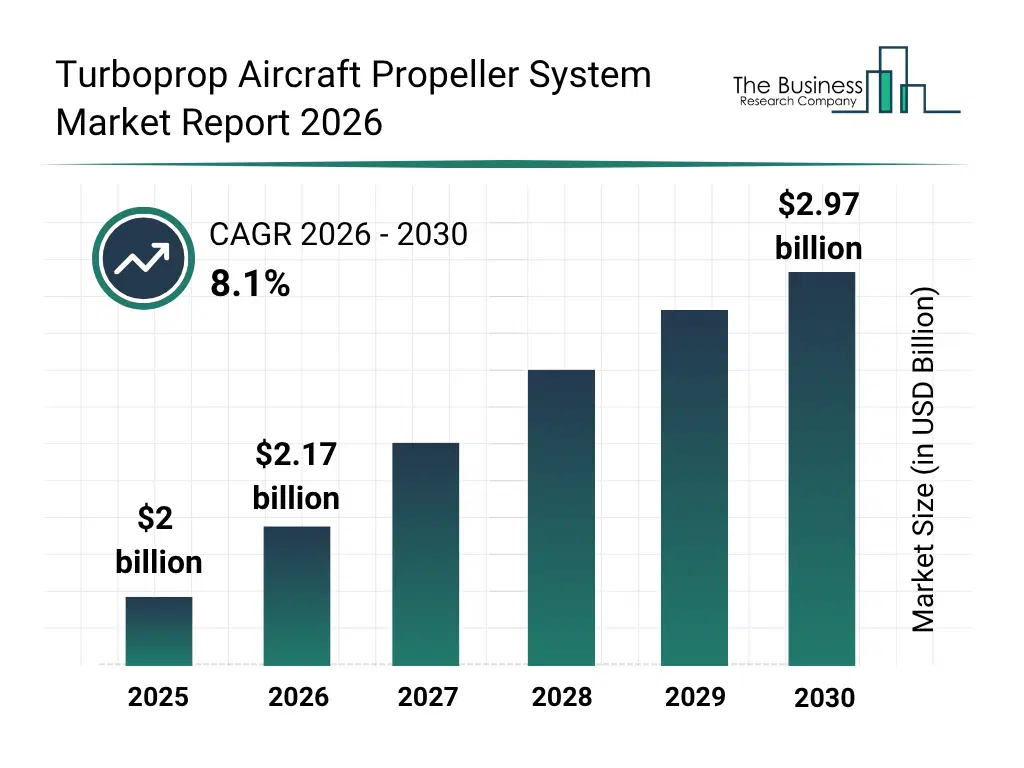
What Is The Turboprop Aircraft Propeller System Market Size and Share 2026?
The turboprop aircraft propeller system market size has grown strongly in recent years. It will grow from $2 billion in 2025 to $2.17 billion in 2026 at a compound annual growth rate (CAGR) of 8.5%. The growth in the historic period can be attributed to growth in regional air connectivity, demand for fuel-efficient aircraft, expansion of short-haul aviation, adoption of variable-pitch propeller technology, growth in turboprop aircraft deliveries.What Is The Turboprop Aircraft Propeller System Market Growth Forecast?
The turboprop aircraft propeller system market size is expected to see strong growth in the next few years. It will grow to $2.97 billion in 2030 at a compound annual growth rate (CAGR) of 8.1%. The growth in the forecast period can be attributed to increasing demand for low-emission aviation, expansion of regional aviation networks, rising adoption of composite propeller blades, increasing aircraft fleet modernization, growth in aircraft aftermarket and MRO activities. Major trends in the forecast period include advanced composite propeller blade adoption, electrically actuated variable-pitch propeller systems, lightweight propeller component development, advanced propeller deicing system integration, high-efficiency aerodynamic blade design.Tariff Impact On Turboprop Aircraft Propeller System Market
Tariffs are impacting the turboprop aircraft propeller system market by increasing the cost of imported aluminum, composite materials, precision components, and aerospace manufacturing equipment used in propeller blades, hubs, spinners, and pitch-control systems. This is increasing production costs and creating supply-chain delays for OEM and aftermarket segments, particularly in regions dependent on imported aerospace components such as Asia-Pacific and Europe. Hardware-intensive segments including propeller blades, hubs, and pitch-control mechanisms are most affected due to their reliance on specialized materials and components. However, tariffs are also encouraging localized manufacturing, supplier diversification, and greater investment in domestic aerospace production capabilities, which can strengthen long-term supply-chain resilience.
Global Turboprop Aircraft Propeller System Market Segmentation
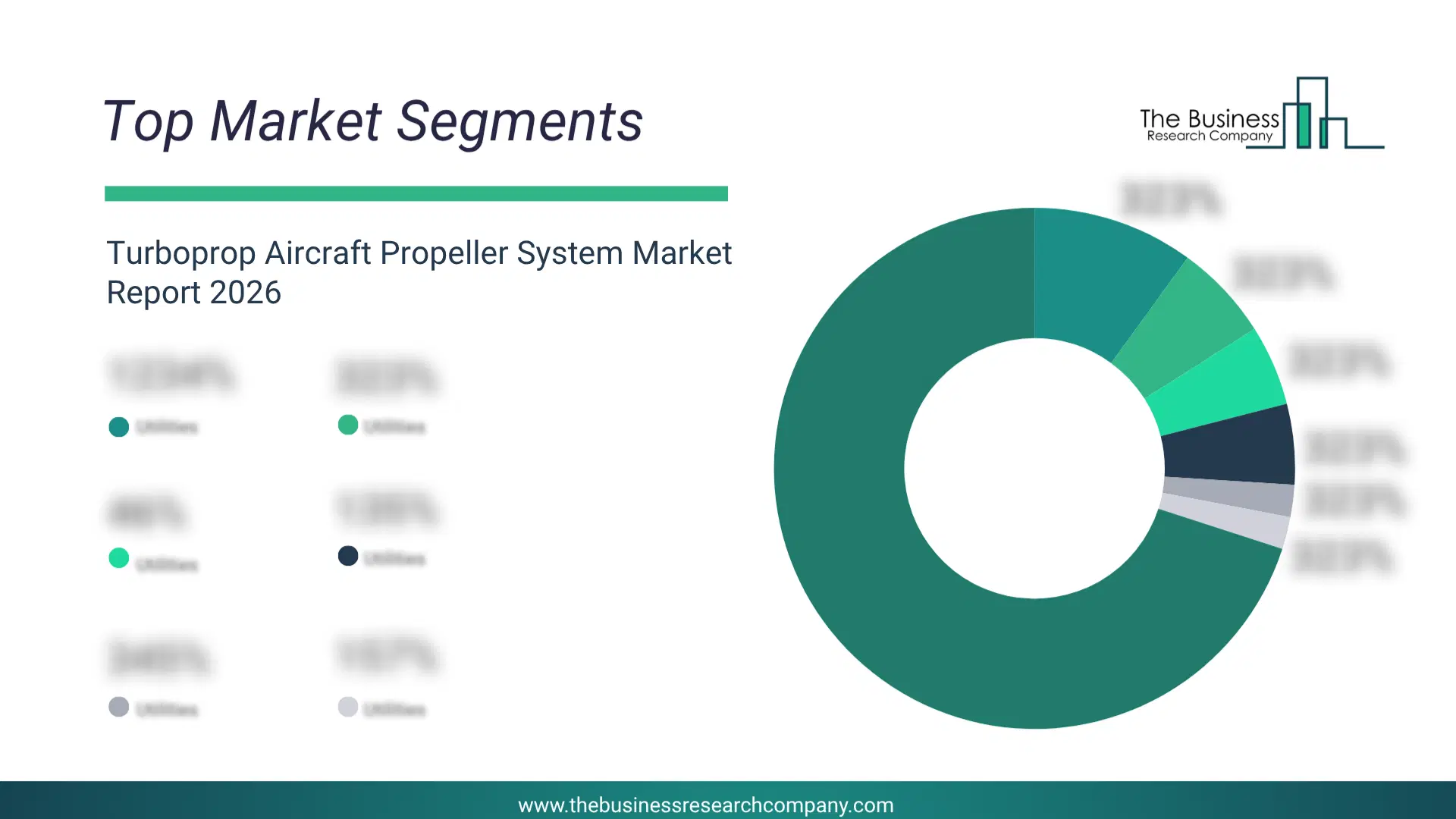
1) By Component: Blades, Hubs, Spinners, Other Components 2) By Material: Aluminum, Composite, Other Materials 3) By Application: Commercial Aviation, Military Aviation, General Aviation 4) By Sales Channel: Original Equipment Manufacturer (OEMs), Aftermarket Subsegments: 1) By Blades: Composite Blades, Aluminum Alloy Blades, Steel Blades, Wooden Blades 2) By Hubs: Hydraulic Propeller Hubs, Electrohydraulic Propeller Hubs, Mechanical Propeller Hubs 3) By Spinners: Aluminum Spinners, Composite Spinners, Steel Spinners 4) By Other Components: Pitch Control Mechanisms, Governors, Deicing Systems, Counterweight AssembliesWhat Is The Driver Of The Turboprop Aircraft Propeller System Market?
The increasing aircraft production is expected to propel the growth of the turboprop aircraft propeller system market going forward. Aircraft production refers to the manufacturing and assembly of commercial, military, and general aviation aircraft by aerospace manufacturers. Aircraft production is increasing due to rising global air passenger traffic, which drives airlines and operators to procure more aircraft to meet growing transportation demand. Increasing aircraft production drives demand for turboprop aircraft propeller systems as every newly manufactured turboprop aircraft requires a propeller system to generate thrust, ensure efficient engine performance, and support safe flight operations. For instance, in July 2026, according to Airbus, a Netherlands-based aerospace manufacturer, the company delivered 351 commercial aircraft in the first half of 2026, up from 306 aircraft in the first half of 2025, representing a 14.7% year-over-year increase. Therefore, the increasing aircraft production is driving the growth of the turboprop aircraft propeller system industry.Key Players In The Global Turboprop Aircraft Propeller System Market
Major companies operating in the turboprop aircraft propeller system market are RTX Corporation, GE Aerospace, Hartzell Propeller Inc., Textron Inc., MT-Propeller Entwicklung GmbH, Avia Propeller s.r.o., Aerosila, Hoffmann Propeller GmbH & Co. KG, Airmaster Propellers Limited, DUC Hélices SAS, Woodcomp Propellers s.r.o., e-Props France SAS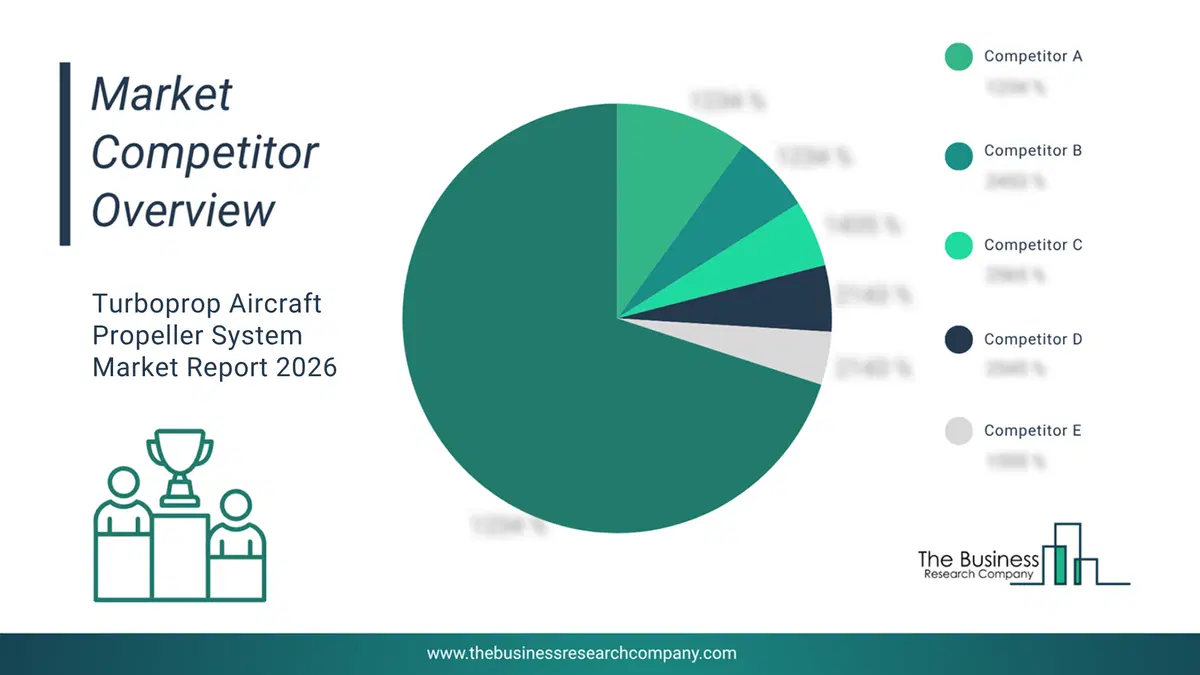
This chart is for illustrative purposes; the full report includes a detailed competitor analysis and comprehensive overview of the top 10 companies in the market.
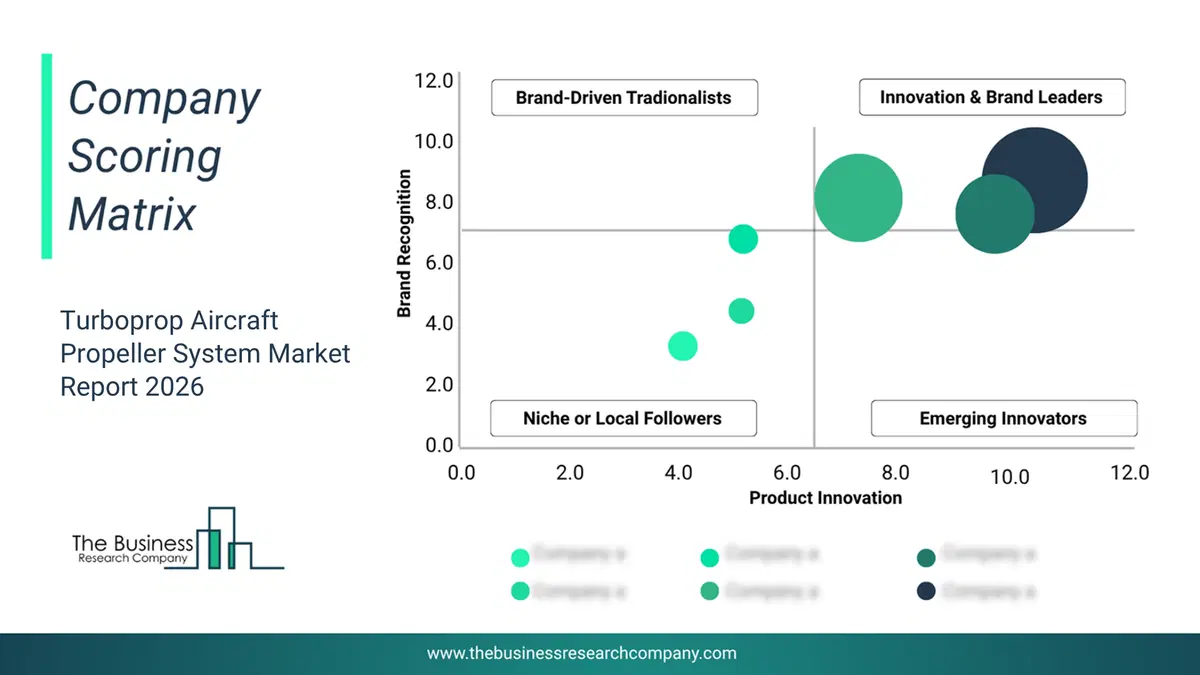
This chart maps companies by product innovation and brand strength, with bubble size indicating relative revenue, helping identify market leaders, challengers, and niche players. This is an illustrative chart; the full report provides a complete and accurate competitive analysis.
Global Turboprop Aircraft Propeller System Market Trends and Insights
Major companies operating in the turboprop aircraft propeller system market are focusing on developing advanced propeller solutions, such as multi-blade composite propellers, to enhance aircraft performance, reduce noise and vibration, and improve operational efficiency. Multi-blade composite propellers refer to lightweight aircraft propeller systems incorporating multiple composite blades designed to optimize thrust generation, aerodynamic performance, vibration damping, and noise reduction. For instance, in July 2026, MT-Propeller Entwicklung GmbH, a Germany-based aircraft propeller manufacturer, received FAA Supplemental Type Certificate (STC) SA12438IB for the installation of its “Silent 7” seven-blade MTV-37 propeller on Piper PA46-600TP and PA46-701TP aircraft powered by Pratt & Whitney PT6A-42A and PT6A-52 turboprop engines. The installation provides approximately 10% shorter takeoff distance, 5% improved climb performance, and a 2–3 KTAS increase in cruise performance, while also delivering significant reductions in cabin and external noise and improved vibration damping.What Are Latest Mergers And Acquisitions In The Turboprop Aircraft Propeller System Market?
In October 2025, Hartzell Propeller Inc., a US-based manufacturer of aircraft propeller systems, partnered with Blackhawk Aerospace Technologies LLC, doing business as the Blackhawk Group, to expand performance and support solutions for turboprop aircraft. Through this partnership, the companies aim to enhance aircraft performance and customer support by combining Hartzell Propeller Inc.'s advanced propeller technology with Blackhawk Aerospace Technologies LLC's engine upgrade and aircraft performance expertise. Blackhawk Aerospace Technologies LLC is a US-based aerospace company specializing in engine performance upgrades, aircraft modifications, and supplemental type certificate (STC) solutions for turboprop aircraft.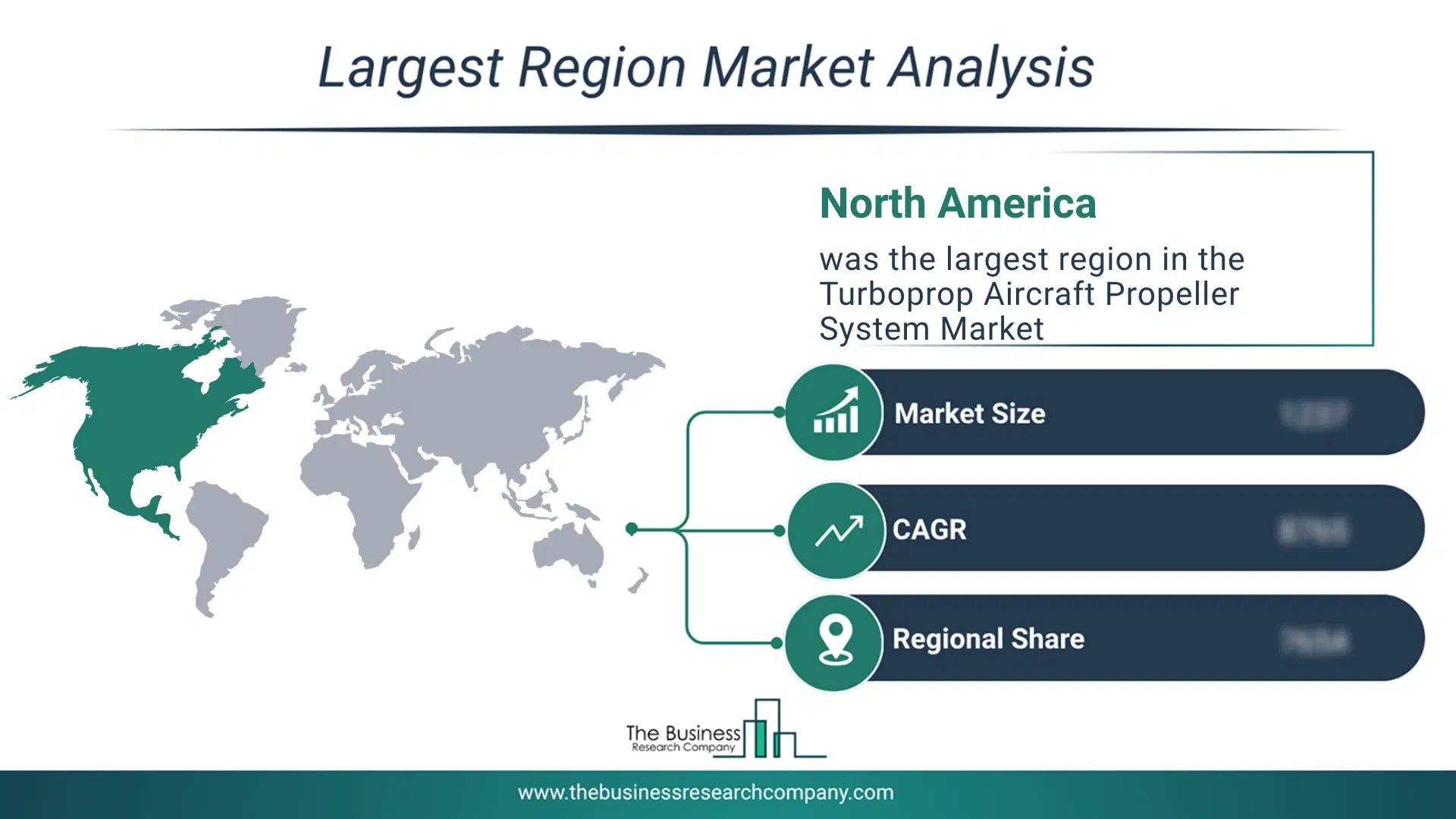
Regional Outlook
North America was the largest region in the turboprop aircraft propeller system market in 2025. Asia-Pacific is expected to be the fastest-growing region in the forecast period. The regions covered in this market report are Asia-Pacific, South East Asia, Western Europe, Eastern Europe, North America, South America, Middle East, Africa. The countries covered in this market report are Australia, Brazil, China, France, Germany, India, Indonesia, Japan, Taiwan, Russia, South Korea, UK, USA, Canada, Italy, Spain.What Defines the Turboprop Aircraft Propeller System Market?
The turboprop aircraft propeller system market consists of sales of propeller control systems, propeller governors, electronic propeller control units, constant-speed propeller systems, full-feathering propeller systems, reversible propeller systems, synchrophasing systems, and propeller de-icing systems. Values in this market are ‘factory gate’ values, that is the value of goods sold by the manufacturers or creators of the goods, whether to other entities (including downstream manufacturers, wholesalers, distributors and retailers) or directly to end customers. The value of goods in this market includes related services sold by the creators of the goods.How is Market Value Defined and Measured?
The market value is defined as the revenues that enterprises gain from the sale of goods and/or services within the specified market and geography through sales, grants, or donations in terms of the currency (in USD unless otherwise specified). The revenues for a specified geography are consumption values that are revenues generated by organizations in the specified geography within the market, irrespective of where they are produced. It does not include revenues from resales along the supply chain, either further along the supply chain or as part of other products.
This chart presents market attractiveness based on a quantitative evaluation of growth, competition, strategic alignment, and risk, offering a clear view of opportunity areas for decision-making. This chart is for illustrative purposes; the full report contains the complete analysis.

This chart highlights the Total Addressable Market (TAM) by estimating the maximum revenue opportunity using an assumption-driven approach, supporting strategic planning and opportunity sizing across markets. The chart is illustrative; the full report provides a more comprehensive analysis.
What Key Data and Analysis Are Included in the Turboprop Aircraft Propeller System Market Report 2026?
The turboprop aircraft propeller system market research report is one of a series of new reports from The Business Research Company that provides market statistics, including industry global market size, regional shares, competitors with the market share, detailed market segments, market trends and opportunities, and any further data you may need to thrive in the turboprop aircraft propeller system industry. The market research report delivers a complete perspective of everything you need, with an in-depth analysis of the current and future state of the industry.Turboprop Aircraft Propeller System Market Report Forecast Analysis
| Report Attribute | Details |
|---|---|
| Market Size Value In 2026 | $2.17 billion |
| Revenue Forecast In 2030 | $2.97 billion |
| Growth Rate | CAGR of 8.1% from 2026 to 2030 |
| Base Year For Estimation | 2025 |
| Actual Estimates/Historical Data | 2020-2025 |
| Forecast Period | 2026 - 2030 |
| Market Representation | Revenue in USD Billion and CAGR from 2026 to 2030 |
| Segments Covered | Component, Material, Application, Sales Channel |
| Regional Scope | Asia-Pacific, Western Europe, Eastern Europe, North America, South America, Middle East, Africa |
| Country Scope | The countries covered in the report are Australia, Brazil, China, France, Germany, India, Indonesia, Japan, Taiwan, Russia, South Korea, UK, USA, Canada, Italy, Spain. |
| Key Companies Profiled | RTX Corporation, GE Aerospace, Hartzell Propeller Inc., Textron Inc., MT-Propeller Entwicklung GmbH, Avia Propeller s.r.o., Aerosila, Hoffmann Propeller GmbH & Co. KG, Airmaster Propellers Limited, DUC Hélices SAS, Woodcomp Propellers s.r.o., e-Props France SAS |
| Customization Scope | Request for Customization |
| Pricing And Purchase Options | Explore Purchase Options |