
Two-Dimensional Image Measuring Instrument Market Report 2026
Global Outlook – By Product Type (Optical Measurement Instruments, Software Solutions), By Size (Small Size Instruments, Medium Size Instruments, Large Size Instruments), By Application (Industrial Measurement, Aerospace Engineering, Automotive Inspection, Research And Development), By End-User (Manufacturing Sector, Defense And Aerospace, Automotive Industry, Academic And Research Institutions) – Market Size, Trends, Strategies, and Forecast to 2030
Two-Dimensional Image Measuring Instrument Market Overview
• Two-Dimensional Image Measuring Instrument market size has reached to $1.46 billion in 2025 • Expected to grow to $2.17 billion in 2030 at a compound annual growth rate (CAGR) of 8.1% • Growth Driver: Surge In Automation In Manufacturing Fueling The Growth Of The Market Due To Rising Demand For Precision And Quality Control • Market Trend: Advancements In Image Vision Systems Driving Accuracy And Efficiency In Manufacturing • North America was the largest region in 2025 and Asia-Pacific is the fastest growing region.What Is Covered Under Two-Dimensional Image Measuring Instrument Market?
A two-dimensional image measuring instrument is a sophisticated device designed to accurately capture and analyze the geometric dimensions, shapes, and spatial relationships of objects within a two-dimensional plane for precise measurement purposes. It employs advanced optical, digital, or laser-based technologies to measure length, width, angles, and contours with high accuracy, all without requiring direct physical contact with the object being examined. The main types of products in two-dimensional image measuring instruments are optical measurement instruments, laser measurement instruments, digital measuring instruments, mechanical measuring instruments, and software solutions. Optical measurement instruments use light, lenses, and cameras to capture and analyze the dimensions and shapes of objects with high precision. It is found in various sizes, such as small-size instruments, medium-size instruments, and large-size instruments, and caters to applications in industrial measurement, medical imaging, aerospace engineering, automotive inspection, research and development. Key end-users include the manufacturing sector, the healthcare sector, defense and aerospace, the automotive industry, and academic and research institutions.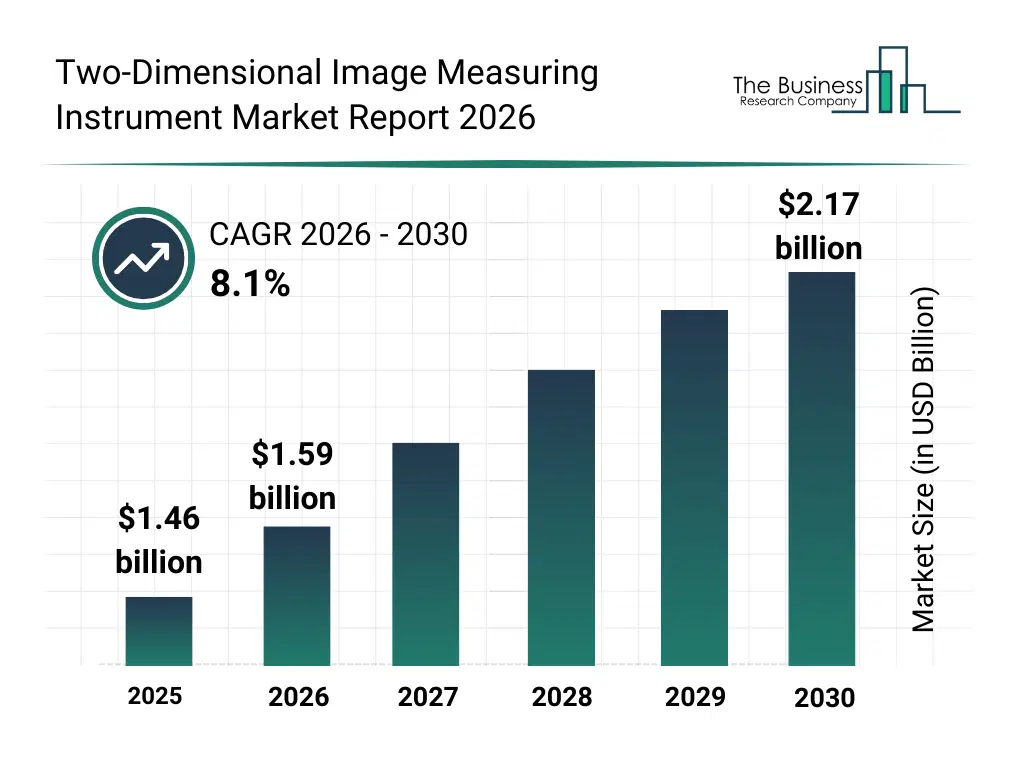
What Is The Two-Dimensional Image Measuring Instrument Market Size and Share 2026?
The two-dimensional image measuring instrument market size has grown strongly in recent years. It will grow from $1.46 billion in 2025 to $1.59 billion in 2026 at a compound annual growth rate (CAGR) of 8.4%. The growth in the historic period can be attributed to expansion of precision manufacturing industries, increasing adoption of quality inspection tools, growth in aerospace and automotive production, rising demand for accurate dimensional measurement, availability of advanced optical technologies.What Is The Two-Dimensional Image Measuring Instrument Market Growth Forecast?
The two-dimensional image measuring instrument market size is expected to see strong growth in the next few years. It will grow to $2.17 billion in 2030 at a compound annual growth rate (CAGR) of 8.1%. The growth in the forecast period can be attributed to increasing automation in manufacturing processes, rising demand for smart inspection systems, expansion of semiconductor and electronics manufacturing, growing adoption of AI-enabled measurement software, increasing focus on zero-defect production. Major trends in the forecast period include increasing adoption of non-contact optical measurement systems, rising integration of software-based image analysis, growing demand for high-precision industrial inspection, expansion of automated quality control applications, enhanced focus on measurement accuracy.Tariff Impact On Two-Dimensional Image Measuring Instrument Market
Tariffs are impacting the two-dimensional image measuring instrument market by increasing the cost of imported optical components, precision lenses, sensors, lasers, and embedded electronics used in high-accuracy measurement systems. Manufacturing, aerospace, and automotive inspection segments in Asia-Pacific, Europe, and North America are most affected due to reliance on globally sourced precision components. These tariffs have raised equipment prices and slowed procurement cycles for advanced metrology tools. However, they are also encouraging domestic manufacturing of optical systems, regional supplier development, and innovation in cost-efficient and modular image measurement solutions.
Global Two-Dimensional Image Measuring Instrument Market Segmentation
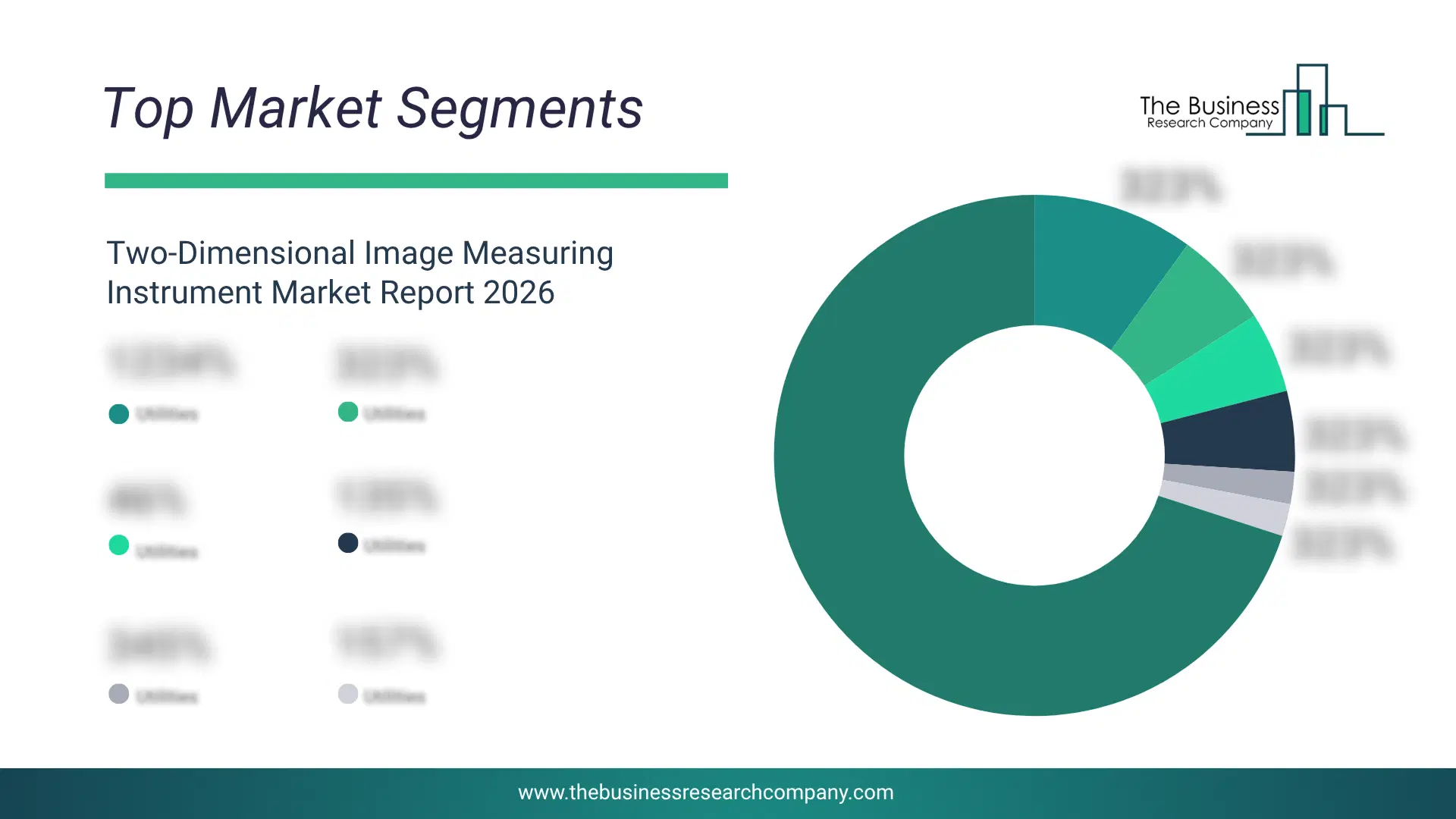
1) By Product Type: Optical Measurement Instruments, Software Solutions 2) By Size: Small Size Instruments, Medium Size Instruments, Large Size Instruments 3) By Application: Industrial Measurement, Aerospace Engineering, Automotive Inspection, Research And Development 4) By End-User: Manufacturing Sector, Defense And Aerospace, Automotive Industry, Academic And Research Institutions Subsegments: 1) By Optical Measurement Instruments: Vision Measuring Machines, Profile Projectors, Microscopes, Camera Based Systems 2) By Software Solutions: Measurement Analysis Software, Inspection Planning Software, Data Management SoftwareWhat Is The Driver Of The Two-Dimensional Image Measuring Instrument Market?
The growing demand for automation in manufacturing is expected to propel the growth of the two-dimensional image measuring instrument market going forward. Automation in manufacturing refers to using machines and technology to perform production tasks with minimal human involvement, improving efficiency and consistency. The demand for automation in manufacturing is growing as companies increasingly focus on improving product quality, using advanced machines and control systems to ensure precise, consistent, and error-free production processes that meet stringent industry standards. Two-dimensional image measuring instruments support automation in manufacturing by providing accurate, real-time measurements that enable defect detection and ensure consistent product quality. For instance, in April 2024, according to the International Federation of Robotics, a Germany-based non-profit organization, manufacturing companies in the United States significantly increased their investment in automation, with industrial robot installations rising by 12% to a total of 44,303 units in 2023. Therefore, the growing demand for automation in manufacturing is driving the growth of the two-dimensional image measuring instrument industry.Key Players In The Global Two-Dimensional Image Measuring Instrument Market
Major companies operating in the two-dimensional image measuring instrument market are Keyence Corporation, Hexagon AB, Carl Zeiss AG, Nikon Metrology NV, Mitutoyo Corporation, Quality Vision International Inc., Vision Engineering Ltd., Starrett Company, WENZEL Group GmbH & Co. KG, Werth Messtechnik GmbH, OGP (Optical Gaging Products), Bruker Corporation, ViTrox Corporation Berhad, Cognex Corporation, Omron Corporation, SICK AG, Pepperl+Fuchs SE, Baumer Group, KEYENCE MICRO Epsilon Messtechnik GmbH & Co. KG, LMI Technologies Inc., Sony Semiconductor Solutions Corporation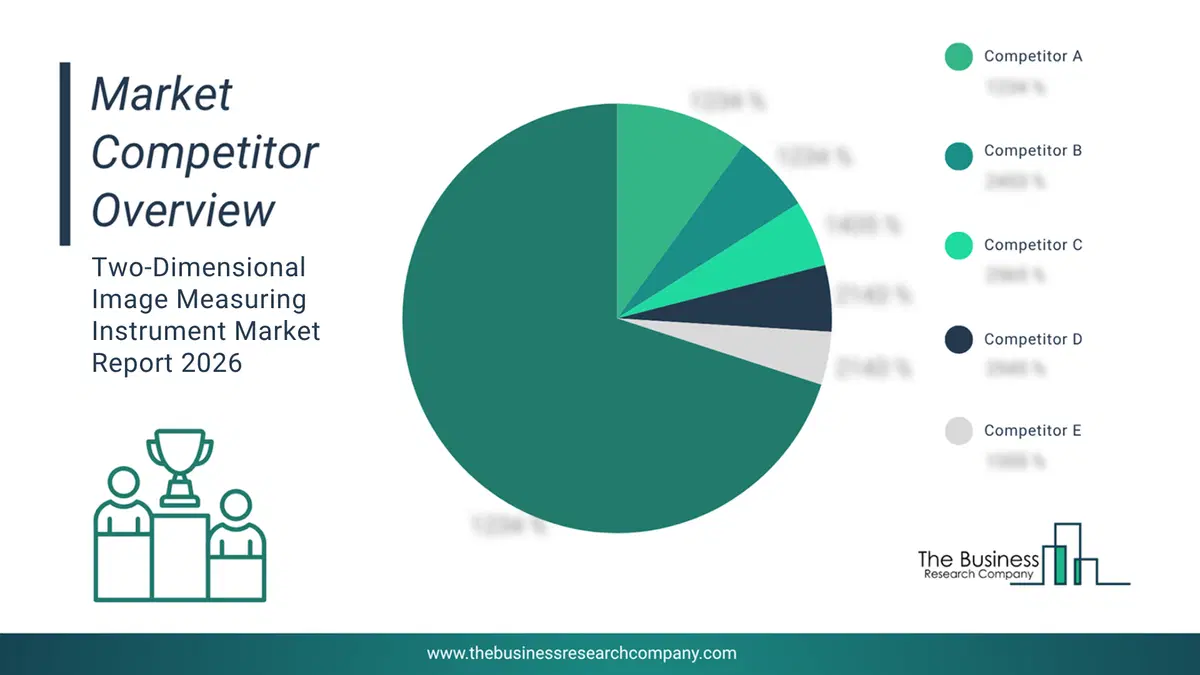
This chart is for illustrative purposes; the full report includes a detailed competitor analysis and comprehensive overview of the top 10 companies in the market.
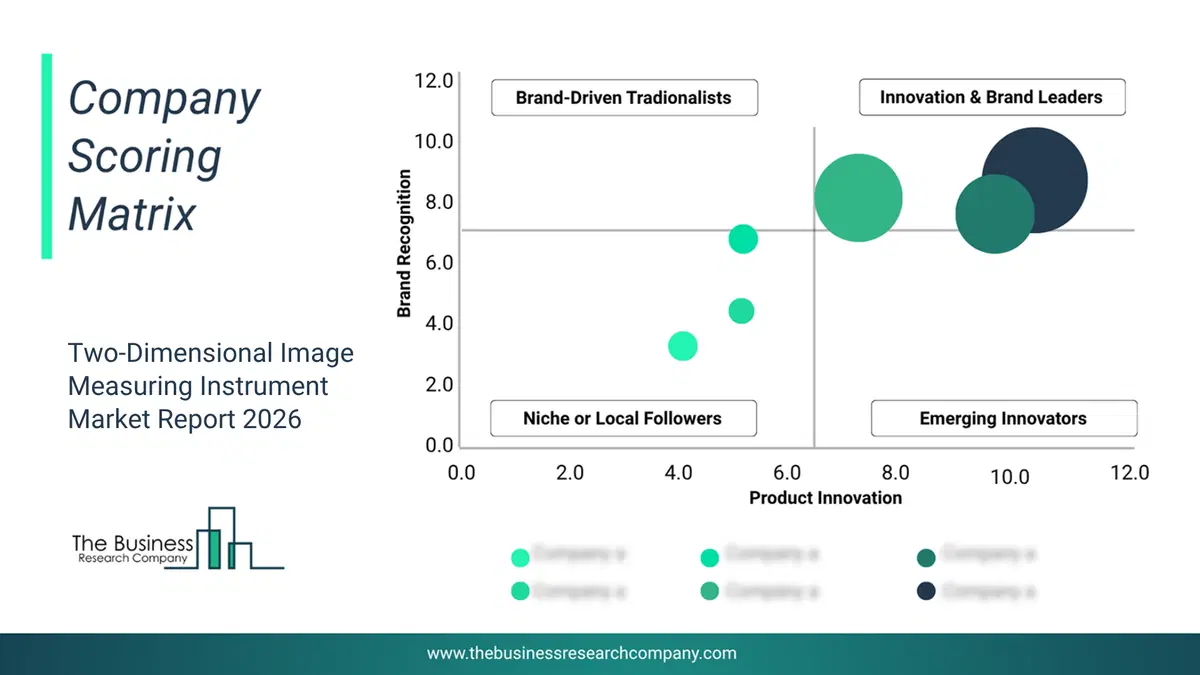
This chart maps companies by product innovation and brand strength, with bubble size indicating relative revenue, helping identify market leaders, challengers, and niche players. This is an illustrative chart; the full report provides a complete and accurate competitive analysis.
Global Two-Dimensional Image Measuring Instrument Market Trends and Insights
Major companies operating in the two-dimensional image measuring instrument market are focusing on developing innovative solutions, such as 2D vision measuring systems, to enhance measurement accuracy, improve inspection efficiency, and support advanced quality control across manufacturing and industrial applications. 2D vision measuring systems refer to optical instruments that use image capture and analysis technology to measure the dimensions and features of objects with high precision. For instance, in October 2024, Mitutoyo America Corporation, a US-based company that specializes in measuring instruments and metrological technology, launched the integration of the Metlogix M3 software into its Quick Image (QI) 2D Vision Measuring System. This integration enhances the QI system by providing a highly intuitive, icon-driven interface with gesture controls for easy operation. The M3 software introduces advanced pattern-based measurement tools that enable multiple points to be measured in one action, reducing setup time and boosting productivity. It also features powerful video edge detection tools, video-based touch probing, and automation through Field of View (FOV) functionality that allows multiple parts to be measured simultaneously without operator intervention.What Are Latest Mergers And Acquisitions In The Two-Dimensional Image Measuring Instrument Market?
In July 2025, AMETEK Inc., a US-based company that manufactures electronic instruments and electromechanical devices, acquired FARO Technologies Inc. for $920 million. Through this acquisition, AMETEK aims to enhance its capabilities in precision measurement and expand its presence in attractive growth markets by combining FARO's differentiated 3D metrology and imaging solutions with its existing Ultra Precision Technologies division, thereby creating compelling opportunities for growth and margin expansion. FARO Technologies Inc. is a US-based company specializing in 3D measurement, imaging, and realization solutions, including solutions that generate and utilize two-dimensional (2D) images and measurements.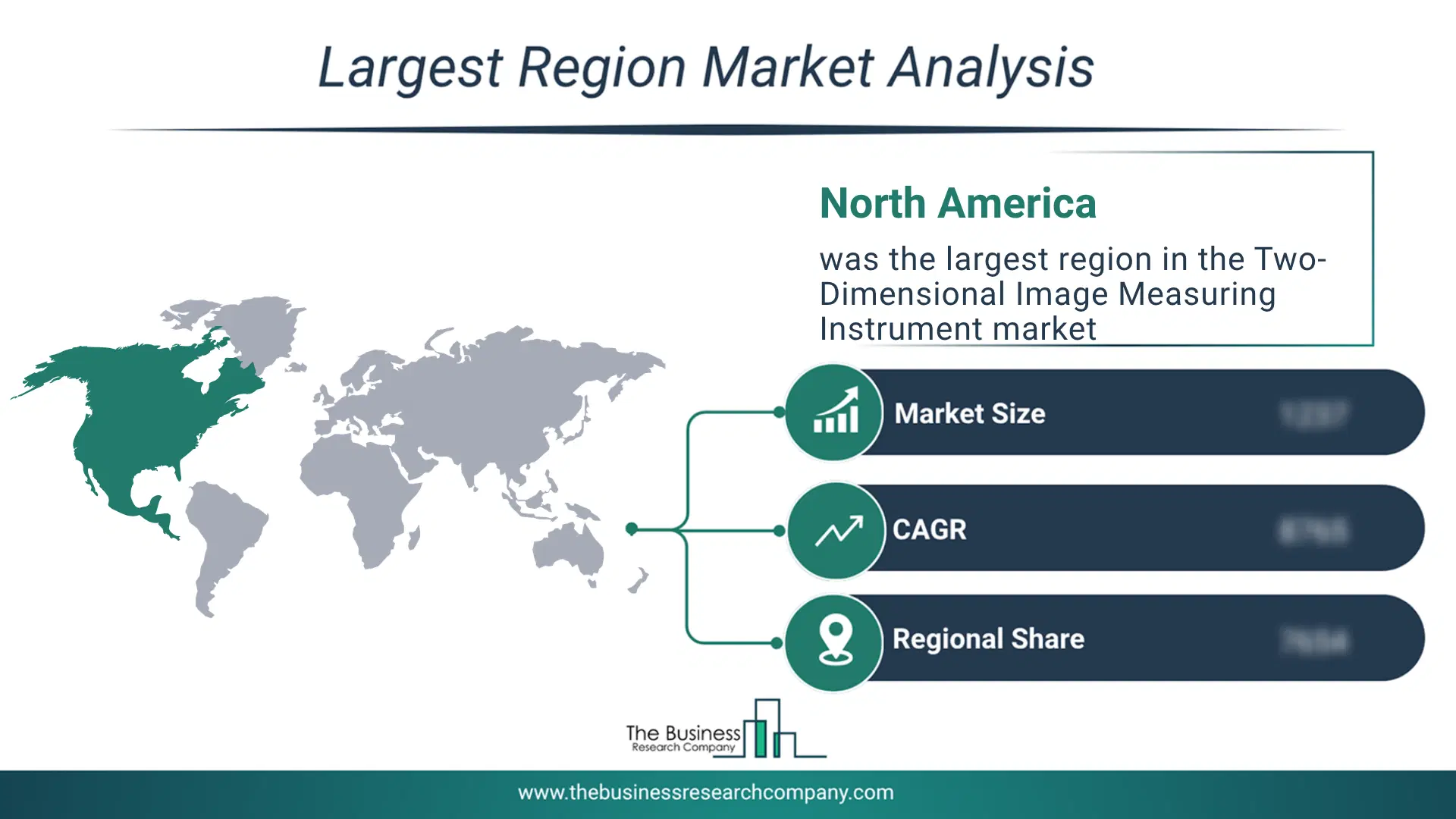
Regional Outlook
North America was the largest region in the two-dimensional image measuring instrument market in 2025. Asia-Pacific is expected to be the fastest-growing region in the forecast period. The regions covered in this market report are Asia-Pacific, South East Asia, Western Europe, Eastern Europe, North America, South America, Middle East, Africa The countries covered in this market report are Australia, Brazil, China, France, Germany, India, Indonesia, Japan, Taiwan, Russia, South Korea, UK, USA, Canada, Italy, Spain.What Defines the Two-Dimensional Image Measuring Instrument Market?
The two-dimensional image measuring instrument market consists of sales of video measuring systems, portable 2D measuring instruments, specialized image analysis software, 2D measuring cameras and lenses, and metrology-grade image capture systems. Values in this market are ‘factory gate’ values, that is, the value of goods sold by the manufacturers or creators of the goods, whether to other entities (including downstream manufacturers, wholesalers, distributors, and retailers) or directly to end customers. The value of goods in this market includes related services sold by the creators of the goods.How is Market Value Defined and Measured?
The market value is defined as the revenues that enterprises gain from the sale of goods and/or services within the specified market and geography through sales, grants, or donations in terms of the currency (in USD unless otherwise specified). The revenues for a specified geography are consumption values that are revenues generated by organizations in the specified geography within the market, irrespective of where they are produced. It does not include revenues from resales along the supply chain, either further along the supply chain or as part of other products.
This chart presents market attractiveness based on a quantitative evaluation of growth, competition, strategic alignment, and risk, offering a clear view of opportunity areas for decision-making. This chart is for illustrative purposes; the full report contains the complete analysis.

This chart highlights the Total Addressable Market (TAM) by estimating the maximum revenue opportunity using an assumption-driven approach, supporting strategic planning and opportunity sizing across markets. The chart is illustrative; the full report provides a more comprehensive analysis.
What Key Data and Analysis Are Included in the Two-Dimensional Image Measuring Instrument Market Report 2026?
The two-dimensional image measuring instrument market research report is one of a series of new reports from The Business Research Company that provides market statistics, including industry global market size, regional shares, competitors with the market share, detailed market segments, market trends and opportunities, and any further data you may need to thrive in the two-dimensional image measuring instrument industry. The market research report delivers a complete perspective of everything you need, with an in-depth analysis of the current and future state of the industry.Two Dimensional Image Measuring Instrument Market Report Forecast Analysis
| Report Attribute | Details |
|---|---|
| Market Size Value In 2026 | $1.59 billion |
| Revenue Forecast In 2030 | $2.17 billion |
| Base Year For Estimation | 2025 |
| Actual Estimates/Historical Data | 2020-2025 |
| Forecast Period | 2026 - 2030 |
| Market Representation | Revenue in USD Billion and CAGR from 2026 to 2030 |
| Segments Covered | Product Type, Size, Application, End-User |
| Regional Scope | Asia-Pacific, Western Europe, Eastern Europe, North America, South America, Middle East, Africa |
| Key Companies Profiled | Keyence Corporation, Hexagon AB, Carl Zeiss AG, Nikon Metrology NV, Mitutoyo Corporation, Quality Vision International Inc., Vision Engineering Ltd., Starrett Company, WENZEL Group GmbH & Co. KG, Werth Messtechnik GmbH, OGP (Optical Gaging Products), Bruker Corporation, ViTrox Corporation Berhad, Cognex Corporation, Omron Corporation, SICK AG, Pepperl+Fuchs SE, Baumer Group, KEYENCE MICRO Epsilon Messtechnik GmbH & Co. KG, LMI Technologies Inc., Sony Semiconductor Solutions Corporation |
| Customization Scope | Request for Customization |
| Pricing And Purchase Options | Explore Purchase Options |