
Ultraviolet-Visible Spectroscopy Market Report 2026
Global Outlook – By Instrument Type (Single-Beam System, Double-Beam System, Array Based System, Handheld System), By Application (Industrial Applications, Physical Chemistry Studies, Life Science Studies, Environmental Studies, Academic Applications, Life Science Research And Development, Quality Assurance And Quality Control), By End User (Pharmaceutical And Biotechnology Companies, Academic And Research Institutes, Agriculture And Food Industries, Environmental Testing Labs) – Market Size, Trends, Strategies, and Forecast to 2030
Ultraviolet-Visible Spectroscopy Market Overview
• Ultraviolet-Visible Spectroscopy market size has reached to $1.63 billion in 2025 • Expected to grow to $2.27 billion in 2030 at a compound annual growth rate (CAGR) of 6.9% • Growth Driver: Ultraviolet-Visible Spectroscopy Market Surges With The Growing Food And Beverage Industry • Market Trend: High-Speed Detection UV-VIS Spectrometer Revolutionizes Educational Laboratories • North America was the largest region in 2025 and Asia-Pacific is the fastest growing region.What Is Covered Under Ultraviolet-Visible Spectroscopy Market?
Ultraviolet-visible spectroscopy is a method used to measure light absorbance in the ultraviolet and visible ranges of the electromagnetic spectrum. The ultraviolet-visible spectroscopy devices find their application in analytical chemistry for the quantitative determination of different analytes, such as transition metal ions, highly conjugated organic compounds, and biological macromolecules. The different types of instruments included in ultraviolet-visible spectroscopy are single-beam systems, double-beam systems, array-based systems, and handheld systems. Single-beam system utilizes one beam of light that passes through the sample, and the intensity of the light reflected from a reference is measured without the sample. Double-beam spectroscopes calculate the sample and conduct blank adjustments using the sample and reference beams. Array-based systems use array detectors that can simultaneously acquire an entire spectral image over a finite spectral region. Handheld systems allow researchers to analyze samples on the spot. Ultraviolet-visible spectroscopy is implemented in a wide range of verticals, such as pharmaceutical and biotechnology companies, academic and research institutes, agriculture and food industries, and environmental testing labs, and is used in industrial applications, physical chemistry studies, life science studies, environmental studies, academic applications, life science research and development, quality assurance, and quality control.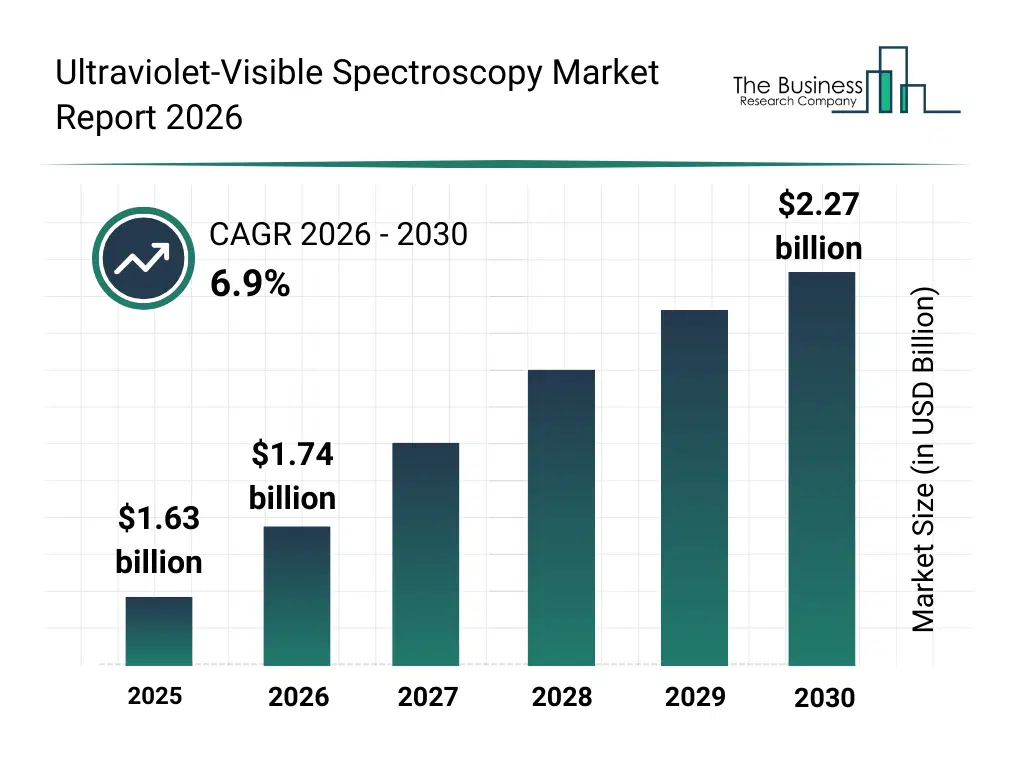
What Is The Ultraviolet-Visible Spectroscopy Market Size and Share 2026?
The ultraviolet-visible spectroscopy market size has grown strongly in recent years. It will grow from $1.63 billion in 2025 to $1.74 billion in 2026 at a compound annual growth rate (CAGR) of 6.6%. The growth in the historic period can be attributed to growth in analytical chemistry applications, expansion of academic research activities, increased pharmaceutical quality testing, rising environmental monitoring needs, adoption of spectroscopic techniques in laboratories.What Is The Ultraviolet-Visible Spectroscopy Market Growth Forecast?
The ultraviolet-visible spectroscopy market size is expected to see strong growth in the next few years. It will grow to $2.27 billion in 2030 at a compound annual growth rate (CAGR) of 6.9%. The growth in the forecast period can be attributed to growth in biotechnology research, demand for rapid analytical testing, expansion of pharmaceutical R&D pipelines, increasing focus on food safety testing, adoption of advanced laboratory automation. Major trends in the forecast period include growing adoption of high sensitivity UV vis instruments, rising demand for portable and handheld spectrophotometers, increased use in life science and biopharma research, expansion of automated and high throughput analysis, preference for multi application and user friendly systems.Tariff Impact On Ultraviolet-Visible Spectroscopy Market
Tariffs have impacted the ultraviolet visible spectroscopy market by increasing the cost of imported optical components, detectors, light sources, and electronic modules, resulting in higher instrument prices. The impact is most evident across array based and double beam systems used in pharmaceutical, biotechnology, and environmental testing applications, particularly in regions reliant on global optical supply chains such as Asia Pacific and Europe. These cost pressures have affected capital equipment purchasing decisions for laboratories. At the same time, tariffs are encouraging local assembly, regional sourcing of components, and strategic supplier diversification, supporting domestic instrument manufacturing capabilities.
Global Ultraviolet-Visible Spectroscopy Market Segmentation
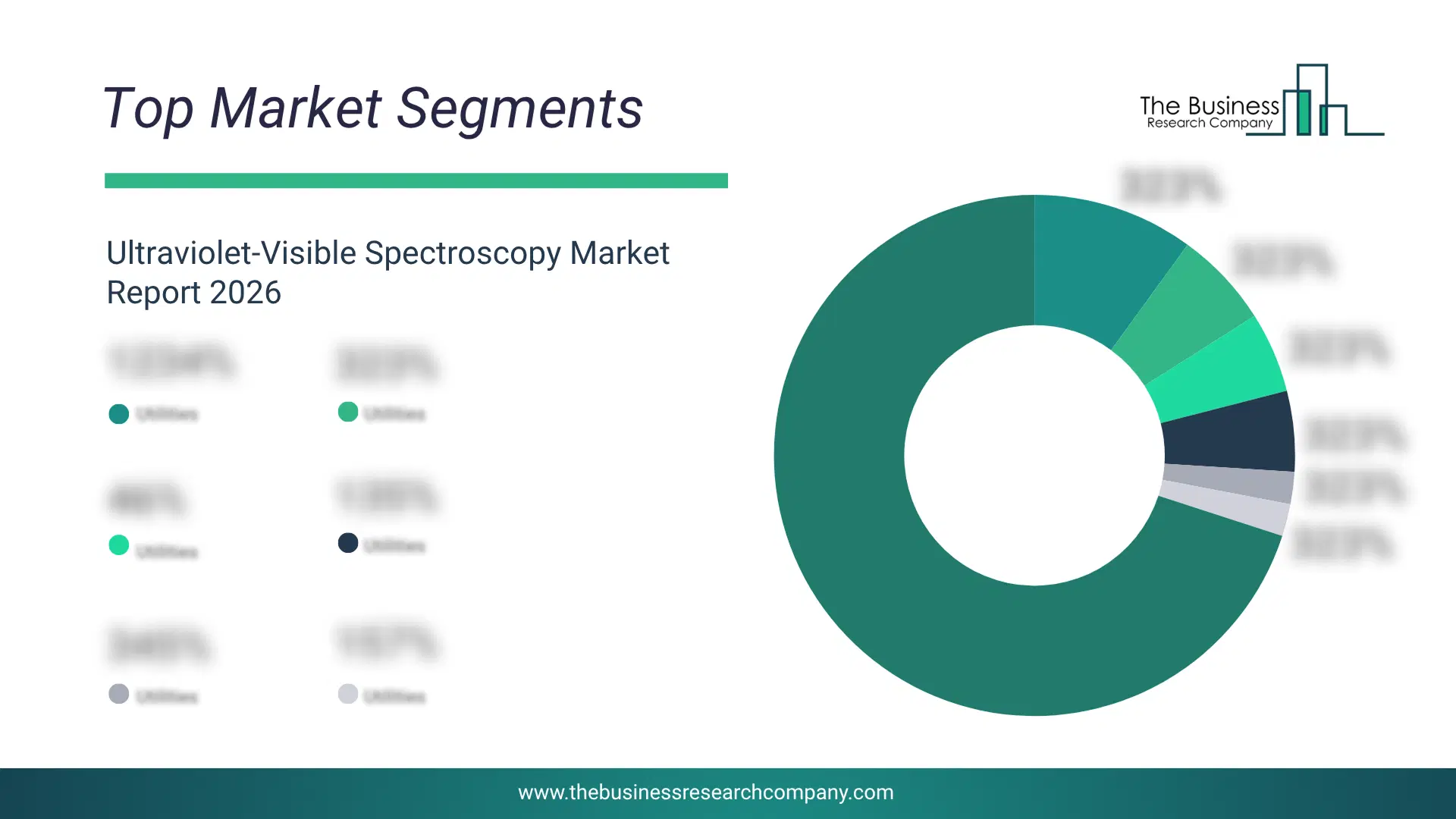
1) By Instrument Type: Single-Beam System, Double-Beam System, Array Based System, Handheld System 2) By Application: Industrial Applications, Physical Chemistry Studies, Life Science Studies, Environmental Studies, Academic Applications, Life Science Research And Development, Quality Assurance And Quality Control 3) By End User: Pharmaceutical And Biotechnology Companies, Academic And Research Institutes, Agriculture And Food Industries, Environmental Testing Labs Subsegments: 1) By Single-Beam System: Basic Single-Beam Spectrophotometers, Advanced Single-Beam Systems 2) By Double-Beam System: Continuous Double-Beam Systems, Pulsed Double-Beam Systems 3) By Array Based System: CCD Array Spectrometers, CMOS Array Spectrometers 4) By Handheld System: Portable UV-Vis Spectrophotometers, Miniature Handheld SystemsWhat Is The Driver Of The Ultraviolet-Visible Spectroscopy Market?
The growing food and beverage industry is expected to boost the growth of the ultraviolet-visible spectroscopy market going forward. The food and beverage industry comprises businesses involved in the production, processing, packaging, distribution, and retailing of food and drink products. Ultraviolet-visible (UV-Vis) spectroscopy is a powerful and versatile tool widely used in the food and beverage industry for ensuring optimal efficiency and product quality by monitoring enzymatic reactions used in food processing. For instance, in July 2025, according to the Government of Canada, a Canada-based federal government, in 2024, exports of processed food and beverage products reached a record $59.8 billion, marking a 3.8% rise compared with 2023. Therefore, the growing food and beverage industry is driving the growth of the ultraviolet-visible spectroscopy radar market.Key Players In The Global Ultraviolet-Visible Spectroscopy Market
Major companies operating in the ultraviolet-visible spectroscopy market are PG Instruments Ltd., Thermo Fisher Scientific Inc., Agilent Technologies Inc., AMETEK Inc., Hitachi High-Technologies Corporation, PerkinElmer Inc., Shimadzu Corporation, Bio-Rad Laboratories Inc., Bruker Corporation, HORIBA Ltd., Hamamatsu Photonics K.K., Hach Company, Buck Scientific Inc., PERSEE PG Scientific Inc., JASCO Inc., Biochrom Ltd., Cecil Instrument Ltd., GBC Scientific Equipment Pty Ltd., Kemtrak AB, Analytik Jena Shanghai Instruments Ltd., Applied Analytics Inc., Guided Wave Inc., ES Industry Pvt. Ltd.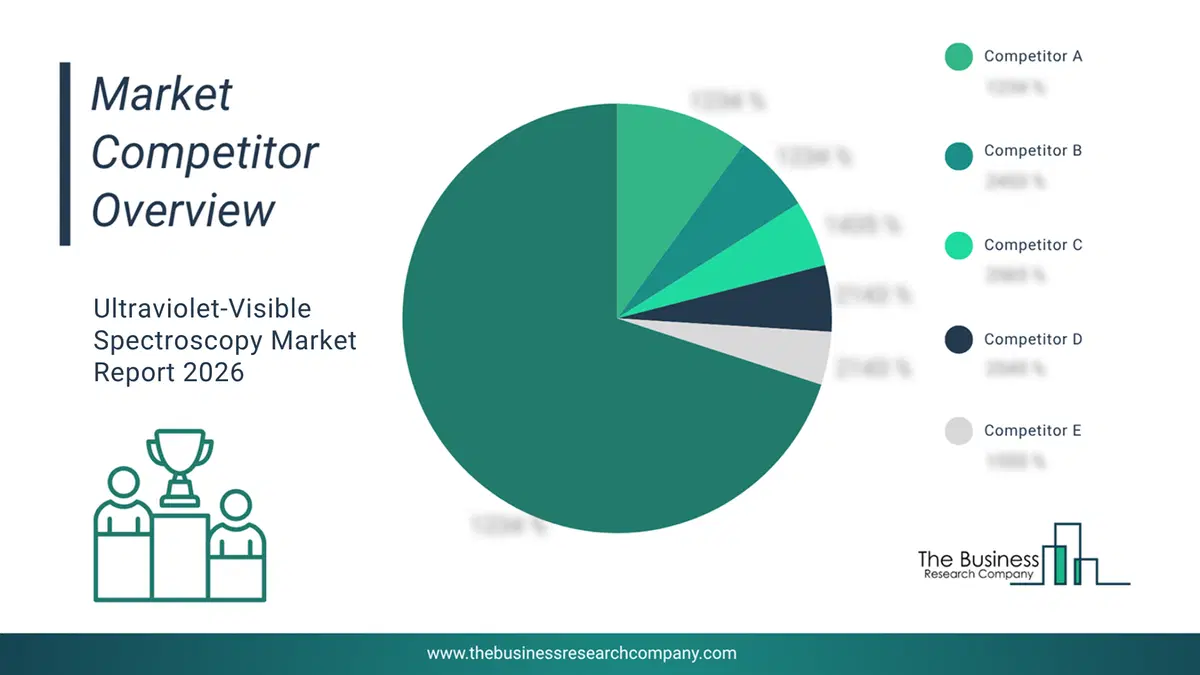
This chart is for illustrative purposes; the full report includes a detailed competitor analysis and comprehensive overview of the top 10 companies in the market.
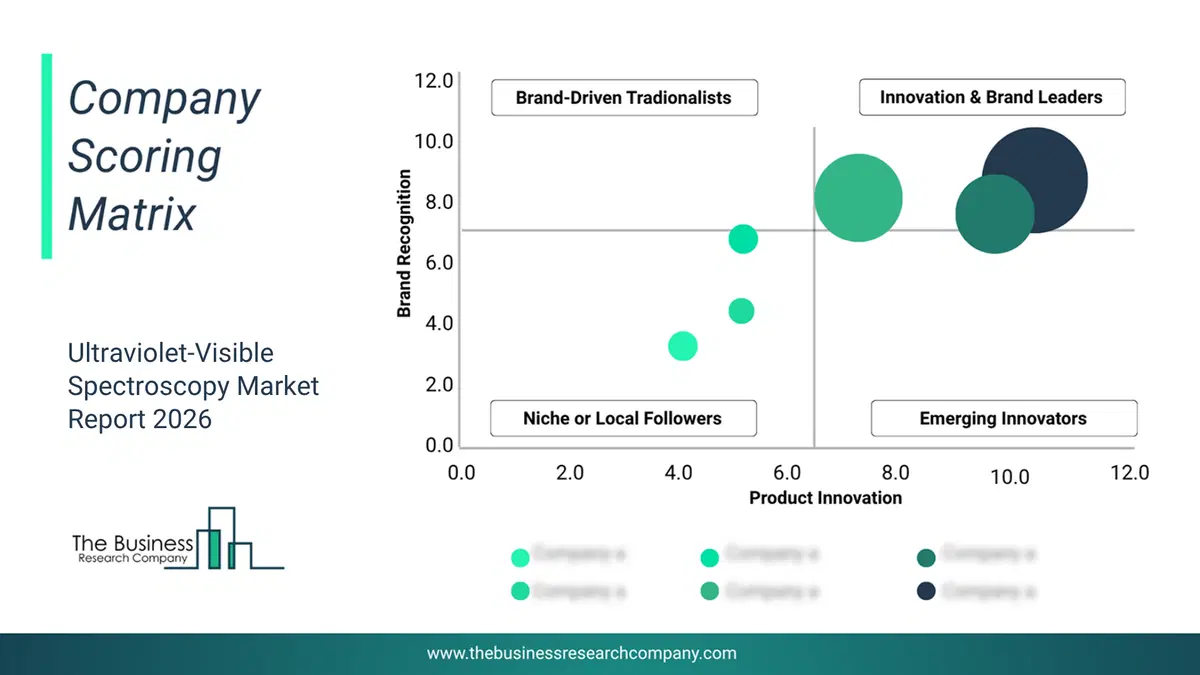
This chart maps companies by product innovation and brand strength, with bubble size indicating relative revenue, helping identify market leaders, challengers, and niche players. This is an illustrative chart; the full report provides a complete and accurate competitive analysis.
Global Ultraviolet-Visible Spectroscopy Market Trends and Insights
Major companies operating in the ultraviolet-visible spectroscopy market are developing innovative products, such as high-speed detection spectrometers, to meet larger customer bases, increase sales, and increase revenue. High-speed detection refers to a spectrometer equipped with a detection system capable of rapidly capturing and processing data. For instance, in April 2023, Shimadzu Corporation, a Japan-based company, leading manufacturer of precision instruments, measuring instruments, and medical equipment launched the Tm Analysis System, a sophisticated tool designed to enhance the analysis of melting temperatures (Tm) of biomolecules, particularly nucleic acids. This system integrates a UV-Vis spectrometer, the TMSPC-8i temperature-controlled cell holder, and LabSolutions UV-Vis Tm Analysis software. The system is specifically engineered to measure the thermal stability of nucleic acids by monitoring changes in absorbance as temperature increases. This allows for the determination of the Tm value, which indicates the temperature at which half of the DNA strands are in the double-stranded state and half are in the single-stranded state.What Are Latest Mergers And Acquisitions In The Ultraviolet-Visible Spectroscopy Market?
In May 2023, HORIBA Advanced Techno Co. Ltd., a Japan-based provider of instruments and systems, acquired Tethys Instruments SAS for an undisclosed amount. The closure of the first of two acquisitions marks a substantial expansion of Veritas Capital's portfolio company, Peraton, increasing its size by approximately sevenfold. Northrop Grumman's IT and mission support services business is now integrated into Peraton because of this acquisition. Tethys Instruments SAS is a France-based provider of ultraviolet-visible (UV-Vis) spectroscopy technology.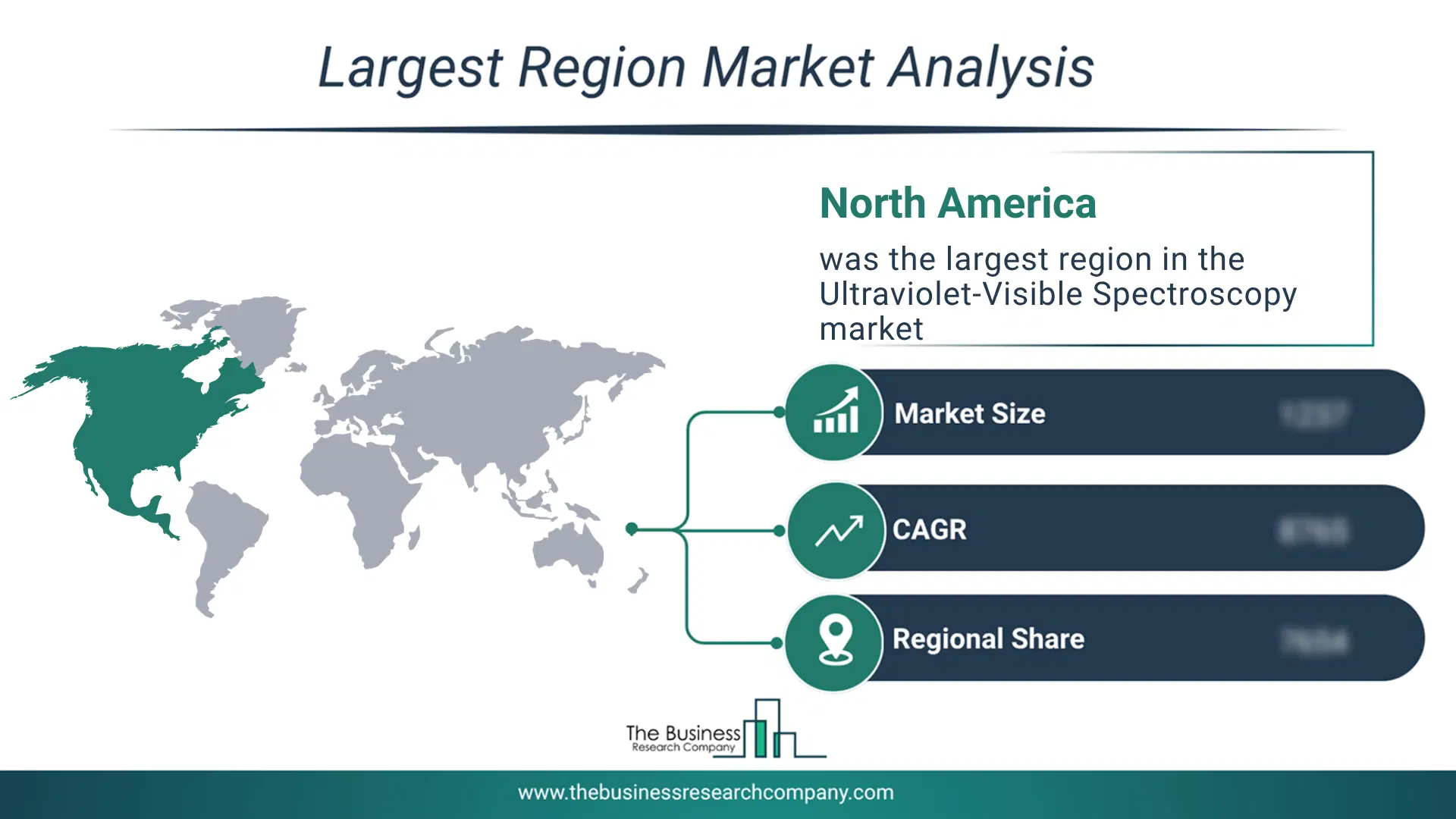
Regional Outlook
North America was the largest region in the ultraviolet-visible spectroscopy market share in 2025. Asia-Pacific is expected to be the fastest growing region in the forecast period. The regions covered in this market report are Asia-Pacific, South East Asia, Western Europe, Eastern Europe, North America, South America, Middle East, Africa The countries covered in this market report are Australia, Brazil, China, France, Germany, India, Indonesia, Japan, Taiwan, Russia, South Korea, UK, USA, Canada, Italy, Spain.What Defines the Ultraviolet-Visible Spectroscopy Market?
The ultraviolet-visible spectroscopy market consists of sales of spectrum machine, wavelength selector, detector, signal processor. Values in this market are ‘factory gate’ values, that is the value of goods sold by the manufacturers or creators of the goods, whether to other entities (including downstream manufacturers, wholesalers, distributors, and retailers) or directly to end customers. The value of goods in this market includes related services sold by the creators of the goods.How is Market Value Defined and Measured?
The market value is defined as the revenues that enterprises gain from the sale of goods and/or services within the specified market and geography through sales, grants, or donations in terms of the currency (in USD unless otherwise specified). The revenues for a specified geography are consumption values that are revenues generated by organizations in the specified geography within the market, irrespective of where they are produced. It does not include revenues from resales along the supply chain, either further along the supply chain or as part of other products.
This chart presents market attractiveness based on a quantitative evaluation of growth, competition, strategic alignment, and risk, offering a clear view of opportunity areas for decision-making. This chart is for illustrative purposes; the full report contains the complete analysis.

This chart highlights the Total Addressable Market (TAM) by estimating the maximum revenue opportunity using an assumption-driven approach, supporting strategic planning and opportunity sizing across markets. The chart is illustrative; the full report provides a more comprehensive analysis.
What Key Data and Analysis Are Included in the Ultraviolet-Visible Spectroscopy Market Report 2026?
The ultraviolet-visible spectroscopy market research report is one of a series of new reports from The Business Research Company that provides market statistics, including industry global market size, regional shares, competitors with the market share, detailed market segments, market trends and opportunities, and any further data you may need to thrive in the ultraviolet-visible spectroscopy industry. The market research report delivers a complete perspective of everything you need, with an in-depth analysis of the current and future state of the industry.Ultraviolet-Visible Spectroscopy Market Report Forecast Analysis
| Report Attribute | Details |
|---|---|
| Market Size Value In 2026 | $1.74 billion |
| Revenue Forecast In 2030 | $2.27 billion |
| Growth Rate | CAGR of 6.9% from 2026 to 2030 |
| Base Year For Estimation | 2025 |
| Actual Estimates/Historical Data | 2020-2025 |
| Forecast Period | 2026 - 2030 |
| Market Representation | Revenue in USD Billion and CAGR from 2026 to 2030 |
| Segments Covered | Instrument Type, Application, End User |
| Regional Scope | Asia-Pacific, Western Europe, Eastern Europe, North America, South America, Middle East, Africa |
| Key Companies Profiled | PG Instruments Ltd., Thermo Fisher Scientific Inc., Agilent Technologies Inc., AMETEK Inc., Hitachi High-Technologies Corporation, PerkinElmer Inc., Shimadzu Corporation, Bio-Rad Laboratories Inc., Bruker Corporation, HORIBA Ltd., Hamamatsu Photonics K.K., Hach Company, Buck Scientific Inc., PERSEE PG Scientific Inc., JASCO Inc., Biochrom Ltd., Cecil Instrument Ltd., GBC Scientific Equipment Pty Ltd., Kemtrak AB, Analytik Jena Shanghai Instruments Ltd., Applied Analytics Inc., Guided Wave Inc., ES Industry Pvt. Ltd. |
| Customization Scope | Request for Customization |
| Pricing And Purchase Options | Explore Purchase Options |