
Underwater Concrete Market Report 2026
Global Outlook – By Material Type (Aggregates, Admixtures, Cement, Other Types), By Product Type (Fly Ash Based, Slag Based, Geopolymer, Other Product Types), By Laying Technique (Tremie Method, Bucket Placing, Pump Method, Other Laying Techniques), By Application (Hydropower, Tunnels, Marine, Shore Protection, Swimming Pools, Underwater Repairs) – Market Size, Trends, Strategies, and Forecast to 2030
Underwater Concrete Market Overview
• Underwater Concrete market size has reached to $187.38 billion in 2025 • Expected to grow to $258.69 billion in 2030 at a compound annual growth rate (CAGR) of 6.6% • Growth Driver: Increasing Marine Infrastructure Investments Drive The Growth Of The Market Due To A Boost Of Waterway Usage • Market Trend: Innovative Low-Carbon Solutions Boost Sustainability In Marine Construction • North America was the largest region and fastest growing region.What Is Covered Under Underwater Concrete Market?
Underwater concrete is a type of concrete specifically designed and placed to set and harden underwater without being washed away or diluted by the surrounding water. It is used in construction projects where the concrete needs to be poured directly into water or underwater environments, such as foundations for bridges, dams, piers, and offshore structures. The main types of underwater concrete are aggregates, admixtures, cement, and others. Aggregates refer to granular materials such as sand, gravel, crushed stone, or slag used in construction to provide bulk, strength, and stability to composite materials such as concrete and asphalt. It has different product types including fly ash-based, slag-based, geopolymer, and others. It is placed using various laying techniques which include the tremie method, bucket placing, the pump method, and others. These are used for varying applications such as hydropower projects, tunnels, marine structures, shore protection, swimming pools, and underwater repair works.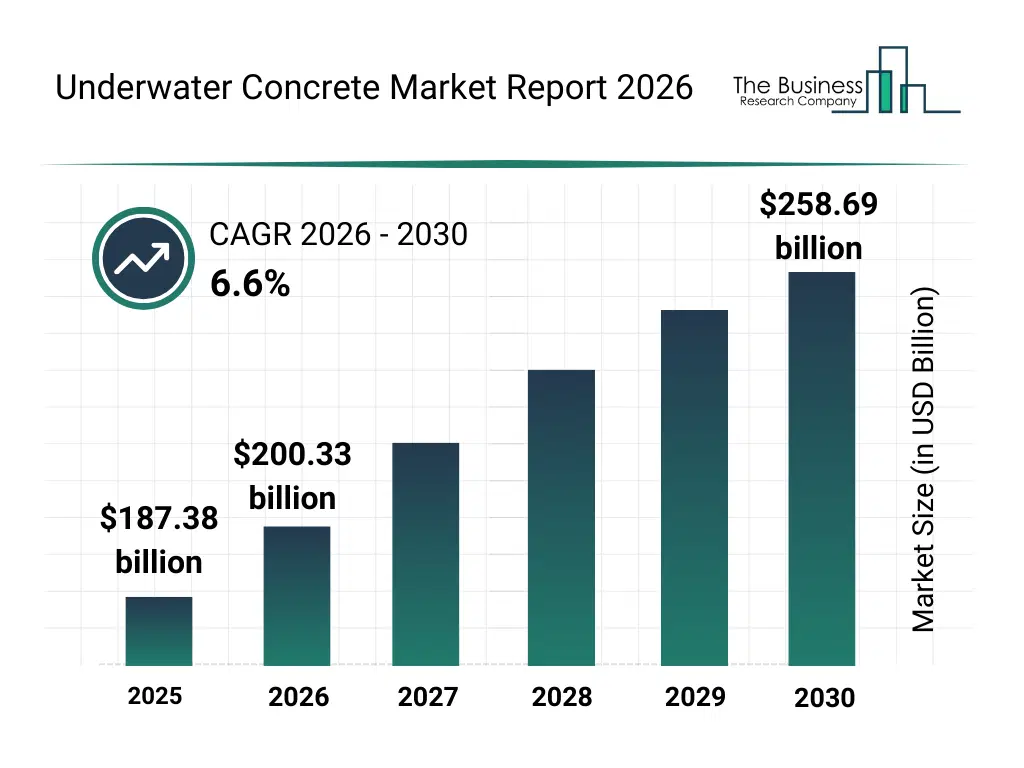
What Is The Underwater Concrete Market Size and Share 2026?
The underwater concrete market size has grown strongly in recent years. It will grow from $187.38 billion in 2025 to $200.33 billion in 2026 at a compound annual growth rate (CAGR) of 6.9%. The growth in the historic period can be attributed to rising underwater construction activities, increasing use of anti-washout admixtures, reliance on high-strength marine-grade cement, expansion of hydropower and port projects, growing demand for underwater repair materials.What Is The Underwater Concrete Market Growth Forecast?
The underwater concrete market size is expected to see strong growth in the next few years. It will grow to $258.69 billion in 2030 at a compound annual growth rate (CAGR) of 6.6%. The growth in the forecast period can be attributed to increasing adoption of sustainable marine concretes, rising investment in offshore infrastructure, growth in tunnel and submerged transit systems, development of advanced underwater curing technologies, expansion of automated underwater construction equipment. Major trends in the forecast period include integration of AI-based mix design optimization, adoption of low-carbon underwater concrete formulations, expansion of automated underwater construction systems, use of smart sensors for submerged concrete monitoring, development of digital quality-control platforms.
Global Underwater Concrete Market Segmentation
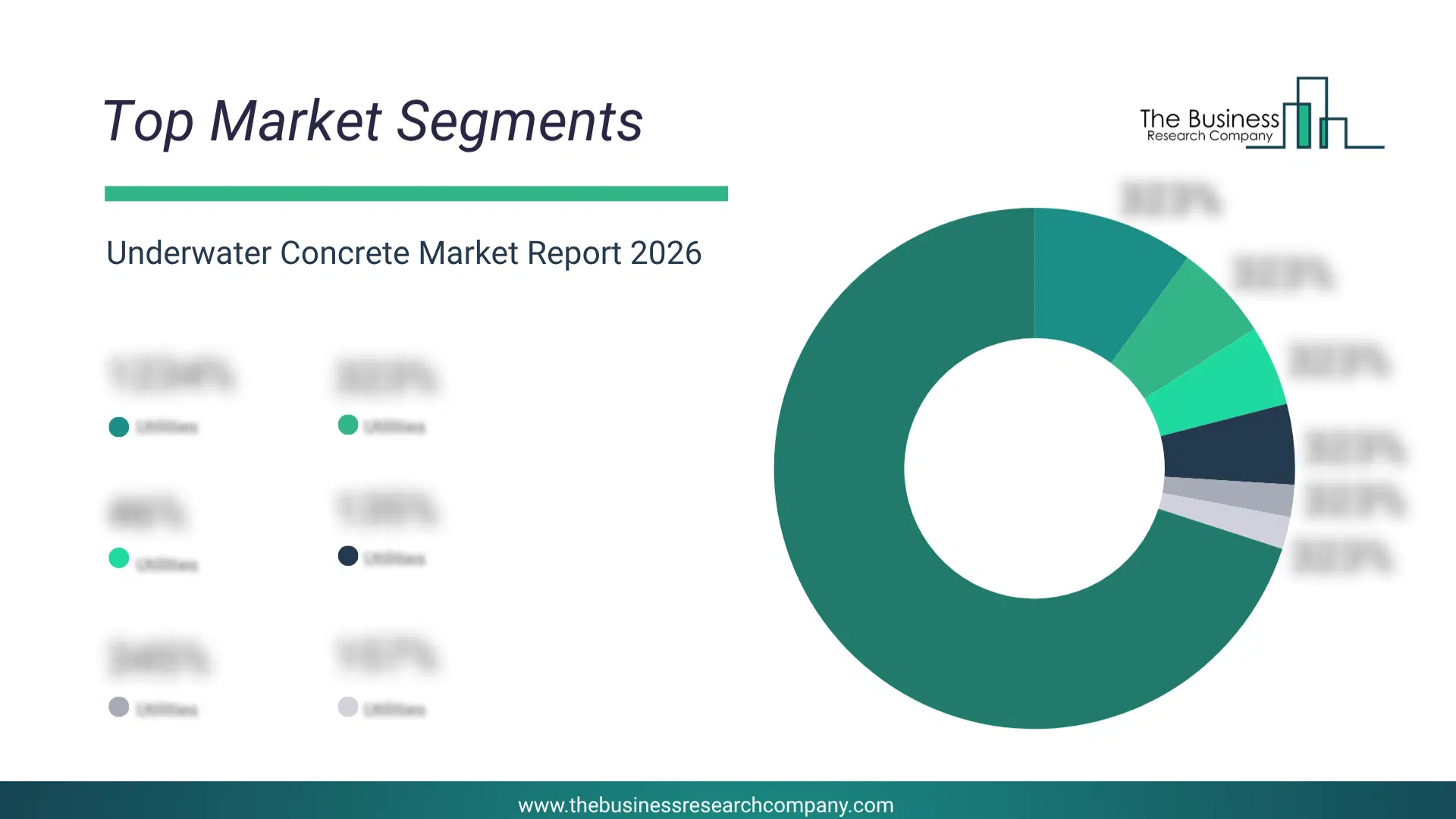
1) By Material Type: Aggregates, Admixtures, Cement, Other Types 2) By Product Type: Fly Ash Based, Slag Based, Geopolymer, Other Product Types 3) By Laying Technique: Tremie Method, Bucket Placing, Pump Method, Other Laying Techniques 4) By Application: Hydropower, Tunnels, Marine, Shore Protection, Swimming Pools, Underwater Repairs Subsegments: 1) By Aggregates: Sand, Gravel, Crushed Stone, Slag 2) By Admixtures: Water-Reducing Admixtures, Retarding Admixtures, Anti-Washout Admixtures, Air-Entraining Admixtures 3) By Cement: Portland Cement, High Alumina Cement, Blast Furnace Cement, Rapid Hardening Cement 4) By Other Types: Silica Fume Concrete, Polymer Concrete, Lightweight Concrete, High-Performance ConcreteWhat Is The Driver Of The Underwater Concrete Market?
The increasing marine infrastructure investments are expected to propel the growth of the underwater concrete market going forward. Marine infrastructure investments refer to allocating funds towards developing and maintaining structures such as ports, harbors, and offshore facilities. Marine infrastructure investments are rising due to the growth of global trade, which increases the demand for efficient maritime transport. Underwater concrete supports marine infrastructure by providing durable, water-resistant foundations for building structures below the waterline. For instance, in June 2025, UN Trade and Development, a Switzerland-based intergovernmental organization, reported that in 2023, global ocean trade totaled $2.2 trillion, comprising $1.3 trillion in services and $900 billion in goods, accounting for roughly 7% of total world trade. Therefore, the increasing marine infrastructure investments are driving the growth of the underwater concrete industry.Key Players In The Global Underwater Concrete Market
Major companies operating in the underwater concrete market are Heidelberg Materials AG, Cemex S.A.B. de C.V., Sika AG, Buzzi S.p.A., Tarmac Trading Limited, GCP Applied Technologies Inc., Fosroc International Ltd, Unibeton Ready Mix L.L.C., J.F. Brennan Company Inc, Normet Group Oy, The Euclid Chemical Company, Conmix Ltd., CHRYSO SAS, Don Construction Products Ltd, CICO Technologies Ltd, Wieser Concrete Products Inc, Xypex Chemical Corporation, MUHU Construction Materials Co. Ltd., Mapei S.p.A., Rockbond SCP Ltd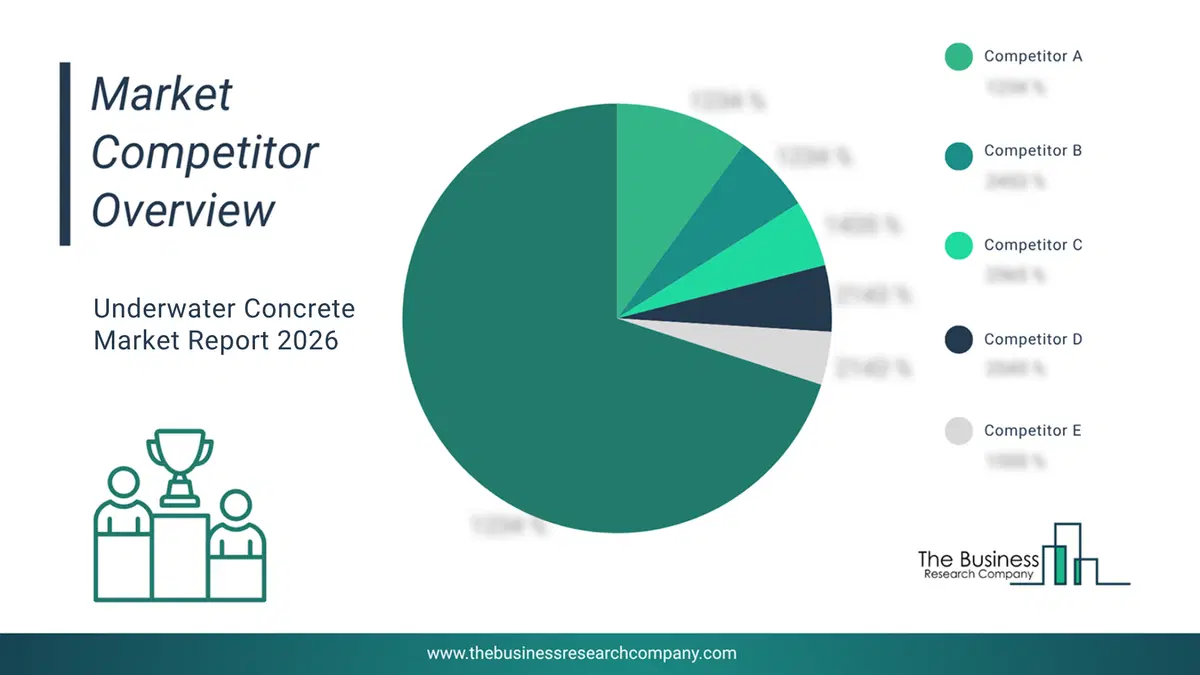
This chart is for illustrative purposes; the full report includes a detailed competitor analysis and comprehensive overview of the top 10 companies in the market.
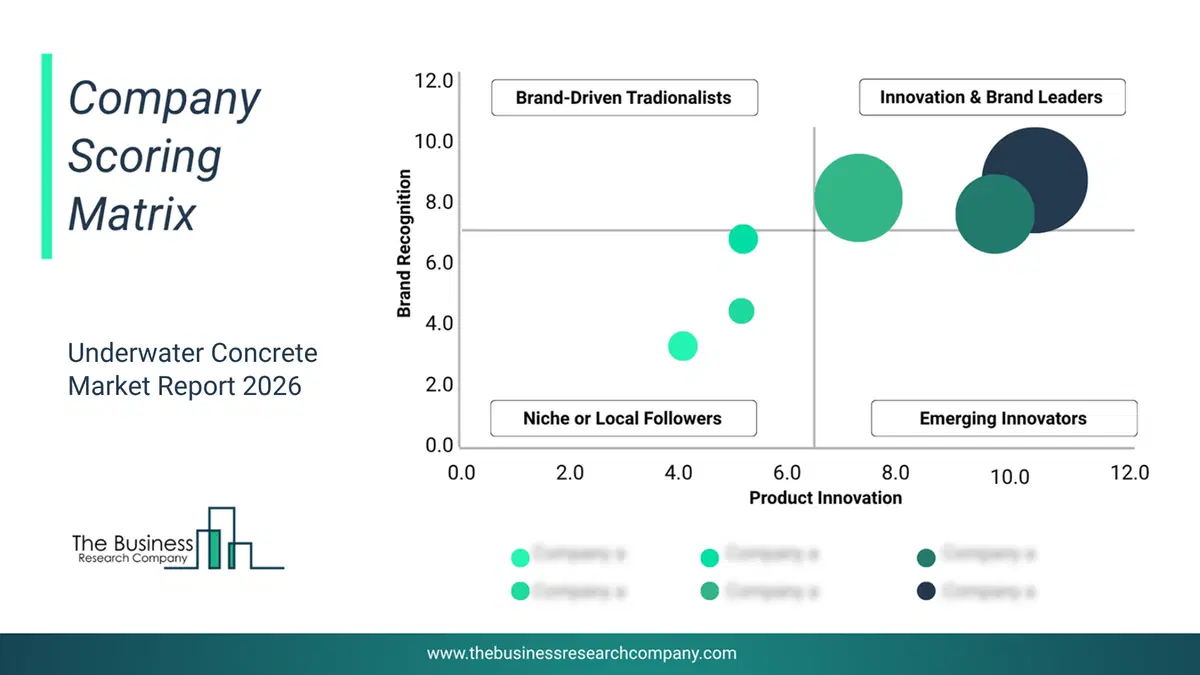
This chart maps companies by product innovation and brand strength, with bubble size indicating relative revenue, helping identify market leaders, challengers, and niche players. This is an illustrative chart; the full report provides a complete and accurate competitive analysis.
Global Underwater Concrete Market Trends and Insights
Major companies operating in the underwater concrete market are focusing on developing innovative solutions such as low-carbon cement and concretes to reduce environmental impact and enhance sustainability in marine construction. Low-carbon cements and concretes are construction materials designed to emit significantly less CO₂ during production using alternative binders, recycled materials, or energy-efficient processes. For instance, in February 2024, Cementos Molins, S.A., a Spain-based cement company, launched DRAGON BM-PL (CEM II/B-M (P-L) 42.5R) and DRAGON IV-SR (CEM IV/A (P) 42.5 R-SR), a low-carbon emission cement and concretes. These innovative, low-carbon footprint cement DRAGON BM-PL for general concrete and mortar production and DRAGON IV-SR designed for underwater structures and sulfate-rich soils. These products use over 55% alternative fuels and additives to reduce CO2 emissions, aligning with circular economy principles. They will account for more than 41% of the company’s Portland cement production in Spain. The company’s concrete division, Promsa, uses this cement to produce concrete with up to 25% lower emissions and incorporates recycled aggregates. Cementos Molins aims for carbon-neutral concrete by 2050, emphasizing sustainable construction and eco-friendly certifications while calling for broad societal collaboration to achieve carbon neutrality.What Are Latest Mergers And Acquisitions In The Underwater Concrete Market?
In May 2023, Sika AG, a Switzerland-based chemical company, acquired MBCC Group for an undisclosed amount. With this acquisition, Sika aims to bolster its global footprint significantly, doubling its sustainable product offerings and accelerating its goal of making 80% of its revenue from eco-friendly construction solutions. MBCC Group is a Germany-based company specializing in construction chemicals and solutions, offering specialized solutions for underwater concrete.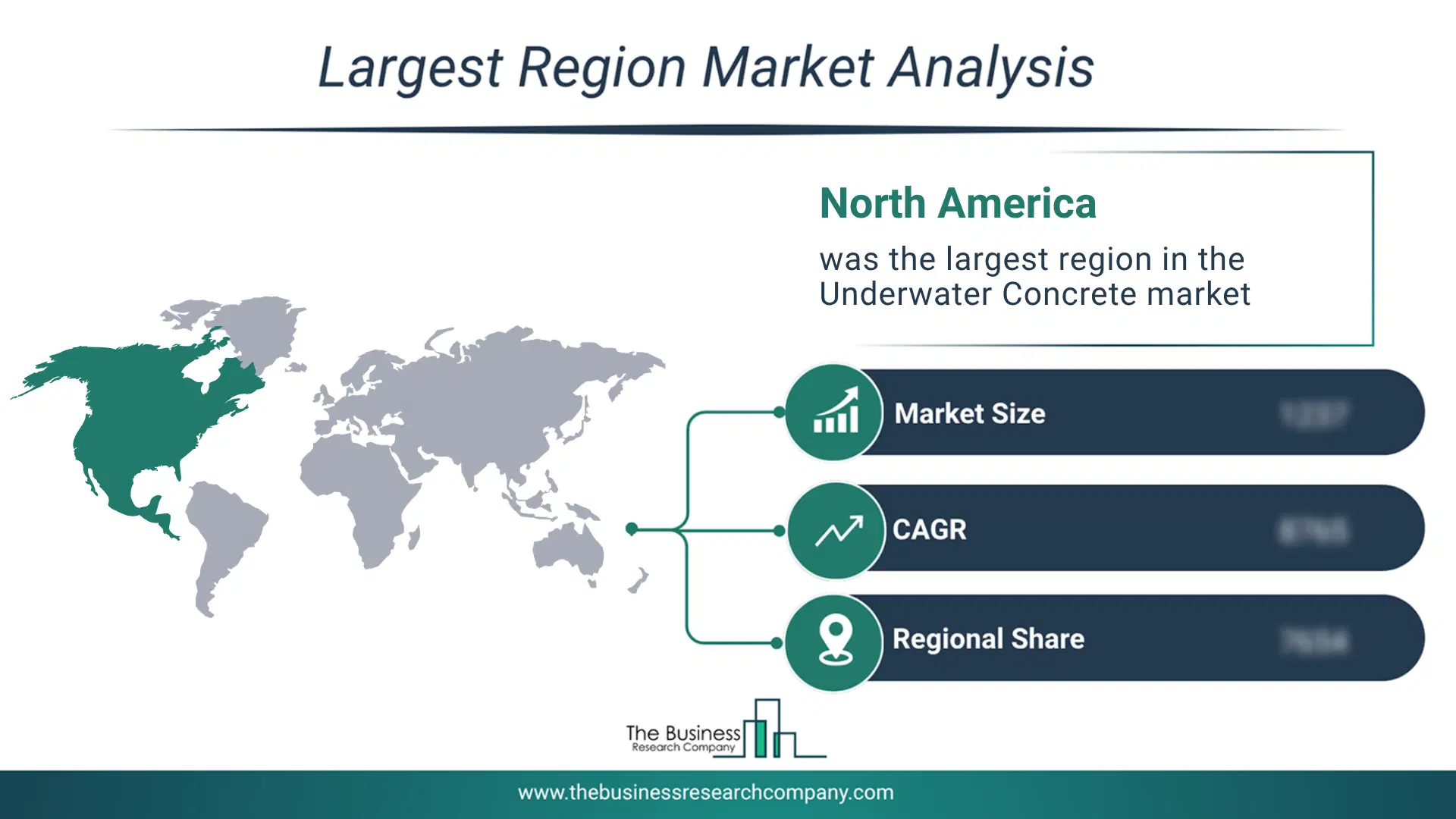
Regional Insights
North America was the largest region in the underwater concrete market in 2025. Asia-Pacific is expected to be the fastest-growing region in the forecast period. The regions covered in this market report are Asia-Pacific, South East Asia, Western Europe, Eastern Europe, North America, South America, Middle East, Africa. The countries covered in this market report are Australia, Brazil, China, France, Germany, India, Indonesia, Japan, Taiwan, Russia, South Korea, UK, USA, Canada, Italy, Spain.What Defines the Underwater Concrete Market?
The underwater concrete market consists of sales of ready-mix underwater concrete, anti-washout admixtures, pre-packed concrete, specialty cement and binders, and underwater curing compounds. Values in this market are ‘factory gate’ values, that is, the value of goods sold by the manufacturers or creators of the goods, whether to other entities (including downstream manufacturers, wholesalers, distributors, and retailers) or directly to end customers. The value of goods in this market includes related services sold by the creators of the goods.How is Market Value Defined and Measured?
The market value is defined as the revenues that enterprises gain from the sale of goods and/or services within the specified market and geography through sales, grants, or donations in terms of the currency (in USD unless otherwise specified). The revenues for a specified geography are consumption values that are revenues generated by organizations in the specified geography within the market, irrespective of where they are produced. It does not include revenues from resales along the supply chain, either further along the supply chain or as part of other products.
This chart presents market attractiveness based on a quantitative evaluation of growth, competition, strategic alignment, and risk, offering a clear view of opportunity areas for decision-making. This chart is for illustrative purposes; the full report contains the complete analysis.

This chart highlights the Total Addressable Market (TAM) by estimating the maximum revenue opportunity using an assumption-driven approach, supporting strategic planning and opportunity sizing across markets. The chart is illustrative; the full report provides a more comprehensive analysis.
What Key Data and Analysis Are Included in theUnderwater Concrete Market Report 2026?
The underwater concrete market research report is one of a series of new reports from The Business Research Company that provides market statistics, including industry global market size, regional shares, competitors with the market share, detailed market segments, market trends and opportunities, and any further data you may need to thrive in the underwater concrete industry. The market research report delivers a complete perspective of everything you need, with an in-depth analysis of the current and future state of the industry.Underwater Concrete Market Report Forecast Analysis
| Report Attribute | Details |
|---|---|
| Market Size Value In 2026 | $200.33 billion |
| Revenue Forecast In 2030 | $258.69 billion |
| Growth Rate | CAGR of 6.9% from 2026 to 2030 |
| Base Year For Estimation | 2025 |
| Actual Estimates/Historical Data | 2020-2025 |
| Forecast Period | 2026 - 2030 |
| Market Representation | Revenue in USD Billion and CAGR from 2026 to 2030 |
| Segments Covered | Material Type, Product Type, Laying Technique, Application |
| Regional Scope | Asia-Pacific, Western Europe, Eastern Europe, North America, South America, Middle East, Africa |
| Country Scope | The countries covered in this market report are Australia, Brazil, China, France, Germany, India, Indonesia, Japan, Taiwan, Russia, South Korea, UK, USA, Canada, Italy, Spain |
| Key Companies Profiled | Heidelberg Materials AG, Cemex S.A.B. de C.V., Sika AG, Buzzi S.p.A., Tarmac Trading Limited, GCP Applied Technologies Inc., Fosroc International Ltd, Unibeton Ready Mix L.L.C., J.F. Brennan Company Inc, Normet Group Oy, The Euclid Chemical Company, Conmix Ltd., CHRYSO SAS, Don Construction Products Ltd, CICO Technologies Ltd, Wieser Concrete Products Inc, Xypex Chemical Corporation, MUHU Construction Materials Co. Ltd., Mapei S.p.A., Rockbond SCP Ltd |
| Customization Scope | Request for Customization |
| Pricing And Purchase Options | Explore Purchase Options |