
Unified Communications As A Service In Healthcare Market Report 2026
Global Outlook – By Service Type (Voice Over Internet Protocol, Video Conferencing, Messaging Services, Contact Center Services, Call Management), By Component (Telephony, Unified Messaging, Collaboration Platforms, Conferencing, Other Components), By Deployment Mode (Cloud-Based, On-Premises, Hybrid), By Application (Telemedicine, Remote Patient Monitoring, Virtual Consultations, Care Coordination, Patient Engagement), By End-User (Hospitals And Clinics, Health Insurance Providers, Diagnostic Laboratories) - Market Size, Trends, Strategies, and Forecast to 2030
Unified Communications As A Service In Healthcare Market Overview
• Unified Communications As A Service In Healthcare market size has reached to $7.88 billion in 2025 • Expected to grow to $15.64 billion in 2030 at a compound annual growth rate (CAGR) of 14.6% • Growth Driver: Surge In Demand For Telehealth Services Fueling The Growth Of The Market Due To Increasing Accessibility And Real-time Communication • Market Trend: Innovations In Integration Tools Aim To Deliver A Seamless Healthcare Experience • North America was the largest region in 2025 and Asia-Pacific is the fastest growing region.What Is Covered Under Unified Communications As A Service In Healthcare Market?
Unified communications as a service in healthcare refers to cloud-based communication platforms that integrate voice, video, messaging, and collaboration tools specifically designed for medical environments. These solutions enable seamless, secure, and real-time interaction among healthcare providers, patients, and administrative staff. By unifying communication channels, they improve care coordination, enhance patient outcomes, and reduce operational inefficiencies. The main service types of unified communications as a service in healthcare are voice over internet protocol, video conferencing, messaging services, contact center services, and call management. Voice over internet protocol refers to the technology that enables voice communication and multimedia sessions over the internet instead of traditional phone lines. There are components such as telephony, unified messaging, collaboration platforms, conferencing, and others. Their deployment mode is used in cloud-based, on-premises, and hybrid. These are used for various applications such as telemedicine, remote patient monitoring, virtual consultations, care coordination, and patient engagement. These are used by various key end-users such as hospitals and clinics, health insurance providers, pharmaceuticals, and diagnostic laboratories.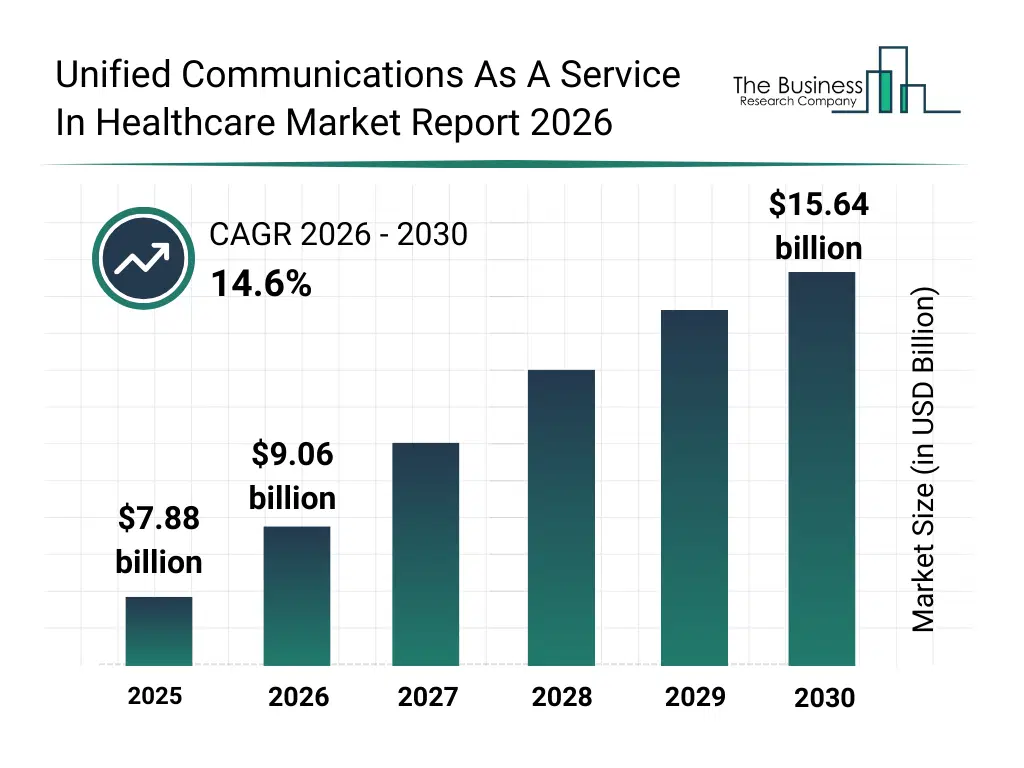
What Is The Unified Communications As A Service In Healthcare Market Size and Share 2026?
The unified communications as a service in healthcare market size has grown rapidly in recent years. It will grow from $7.88 billion in 2025 to $9.06 billion in 2026 at a compound annual growth rate (CAGR) of 14.9%. The growth in the historic period can be attributed to increasing digital transformation of healthcare operations, expansion of telemedicine services, rising need for care coordination, adoption of electronic health records, growth of remote healthcare delivery models.What Is The Unified Communications As A Service In Healthcare Market Growth Forecast?
The unified communications as a service in healthcare market size is expected to see rapid growth in the next few years. It will grow to $15.64 billion in 2030 at a compound annual growth rate (CAGR) of 14.6%. The growth in the forecast period can be attributed to increasing investments in digital care infrastructure, rising demand for real-time clinical collaboration, expansion of hybrid healthcare delivery models, growing focus on patient engagement tools, increasing regulatory emphasis on secure healthcare communications. Major trends in the forecast period include increasing adoption of cloud-based healthcare communication platforms, growing integration of secure messaging and collaboration tools, rising use of video-based virtual consultations, expansion of interoperable communication systems, enhanced focus on data security and compliance.
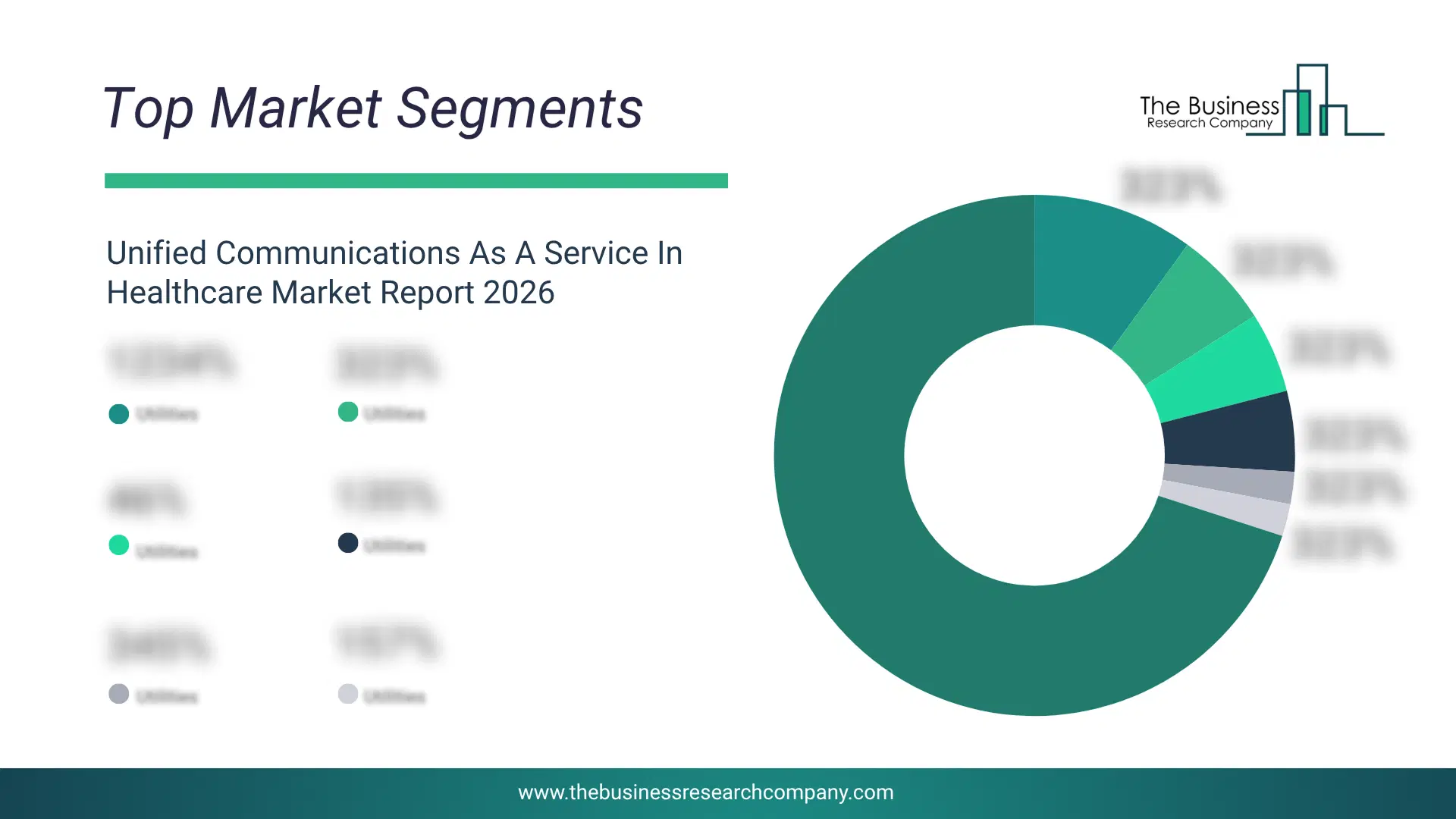
Global Unified Communications As A Service In Healthcare Market Segmentation
1) By Service Type: Voice Over Internet Protocol, Video Conferencing, Messaging Services, Contact Center Services, Call Management 2) By Component: Telephony, Unified Messaging, Collaboration Platforms, Conferencing, Other Components 3) By Deployment Mode: Cloud-Based, On-Premises, Hybrid 4) By Application: Telemedicine, Remote Patient Monitoring, Virtual Consultations, Care Coordination, Patient Engagement 5) By End-User: Hospitals And Clinics, Health Insurance Providers, Diagnostic Laboratories Subsegments: 1) By Voice Over Internet Protocol: Hosted Voice Solutions, Cloud Private Branch Exchange, Managed Voice Services, Session Initiation Protocol Trunking 2) By Video Conferencing: Cloud-Based Video Conferencing, Web-Based Video Conferencing, Virtual Meeting Platforms, Telepresence System 3) By Messaging Services: Instant Messaging Platforms, Secure Healthcare Messaging, Group Collaboration Tools, Patient Engagement Messaging 4) By Contact Center Services: Cloud-Based Contact Centers, Virtual Assistance Services, Omni Channel Communication Solutions, Interactive Voice Response Systems 5) By Call Management: Automated Call Distribution, Call Recording And Monitoring, Interactive Call Routing, Voicemail To Email IntegrationWhat Is The Driver Of The Unified Communications As A Service In Healthcare Market?
The increasing demand for telehealth services is expected to propel the growth of the unified communications as a service in healthcare market going forward. Telehealth services refer to the delivery of healthcare, medical consultations, and health-related services remotely using digital communication technologies. The rise in demand for telehealth services is due to the increasing accessibility, as they allow patients to consult healthcare providers remotely, saving time and reducing the need for travel. The demand for telehealth services enables seamless, secure, and real-time communication between patients and providers, improving care coordination and patient engagement. For instance, in December 2023, according to the National Health Service, a UK-based government department, there are 33.6 million telehealth app users, with monthly logins rising 54% over the past year from 16.8 million in November 2022 to 25.8 million in November 2023. Therefore, the increasing need for real-time communication is driving the growth of the Unified Communications as a Service in Healthcare industry.Key Players In The Global Unified Communications As A Service In Healthcare Market
Major companies operating in the unified communications as a service in healthcare market are Google LLC, Microsoft Corporation, Verizon Communications Incorporated, IBM Corporation, Cisco Systems Incorporated, BT Group Public Limited Company, NEC Corporation, Orange Business Services India Network Private Limited, Zoom Video Communications Incorporated, RingCentral Incorporated, Alcatel-Lucent Enterprise International Société par Actions Simplifiée, Mitel Networks Corporation, 8x8 Incorporated, GoTo Technologies Incorporated, Nextiva Incorporated, Intrado Incorporated, Dialpad Incorporated, Windstream Holdings Incorporated, Salesforce.com, Inc., Avaya Holdings Corp.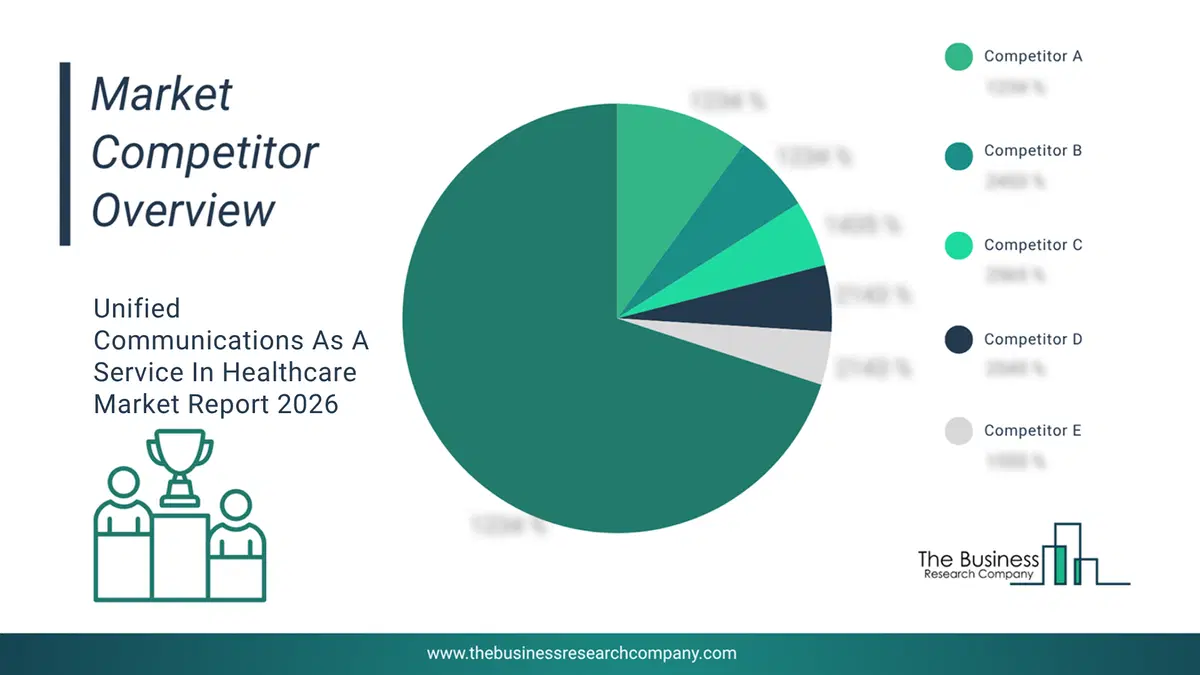
This chart is for illustrative purposes; the full report includes a detailed competitor analysis and comprehensive overview of the top 10 companies in the market.
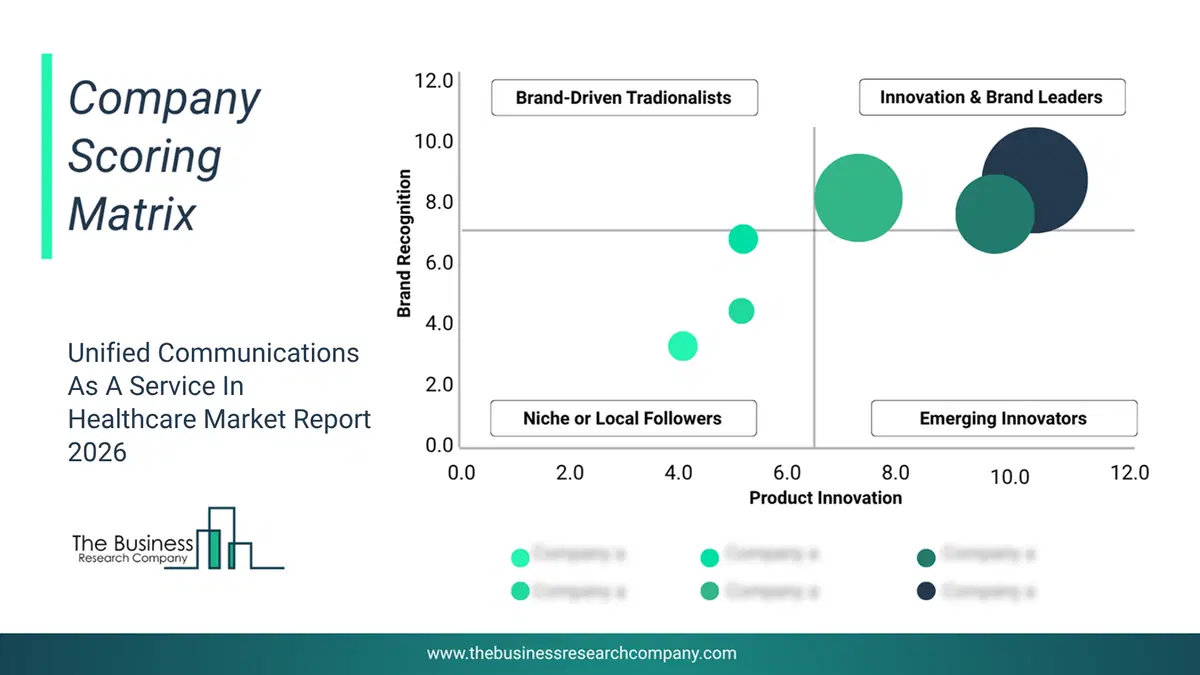
This chart maps companies by product innovation and brand strength, with bubble size indicating relative revenue, helping identify market leaders, challengers, and niche players. This is an illustrative chart; the full report provides a complete and accurate competitive analysis.
Global Unified Communications As A Service In Healthcare Market Trends and Insights
Major companies operating in the unified communications as a service (UCaaS) in the healthcare market are focusing on developing advanced solutions, such as advanced API integrations, to improve interoperability between digital health tools, streamline workflow automation, and enhance real-time communication across care teams. Advanced API integrations refer to sophisticated software connection frameworks that enable multiple healthcare applications to securely exchange data, automate complex operational tasks, and support unified communication workflows within cloud-based environments. For instance, in April 2025, First Light Fiber Inc., a US-based provider of fiber-optic data, internet, cloud, and voice services, launched the next phase of its Unified Communications (UC) platform, featuring enhanced integration capabilities for seamless connectivity across healthcare systems, advanced administrative tools for centralized management, and improved user experience designed to support reliable, secure, real-time communication essential for clinical environments.What Are Latest Mergers And Acquisitions In The Unified Communications As A Service In Healthcare Market?
In May 2024, Avaya, a US-based company that offers cloud communications, partnered with RingCentral to enhance communications with AI-powered collaboration. This partnership allows enterprise customers to leverage existing Avaya platforms for unified call, messaging, and video experiences. RingCentral is a US-based company that provides unified communications as a service (UCaaS) to the healthcare sector, offering a unified platform that integrates messaging, video conferencing, and phone calls for improved communication and care coordination between staff and patients.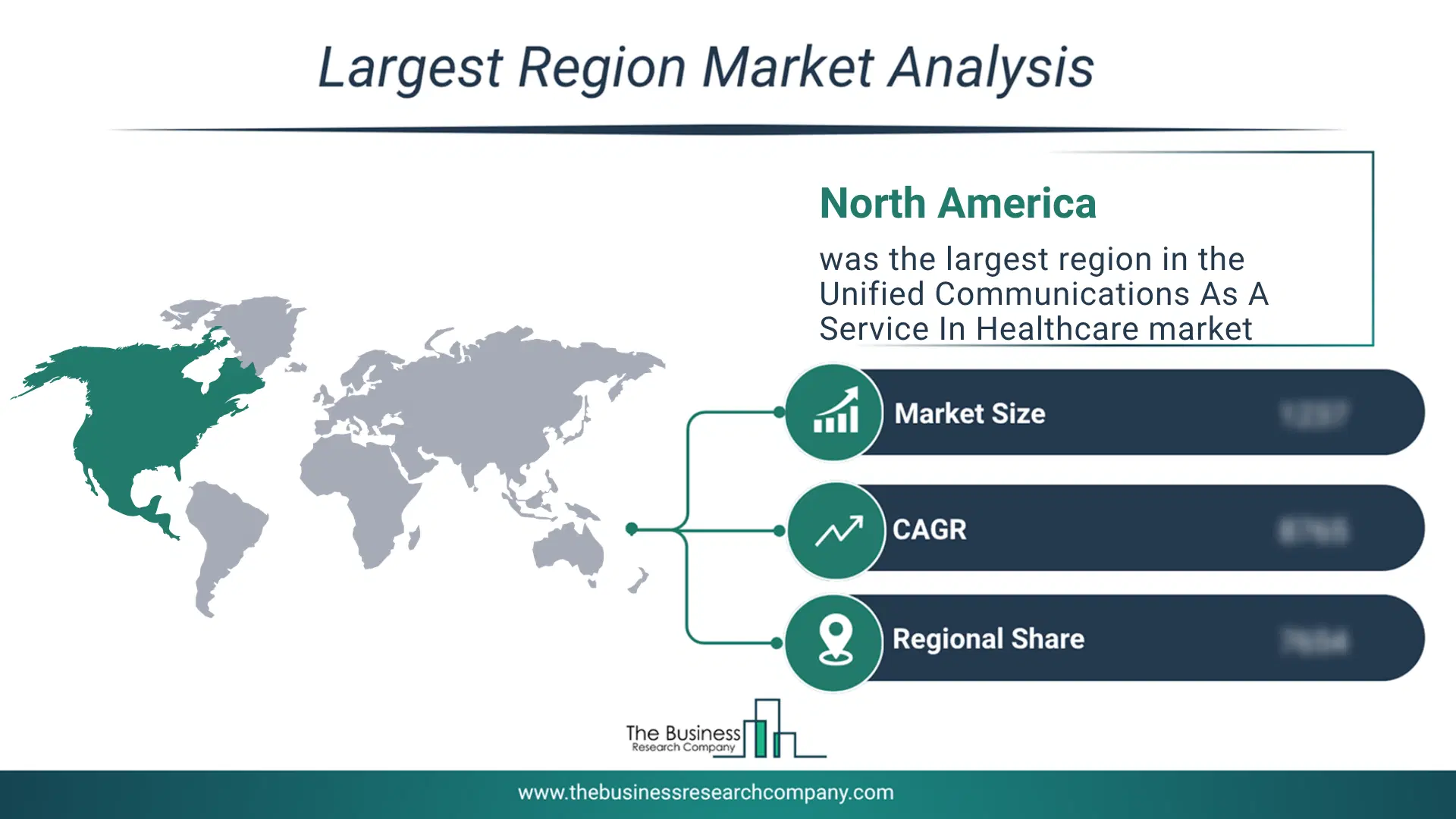
Regional Outlook
North America was the largest region in the unified communications as a service in healthcare market in 2025. Asia-Pacific is expected to be the fastest-growing region in the forecast period. The regions covered in this market report are Asia-Pacific, South East Asia, Western Europe, Eastern Europe, North America, South America, Middle East, Africa. The countries covered in this market report are Australia, Brazil, China, France, Germany, India, Indonesia, Japan, Taiwan, Russia, South Korea, UK, USA, Canada, Italy, Spain.What Defines the Unified Communications As A Service In Healthcare Market?
The unified communications as a service in healthcare market consists of revenues earned by entities by providing services such as integration with electronic health records, workflow automation tools, and multi-language translation and interpretation services. The market value includes the value of related goods sold by the service provider or included within the service offering. The unified communications as a service in healthcare market also includes sales of emergency and critical alert systems, secure data and imaging exchange platforms, and patient self-service UCaaS kiosks. Values in this market are ‘factory gate’ values, that is, the value of goods sold by the manufacturers or creators of the goods, whether to other entities (including downstream manufacturers, wholesalers, distributors, and retailers) or directly to end customers. The value of goods in this market includes related services sold by the creators of the goods.How is Market Value Defined and Measured?
The market value is defined as the revenues that enterprises gain from the sale of goods and/or services within the specified market and geography through sales, grants, or donations in terms of the currency (in USD unless otherwise specified). The revenues for a specified geography are consumption values that are revenues generated by organizations in the specified geography within the market, irrespective of where they are produced. It does not include revenues from resales along the supply chain, either further along the supply chain or as part of other products.
This chart presents market attractiveness based on a quantitative evaluation of growth, competition, strategic alignment, and risk, offering a clear view of opportunity areas for decision-making. This chart is for illustrative purposes; the full report contains the complete analysis.

This chart highlights the Total Addressable Market (TAM) by estimating the maximum revenue opportunity using an assumption-driven approach, supporting strategic planning and opportunity sizing across markets. The chart is illustrative; the full report provides a more comprehensive analysis.
What Key Data and Analysis Are Included in the Unified Communications As A Service In Healthcare Market Report 2026?
The unified communications as a service in healthcare market research report is one of a series of new reports from The Business Research Company that provides market statistics, including industry global market size, regional shares, competitors with the market share, detailed market segments, market trends and opportunities, and any further data you may need to thrive in the unified communications as a service in healthcare industry. The market research report delivers a complete perspective of everything you need, with an in-depth analysis of the current and future state of the industry.Unified Communications As A Service In Healthcare Market Report Forecast Analysis
| Report Attribute | Details |
|---|---|
| Market Size Value In 2026 | $9.06 billion |
| Revenue Forecast In 2030 | $15.64 billion |
| Growth Rate | CAGR of 14.6% from 2026 to 2030 |
| Base Year For Estimation | 2025 |
| Actual Estimates/Historical Data | 2020-2025 |
| Forecast Period | 2026 - 2030 |
| Market Representation | Revenue in USD Billion and CAGR from 2026 to 2030 |
| Segments Covered | Service Type, Component, Deployment Mode, Application, End-User |
| Regional Scope | Asia-Pacific, Western Europe, Eastern Europe, North America, South America, Middle East, Africa |
| Country Scope | The countries covered in the report are Australia, Brazil, China, France, Germany, India, Indonesia, Japan, Taiwan, Russia, South Korea, UK, USA, Canada, Italy, Spain |
| Key Companies Profiled | Google LLC, Microsoft Corporation, Verizon Communications Incorporated, IBM Corporation, Cisco Systems Incorporated, BT Group Public Limited Company, NEC Corporation, Orange Business Services India Network Private Limited, Zoom Video Communications Incorporated, RingCentral Incorporated, Alcatel-Lucent Enterprise International Société par Actions Simplifiée, Mitel Networks Corporation, 8x8 Incorporated, GoTo Technologies Incorporated, Nextiva Incorporated, Intrado Incorporated, Dialpad Incorporated, Windstream Holdings Incorporated, Salesforce.com, Inc., Avaya Holdings Corp. |
| Customization Scope | Request for Customization |
| Pricing And Purchase Options | Explore Purchase Options |