
Unmanned Aerial Vehicle (UAV) Main Control Chip Market Report 2026
Global Outlook – By Type (Microcontrollers, Field-Programmable Gate Arrays (FPGAs), Digital Signal Processors (DSPs), Application-Specific Integrated Circuits (ASICs)), By Component (Sensor Integration, Power Management, Connectivity Modules, Interfacing Units), By Application (Aerial Photography And Videography, Mapping And Surveying, Agricultural Monitoring, Defense And Surveillance, Industrial Inspection), By End-User Industry (Aerospace And Defense, Agriculture, Construction And Mining) – Market Size, Trends, Strategies, and Forecast to 2030
Unmanned Aerial Vehicle (UAV) Main Control Chip Market Overview
• Unmanned Aerial Vehicle (UAV) Main Control Chip market size has reached to $2.38 billion in 2025 • Expected to grow to $3.67 billion in 2030 at a compound annual growth rate (CAGR) of 8.9% • Growth Driver: The Rising Demand For Commercial Drones Is The Growth Of The Market Due To Expanding Applications And Increasing Flight Operations • Market Trend: Advancements In UAV Control Chips Driving Enhanced Flight Precision And Autonomous Capabilities • North America was the largest region in 2025 and Asia-Pacific is the fastest growing region.Market Gains By 2030 – Top Opportunities By Segment
Market Gain identifies the most promising market opportunities by highlighting the segments or products expected to generate the highest incremental revenue growth over the next five years.
What Is Covered Under Unmanned Aerial Vehicle (UAV) Main Control Chip Market?
Unmanned aerial vehicle (UAV) main control chips are specialized integrated circuits that serve as drones' central processing units (CPUs). These chips manage and coordinate all critical flight functions, including navigation, stabilization, communication, sensor integration, and motor control. Unmanned aerial vehicle (UAV) main control chips are designed for high performance, low power consumption, and real-time decision-making, making them essential for consumer and military-grade UAV systems. The main types of unmanned aerial vehicle (UAV) main control chip are microcontrollers, field-programmable gate arrays (FPGAs), digital signal processors (DSPs), and application-specific integrated circuits (ASICs). Microcontrollers are compact, power-efficient chips that integrate processing, memory, and I/O functions to manage real-time operations, crucial for controlling flight and processing sensor data in UAV systems. It includes components such as sensor integration, power management, connectivity modules, and interfacing units for various applications such as aerial photography and videography, mapping and surveying, agricultural monitoring, defense and surveillance, and industrial inspection, and it is used by several end-user industries, including aerospace and defense, agriculture, construction, and mining.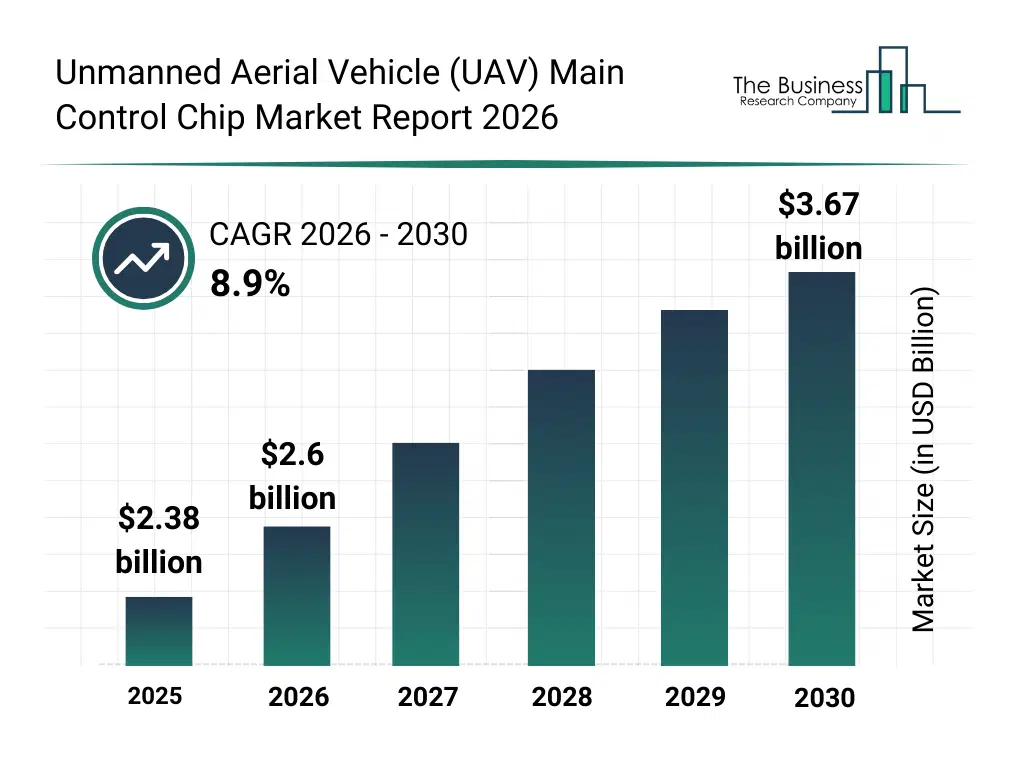
What Is The Unmanned Aerial Vehicle (UAV) Main Control Chip Market Size and Share 2026?
The unmanned aerial vehicle (UAV) main control chip market size has grown strongly in recent years. It will grow from $2.38 billion in 2025 to $2.6 billion in 2026 at a compound annual growth rate (CAGR) of 9.2%. The growth in the historic period can be attributed to early development of central processing units for uav systems, integration of system-on-chip technologies in drones, advancements in graphics processing units for flight data handling, government and military funding for high-performance uav chips, initial adoption of neural processing and multi-core processors for navigation and sensor integration.What Is The Unmanned Aerial Vehicle (UAV) Main Control Chip Market Growth Forecast?
The unmanned aerial vehicle (UAV) main control chip market size is expected to see strong growth in the next few years. It will grow to $3.67 billion in 2030 at a compound annual growth rate (CAGR) of 8.9%. The growth in the forecast period can be attributed to rising demand for high-performance main control chips in commercial and military drones, development of next-generation heterogeneous multi-core processors, adoption of advanced neural processing units for real-time decision-making, expansion of uav platforms requiring low-power, high-efficiency control chips, increased collaboration between chip manufacturers and uav developers for optimized flight control solutions. Major trends in the forecast period include miniaturization and integration of components, enhanced real-time processing capabilities, energy efficiency and power management innovations, increased demand for high-precision sensor fusion, expansion of commercial and consumer uav applications.
Global Unmanned Aerial Vehicle (UAV) Main Control Chip Market Segmentation
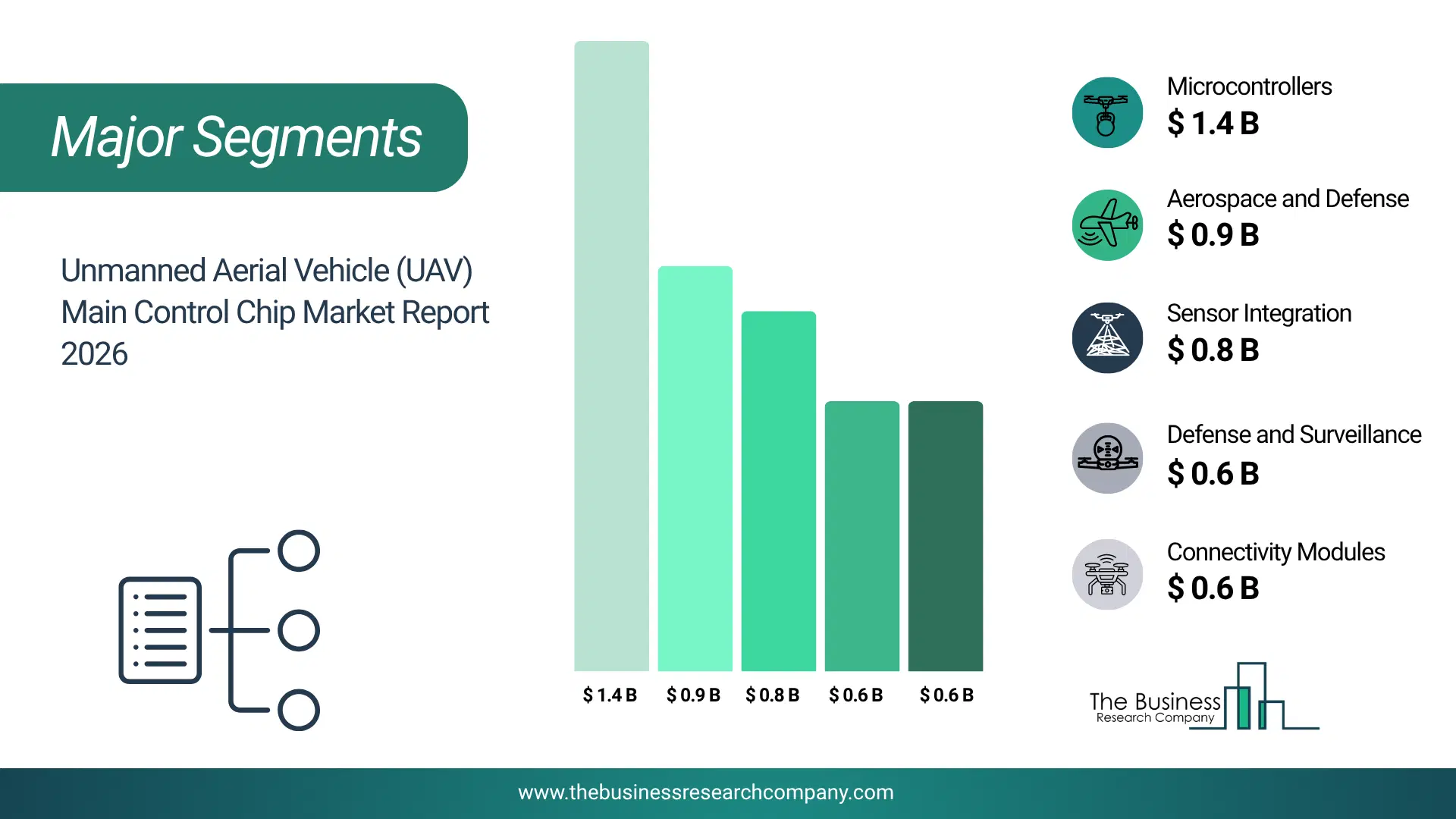
1) By Type: Microcontrollers, Field-Programmable Gate Arrays (FPGAs), Digital Signal Processors (DSPs), Application-Specific Integrated Circuits (ASICs) 2) By Component: Sensor Integration, Power Management, Connectivity Modules, Interfacing Units 3) By Application: Aerial Photography And Videography, Mapping And Surveying, Agricultural Monitoring, Defense And Surveillance, Industrial Inspection 4) By End-User Industry: Aerospace And Defense, Agriculture, Construction And Mining Subsegments: 1) By Microcontrollers: 8-Bit Microcontrollers, 16-Bit Microcontrollers, 32-Bit Microcontrollers, ARM Cortex-Based Microcontrollers, RISC-V Microcontrollers 2) By Field-Programmable Gate Arrays (FPGAs): Static Random-Access Memory (SRAM)-based Field-Programmable Gate Arrays (FPGAs), Flash-Based Field-Programmable Gate Arrays (FPGAs), Anti-Fuse Field-Programmable Gate Arrays (FPGAs), System on Chip (SoC) Field-Programmable Gate Arrays (FPGAs), Low Power Field-Programmable Gate Arrays (FPGAs) 3) By Digital Signal Processors (DSPs): Fixed-Point Digital Signal Processors (DSPs), Floating-Point Digital Signal Processors (DSPs), General-Purpose Digital Signal Processors (DSPs), Application-Specific Digital Signal Processors (DSPs), Multi-Core Digital Signal Processors (DSPs) 4) By Application-Specific Integrated Circuits (ASICs): Custom Application-Specific Integrated Circuits (ASICs), Semi-Custom Application-Specific Integrated Circuits (ASICs), Full-Custom Application-Specific Integrated Circuits (ASICs), Standard Cell Application-Specific Integrated Circuits (ASICs), Gate Array Application-Specific Integrated Circuits (ASICs) The top segments in the unmanned aerial vehicle (uav) main control chip market will be: • Microcontrollers will reach $1443.43 Million by 2025. • Aerospace and Defense will reach $928.96 Million by 2025. • Sensor Integration will reach $860.13 Million by 2025. • Defense and Surveillance will reach $664.1 Million by 2025. • Connectivity Modules will reach $661.91 Million by 2025.What Is Driver Of The Unmanned Aerial Vehicle (UAV) Main Control Chip Market?
The rising demand for commercial drones is expected to propel the growth of the unmanned aerial vehicle (UAV) main control chip market going forward. Commercial drones are UAVs deployed in various industries for mapping, delivery, farming, infrastructure inspection, and security monitoring. The rise in demand for commercial drones is driven by growing demand for aerial data, enabling faster and more efficient capture of high-resolution imagery and insights. The UAV's main control chip is the central processor, handling flight control, navigation, and data processing. It enables stable flight, accurate movement, and smooth integration of sensors and components. For instance, in February 2024, according to Airservices Australia, an Australia-based government-owned corporation responsible for providing services to the aviation industry, Australian drone activity is set to skyrocket, increasing from 1.5 million flights annually in 2023 to an impressive 60.4 million by 2043. Therefore, the rising demand for commercial drones drives the unmanned aerial vehicle (UAV) main control chips industry.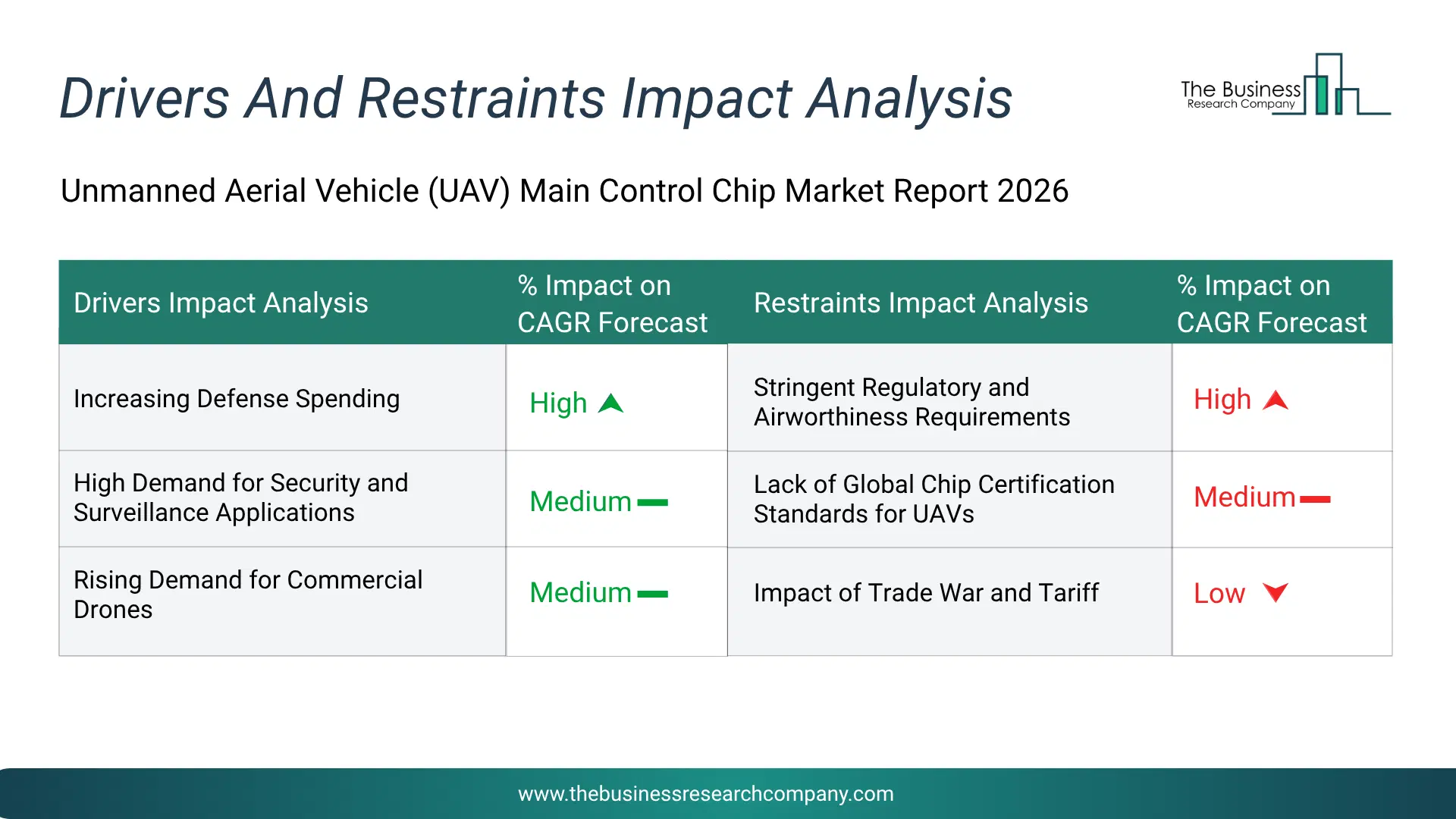
Infographic Chart Showing Key Market Drivers Analysis And Restraints For Unmanned Aerial Vehicle (Uav) Main Control Chip Market
The chart presents an impact analysis of key drivers and restraints, quantifying their relative influence on the market's growth rate and helping assess the balance between growth enablers and limiting factors. This chart offers a high-level perspective; the full report contains more detailed insights.
How Will The Drivers Impact Growth In The Global Unmanned Aerial Vehicle (UAV) Main Control Chip Market?
• Increasing Defense Spending (High) – The increasing defense spending will emerge as a major factor driving the expansion of the unmanned aerial vehicle (UAV) main control chip market by 2030. Nations across the world are allocating larger portions of their military budgets toward modernization programs, which include expanding fleets of intelligence, surveillance and reconnaissance (ISR) drones, enhancing autonomous battlefield capabilities and upgrading mission-critical electronic systems. UAV platforms used in defense operations require highly reliable, secure and high-performance main control chips capable of supporting advanced navigation, sensor fusion, target tracking and real-time data processing. Rising geopolitical tensions and sustained investment in unmanned systems further strengthen the demand for technologically sophisticated UAVs equipped with robust onboard computing power. As global military expenditure continues to grow, defense agencies are expected to accelerate procurement of UAVs, thereby driving the demand for advanced main control chips. As a result, increasing defense spending will significantly support the expansion of the unmanned aerial vehicle (UAV) main control chip market during the forecast period. Consequently, the increasing defense spending capabilities is projected to contributing to a 1.5% annual growth in the market. • High Demand for Security and Surveillance Applications (Medium) – The high demand for security and surveillance applications will become a key driver of growth in the unmanned aerial vehicle (UAV) main control chip market by 2030. Law enforcement agencies, border-control units, critical-infrastructure operators and event-security teams are increasingly deploying UAVs to enhance real-time situational awareness, monitor crowds, track assets and support emergency responses, tasks that require advanced onboard processing, seamless sensor fusion and secure connectivity, all enabled by sophisticated main control chips. As safety concerns continue to rise globally and public-security infrastructures evolve, the need for intelligent aerial systems that can deliver rapid deployment, autonomous operations and high-resolution data capture grows significantly, thereby driving demand for specialized UAV control-chip solutions during the forecast period. As a result, the high demand for security and surveillance applications is anticipated to contributing to a 2.0% annual growth in the market. • Rising Demand for Commercial Drones (Medium) – The rising demand for commercial drones will serve as a key growth catalyst for the unmanned aerial vehicle (UAV) main control chip market by 2030. Businesses across logistics, agriculture, infrastructure inspection and media are ramping up drone operations to improve operational efficiency, reduce costs and enable new service models. These commercial drones require high-performance main control chips capable of handling tasks such as autonomous navigation, real-time data processing, multi-sensor fusion and connectivity across complex environments features that significantly improve system reliability and scalability. As regulatory frameworks evolve and commercial use cases expand, more companies will deploy UAVs at scale, thereby increasing the need for advanced onboard processing solutions. As commercial drone platforms proliferate and scale, the market for UAV main control chips is expected to accelerate significantly, driven by increased demand for intelligent, autonomous aerial systems. Therefore, this rising demand for commercial drones operations is projected to supporting to a 1.0% annual growth in the market. • Increasing Focus on Precision Agriculture (Low) – The increasing focus on precision agriculture will become a significant driver contributing to the growth of the unmanned aerial vehicle (UAV) main control chip market by 2030. Modern farms are rapidly adopting drone-based solutions to improve crop health monitoring, optimize pesticide and fertilizer usage and enhance overall agricultural productivity. These applications require UAVs capable of executing autonomous flight paths, processing multispectral and thermal imagery and performing real-time data analysis, all of which depend heavily on advanced main control chips. Precision agriculture emphasizes accuracy, efficiency and timely decision-making, making high-performance UAV control systems essential for meeting these operational demands. As the global agricultural sector continues to expand data-driven and sustainable farming practices, the need for intelligent UAV platforms with powerful onboard processing capabilities will increase, thereby driving the growth of the unmanned aerial vehicle (UAV) main control chip market during the forecast period. Consequently, the increasing focus on precision agriculture is projected to contributing to a 0.4% annual growth in the market.How Will The Restraints Impact Growth In The Global Unmanned Aerial Vehicle (UAV) Main Control Chip Market?
• Stringent Regulatory and Airworthiness Requirements (Medium) – Stringent Regulatory and Airworthiness Requirements will restrict the growth of the Unmanned Aerial Vehicle (UAV) Main Control Chip market during the forecast period. UAV main control chips must meet stringent regulatory and airworthiness requirements for safety and reliability. Compliance with regulations adds to development and certification costs. Regulatory requirements can affect time-to-market and limit the availability of certified chip solutions. • Lack of Global Chip Certification Standards for UAVs (Medium) – Lack of Global Chip Certification Standards for UAVs will restrict the growth of the Unmanned Aerial Vehicle (UAV) Main Control Chip market during the forecast period. The absence of global certification standards for UAV chips creates regulatory uncertainty and compliance challenges. Different standards across regions complicate product development and market entry. Lack of harmonization can increase costs and limit market growth. • Impact of Trade War and Tariff (Low) – Impact of Trade War and Tariff will restrict the growth of the Unmanned Aerial Vehicle (UAV) Main Control Chip market during the forecast period. UAV chips rely on global semiconductor supply chains subject to trade tariffs and restrictions. Trade barriers can increase costs and affect chip availability. Trade tensions may also impact UAV manufacturing and technology development.Key Players In The Global Unmanned Aerial Vehicle (UAV) Main Control Chip Market
Major companies operating in the unmanned aerial vehicle (UAV) main control chip market are Intel Corporation, Qualcomm Incorporated, Micron Technology, Nvidia Corporation, Texas Instruments, STMicroelectronics NV, Infineon Technologies, NXP Semiconductors, Analog Devices Inc., Renesas Electronics, Microchip Technology, Nuvoton Technology Corporation, Silicon Labs, Nordic Semiconductor, Lattice Semiconductor, Allwinner Technology, Maxon Computer GmbH, UXV Technologies, ARTERY Technology, InsideFPV Ventures Pvt Ltd.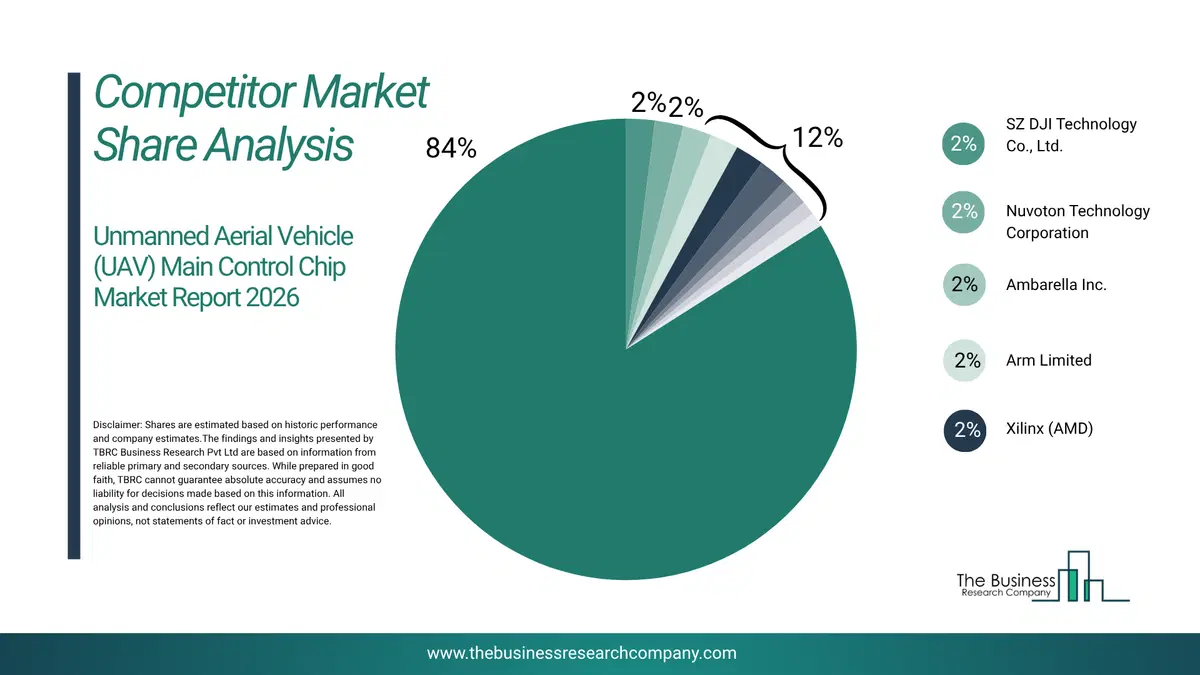
This chart is for illustrative purposes; the full report includes a detailed competitor analysis and comprehensive overview of the top 10 companies in the market.
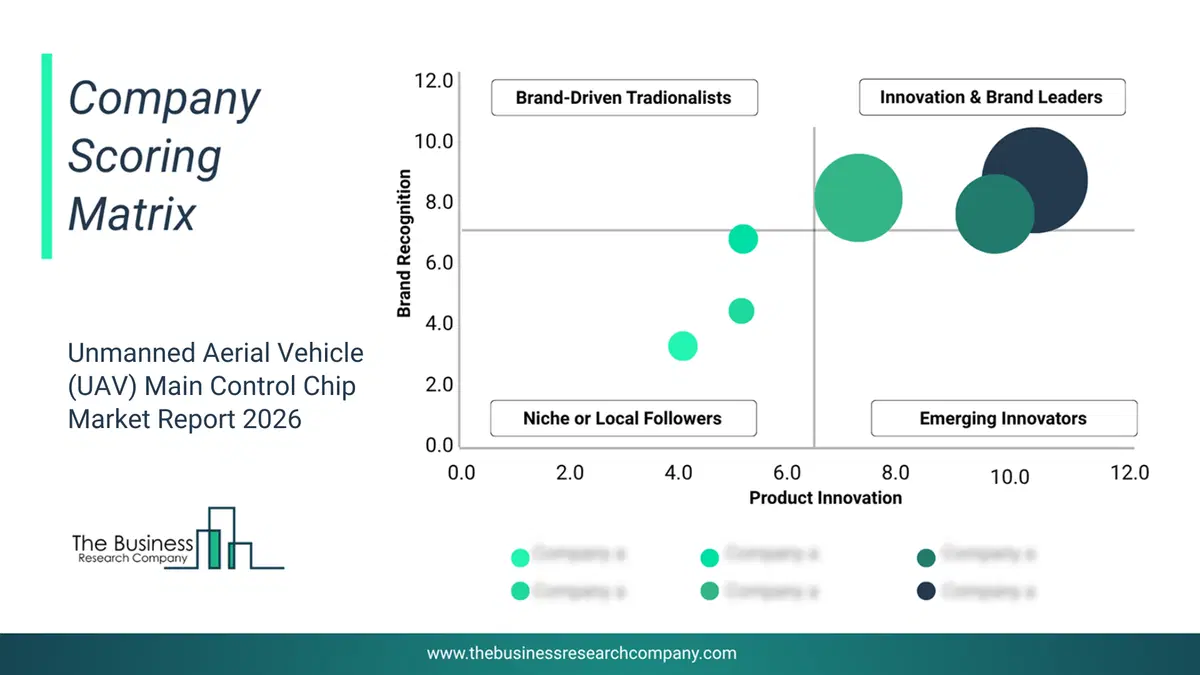
This chart maps companies by product innovation and brand strength, with bubble size indicating relative revenue, helping identify market leaders, challengers, and niche players. This is an illustrative chart; the full report provides a complete and accurate competitive analysis.
Global Unmanned Aerial Vehicle (UAV) Main Control Chip Market Trends and Insights
Major companies operating in the unmanned aerial vehicle (UAV) main control chip market are focusing on developing advanced products, such as drone flight controllers, to enhance flight stability and improve real-time data processing for smarter and more efficient drone operations. Drone flight controllers are embedded systems that regulate and stabilize a drone’s movement by interpreting sensor inputs and managing motor functions. They support key operations such as navigation, altitude control, GPS tracking, and autonomous flight capabilities. For instance, in March 2025, ARTERY Technology, a China-based manufacturer of microcontrollers, introduced AT32 microcontroller units (MCUs), next-generation drone innovations. The AT32 MCUs, such as the high-performance AT32F435 and AT32F423, deliver robust computing power, real-time control, and efficient data processing for core drone components such as flight controllers, electronic speed controllers (ESCs), and gimbals. These MCUs enable drones to achieve higher flight precision, longer endurance, and advanced features such as intelligent obstacle avoidance and high-quality image stabilization, accelerating their adoption across logistics, agriculture, inspection, and emergency rescue industries.What Are Latest Mergers And Acquisitions In The Unmanned Aerial Vehicle (UAV) Main Control Chip Market? SEALSQ Partnered With Parrot And AgEagle To Enhance Security Of Autonomous Aerial Vehicles
In August 2024, SEALSQ Corp., a Switzerland-based manufacturer of microcontrollers for unmanned aerial systems (UAS) security, partnered with Parrot and AgEagle to secure the skies with quantum-resistant innovation. The partnership aims to integrate SEALSQ’s secure chips into drone platforms, enhancing cybersecurity, encrypted communication, and data integrity for commercial and defense applications. Parrot is a France-based professional drone manufacturer, and AgEagle is a US-based provider of drone software for automated flight control.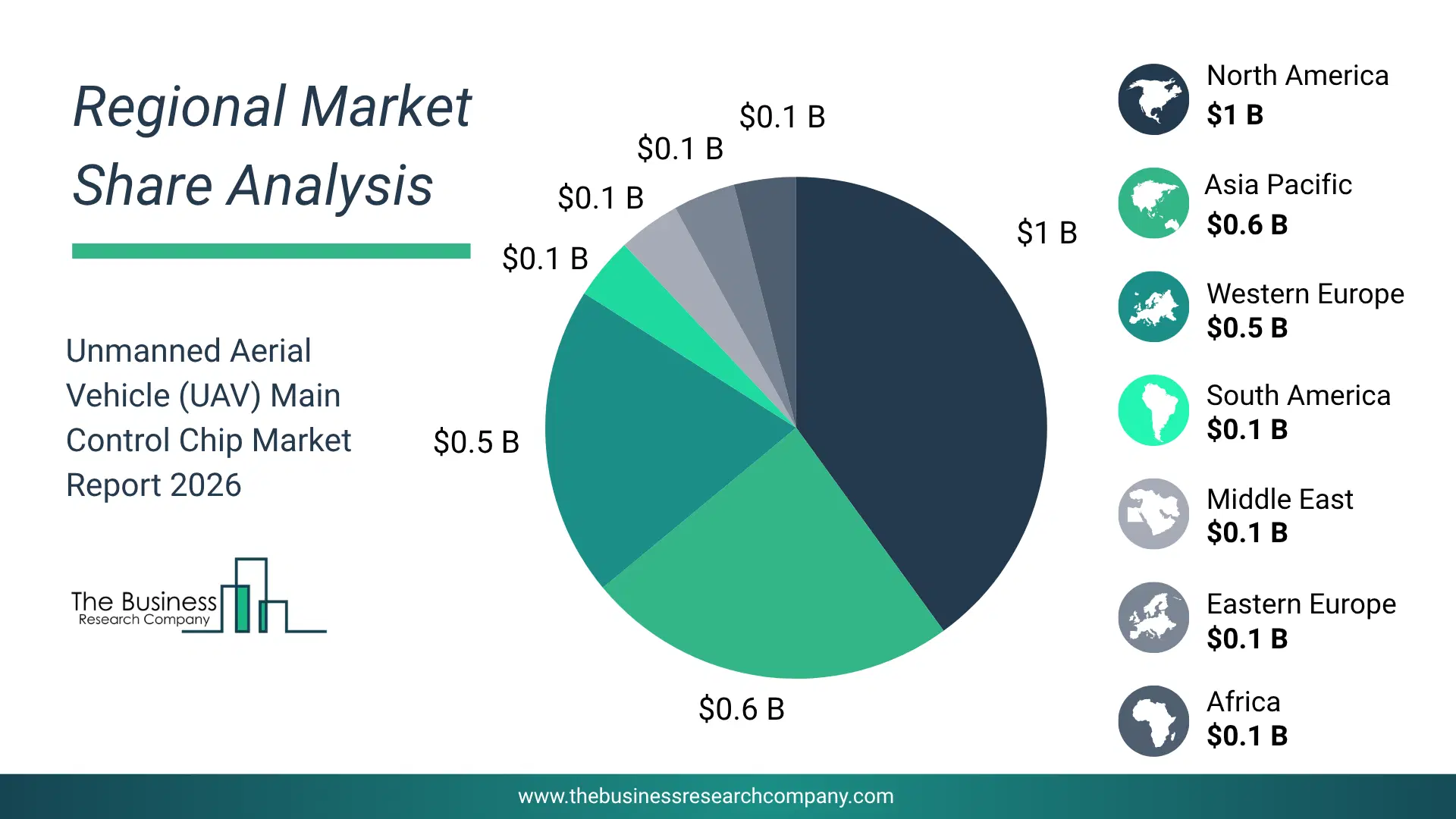
Regional Insights
North America was the largest region in the unmanned aerial vehicle (UAV) main control chip market in 2025. Asia-Pacific is expected to be the fastest-growing region in the forecast period. The regions covered in this market report are Asia-Pacific, South East Asia, Western Europe, Eastern Europe, North America, South America, Middle East, Africa. The countries covered in this market report are Australia, Brazil, China, France, Germany, India, Indonesia, Japan, Taiwan, Russia, South Korea, UK, USA, Canada, Italy, SpainWhat Defines the Unmanned Aerial Vehicle (UAV) Main Control Chip Market?
The unmanned aerial vehicle (UAV) main control chip market consists of sales of system-on-chip, graphics processing units, neural processing units, and heterogeneous multi-core processors. Values in this market are ‘factory gate’ values, that is, the value of goods sold by the manufacturers or creators of the goods, whether to other entities (including downstream manufacturers, wholesalers, distributors, and retailers) or directly to end customers. The value of goods in this market includes related services sold by the creators of the goods.How is Market Value Defined and Measured?
The market value is defined as the revenues that enterprises gain from the sale of goods and/or services within the specified market and geography through sales, grants, or donations in terms of the currency (in USD unless otherwise specified). The revenues for a specified geography are consumption values that are revenues generated by organizations in the specified geography within the market, irrespective of where they are produced. It does not include revenues from resales along the supply chain, either further along the supply chain or as part of other products.
This chart presents market attractiveness based on a quantitative evaluation of growth, competition, strategic alignment, and risk, offering a clear view of opportunity areas for decision-making. This chart is for illustrative purposes; the full report contains the complete analysis.

This chart highlights the Total Addressable Market (TAM) by estimating the maximum revenue opportunity using an assumption-driven approach, supporting strategic planning and opportunity sizing across markets. The chart is illustrative; the full report provides a more comprehensive analysis.
What Key Data and Analysis Are Included in the Unmanned Aerial Vehicle (UAV) Main Control Chip Market Report 2026?
The unmanned aerial vehicle (uav) main control chip market research report is one of a series of new reports from The Business Research Company that provides market statistics, including industry global market size, regional shares, competitors with the market share, detailed market segments, market trends and opportunities, and any further data you may need to thrive in the unmanned aerial vehicle (uav) main control chip industry. The market research report delivers a complete perspective of everything you need, with an in-depth analysis of the current and future state of the industry.Unmanned Aerial Vehicle (UAV) Main Control Chip Market Report Forecast Analysis
| Report Attribute | Details |
|---|---|
| Market Size Value In 2026 | $2.6 billion |
| Revenue Forecast In 2030 | $3.67 billion |
| Growth Rate | CAGR of 9.2% from 2026 to 2030 |
| Base Year For Estimation | 2025 |
| Actual Estimates/Historical Data | 2020-2025 |
| Forecast Period | 2026 - 2030 |
| Market Representation | Revenue in USD Billion and CAGR from 2026 to 2030 |
| Segments Covered | Type, Component, Application, End-User Industry |
| Regional Scope | Asia-Pacific, Western Europe, Eastern Europe, North America, South America, Middle East, Africa |
| Country Scope | The countries covered in the report are Australia, Brazil, China, France, Germany, India, Indonesia, Japan, Taiwan, Russia, South Korea, UK, USA, Canada, Italy, Spain. |
| Key Companies Profiled | Intel Corporation, Qualcomm Incorporated, Micron Technology, Nvidia Corporation, Texas Instruments, STMicroelectronics NV, Infineon Technologies, NXP Semiconductors, Analog Devices Inc., Renesas Electronics, Microchip Technology, Nuvoton Technology Corporation, Silicon Labs, Nordic Semiconductor, Lattice Semiconductor, Allwinner Technology, Maxon Computer GmbH, UXV Technologies, ARTERY Technology, InsideFPV Ventures Pvt Ltd. |
| Customization Scope | Request for Customization |
| Pricing And Purchase Options | Explore Purchase Options |