

Unmanned Aerial Vehicle (UAV) Main Control Chip Market 2026
By Type (Microcontrollers, Field-Programmable Gate Arrays (FGPAs), Digital Signal Processors (DSPs), Application-Specific Integrated Circuits (ASICs)), By Component (Sensor Integration, Power Management, Connectivity Modules, Interfacing Units), By Application (Aerial Photography And Videography, Mapping And Surveying, Agricultural Monitoring, Defense And Surveillance, Industrial Inspection), By End-User Industry (Aerospace And Defense, Agriculture, Construction And Mining, Logistics And Delivery, Media, Entertainment And Filmmaking, Other End-User Industries), And By Region, Opportunities And Strategies – Global Forecast To 2035
Unmanned Aerial Vehicle (UAV) Main Control Chip Market Definition
Unmanned Aerial Vehicle (UAV) main control chips are specialized integrated circuits that serve as the central processing and control unit of a drone. They coordinate core flight functions including sensor data processing, navigation, stabilization, power management, communication, and execution of flight algorithms enabling the UAV to operate autonomously or via remote control. The unmanned aerial vehicle (UAV) main control chips market consists of sales, by entities (organizations, sole traders or partnerships) that supply processing and control components to drone manufacturers, system integrators and end-users across sectors such as aerospace and defense, agriculture, industrial inspection and construction. These chips are essential for all UAV operations, supporting both autonomous missions and remote-piloted flights by enabling flight control, navigation, sensor processing and communication functions.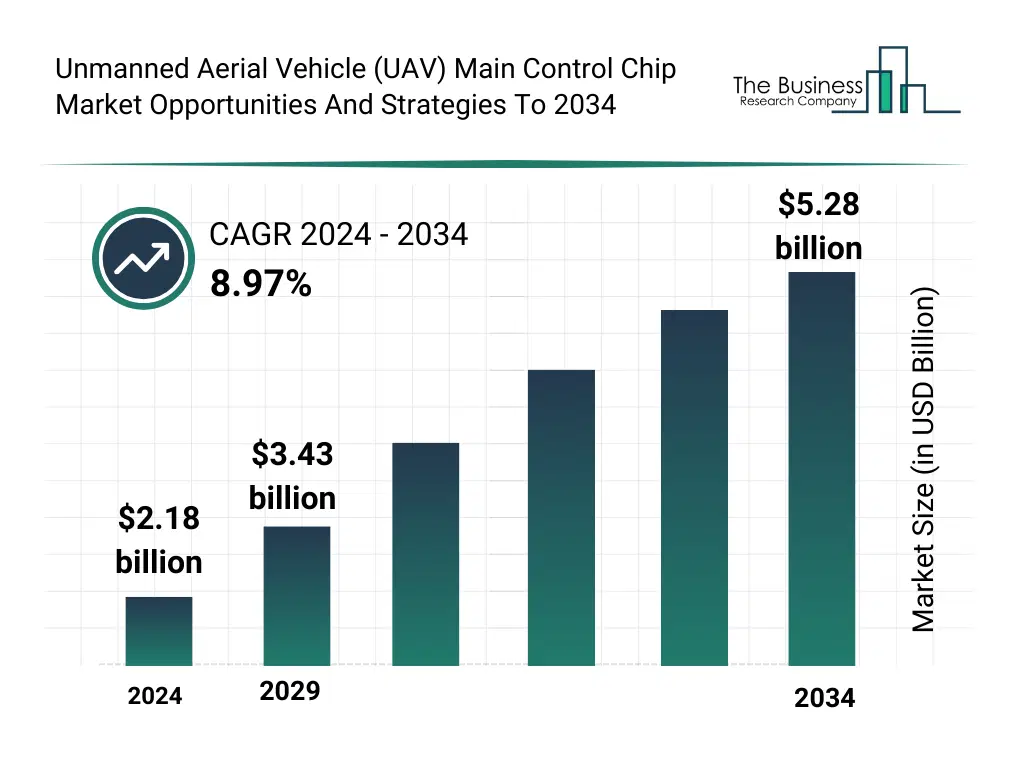
Unmanned Aerial Vehicle (UAV) Main Control Chip Market Size
The global unmanned aerial vehicle (UAV) main control chip market reached a value of nearly $2,183.39 million in 2024, having grown at a compound annual growth rate (CAGR) of 6.97% since 2019. The market is expected to grow from $2,183.39 million in 2024 to $3,434.13 million in 2029 at a rate of 9.48%. The market is then expected to grow at a CAGR of 8.97% from 2029 and reach $5,275.73 million in 2034. Growth in the historic period resulted from significant rise in smart city initiatives, rising demand for unmanned delivery services, growing adoption of 5G connectivity and increasing integration of UAVs in disaster relief and humanitarian missions. Factors that negatively affected growth in the historic period were limited access to critical raw materials and high initial development and production costs. Going forward, increasing focus on precision agriculture, high demand for security and surveillance applications, rising demand for commercial drones and increasing defense spending will drive growth. Factors that could hinder the growth of the unmanned aerial vehicle (UAV) main control chip market in the future include stringent regulatory and airworthiness requirements, lack of global chip certification standards for UAVs and impact of trade war and tariff.Unmanned Aerial Vehicle (UAV) Main Control Chip Market Drivers
The key drivers of the unmanned aerial vehicle (UAV) main control chip market include: Rising Demand For Commercial Drones During the forecast period, the rising demand for commercial drones will propel the growth of the unmanned aerial vehicle (UAV) main control chip market. Businesses across logistics, agriculture, infrastructure inspection and media are ramping up drone operations to improve operational efficiency, reduce costs and enable new service models. These commercial drones require high-performance main control chips capable of handling tasks such as autonomous navigation, real-time data processing, multi-sensor fusion and connectivity across complex environments—features that significantly improve system reliability and scalability. As regulatory frameworks evolve and commercial use cases expand, more companies will deploy UAVs at scale, thereby increasing the need for advanced onboard processing solutions. As commercial drone platforms proliferate and scale, the market for UAV main control chips is expected to accelerate significantly, driven by increased demand for intelligent, autonomous aerial systems. The increasing prevalence of chronic diseases growth contribution during the forecast period in 2024 is 1.00%.Unmanned Aerial Vehicle (UAV) Main Control Chip Market Restraints
The key restraints on the unmanned aerial vehicle (UAV) main control chip market include: Stringent Regulatory And Airworthiness Requirements Stringent regulatory and airworthiness requirements are restricting the growth of the unmanned aerial vehicle (UAV) main control chip market during the forecast period. As civil and commercial drone operations expand, aviation authorities are enforcing increasingly strict rules around operational safety, remote identification, airspace compliance and system reliability. These regulations require UAVs to meet detailed technical standards, including altitude limits, geofencing capabilities, safety redundancies and identification modules, all of which add complexity to main control chip design. The need to integrate certified components, comply with multi-layered approval frameworks and support real-time monitoring functions significantly increases development costs and slows product innovation. Additionally, manufacturers face longer certification timelines and higher barriers to market entry, especially in regions with comprehensive drone oversight such as the EU. Consequently, these stringent regulatory and airworthiness requirements are expected to constrain technological flexibility, delay deployment of next-generation UAV systems and limit the overall expansion of the unmanned aerial vehicle (UAV) main control chip market during the forecast period. Growth affected by regulatory complexity across regions during the forecast period in 2024 is -2.02%.Unmanned Aerial Vehicle (UAV) Main Control Chip Market Trends
Major trends shaping the unmanned aerial vehicle (UAV) main control chip market include: Integration Of AI-Powered Processing Units To Enhance On-Board Decision-Making And Autonomy Major companies in the unmanned aerial vehicle (UAV) main control chip market are increasingly integrating AI-accelerators and edge-inference engines directly into main control chips, enabling UAVs to perform local sensor fusion, object detection, autonomous path planning, and mission reconfiguration without relying solely on ground stations or cloud connectivity. These innovations/efforts are boosting on-board autonomy, reducing latency and enabling more complex UAV applications across mapping, inspection, delivery and surveillance. For example, in May 2025, Nano Ve U Limited, a Singapore-based applied technology company, announced the launch of its Edge AI (artificial intelligence) Evaluation programme for drones, targeting sub-milliwatt power consumption and longer flight endurance via on-board AI inference and reduced data uplink dependency. These efforts are transforming the UAV main control chip market by moving the intelligence from ground-based systems into the air vehicle, enabling smaller, lighter drones with higher mission flexibility and minimal latency for real-time decision-making. Advancement In Main Control Chip Architectures Enhancing Autonomous Flight Capabilities Major companies in the unmanned aerial vehicle (UAV) main control chip market are focusing on re-architecting their central control chips to integrate flight control, sensor fusion, navigation, communications and AI (artificial intelligence) inference on a unified platform, aimed at enabling higher levels of autonomy, faster decision-making and reduced system weight and complexity. These innovations are allowing UAV systems to transition from manual or semi-autonomous operation toward fully autonomous flight operations, multi-mission capabilities, and swarm coordination. For example, in December 2024, SEALSQ Corp, a Switzerland-based holding company primarily operating in the semiconductor industry, announced its entry into the UAV market by disclosing its roadmap to launch a Quantum-Resistant Secure Chip portfolio (QS7001 Open Platform and QVault TPM) in 2025. The product is specifically targeted at professional drones and unmanned aerial systems, and is built to embed high-performance control, secure boot and firmware update capabilities, encrypted communications and a trusted identity root, thereby supporting the next-generation UAV control architectures with enhanced autonomy, reliability and security.Opportunities And Recommendations In The Unmanned Aerial Vehicle (UAV) Main Control Chip Market
Opportunities – The top opportunities in the unmanned aerial vehicle (UAV) main control chip market segmented by type will arise in the microcontrollers segment, which will gain $673.58 million of global annual sales by 2029. The top opportunities in the unmanned aerial vehicle (UAV) main control chip market segmented by component will arise in the sensor integration segment, which will gain $496.18 million of global annual sales by 2029. The top opportunities in the unmanned aerial vehicle (UAV) main control chip market segmented by application will arise in the defense and surveillance segment, which will gain $398.61 million of global annual sales by 2029. The top opportunities in the unmanned aerial vehicle (UAV) main control chip market segmented by end-user industry will arise in the aerospace and defense segment, which will gain $531.85 million of global annual sales by 2029. The unmanned aerial vehicle (UAV) main control chip market size will gain the most in the USA at $388.63 million. Recommendations- To take advantage of the opportunities, The Business Research Company recommends the unmanned aerial vehicle (UAV) main control chip companies to focus on AI-integrated main control chips to enable autonomous UAV operations, focus on unified and secure control chip architectures to enable autonomous UAV systems, focus on high-efficiency MCUs to extend UAV flight endurance, focus on FPGA-based main control chips for mission flexibility and faster UAV scaling, focus on chip-level cybersecurity to secure professional UAV operations, focus on application-specific integrated circuits (ASICs), focus on advanced sensor integration platforms, expand in emerging markets, focus on secure and tiered channel expansion, promotion strategy focused on trust, performance and design wins, account-led and ecosystem-driven promotion framework, focus on defense and surveillance applications and focus on logistics and delivery applications.
Unmanned Aerial Vehicle (UAV) Main Control Chip Market Segmentation
The unmanned aerial vehicle (UAV) main control chip market is segmented by type, by component, by application and end user.By Type –
The unmanned aerial vehicle (UAV) main control chip market is segmented by type into:
- a) Microcontrollers
- b) Field-Programmable Gate Arrays (FPGAs)
- c) Digital Signal Processors (DSPs)
- d) Application-Specific Integrated Circuits (ASICs)
By Component –
The unmanned aerial vehicle (UAV) main control chip market is segmented by component into:
- a) Sensor Integration
- b) Power Management
- c) Connectivity Modules
- d) Interfacing Units
By Application –
The unmanned aerial vehicle (UAV) main control chip market is segmented by application into:
- a) Aerial Photography And Videography
- b) Mapping And Surveying
- c) Agricultural Monitoring
- d) Defense And Surveillance
- e) Industrial Inspection
By End User –
The unmanned aerial vehicle (UAV) main control chip market is segmented by end user into:
- a) Aerospace And Defense
- b) Agriculture And Construction
- c) Minning
- d) Logistics And Delivery
- e) Media
- f) Entertainment
- g) Filmmaking
- h) Other End-User Industries
By Geography - The unmanned aerial vehicle (UAV) main control chip market is segmented by geography into:
- • China
- • India
- • Japan
- • Australia
- • Indonesia
- • South Korea
- • USA
- • Canada
- • Brazil
- • France
- • Germany
- • UK
- • Italy
- • Spain
- • Russia
-
o Asia Pacific
o Africa