

Upstream Bioprocessing Equipment Market Report 2026
Global Outlook – By Product Type (Bioreactors And Fermenters, Cell Culture Vessels, Filtration Systems, Mixing Systems, Sampling Systems, Other Product Types), By Workflow (Media Preparation, Cell Culture, Cell Separation), By Application (Monoclonal Antibodies Production, Vaccines Manufacturing, Recombinant Proteins, Gene Therapy, Other Application), By End User (Pharmaceutical And Biotechnology Companies, Contract Manufacturing Organizations, Academic And Research Institutes) – Market Size, Trends, Strategies, and Forecast to 2035
Upstream Bioprocessing Equipment Market Overview
• Upstream Bioprocessing Equipment market size has reached to $11.13 billion in 2025 • Expected to grow to $18.61 billion in 2030 at a compound annual growth rate (CAGR) of 10.9% • Growth Driver: Increasing Need For Scalable Bioprocessing Solutions Fueling Market Growth Due To Rising Biologics Investment And Expansion Of Production Pipelines • Market Trend: Technological Advancements In Single Use Technologies Enable Higher Efficiency And Flexible Manufacturing • North America was the largest region in 2025 and Asia-Pacific is the fastest growing region.What Is Covered Under Upstream Bioprocessing Equipment Market?
Upstream bioprocessing equipment consists of specialized systems used in the initial stages of biopharmaceutical production, where microbial or mammalian cells are cultivated to produce biological products. It supports processes such as cell line development, media preparation, cell culture, and fermentation under controlled conditions to optimize yield. These systems enable efficient and scalable manufacturing of biologics, including vaccines, monoclonal antibodies, and recombinant proteins. The main product types of upstream bioprocessing equipment include bioreactors and fermenters, cell culture vessels, filtration systems, mixing systems, sampling systems, and other product type. Bioreactors and fermenters refer to controlled systems used to facilitate cell growth and biological reactions under optimized conditions for biopharmaceutical production. The workflow spans media preparation, cell culture, and cell separation. They find application in monoclonal antibodies production, vaccines manufacturing, recombinant proteins, gene therapy, and other application, and they are used by several end users such as pharmaceutical and biotechnology companies, contract manufacturing organizations, and academic and research institutes.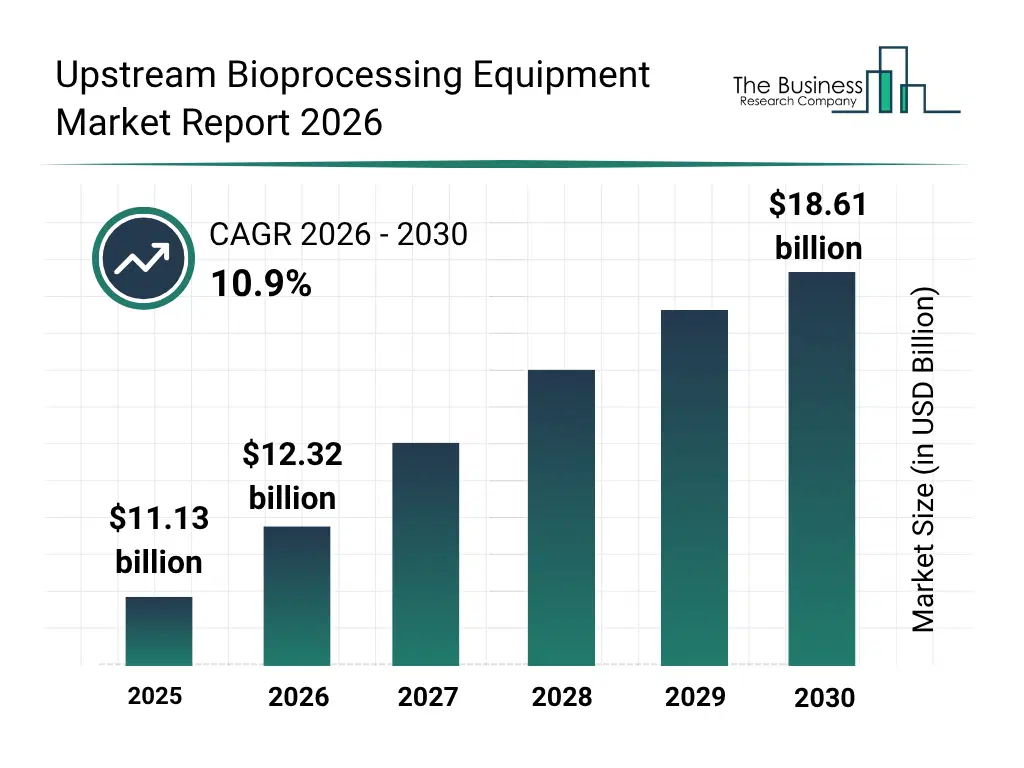
What Is The Upstream Bioprocessing Equipment Market Size and Share 2026?
The upstream bioprocessing equipment market size has grown rapidly in recent years.It will grow from $11.13 billion in 2025 to $12.32 billion in 2026 at a compound annual growth rate (CAGR) of 10.6%. The growth in the historic period can be attributed to growing demand for monoclonal antibodies and vaccines, increasing investment in biopharmaceutical manufacturing capacity, rising adoption of mammalian cell culture systems, expansion of contract manufacturing organizations, increasing focus on process efficiency and yield optimization.What Is The Upstream Bioprocessing Equipment Market Growth Forecast?
The upstream bioprocessing equipment market size is expected to see rapid growth in the next few years.It will grow to $18.61 billion by 2030 at a compound annual growth rate (CAGR) of 10.9%. The growth in the forecast period can be attributed to increasing pipeline of biosimilars and biologics, growing adoption of single-use technologies, rising demand for personalized medicine production, expansion of gene and cell therapy manufacturing, increasing investment in flexible biomanufacturing facilities.Major trends in the forecast period include rising adoption of single-use bioreactor systems to reduce contamination risk and improve flexibility in biologics production, increasing demand for perfusion-based cell culture systems for continuous biologics manufacturing, growing use of modular and scalable upstream bioprocessing equipment for faster facility expansion, expanding deployment of closed-system bioprocessing solutions to enhance sterility and process efficiency, increasing integration of automated sampling and process control systems for improved upstream process consistency.
Global Upstream Bioprocessing Equipment Market Segmentation
1) By Product Type: Bioreactors And Fermenters, Cell Culture Vessels, Filtration Systems, Mixing Systems, Sampling Systems, Other Product Types 2) By Workflow: Media Preparation, Cell Culture, Cell Separation 3) By Application: Monoclonal Antibodies Production, Vaccines Manufacturing, Recombinant Proteins, Gene Therapy, Other Application 4) By End User: Pharmaceutical And Biotechnology Companies, Contract Manufacturing Organizations, Academic And Research Institutes Subsegments: 1) By Bioreactors And Fermenters: Stirred Tank Bioreactors, Airlift Bioreactors, Bubble Column Bioreactors, Wave Induced Bioreactors, Packed Bed Bioreactors, Fluidized Bed Bioreactors 2) By Cell Culture Vessels: Cell Culture Flasks, Cell Culture Plates, Cell Culture Bottles, Spinner Flasks, Roller Bottles, Cell Culture Bags 3) By Filtration Systems: Depth Filtration Systems, Microfiltration Systems, Ultrafiltration Systems, Nanofiltration Systems, Membrane Filtration Systems, Cross Flow Filtration Systems 4) By Mixing Systems: Magnetic Mixing Systems, Mechanical Mixing Systems, Static Mixing Systems, Single Use Mixing Systems, High Shear Mixing Systems, Low Shear Mixing Systems 5) By Sampling Systems: Manual Sampling Systems, Automated Sampling Systems, Aseptic Sampling Systems, In Line Sampling Systems, Off Line Sampling Systems, Closed Sampling Systems 6) By Other Product Types: Incubators, Centrifuges, Sensors And Probes, Sterilization Equipment, Media Preparation Systems, Single Use AssembliesWhat Is The Driver Of The Upstream Bioprocessing Equipment Market?
The increasing need for scalable bioprocessing solutions is expected to propel the growth of the upstream bioprocessing equipment industry going forward.Scalable bioprocessing solutions are systems and equipment that enable seamless transition from research-scale production to large-scale commercial manufacturing while maintaining consistent product quality and operational efficiency.The need for scalable bioprocessing solutions is increasing due to the rapid expansion of biologics development pipelines, which require flexible manufacturing capacity across multiple production scales.Upstream bioprocessing equipment supports this need by enabling efficient scaling of cell culture, fermentation, and production processes through advanced bioreactors and integrated systems.For instance, in January 2025, according to the BioIndustry Association, a UK-based biotechnology industry organization, the UK biotech sector raised approximately $4.4 billion in investment, marking a 94% increase compared to the previous year.Therefore, the increasing need for scalable bioprocessing solutions is driving the growth of the upstream bioprocessing equipment industry.Key Players In The Global Upstream Bioprocessing Equipment Market
Major companies operating in the upstream bioprocessing equipment market are Saint-Gobain Performance Plastics Corporation, Thermo Fisher Scientific Inc., Merck KGaA, Danaher Corporation, Parker-Hannifin Corporation, GE Healthcare Technologies Inc., Corning Incorporated, Lonza Group AG, Avantor Inc., Sartorius AG, Entegris Inc., Getinge AB, Waters Corporation, Eppendorf SE, ZETA GmbH, Repligen Corporation, ABEC Inc., Shelcel Biozeen Technologies Private Limited, PBS Biotech Inc., Bionet Engineering S. r. l., Meissner Filtration Products Inc., ESCO Micro Pte. Ltd., BBI-Biotech GmbH, Morimatsu International Holdings Company Limited, Adolf Kühner AGGlobal Upstream Bioprocessing Equipment Market Trends and Insights
Major companies operating in the upstream bioprocessing equipment market are focusing on advancements in single-use technologies, such as integrated single-use bioreactor intensification systems, to improve production flexibility, reduce contamination risks, and enhance process efficiency. Integrated single-use bioreactor intensification systems are advanced bioprocessing setups that combine disposable bioreactors with embedded cell retention and process control technologies to support high-density cell culture and continuous manufacturing without extensive cleaning requirements. For instance, in August 2023, Sartorius AG, a Germany-based life sciences company, introduced an integrated Biostat STR system incorporating Repligen’s XCell Alternating Tangential Flow technology. The system features embedded hardware and software modules with predefined control recipes, integrated process analytical technology for real-time monitoring, and enhanced cell retention capabilities that eliminate the need for separate control units, thereby streamlining upstream processing workflows.What Are Latest Mergers And Acquisitions In The Upstream Bioprocessing Equipment Market?
In May 2023, Getinge, a Sweden-based medical technology company, acquired High Purity New England, Inc. for $120 million, with an additional earn-out of up to $170 million. With this acquisition, Getinge aims to strengthen its presence in the bioprocessing market by expanding its single-use solutions portfolio and enhancing its capabilities in upstream and downstream bioprocessing applications. High Purity New England, Inc. is a US-based provider of custom single-use bioprocessing solutions and equipment, supporting drug discovery, upstream and downstream processing, and biopharmaceutical manufacturing.Regional Insights
North America was the largest region in the upstream bioprocessing equipment market in 2025. Asia-Pacific is expected to be the fastest-growing region in the forecast period. The regions covered in this market report are Asia-Pacific, South East Asia, Western Europe, Eastern Europe, North America, South America, Middle East and Africa. The countries covered in this market report are Australia, Brazil, China, France, Germany, India, Indonesia, Japan, Taiwan, Russia, South Korea, UK, USA, Canada, Italy, Spain.What Defines the Upstream Bioprocessing Equipment Market?
The upstream bioprocessing equipment market consists of sales of media preparation systems, filtration systems, and sterilization equipment. Values in this market are ‘factory gate’ values, that is, the value of goods sold by the manufacturers or creators of the goods, whether to other entities (including downstream manufacturers, contract manufacturing organizations, research institutes, wholesalers, distributors, and retailers) or directly to end customers. The value of goods in this market includes related services sold by the creators of the goods.What is the Market Assessment and Strategic Outlook for the Upstream Bioprocessing Equipment Industry?
The upstream bioprocessing equipment market research report is one of a series of new reports from The Business Research Company that provides market statistics, including industry global market size, regional shares, competitors with the market share, detailed market segments, market trends and opportunities, and any further data you may need to thrive in the upstream bioprocessing equipment industry. The market research report delivers a complete perspective of everything you need, with an in-depth analysis of the current and future state of the industry.What is the Market Assessment and Strategic Outlook for the Upstream Bioprocessing Equipment Market Report 2026?
The upstream bioprocessing equipment market research report is one of a series of new reports from The Business Research Company that provides upstream bioprocessing equipment market statistics, including upstream bioprocessing equipment industry global market size, regional shares, competitors with a upstream bioprocessing equipment market share, detailed upstream bioprocessing equipment market segments, market trends and opportunities, and any further data you may need to thrive in the upstream bioprocessing equipment industry. This upstream bioprocessing equipment market research report delivers a complete perspective of everything you need, with an in-depth analysis of the current and future scenario of the industry.Upstream Bioprocessing Equipment Market Report Forecast Analysis
| Report Attribute | Details |
|---|---|
| Market Size Value In 2026 | $12.32 billion |
| Revenue Forecast In 2035 | $18.61 billion |
| Growth Rate | CAGR of 10.9% from 2026 to 2035 |
| Base Year For Estimation | 2025 |
| Actual Estimates/Historical Data | 2020-2025 |
| Forecast Period | 2026 - 2030 - 2035 |
| Market Representation | Revenue in USD Billion and CAGR from 2026 to 2035 |
| Segments Covered | Product Type, Workflow, Application, End User |
| Regional Scope | Asia-Pacific, Western Europe, Eastern Europe, North America, South America, Middle East, Africa |
| Country Scope | The countries covered in the report are Australia, Brazil, China, France, Germany, India, Indonesia, Japan, Taiwan, Russia, South Korea, UK, USA, Canada, Italy, Spain. |
| Key Companies Profiled | Saint-Gobain Performance Plastics Corporation, Thermo Fisher Scientific Inc., Merck KGaA, Danaher Corporation, Parker-Hannifin Corporation, GE Healthcare Technologies Inc., Corning Incorporated, Lonza Group AG, Avantor Inc., Sartorius AG, Entegris Inc., Getinge AB, Waters Corporation, Eppendorf SE, ZETA GmbH, Repligen Corporation, ABEC Inc., Shelcel Biozeen Technologies Private Limited, PBS Biotech Inc., Bionet Engineering S. r. l., Meissner Filtration Products Inc., ESCO Micro Pte. Ltd., BBI-Biotech GmbH, Morimatsu International Holdings Company Limited, Adolf Kühner AG |
| Customization Scope | Request for Customization |
| Pricing And Purchase Options | Explore Purchase Options |